

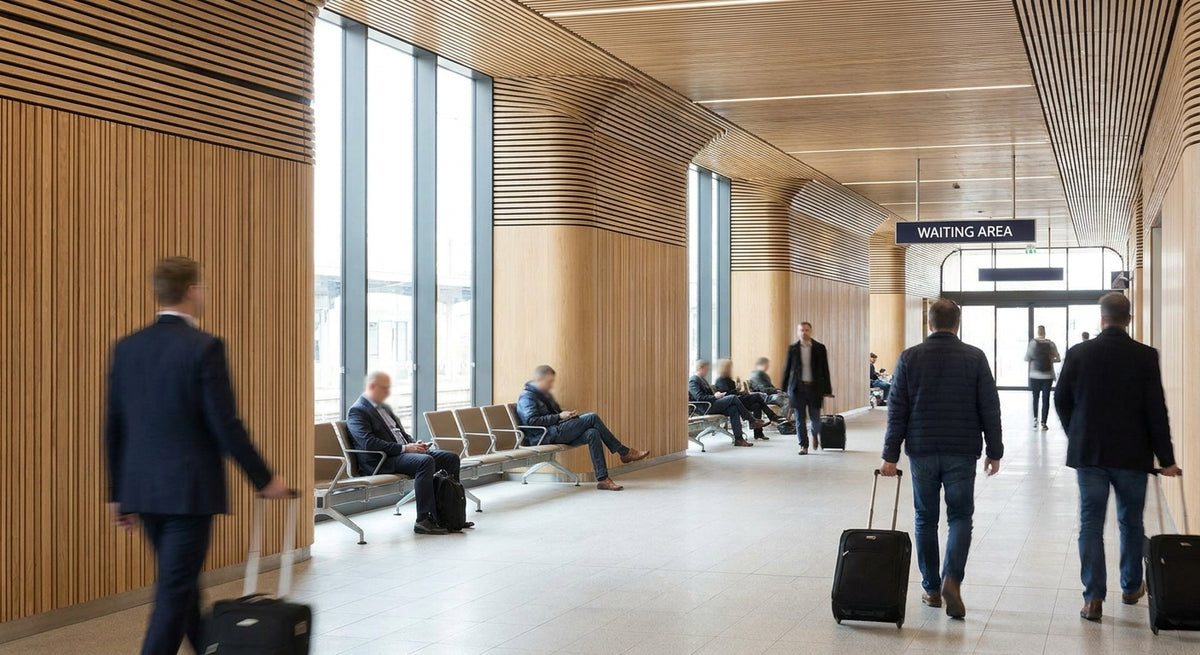
Train station waiting areas are some of the hardest rooms in the UK to control acoustically — hard floors, glazed roofs, concrete platforms, and constant PA announcements bouncing between surfaces. Acoustic wood panels solve the echo problem while giving a tired concourse a material upgrade that looks intentional, not bolted-on.
- Train station acoustic panels need an NRC of 0.75 or higher and a fire-rated core — smoked oak hexagon panels hit both specs. Buy.
- 240cm and 300cm slat panels from Akuwood Panel cut PA and footfall echo in high-ceiling waiting halls. Consider.
- Skip untested MDF veneer panels in transit settings — no fire certification, no vandalism resistance.
- Hexagon acoustic panels at £40.95 each suit accent zones and seating bays; full slat panels suit long platform-facing walls.
Why this matters
A station waiting room with 4-metre ceilings and terrazzo flooring can hold a reverberation time well past what's comfortable for passengers straining to hear a platform change announcement. That's the same problem airport lounge walls face — big volumes, hard surfaces, constant PA traffic — and the fix is identical: absorb sound at the wall instead of fighting it with more speakers.
Station operators and fit-out contractors in 2026 are under more pressure than most sectors to combine acoustic performance with durability and fire compliance in one product, because waiting areas get 16-plus hours of footfall a day and zero tolerance for panels that scuff, warp, or fail a fire test.
Who this is for
This guide is for facilities managers, station operators, and fit-out contractors specifying wall treatment for waiting halls, ticket concourses, or platform shelters — anyone choosing between acoustic wood panels and generic foam or fabric baffles for a space that sees thousands of people a day and needs to look presentable in year three, not just week one.
What to look for in acoustic panels for train station waiting areas
Sound absorption rating (NRC)
The NRC (Noise Reduction Coefficient) tells you how much sound a panel absorbs versus reflects — a rating of 0.75 means 75% absorption, which is the threshold worth specifying for any space with hard flooring and a high ceiling. Anything below 0.5 barely dents echo in a room this size. If NRC numbers aren't listed on a spec sheet, that's a red flag, not an oversight — check how to read NRC sound absorption ratings before signing off any order.
Fire rating for public transport infrastructure
Station interiors sit under stricter fire compliance than a home living room or office, and a panel that's fine for a bedroom feature wall isn't automatically cleared for a public transit hall. Confirm fire classification before specifying anything at scale — see fire-rated acoustic wall panels for commercial fit-outs for what to check on a spec sheet.
Durability under continuous footfall
A waiting area doesn't get a quiet Sunday — luggage trolleys clip walls, kids lean on panels, cleaning crews mop past them daily. Real wood veneer with a felt backing holds up to that traffic far better than printed laminate, which chips and shows wear inside 12 months in a busy concourse.
Cleaning and maintenance simplicity
Station cleaning contracts run on tight schedules, so panels that need special polish or delicate handling get skipped, and skipped maintenance shows within a year. A wipeable veneer finish that tolerates a damp cloth is non-negotiable for a space this heavily used.
Installation speed around live operations
You rarely get to shut a waiting hall down for a fortnight of fit-out work. Panels that click or glue into place in phased sections — rather than requiring a full wet-trade process — let contractors work overnight or in cordoned zones without disrupting passenger flow.
Visual warmth against institutional finishes
Most stations are steel, glass, and painted plasterboard. Real wood veneer breaks that up and reads as a deliberate upgrade rather than an acoustic patch, which matters when the client is a transport authority thinking about passenger experience scores, not just decibels.
Top picks for train station waiting areas
Hexagon Panel Smoked Oak — the transit hub workhorse NRC 0.75, 81 cm hexagon format, £40.95 per panel. This finish reads dark and formal enough for a concourse without looking like a domestic living room accent wall, and the felt backing does the acoustic work while the smoked oak veneer takes the visual load. Best used in seating bays and ticket-window surrounds where passengers sit close to the wall. Buy — see the smoked oak hexagon acoustic panel for the full spec.
Wooden Wall Panel Black Oak — the full-wall solution Available in 240 cm and 300 cm slat formats, this is the pick for long platform-facing walls or ticket hall perimeters where you need continuous coverage rather than a patterned accent. The 3-sided real wood veneer finish holds its colour under fluorescent station lighting better than a painted MDF alternative. Buy — check the black oak wall panel sizing before ordering for a full wall run.
Wooden Wall Panel Natural Oak — the daylight platform pick Natural oak veneer reflects more ambient light than the darker finishes, which suits waiting areas with skylights or glazed frontages where you don't want the room to feel heavier. It carries the same acoustic felt backing as the rest of the Akuwood Panel range. Consider for stations with strong natural light; Skip it for underground or low-light concourses where a darker finish hides grime better.
Hexagon Panel Walnut with Grey Felt — the accent zone pick A warmer mid-tone finish suited to café seating or waiting nooks within a larger hall, where you want a softer visual break from the smoked or black oak used on the main walls. Same 0.75 NRC rating and 81 cm format as the rest of the hexagon line, so mixing finishes across zones doesn't cost you acoustic performance. Consider for mixed-use waiting areas with distinct seating zones.


What to avoid in acoustic panels for waiting areas
- Uncertified acoustic foam wedges. They look industrial, absorb high frequencies well, but do nothing for the low-mid rumble of trains and PA systems that dominates a station environment.
- Printed laminate "wood-look" panels. They cost less upfront but chip at corners and edges within a year under luggage-trolley traffic — a real veneer with a 3-sided finish holds up far longer in a concourse.
- Fabric-wrapped panels without a wipeable surface. Stations generate dust, grime, and spills at a rate that soft fabric fronts can't handle without staining inside the first six months.
Verdict comparison table
| Panel | NRC rating | Format | Best zone | Verdict |
|---|---|---|---|---|
| Hexagon Smoked Oak | 0.75 | 81 cm hexagon | Seating bays, ticket surrounds | Buy |
| Wooden Wall Panel Black Oak | Acoustic felt-backed | 240/300 cm slat | Platform walls, long runs | Buy |
| Wooden Wall Panel Natural Oak | Acoustic felt-backed | 240/300 cm slat | Daylight-heavy halls | Consider |
| Hexagon Walnut with Grey Felt | 0.75 | 81 cm hexagon | Café nooks, mixed-use zones | Consider |
Across every row, the pattern holds: acoustic wood panels earn their place in a train station waiting area when the NRC number and the fire rating both check out — everything else is finish preference.
FAQ
What NRC rating do train station acoustic panels need?
Aim for NRC 0.75 or higher in a waiting hall with hard flooring and a high ceiling. Below 0.5, echo reduction is barely noticeable in a room that size.
Are wood veneer acoustic panels fire-rated for public transport use?
Fire classification varies by product and manufacturer, so check the spec sheet before ordering for a station fit-out in 2026. Public transport interiors sit under stricter compliance than domestic or light-commercial spaces.
How much do acoustic wood panels cost for a waiting area project?
Hexagon acoustic panels run around £40.95 per unit in 2026, with larger slat formats priced per panel across 240 cm and 300 cm sizes. Total project cost depends on wall area and coverage density.
Is hexagon or slat panel format better for a station concourse?
Hexagon panels suit accent zones like seating bays and café nooks, while slat panels in 240 cm or 300 cm formats suit long, continuous platform-facing walls. Most projects mix both formats across different zones.
Can acoustic wood panels be cleaned in a high-traffic public space?
A real wood veneer finish with a wipeable surface tolerates daily cleaning contracts better than fabric-wrapped alternatives. Check maintenance guidance before specifying for a 16-hour operating schedule.
Do acoustic panels reduce PA announcement echo in waiting halls?
Yes — panels with an NRC of 0.75 absorb the mid-range frequencies that PA systems and human speech occupy, cutting reverberation in rooms with hard, reflective surfaces. This is the primary reason stations specify acoustic treatment at all.
What's the difference between smoked oak and natural oak finishes for stations?
Smoked oak reads darker and hides grime better in low-light or underground concourses, while natural oak reflects more ambient light and suits daylight-heavy halls with skylights or glazed frontages. Both carry the same acoustic felt backing.
Should a waiting area use 240 cm or 300 cm panel sizes?
300 cm panels suit floor-to-ceiling coverage in taller concourse walls with fewer joints, while 240 cm suits standard ceiling heights and tighter budgets. Panel joints affect both acoustic continuity and visual finish, so match the format to the actual wall height.
One last thing
The detail that gets missed most often on station projects: mixing finishes across zones — smoked oak on platform walls, walnut in the café nook — costs nothing in acoustic performance because every panel in the Akuwood Panel hexagon range carries the same 0.75 NRC rating regardless of veneer colour. Specify for the zone, not the whole building as one uniform surface.
Share:
Bowling Alley Acoustic Panels: Best Picks for 2026
Spin Studio Acoustic Panels: Best Picks for 2026