

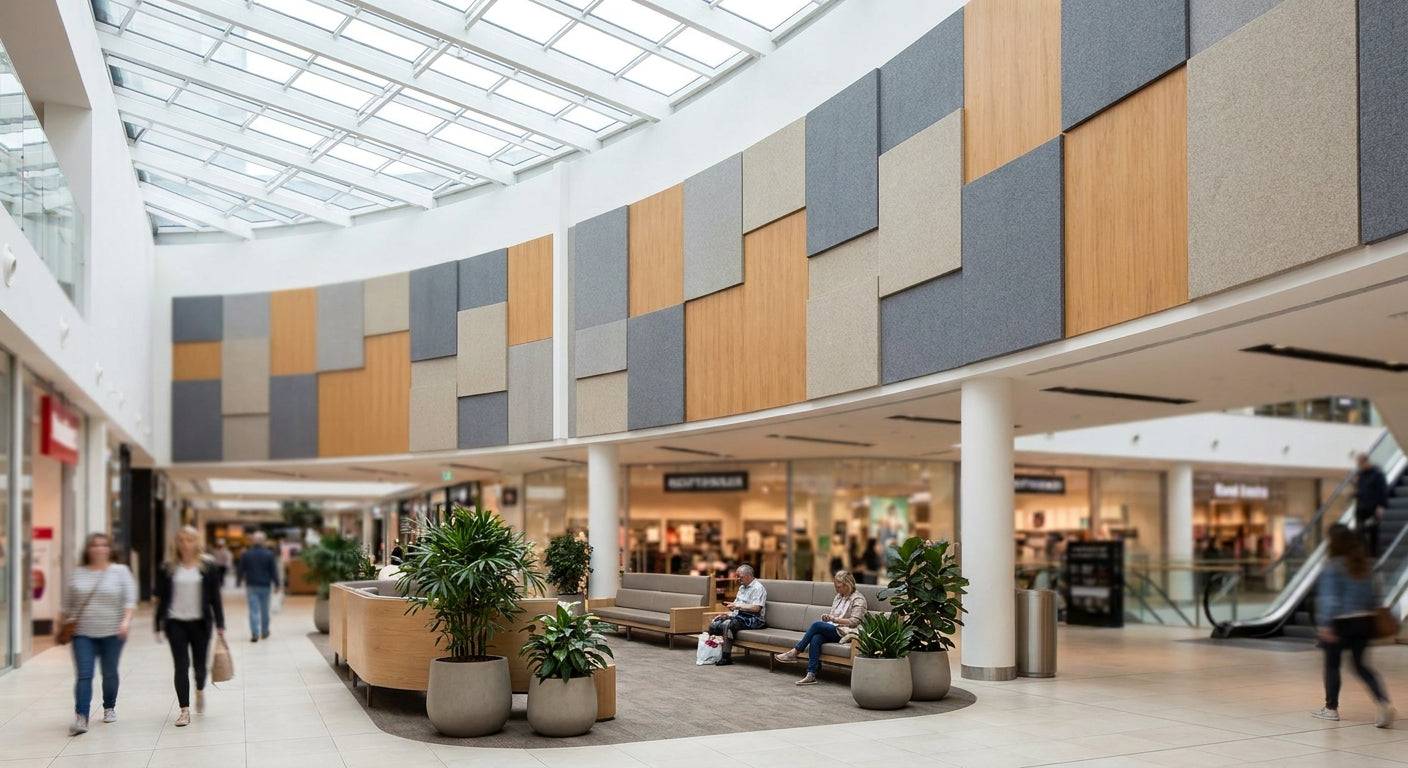
Shopping centre common areas — atriums, food courts, mall corridors, the space between unit fronts — are some of the toughest environments to quiet down. Hard floors, glass shopfronts, and constant footfall bounce sound around all day. This guide ranks the acoustic wall panels for shopping centres that actually cut reverberation in 2026, not just the ones that look good in a rendering.
- Hexagon Acoustic Panel Walnut with Grey Felt wins for shopping centre common areas in 2026 — buy it for corridor runs and curved bays.
- Grey Oak felt-backed panels are the safe pick for food courts and atriums with hard flooring.
- Decorative 3D veneer panels without felt backing don't belong in an acoustic wall panels for shopping centres shortlist — skip them for common area echo work.
- Black Oak panels hold well for anchor entrances but need doubled coverage in tall, open volumes.
- Coverage across 30-40% of exposed hard wall changes how a common area sounds; a single feature wall does not.
Why this matters
A shopping centre common area is a sound trap by design. Polished tile or terrazzo floors, glass shopfronts, escalators, and a ceiling that's often 4-6 metres up mean sound reflects wall to wall with almost nothing to absorb it. Retail tenants notice this before landlords do — announcements get lost, phone calls in food courts get shouted, and the space feels louder than the actual footfall justifies.
Wood-veneer acoustic panels solve part of this without changing the finish landlords want in a common area. The felt backing behind the veneer does the absorption work; the wood face keeps the aesthetic commercial rather than industrial. That's the trade-off worth understanding before you spec anything for a mall corridor or atrium in 2026.
How this list was ranked
The ranking below weighs three things specific to shopping centre common areas: felt-backed absorption versus decorative-only construction, panel format relative to typical corridor and atrium wall heights (240 cm and 300 cm formats cover most soffit-to-dado runs without excess cutting), and finish durability under constant foot traffic and daylight exposure through glass shopfronts. This is based on aggregated product specification data, not a lab test — treat NRC-style performance claims from any supplier with the same scrutiny you'd apply to a fire certificate.
Decorative panels without a felt layer are excluded from the top tier here even where they look similar on a spec sheet, because a common area problem is an echo problem first and a finish problem second.
The ranked list
1. Hexagon Acoustic Panel Walnut with Grey Felt — the coverage workhorse
Hexagon-format panels tile without the visible seam lines you get from straight slat runs, which matters on long corridor stretches where repetition gets monotonous fast. The grey felt sits directly behind the walnut veneer, so the panel absorbs from installation day one rather than needing a secondary acoustic layer.
For a mall corridor with a ceiling height over 3 metres, hexagon tiling covers curved bays and column wraps that straight 240 cm or 300 cm slats can't handle cleanly. Buy the Hexagon Acoustic Panel Walnut with Grey Felt for any common area with curved architecture, column surrounds, or a mix of straight and angled runs.
2. Wooden Wall Panel Grey Oak — the safe pick for food courts
Grey Oak with felt backing is the neutral option that doesn't fight with tenant signage or seasonal decor, which is exactly what a food court needs since the wall colour has to sit behind dozens of competing brand fascias. It comes in the standard 240 cm and 300 cm formats, so a single order covers most soffit heights without an end-piece order on the first pass.
Food courts run loud from tray return noise, chair scraping on tile, and overlapping conversation — a felt-backed panel on the perimeter wall takes the edge off without absorbing so much that announcements sound dead. Buy the Wooden Wall Panel Grey Oak for food court perimeter walls and seating zone backdrops.
3. Wooden Wall Panel Black Oak — the dark accent for anchor entrances
Black Oak reads premium against glass shopfronts and works well framing an anchor tenant entrance where the landlord wants a statement wall rather than a full acoustic treatment. It's still felt-backed, so it's doing real absorption work, not just decoration.
The catch: in a double-height atrium, a single Black Oak run won't move the reverberation number much on its own — it needs to be paired with coverage elsewhere in the space. Hold it as an accent treatment near entrances rather than the primary acoustic fix for a large atrium.
4. Wooden Wall Panel Natural Oak with Grey Felt — the neutral pick for daylight atriums
Natural Oak with grey felt handles daylight-heavy atriums better than darker finishes because it doesn't read as heavy against skylights or glazed roofs. Grey felt behind a lighter veneer still absorbs the same way — the colour change is cosmetic, not acoustic.
It suits management offices bordering the common area too, where tenants and centre staff need the same finish continuity without switching product lines. Consider it where the common area gets significant natural light through a glazed roof or atrium wall.
5. Wooden Wall Panel Rustic Oak Premium 3-Sided Wood Veneer — the texture pick for seating zones
The 3-sided veneer construction gives Rustic Oak a heavier grain texture than the flat-faced finishes, which reads better up close near seating clusters where shoppers actually stop and look at the wall. It's a good match for lounge zones or waiting areas adjacent to a food court.
It's less suited to long, uninterrupted corridor runs where the heavier grain repeats too obviously at scale. Consider it for seating nooks and feature bays, not full corridor coverage.
6. Wooden Wall Panel Smoked Oak — the wildcard for dim corridor runs
Smoked Oak works in service corridors and back-of-house-adjacent common areas where lighting is dimmer and a darker finish hides scuffs and trolley marks better than a pale veneer. It's the same felt-backed construction as the rest of the range, so absorption performance doesn't drop with the darker finish.
In a bright, glass-fronted main concourse it can look heavy and closes the space down visually. Consider it for dimmer service corridors; skip it for the main daylight-facing concourse.
“If the common area still echoes after panels go up, the coverage is too thin, not the panels.”
Comparison table
| Panel | Best for | Felt backing | Format | Verdict |
|---|---|---|---|---|
| Hexagon Acoustic Panel Walnut with Grey Felt | Curved corridors, column wraps | Yes | Hexagon tile | Buy |
| Wooden Wall Panel Grey Oak | Food court perimeter walls | Yes | 240 cm / 300 cm | Buy |
| Wooden Wall Panel Black Oak | Anchor entrance accents | Yes | 240 cm / 300 cm | Hold |
| Wooden Wall Panel Natural Oak (grey felt) | Daylight-heavy atriums | Yes | 240 cm / 300 cm | Consider |
| Wooden Wall Panel Rustic Oak Premium 3-Sided Veneer | Seating zones, feature bays | Yes | 240 cm / 300 cm | Consider |
| Wooden Wall Panel Smoked Oak | Dim service corridors | Yes | 240 cm / 300 cm | Consider / Skip main concourse |
Where to buy
- Order a sample of the finish before committing to a common area run — colour reads differently under mall lighting rigs than it does on a screen.
- Confirm the fire rating documentation for the specific run before it goes to a centre's fit-out approval — public common areas get checked harder than a single retail unit.
- Order end pieces and trim alongside the main panel run, not after — corridor corners and column wraps need clean edges, and matching trim ordered late slows the install.
An early link worth following if you're specifying for multiple tenants rather than one common area: best acoustic wall panels for multi-tenant business centres covers the coverage math for shared spaces with several landlords involved.
What to avoid
- Decorative-only 3D veneer panels with no felt layer. They look identical to acoustic panels in a photo but do none of the absorption work — fine for a feature wall in a single shop unit, wrong for a common area echo problem.
- A single feature wall as the whole fix. One accent wall in an atrium that's 15 metres wide won't move the reverberation time. Coverage has to span a meaningful share of the exposed hard wall.
- Skipping the fire rating check because it's "just wood veneer." Public common areas in shopping centres get fire compliance scrutiny that a private office refurb doesn't; get the documentation before install, not after the centre's fire officer asks.
FAQ
What are the best acoustic wall panels for shopping centres in 2026?
Felt-backed wood veneer panels in hexagon or slat format, such as Hexagon Acoustic Panel Walnut with Grey Felt or Wooden Wall Panel Grey Oak, work best for shopping centre common areas in 2026. They combine real absorption with a finish that suits a retail environment.
How much wall coverage do you need to fix echo in a common area?
Aim for coverage across 30-40% of the exposed hard wall, not a single feature panel. A common area with hard floors and glass shopfronts needs meaningful surface area treated to change how it sounds.
Are wooden acoustic panels fire safe for public spaces?
Fire performance varies by product and finish, so confirm documentation for the specific panel run before a centre's fit-out approval. Never assume a wood veneer panel is automatically compliant for a public common area.
Do acoustic panels work on hard floors and glass shopfronts?
Wall-mounted felt-backed panels reduce reflected sound from hard floors and glazing by absorbing energy at the wall rather than the floor. They won't eliminate footstep noise on tile but they do cut the reverberation that makes a space feel loud.
What's the difference between decorative and acoustic wall panels?
Decorative panels are veneer-faced with no absorptive backing, built for looks. Acoustic panels add a felt layer behind the veneer that actually absorbs sound, which is the layer that matters for a shopping centre common area.
Can acoustic wall panels be used in food courts?
Yes — felt-backed panels like Wooden Wall Panel Grey Oak suit food court perimeter walls because the neutral finish doesn't compete with tenant signage while still absorbing tray-return and conversation noise.
How long do acoustic wood panels last in high-footfall areas?
Durability depends on placement and finish; darker finishes like Smoked Oak or Black Oak hide scuffs and trolley marks better in high-traffic corridors than pale veneers do.
Is grey felt backing better than standard felt for retail environments?
Grey felt performs the same acoustically as other felt colours — the difference is purely visual, sitting neutrally behind lighter or darker veneers without changing the absorption result.
One last thing
The felt backing is invisible once the panel is up — nobody browsing a shopping centre in 2026 will ever see it. That's the point: the acoustic fix has to disappear into a finish the centre already wants, or it never gets specified past the first fit-out meeting. Pick the veneer for the tenant mix first, then confirm the felt is doing the work behind it.
Share:
Acoustic Panels for Car Showrooms: 2026 Buying Verdict
Wooden Wall Panels for Barbershops: 2026 Buying Guide