

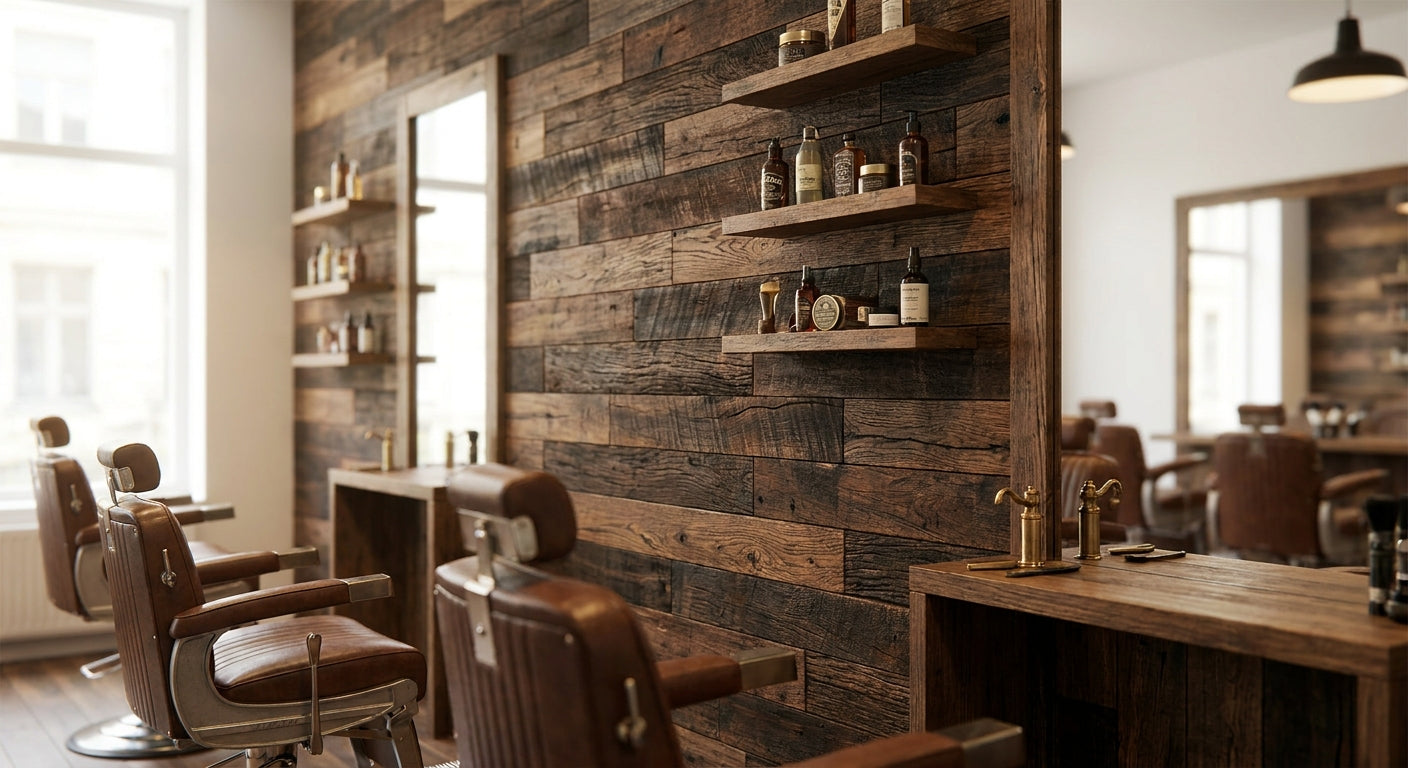
Barbershops live and die on sound as much as scissors — clippers buzzing, five conversations at once, hard floors bouncing every word back at the waiting bench. Wooden wall panels for barbershops fix that echo problem while giving the room the warm, masculine finish clients actually notice.
- Black Oak wooden wall panels win for barbershop feature walls in 2026 — real wood veneer with acoustic felt backing, not just a dark finish.
- Walnut suits reception and waiting areas where you want warmth without the moodier Black Oak contrast.
- Grey Walnut hexagon acoustic panels work as a texture accent behind the till, not a full-wall treatment.
- Skip decorative 3D panels with no felt backing directly behind cutting stations — they look sharp but absorb nothing.
Why this matters
A barbershop with hard floors, mirrors, and bare plaster walls is an acoustic trap. Sound has nowhere to go except back and forth between reflective surfaces, which is why a busy shop at 6pm on a Saturday can feel louder than the same room actually is. The fix most fit-out guides skip is the wall behind the waiting bench — it's the surface closest to both the mirrors and the floor, so it reflects the most noise. Treating that wall, rather than the wall behind the chairs, is the move most shops miss, and it's covered in more detail in office reception feature walls if you're weighing up reception versus cutting-station priorities.
Acoustic wooden slat panels solve this differently from paint, tile, or plain MDF cladding: the felt backing behind the wood veneer actually absorbs sound rather than just looking the part. That distinction matters more in a barbershop than almost any other retail interior, because the noise floor is constant for 10+ hours a day, not occasional.
Who this is for
This guide is for barbershop owners and grooming lounge operators fitting out a new site or refreshing an existing one in 2026 — whether that's a single-chair setup with one feature wall or a multi-chair shop treating reception, waiting, and cutting zones separately. If you're specifying for a franchise rollout with multiple locations, the same criteria apply, just multiplied across sites.
What to look for in wooden wall panels for barbershops
Real acoustic backing, not just a wood look
A panel that's only decorative does nothing for the noise problem you're actually trying to solve. Look for panels with an acoustic felt backing behind the veneer — that's the layer doing the sound absorption work, not the wood surface itself.
Durable veneer that handles daily contact
Clients lean back against walls, staff brush past with trolleys, and cleaning happens daily with disinfectant. A 3-sided real wood veneer finish holds up to that traffic far better than a printed laminate that chips or peels at the edges.
Panel size that matches your wall height
Most barbershop walls run standard ceiling heights, which is where 240 cm panels fit cleanly with minimal cutting. Taller shopfronts or double-height reception walls suit the 300 cm format better — check your ceiling height before ordering either.
A finish that reads masculine without going dark and flat
Grooming lounges lean toward Black Oak, Smoked Oak, and Walnut because they read confident and warm under shop lighting, rather than cold like grey laminate or busy like a bright natural oak.
Consistency across zones
Mixing five different finishes across reception, waiting, and cutting stations reads chaotic. Pick one core finish and use a second, darker or lighter tone only as a deliberate accent wall.
Installation that doesn't shut the shop for a week
Slat panel systems fit with adhesive and click-together edges rather than full replastering, which matters when every day closed is lost chair revenue.
Top picks for barbershop interiors
Black Oak — the moody backdrop. Real wood veneer with acoustic felt backing, available in both 240 cm and 300 cm formats to match reception or full-height cutting walls. This is the finish most grooming lounges reach for first because it photographs well under warm downlights and hides scuffs better than lighter tones. Verdict: Buy for the wall behind your chairs. Black Oak wall panel
Walnut — the upscale reception pick. Warmer mid-tone veneer, same felt-backed construction, same two size formats. It lifts a waiting area without tipping into the dark, almost-black look of Black Oak, which suits shops that want warmth over drama. Verdict: Buy for reception and waiting zones. Walnut wall panel
Grey Walnut hexagon acoustic panel — the texture accent. Geometric hexagon layout instead of a flat slat run, built for a single feature area rather than full-wall coverage. It's the pick for shops that want one wall to do the talking behind the till or the barber pole. Verdict: Consider as an accent, not a full-room treatment. Grey Walnut hexagon panel
Smoked Oak — the dark contrast option. Deep, near-charcoal veneer that pairs well with black fixtures and leather chairs, but it swallows light in a shop that's already dim or has small windows. It's worth naming here specifically so you know when to skip it. Verdict: Skip in compact or low-light shops; reserve it for larger, well-lit floor plans.


What to avoid
- Decorative-only MDF slat panels with no felt backing directly behind cutting stations — they look identical in photos but do zero acoustic work where the buzz is loudest.
- High-gloss laminate finishes that show every fingerprint and hair-clipping streak under bright grooming-station lighting.
- Peel-and-stick veneer strips that aren't rated for repeated alcohol-based disinfectant wipe-downs — they lift at the seams within months in a shop cleaned daily.
Verdict comparison
| Panel | Best zone | Finish | Format | Verdict |
|---|---|---|---|---|
| Black Oak | Cutting stations | Dark, real wood veneer | 240/300 cm | Buy |
| Walnut | Reception/waiting | Warm mid-tone veneer | 240/300 cm | Buy |
| Grey Walnut hexagon | Accent wall | Textured hexagon layout | Single-panel accent | Consider |
| Smoked Oak | Large, well-lit shops only | Near-charcoal veneer | 240/300 cm | Skip in small shops |
FAQ
What's the best wood finish for a barbershop feature wall in 2026?
Black Oak is the strongest pick for barbershop feature walls in 2026 because it hides scuffs and reads confident under warm lighting. Walnut is the better call for reception if you want warmth without the darker contrast.
Do acoustic wall panels actually reduce noise from clippers and hair dryers?
Panels with acoustic felt backing absorb reflected sound rather than blocking it at the source. That cuts the reverberation that makes a busy shop feel louder than it is, though it won't silence a running clipper.
Are wooden wall panels durable enough for high-traffic barbershops?
A 3-sided real wood veneer finish holds up to daily contact, trolley bumps, and disinfectant wipe-downs better than printed laminate. Cheap peel-and-stick finishes are the ones that fail first in high-traffic shops.
Is Black Oak or Walnut better for a grooming lounge?
Black Oak suits cutting stations and moody, dramatic interiors, while Walnut suits reception and waiting areas that want warmth. Most shops in 2026 use Black Oak as the primary tone and Walnut as the lighter accent zone.
How much wall space needs panelling to cut echo in a barbershop?
The wall behind the waiting bench, closest to hard flooring and mirrors, gives the biggest acoustic return for the smallest area treated. Full-room panelling helps further but isn't required to notice a difference.
Can wooden wall panels handle disinfectant and alcohol-based products?
Real wood veneer panels with a sealed finish handle routine disinfectant wiping better than laminate or peel-and-stick alternatives. Check the specific finish's cleaning guidance before using stronger solvents.
What size format should I order — 240 cm or 300 cm panels?
240 cm panels fit standard ceiling heights with minimal cutting, while 300 cm suits taller shopfronts or double-height reception walls. Measure your wall height first; guessing wrong means more waste on the cut.
Do hexagon acoustic panels work well in small barbershops?
Hexagon panels work best as a single accent wall rather than covering a small shop entirely, since the pattern reads busy at close range. Reserve them for the till wall or a feature behind the barber pole.
One last thing
Most barbershop fit-outs panel the wall behind the mirrors because it's the obvious photo spot, then leave the waiting bench wall bare. That's backwards for acoustics — the bench wall, sandwiched between hard flooring and a row of mirrors, is where sound bounces hardest, and it's the one wall clients stare at for the full length of their wait in 2026's busier, louder shop floors.
Share:
Best Acoustic Wall Panels for Shopping Centres 2026
Best Wall Panels for Wedding Venues 2026: Top 6 Ranked