

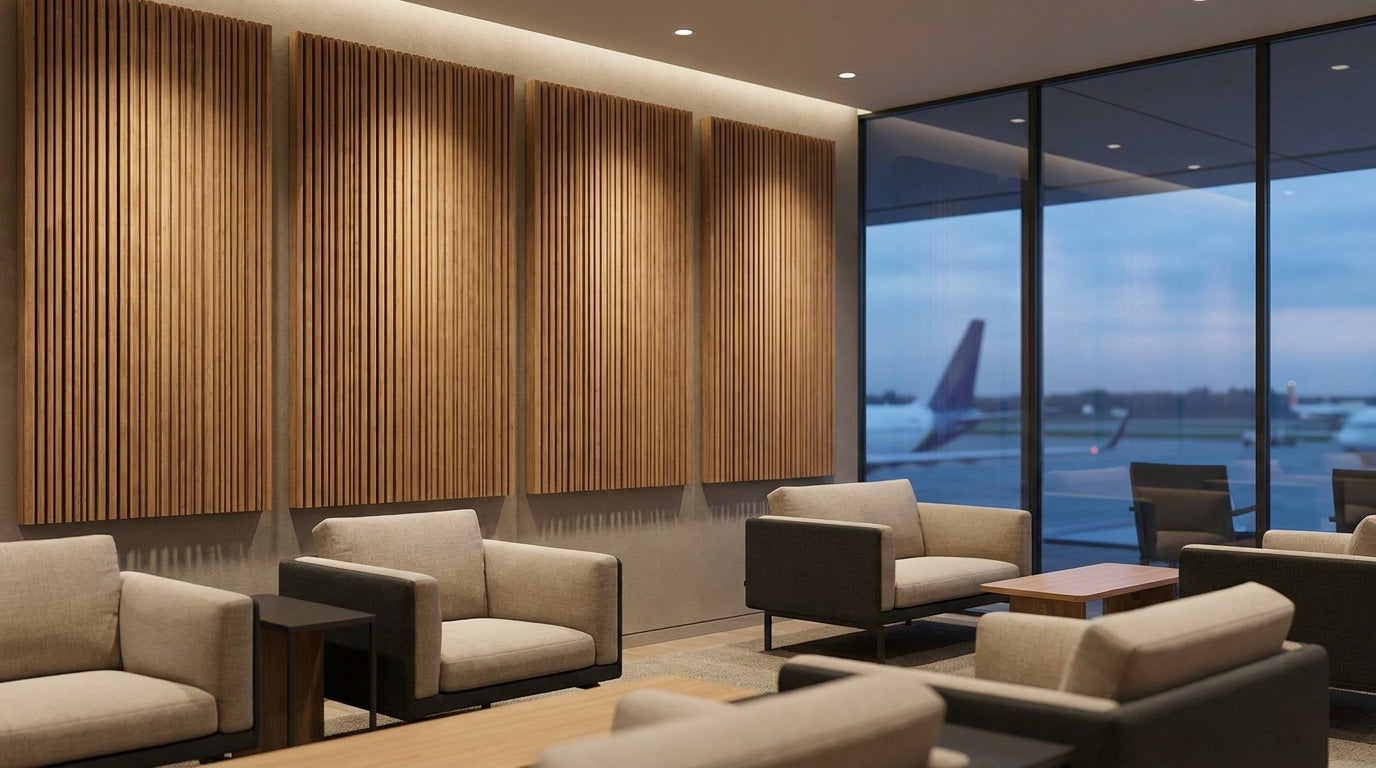
Airport lounge walls take a battering that a living room never sees: hard-soled footfall on terrazzo, luggage trolleys clipping corners, PA announcements bouncing off glass frontages. Acoustic panels for airport lounges have to cut that reverberation while surviving thousands of passengers a day, not just look calm in a rendering.
- Akuwood Panel's Black Oak veneer panel is the safe pick for airport lounge walls in 2026 - Buy for low-light corners and bulkheads.
- Rustic Oak Premium 3-sided veneer panels handle luggage-cart contact better than laminate skins - Buy for high-touch corridors.
- Hexagon Natural Oak acoustic panels carry a 0.75 NRC rating at 81cm module size for £40.95 - Consider for wayfinding feature zones.
- Skip decorative panels without felt backing in acoustic-critical lounge zones - they add texture, not noise control.
Why this matters
Most lounge interiors run on concrete, glass and stone because those materials clean fast and survive constant traffic. Those same surfaces reflect sound instead of absorbing it, which is why a gate-change announcement gets lost under trolley wheels and hold music in a busy departure lounge.
Acoustic wood panels for airport lounges exist to counter that reverb without adding soft furnishings that pick up dirt within a week. The Akuwood Panel wood panel collection pairs a real wood veneer face with a felt acoustic backing, so a lounge gets sound control and a hospitality-grade finish from one board rather than two separate specs.
A panel without a published NRC rating is a decoration, not an acoustic treatment, and that distinction matters more in a terminal than almost anywhere else.
Who this guide is for
This is written for airport lounge operators, priority-lounge fit-out contractors, terminal facilities managers, and interior firms bidding on gate-side refurbishments. It is not for someone panelling a home cinema — the acoustic load, the footfall, and the sign-off paperwork are a different category entirely, and specifying a domestic-grade board for a public transport building creates problems later, not savings.
What to look for in acoustic panels for airport lounges
Acoustic performance under constant background noise
Look for a published NRC (Noise Reduction Coefficient) rather than a marketing line about "improved acoustics." Akuwood Panel's hexagon acoustic range carries an NRC of 0.75, which sits in the range a lounge needs to cut mid-frequency chatter and PA feedback rather than just softening a single echo point.
Face finish that survives luggage and cart contact
A 3-sided real wood veneer face resists trolley-wheel scuffs and cart contact better than a printed laminate skin, because the grain runs through the cut edges instead of stopping at a photographic layer. Cut a laminate panel down for a bulkhead and the raw edge shows within months of daily contact.
Format flexibility for irregular terminal walls
Lounge walls rarely run in clean multiples of one panel size. Having two size formats — 240cm and 300cm — lets an installer minimise offcuts and horizontal seams across columns, bulkheads and the recessed lighting coves that terminal walls are full of.
Fire and compliance paperwork
Terminal buildings sit under stricter fire and means-of-escape rules than a private house. Ask any supplier for technical documentation before specifying a panel for a public transport building, not after the order has shipped and the installer is on site.
Installation speed during limited downtime windows
Lounges rarely close for a full refit — contractors usually get a red-eye window or a hoarded-off bay. Panels that click together on concealed fixings install faster than boards that need wet adhesive with an overnight cure, which matters when the working window is six hours, not six days.


Top picks for airport lounge walls
The safe pick: Black Oak wall panel
Black Oak disappears into low-light lounge corners without reading as a fire door or a retail fitting. It ships in both the 240cm and 300cm formats with a 3-sided real wood veneer face and acoustic felt backing behind it, and it holds its colour under the mixed daylight-and-downlight conditions typical of a departure lounge. Verdict: Buy for bulkheads and low-traffic perimeter walls. See the Black Oak wall panel.
The durability pick: Rustic Oak Premium 3-sided veneer
This is the panel for corridors between gates, where luggage carts and rolling cases make constant contact with the lower third of the wall. The 3-sided veneer means a cut edge at skirting height still shows grain, not substrate, after repeated knocks. Verdict: Buy for high-touch zones and boarding corridors. See the Rustic Oak Premium 3-sided veneer panel.
The wayfinding pick: Hexagon Natural Oak acoustic panel
Hexagon modules at 81cm let a designer build a feature pattern that doubles as a directional cue toward gates or lounge seating, at £40.95 per panel with a 0.75 NRC rating. It is not the pick for a full acoustic wall on its own — the seams between hexagons need a backing structure — but as an accent zone next to full-format boards it earns its place. Verdict: Consider for feature walls, not primary acoustic coverage. See the Hexagon Natural Oak acoustic panel.
What to avoid
- Decorative-only panels without felt backing. They add texture and nothing else — fine for a residential alcove, wrong for an acoustic-critical lounge zone.
- Panels without a 3-sided veneer. The raw substrate edge shows the moment it gets cut down for a bulkhead or column wrap, and airport maintenance teams notice within a season.
- Unbranded imports with no fire documentation. A public transport building is not the place to discover a supplier cannot produce compliance paperwork after the panels are already on the wall.
Verdict comparison
| Criteria | Black Oak | Rustic Oak Premium | Hexagon Natural Oak |
|---|---|---|---|
| Acoustic backing | Felt-backed | Felt-backed | 0.75 NRC felt-backed |
| Best use | Perimeter walls, bulkheads | High-touch corridors | Feature/wayfinding zones |
| Size format | 240cm / 300cm | 240cm / 300cm | 81cm hexagon |
| Verdict (2026) | Buy | Buy | Consider |
FAQ
What is the best acoustic panel for an airport lounge wall?
For primary acoustic coverage in 2026, a felt-backed 3-sided veneer panel such as Black Oak or Rustic Oak Premium outperforms decorative-only boards because the felt layer does the sound work, not just the wood face.
Do wood veneer panels actually reduce echo in large lounges?
Yes, when the panel carries a felt acoustic backing behind the veneer - the wood face is cosmetic, the felt layer is what absorbs mid-frequency sound reflecting off glass and hard flooring.
Is hexagon panelling suitable for a full lounge acoustic wall?
Hexagon panels work best as an accent or wayfinding feature rather than the sole acoustic treatment, because the joint pattern between modules needs a supporting wall build rather than standing alone across a full bulkhead.
How much do acoustic wood panels cost for a commercial fit-out in 2026?
Hexagon acoustic panels run £40.95 per 81cm module in 2026; full-format Black Oak and Rustic Oak Premium boards are priced separately and available in 240cm or 300cm lengths, so total cost scales with wall area and format chosen.
What NRC rating should I look for in a public building?
A published NRC of 0.75, as carried on the hexagon acoustic range, is a reasonable benchmark for cutting mid-frequency noise in a high-ceiling public space - anything without a stated NRC figure should be treated as decorative only.
Can these panels handle luggage cart and trolley contact?
A 3-sided real wood veneer finish, as used on the Rustic Oak Premium panel, holds up to repeated cart and trolley contact better than a printed laminate skin because the grain continues through the cut edge instead of exposing a substrate layer.
Do I need fire documentation before installing wood panels in a terminal?
Yes - terminal and public transport buildings sit under stricter fire and means-of-escape rules than residential projects, so request technical documentation from the supplier before specifying, not after installation begins.
One last thing
Running 300cm boards up a 3-metre lounge bulkhead instead of 240cm boards cuts the number of horizontal seams by roughly a fifth, and in a terminal that matters more than it does at home — every seam is a dust line under an airport's cleaning contract. Mixing felt-backed hexagon panels next to full-format Black Oak or Rustic Oak Premium boards also lets a lounge keep its acoustic coverage where it counts while using the hexagon pattern purely for wayfinding, rather than trying to make one product do both jobs at once.
Share:
Acoustic Panels for Warehouse Offices: 2026 Buying Guide
Acoustic Panels for TV Studios 2026: Buy Verdicts