

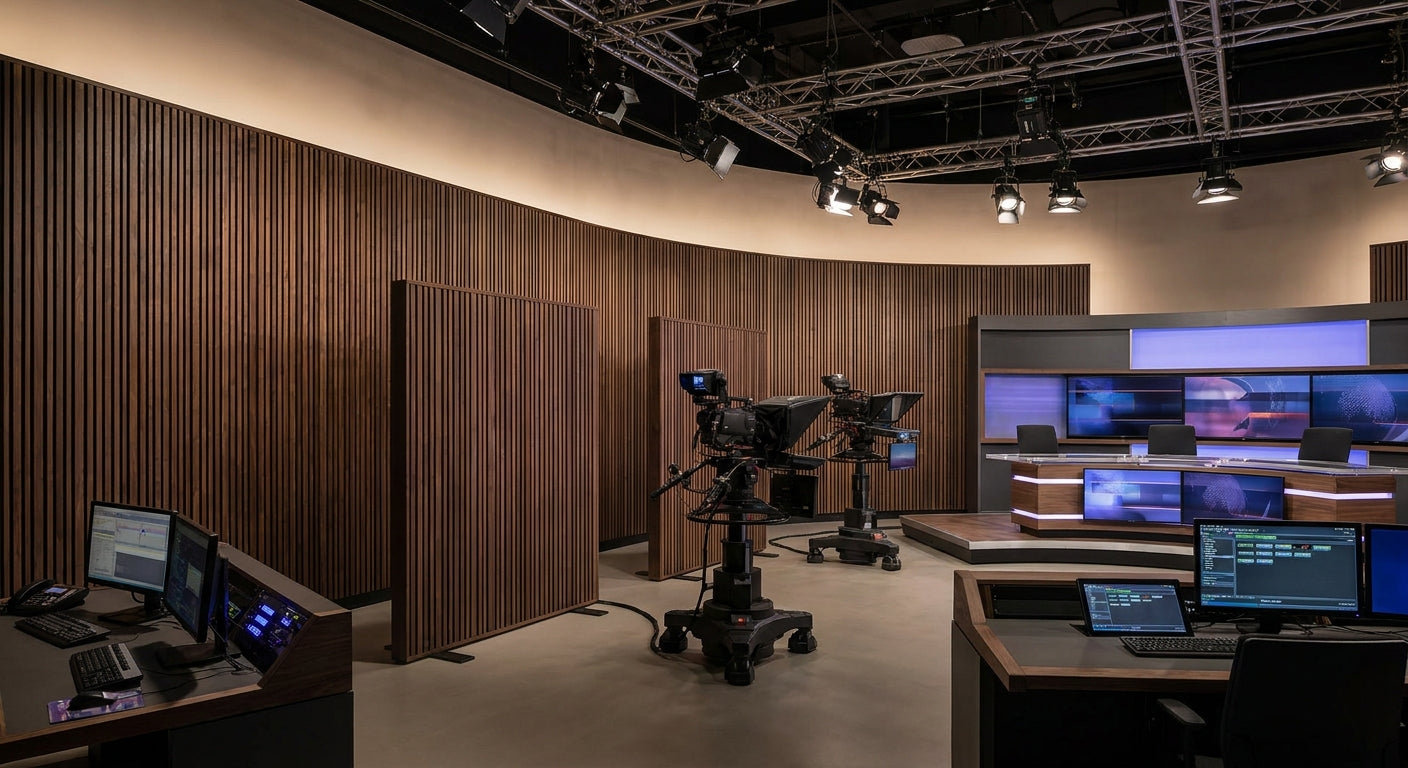
Broadcast TV studios need to kill flutter echo without turning a set into a padded box — acoustic wood panels handle both jobs at once, and the wrong finish shows up under a lighting rig before the first take wraps. This guide covers what acoustic panels for TV studios need to do structurally and visually in 2026, and which finishes actually hold up on camera.
- Natural Oak Grey Felt panels suit control rooms and news sets — Buy for dependable acoustic panels for TV studios in 2026.
- Black Oak reads clean under 3200K key lighting and hides cable runs on night-set backdrops — Buy.
- Hexagon Natural Oak with Grey Felt panels carry an NRC 0.75 rating at £40.95 each in 2026 — Consider for textured backdrops.
- Skip exterior cladding and unfelted decorative panels on studio walls — they add texture, not absorption.
Why this matters
A studio floor full of hard flats, glass control room windows and a concrete or screed floor is a flutter-echo machine. Shotgun mics and lavalier packs pick up the slap-back off bare walls long before a viewer notices anything visually wrong, and by the time an editor hears it in post, the set is already struck. Acoustic wood panels solve the reflection problem and the on-camera finish problem in a single install, which is why they've replaced foam wedges and painted MDF in most 2026 studio fit-outs.
Who this is for
This guide is for AV integrators, set designers and facilities managers fitting out news studios, corporate video rooms, control room walls and podcast-adjacent broadcast spaces where a camera will point at the wall. If you're speccing a panel that needs to look intentional in 4K and behave acoustically, a natural oak grey felt panel is a reasonable starting reference point — three-sided real wood veneer over a felt-backed acoustic core, built for exactly this kind of wall.
What to look for in acoustic panels for TV studios
Felt-backed absorption, not just visible slats
A slatted surface alone does very little for reflection — the absorption comes from the felt backing behind the veneer. Hexagon panels in this range carry an NRC rating of 0.75, meaning three-quarters of incident sound energy gets absorbed rather than bounced back into a boom mic. Confirm felt backing on any panel before it goes on a studio wall, not just the visible wood face.
On-camera colour under studio lighting
Broadcast lighting rigs typically sit around 3200K tungsten-balanced or mixed LED, and wood grain reads very differently under that colour temperature than it does in a showroom with daylight bulbs. Darker finishes like Black Oak or Smoked Oak tend to hold their tone consistently across a lighting change, while pale finishes can blow out under a hard key light. Test a sample under the actual rig before committing to a full backdrop wall.
Size format matching the set build
Panels come in 240cm and 300cm formats, and the choice matters more on a studio wall than in a living room. A standard 240cm studio ceiling height suits the shorter format with minimal cutting, while cyclorama walls and double-height control rooms need the 300cm run to avoid a visible horizontal seam mid-shot. Get the ceiling height measured before ordering, not after the panels arrive.
Fire rating and compliance documentation
Broadcast facilities, especially shared studio hire spaces, usually require fire rating documentation on any wall finish before a build gets signed off. Ask for the paperwork upfront rather than assuming — it's a five-minute email that saves a rejected install later.
Install speed against a build schedule
Studio builds run on tight turnaround between shoots, and a panel system that clicks or glues into place beats one that needs a full carpentry crew. Order samples first so the finish and grain match is confirmed before a bulk order lands on-site.
Top picks for TV studio walls
Natural Oak Grey Felt Panel — the safe pick. Three-sided real wood veneer over a grey felt acoustic backing, available in 240cm and 300cm formats, and light enough in tone to work behind a presenter without dominating the shot. It's the default spec for a news set or control room wall in 2026. Buy.
Black Oak Panel — the broadcast classic. Deep, near-black veneer that reads consistently under a 3200K key light and does the best job of any finish in this range at hiding cable runs and equipment shadows on a darker set. Suits night-format shows and corporate video studios that want a moody backdrop. Black Oak wall panel: Buy.
Hexagon Panel Natural Oak with Grey Felt — the wildcard. A geometric texture panel rather than a flat slat run, priced at £40.95 per panel and carrying the same NRC 0.75 absorption rating as the standard hexagon range. Works well as an accent zone behind a desk or on a control room feature wall where a flat slat run would look plain. Hexagon acoustic panel, natural oak with grey felt: Consider.
Smoked Oak Panel — consider for warm-toned sets. A mid-brown finish that sits between Natural Oak and Black Oak on the colour scale, useful when a set designer wants warmth without the visual weight of full black. No acoustic disadvantage versus the darker finishes, purely a styling call. Consider.


What to avoid
- Exterior wall cladding panels. These are built for weatherproofing outdoor facades, not felt-backed sound absorption, and putting one on an interior studio wall solves nothing acoustically.
- Decorative panels with no felt backing. Some 3D decorative panels look sharp in a boardroom but carry no acoustic core — fine for a reception wall, wrong for a wall that faces a shotgun mic all day.
- Pale finishes without a lighting test. A finish that looks warm in a showroom can blow out or shift colour completely under a 3200K rig. Never spec a colour off a swatch alone for a studio wall.
Verdict comparison
| Panel | Acoustic backing | Size formats | On-camera finish | Verdict |
|---|---|---|---|---|
| Natural Oak Grey Felt | Felt-backed veneer | 240cm / 300cm | Light, neutral | Buy |
| Black Oak | Felt-backed veneer | 240cm / 300cm | Deep, consistent under key light | Buy |
| Hexagon Natural Oak w/ Grey Felt | NRC 0.75 | 81cm hex format | Textured accent | Consider |
| Smoked Oak | Felt-backed veneer | 240cm / 300cm | Mid-brown, warm | Consider |
| Exterior cladding | Weatherproof, not acoustic | Varies | Outdoor-grade only | Skip |
FAQ
What's the best acoustic panel for a TV studio backdrop in 2026?
A felt-backed real wood veneer panel like Natural Oak Grey Felt or Black Oak is the standard 2026 spec for TV studio backdrops, since it absorbs sound and reads cleanly under broadcast lighting. Hexagon panels work as a textured accent rather than the full backdrop wall.
Do wood slat acoustic panels actually reduce echo in broadcast studios?
Yes, provided the panel has a felt backing behind the wood veneer, not just visible slats. The felt layer is what absorbs sound energy; hexagon panels in this range carry an NRC rating of 0.75.
Is 240cm or 300cm panel format better for a TV studio wall?
240cm suits standard studio ceiling heights with minimal cutting, while 300cm suits cyclorama walls and double-height control rooms where a horizontal seam would show mid-shot. Measure the wall before ordering either format.
How much do acoustic wood panels cost for a studio wall in 2026?
Hexagon acoustic panels list around £40.95 per panel in 2026; full-format slat panels are priced separately by finish and size. Total cost depends on wall area and finish choice, so measure the run first.
Can hexagon acoustic panels handle bright studio lighting?
Yes, the wood veneer finish holds its tone under standard broadcast lighting, though darker finishes like Black Oak or Smoked Oak stay more visually consistent than pale finishes under a hard key light.
Do acoustic wood panels work near a green screen wall?
They work well on adjacent walls and control room partitions, but keep them off the chroma key surface itself since wood grain and texture will show through in the keyed shot. Use them on the walls flanking the green screen instead.
How many acoustic panels do I need to cover a studio backdrop wall?
Coverage depends on panel width and wall dimensions, so measure the wall run in metres and divide by the panel's stated width before ordering. Order a sample first to confirm finish and grain match before a bulk order.
Is real wood veneer or laminate better for studio panels?
Real wood veneer holds colour and texture more consistently under broadcast lighting than laminate finishes, which can look flat or plasticky on camera. A three-sided veneer finish is the standard spec for a wall a camera will point at.
One last thing
The detail most studio builds miss isn't the panel choice — it's skipping the lighting test. A Natural Oak sample that looks perfect in a warehouse can shift three shades warmer under a 3200K rig, and nobody notices until the edit bay. Order a sample panel, hang it under the actual key light for an afternoon, and only then commit to the bulk order.
Share:
Acoustic Panels for Airport Lounges: 2026 Buying Guide
Acoustic Panels for Gaming Rooms 2026: The Verdict