

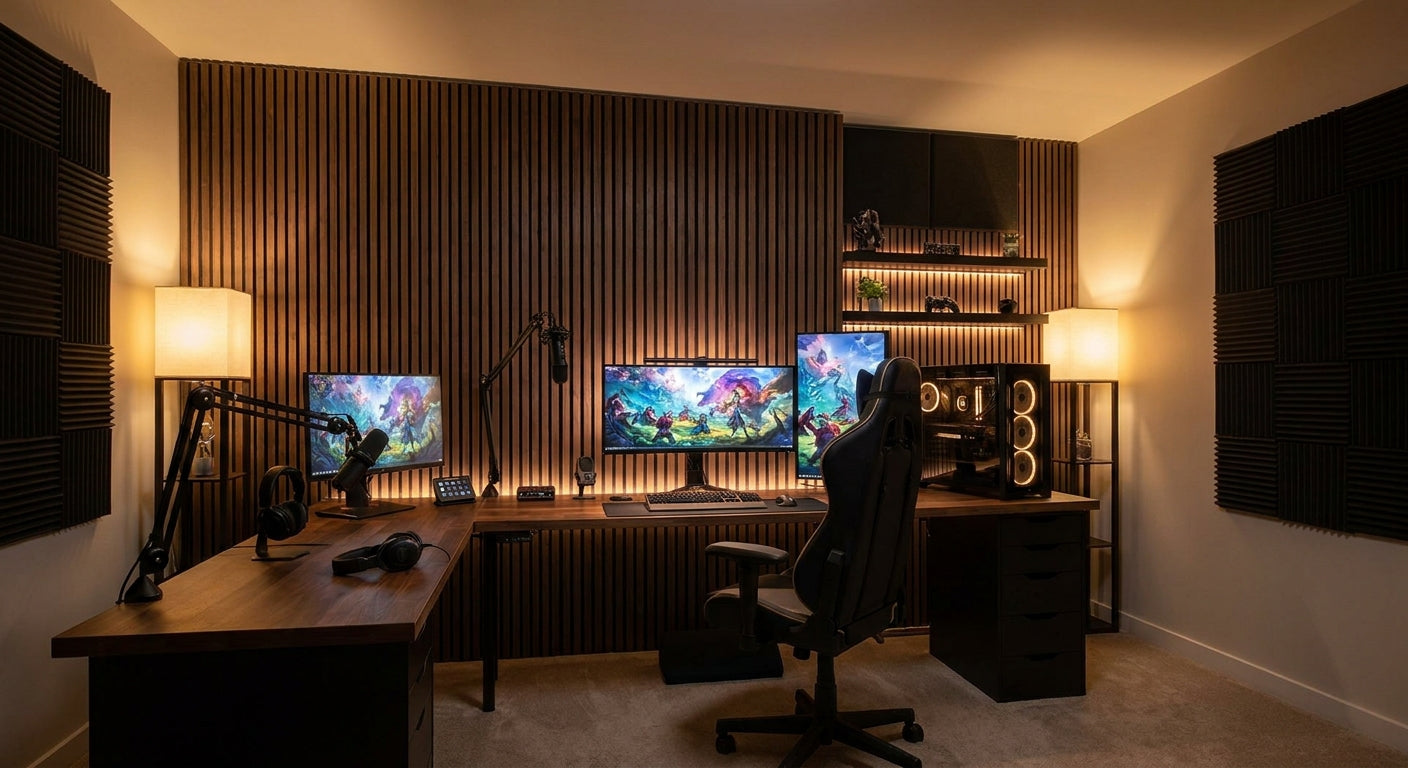
Gaming and esports rooms turn into echo chambers fast — hard desks, glass monitors, tile or laminate floors, bare plasterboard walls that bounce every gunshot and Discord ping straight back at your mic. Acoustic panels for gaming rooms fix that without turning the space into a padded cell, and the right wood-finish pick doubles as a streaming backdrop.
- Hexagon Panel Natural Oak with Grey Felt scores an NRC of 0.75 — the safe acoustic panels for gaming rooms pick in 2026, Buy.
- Skip full foam walls; real wood veneer from Akustiq UK hides monitor and RGB glare better than open-cell foam.
- Hexagon Panel Walnut with Grey Felt suits dark streaming backdrops at 40.95 per panel — Buy for on-camera setups.
- 240cm and 300cm wooden wall panel formats cover most gaming desk walls with minimal cutting.
Why this matters
A gaming room with untreated walls doesn't just sound bad to you — it sounds bad to everyone on your call. Voice comms clip and echo, your mic picks up slap-back off a monitor wall, and if you stream in 2026, viewers hear every bit of it before they hear your actual commentary.
Foam tiles handle mid and high frequencies but do nothing for the low-end rumble of a subwoofer or a chair rolling on hard flooring, and they look like a server room. Wood-faced acoustic panels absorb sound through a felt backing while the veneer face stays camera-friendly, which matters if your gaming room doubles as a stream set.
Who this is for
This guide is for anyone setting up a dedicated gaming or esports room in 2026 — solo streamers dealing with mic bleed, competitive players who need clean voice comms during ranked play, and small esports team houses trying to stop noise from one battlestation bothering the next. If your walls are bare plasterboard, brick, or a rented flat you can't drill without a fight over the deposit, the mounting method matters as much as the acoustic spec.
What to look for in acoustic panels for gaming rooms
Sound absorption rating matched to your setup
Check the NRC (Noise Reduction Coefficient) before anything else — a panel rated 0.75 absorbs roughly three-quarters of the sound energy hitting it, which is enough to tame voice-frequency echo from a desk mic without over-deadening a room used for music or streaming. Anything below 0.5 is decoration, not acoustic treatment.
Panel size versus your desk wall
Standard formats run 240cm and 300cm — measure your gaming wall before you order, because cutting a wood veneer panel down midway through installation is harder to hide than cutting foam. A 300cm panel suits a floor-to-ceiling feature wall behind a triple-monitor setup; 240cm fits a standard UK ceiling height without waste.
A finish that survives RGB lighting and long sessions
Glossy foam and cheap MDF reflect monitor glare and RGB strip light straight back at the camera. A real wood veneer finish diffuses that light instead of bouncing it, which is why finishes like smoked oak or black oak read better on stream than a flat white acoustic tile.
Mounting that doesn't wreck a rented setup
Renters and shared houses need panels that go up with adhesive rather than screws through a stud wall. High-tack panel glue holds a wood-faced panel to plasterboard without the two dozen screw holes a full acoustic wall usually leaves behind.
On-camera backdrop quality
If your gaming room is also a stream set, the wall behind you is part of your brand. A hexagon pattern or a single dark oak feature wall reads as intentional design; a wall of grey foam wedges reads as a server closet.
Cost per square metre versus foam alternatives
Wood veneer acoustic panels cost more per unit than basic foam tiles, but foam needs replacing as it yellows and crumbles within a couple of years under constant desk-lamp heat. A hexagon panel at 40.95 per 81cm unit holds its finish far longer under normal gaming-room use.
Top picks for gaming and esports rooms
The safe pick — Hexagon Panel Natural Oak with Grey Felt (81cm). Rated 0.75 NRC, priced at 40.95, and light enough in tone to brighten a windowless gaming room without washing out on camera. Hexagon acoustic panel natural oak with grey felt tiles cleanly into a honeycomb feature wall behind a desk in an afternoon. Buy.
The wildcard — Hexagon Panel Walnut with Grey Felt (81cm). Same 0.75 NRC rating, but the darker walnut tone hides monitor glare and RGB bleed better for late-night streaming sessions. The hexagon acoustic panel walnut with grey felt reads as a deliberate design choice on stream rather than an acoustic patch job. Buy for anyone streaming in 2026 with ring-light or RGB setups.
The blackout pick — Wooden Wall Panel Black Oak. For teams running dark-room setups with minimal ambient light, black oak absorbs stray light the way foam never does, and the 3-sided real wood veneer finish still reads as premium rather than gaming-den black-out cloth. Buy if your room already runs a dark colour scheme.
The streaming-backdrop pick — Wooden Wall Panel Smoked Oak. A mid-tone finish that photographs well under most webcam white balance settings without needing constant colour correction between sessions. Consider if you're building a backdrop rather than solving an echo problem first.
The neutral pick — Wooden Wall Panel Grey Oak. Works for shared esports houses where the room needs to look tidy for parents, landlords, or sponsors rather than gamer-aesthetic. Consider for team houses over solo streamer setups.


What to avoid
- Egg-crate foam wedges — cheap and fast to fit, but they only handle mid-range frequencies, yellow within 12 to 18 months under desk lamp heat, and read poorly on any stream or clip.
- Full-carpet wall treatments — absorb sound but trap dust and heat behind a hot gaming PC, and most landlords won't allow permanent carpet fixings on a wall.
- Cheap MDF slat panels with no felt backing — look like a wood panel but carry no real acoustic rating, so you pay for the aesthetic without solving the echo problem.
For context on mic bleed and echo fixes beyond panelling, the guide on acoustic panels for podcast studio walls covers mic placement alongside wall treatment, which applies directly to a gaming room used for voice comms or commentary.
Verdict comparison
| Pick | NRC rating | Size | Best for | Verdict |
|---|---|---|---|---|
| Hexagon Natural Oak + Grey Felt | 0.75 | 81cm | Bright rooms, general echo control | Buy |
| Hexagon Walnut + Grey Felt | 0.75 | 81cm | Dark streaming backdrops | Buy |
| Wooden Panel Black Oak | felt-backed | 240cm/300cm | Blackout gaming rooms | Buy |
| Wooden Panel Smoked Oak | felt-backed | 240cm/300cm | Webcam-friendly backdrop | Consider |
| Wooden Panel Grey Oak | felt-backed | 240cm/300cm | Shared/team houses | Consider |
Check acoustic wall panels from Akustiq UK directly for current stock across all finishes before ordering — hexagon panels and full wooden wall panels sell in different batch sizes.
FAQ
What's the best acoustic panel for a gaming room in 2026?
Hexagon Panel Natural Oak with Grey Felt is the safe pick for most gaming rooms in 2026, rated 0.75 NRC and priced at 40.95 per 81cm panel. Darker finishes like walnut suit rooms doubling as a streaming backdrop.
Is wood panelling better than foam for a gaming room?
Wood-faced acoustic panels absorb sound through a felt backing while staying camera-friendly, unlike foam which reflects monitor and RGB glare and degrades within a couple of years. Foam is cheaper upfront but wears out faster under constant desk-lamp heat.
How much does it cost to soundproof a gaming room?
Hexagon acoustic panels run 40.95 per 81cm unit, so a small feature wall behind a desk typically needs 6 to 10 panels depending on coverage. Full wooden wall panels in 240cm or 300cm formats cost more per unit but cover larger walls with fewer joins.
Do acoustic panels actually reduce echo for streaming?
Panels rated around 0.75 NRC absorb roughly three-quarters of sound energy at voice frequencies, which cuts the slap-back echo a desk mic picks up off bare walls. Full silence isn't the goal — clean, controlled voice comms is.
Can I fit acoustic wood panels in a rented gaming room?
Yes, high-tack panel glue mounts wood-faced acoustic panels to plasterboard without the screw holes a stud-mounted install leaves behind. This suits renters and shared houses who need the wall back to original condition later.
What size acoustic panels fit a standard gaming desk wall?
Wooden wall panels come in 240cm and 300cm formats, with 240cm suited to standard UK ceiling heights and 300cm better for floor-to-ceiling feature walls behind a monitor setup. Hexagon panels at 81cm let you tile a smaller feature area instead.
Do dark acoustic panels work better for streaming setups?
Darker finishes like black oak or walnut hide monitor glare and RGB light bleed better than lighter oak tones, which matters for anyone streaming under constant screen and ring-light exposure. Lighter finishes like natural oak still work fine for rooms without heavy RGB lighting.
Is a full acoustic wall overkill for a small gaming room?
A single feature wall behind the desk and mic usually handles the worst of the echo without treating every wall in the room. Full coverage matters more in larger, harder-surfaced rooms like tiled esports team houses.
One last thing
Most gaming room echo problems come from one wall — the one directly behind or beside the mic — not the whole room, so a single hexagon feature wall at 81cm panels often solves 80% of the audible bleed before you spend a penny on a full acoustic build-out. Start there in 2026, listen back on a recorded clip, and only expand coverage if the echo is still audible.
Share:
Acoustic Panels for TV Studios 2026: Buy Verdicts
Acoustic Panels for Insurance Offices: 2026 Buying Guide