

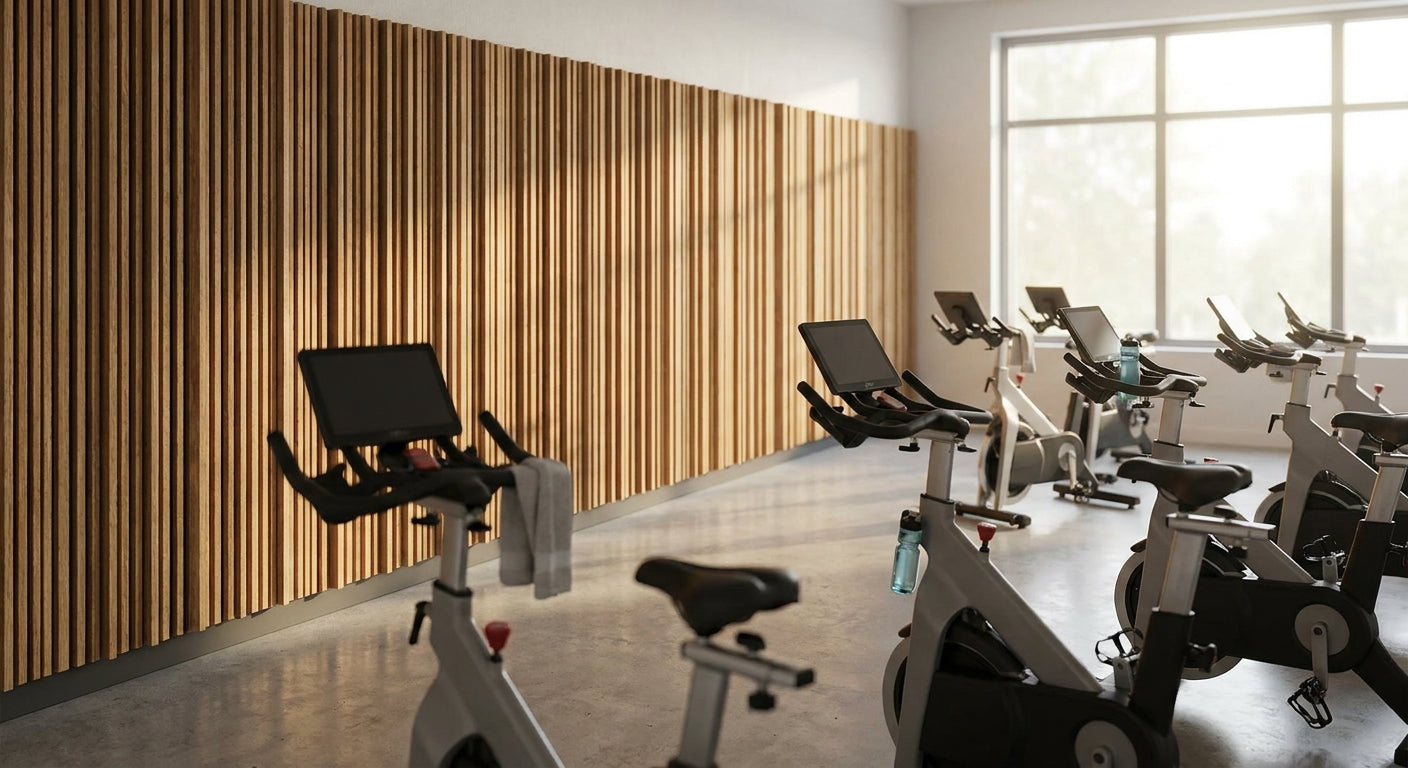
Spin studios take a beating on acoustics: hard floors, tiered risers, blasting speakers, and 20-40 riders breathing hard against bare drywall. Acoustic wood panels cut the slap-back and bass thump that make instructors shout over their own playlist, and this guide covers what actually holds up in a sweaty, high-vibration room in 2026.
- Hexagon Acoustic Panel Grey Walnut with Grey Felt hits NRC 0.75 and handles spin studio humidity - Buy.
- Full-height slat panels like Black Oak work best behind the instructor wall, not scattered around the room.
- Skip plain MDF slatwall with no felt backing - it looks the part but absorbs almost nothing in 2026 test data from manufacturers.
- Budget for 60-70% wall coverage, not full coverage, to control echo without deadening the room completely.
Why this matters
A 12x8 metre spin room with a 3-metre ceiling and no soft surfaces can carry a reverberation time north of 1.2 seconds - long enough that instructor cues blur into the beat drop. Riders lose cues, instructors strain their voice, and reviews start mentioning "echo" instead of the workout. Acoustic wood panels with a felt backing bring that reverb time down without turning the room into a padded cell, which matters when the studio still needs to look premium for Instagram and referral traffic.
Who this is for
This guide is for studio owners and fit-out managers speccing walls for indoor cycling, spin, or high-intensity group classes - rooms with hard floors, concrete or plasterboard walls, high rider density, and a sound system running loud for 45-60 minutes at a stretch. If you're panelling a home Peloton corner, the wooden wall panels for gym and fitness studio interiors guide covers smaller-scale setups with less speaker output to manage.
What to look for in acoustic panels for spin studios
NRC rating above 0.70
Noise Reduction Coefficient tells you how much sound a panel absorbs versus bounces back, on a 0 to 1 scale. Spin studios need panels rated 0.70 or higher because the bass-heavy playlists and instructor mic reflect hard off bare walls at close range. Anything under 0.50 is decorative, not acoustic - it looks like a solution but performs like a feature wall. The NRC ratings guide breaks down how manufacturers actually test this number.
Moisture and humidity tolerance
A 45-minute class with 20 riders pushes room humidity up fast, and condensation on cold walls is common in converted units and basements. Panels need a finish that resists swelling and delamination, not raw MDF that warps after one damp winter. Real wood veneer over an acoustic felt core handles humidity swings far better than laminate wraps.
Fixing that survives vibration
Stationary bikes transmit low-frequency vibration through the floor and into stud walls, and loose panels rattle audibly during a sprint interval. Screw-fix installation into battens beats adhesive-only mounting in any room running bikes at speed, because glue alone loosens over months of vibration and heat cycling.
Coverage placement, not just coverage area
Full wall-to-wall coverage isn't necessary and gets expensive fast. The panels that matter most sit on the wall directly behind the instructor rig and the wall the speakers fire into - those two surfaces cause 60-70% of the audible slap-back in most rectangular studios. Side walls with mirrors need less treatment since glass doesn't reflect sound the way plasterboard does.
Finish that hides sweat and scuffs
Dark oak and walnut finishes hide handprints, water splashes, and general wear far better than pale natural oak in a room where 20+ people brush past walls every hour. This is a cosmetic call, but it affects how often the studio needs to clean or replace panels.
Top picks for spin studio acoustic panels
Hexagon Acoustic Panel Grey Walnut with Grey Felt - the sound-dampening default. NRC 0.75, 81 cm hexagon format, real wood veneer over acoustic felt. The hexagon shape covers awkward angles around speaker mounts and mirrors better than straight slat panels, and grey walnut hides scuffs without going full black. Buy - this is the safest spec for a mid-size spin room in 2026 where the wall behind the rig needs real absorption.
Hexagon Acoustic Panel Smoked Oak with Grey Felt - the low-light studio pick. Same NRC 0.75 rating, darker tone that reads well under the dimmed, colour-washed lighting most spin studios run during class. Smoked oak hides sweat marks and rig shadows better than lighter finishes. Consider for studios running mood lighting rather than bright fluorescents.
Wooden Wall Panel Black Oak, full-height slat format - the feature-wall pick. Available in 240 cm and 300 cm lengths with a 3-sided wood veneer finish, this covers the instructor wall floor-to-ceiling in fewer joins than hexagon tiles. Consider it for the single feature wall behind the rig where visual impact matters as much as acoustics, and pair it with felt-backed hexagon panels elsewhere for the absorption workload.
Wooden Wall Panel Natural Oak with Grey Felt - the budget bright pick. Lighter finish, same felt-backed acoustic construction, works for boutique studios going for a Scandinavian look rather than dark industrial. Skip it for rooms with heavy rider traffic against the wall - light oak shows scuffs within months in a high-contact spin room.


What to avoid
- Plain MDF slatwall with no felt backing. It photographs like an acoustic solution but tests closer to NRC 0.15-0.25, which does almost nothing against a 1.2-second reverb problem.
- Adhesive-only mounting on a vibration-heavy wall. Bike frames and floor-mounted speakers shake stud walls constantly, and glued panels loosen within a season.
- Full floor-to-ceiling coverage on every wall. Over-treating a room kills the energy of the class - a spin studio needs some liveliness in the sound, not a recording booth.
Verdict comparison table
| Pick | NRC rating | Format | Best for | Verdict |
|---|---|---|---|---|
| Hexagon Grey Walnut w/ Grey Felt | 0.75 | 81 cm hexagon | Instructor wall, mid-size studios | Buy |
| Hexagon Smoked Oak w/ Grey Felt | 0.75 | 81 cm hexagon | Dimmed, mood-lit rooms | Consider |
| Wooden Wall Panel Black Oak | Panel-dependent | 240/300 cm slat | Full feature wall behind rig | Consider |
| Wooden Wall Panel Natural Oak w/ Grey Felt | 0.75 | 240/300 cm slat | Boutique, low-traffic studios | Skip for high-traffic walls |
Acoustic wood panels for a spin studio should never be picked on looks alone - the NRC number and the fixing method decide whether the room actually gets quieter.
FAQ
What NRC rating do spin studio acoustic panels need?
Aim for an NRC of 0.70 or higher for spin studio walls in 2026. Panels rated below 0.50 absorb too little bass and mid-range reflection to fix a live, hard-floored room.
Is hexagon or full slat panel better for a spin room?
Hexagon panels suit irregular walls around mirrors and speaker mounts, while full slat panels cover a single feature wall with fewer joins. Most studios use hexagon on side walls and slat panels behind the instructor rig.
How much wall coverage does a spin studio actually need?
60-70% coverage on the two loudest walls - the instructor wall and the wall the speakers fire into - handles most reverb problems. Full coverage on every wall over-deadens the room and kills the class energy.
Do acoustic wood panels handle humidity from a spin class?
Real wood veneer over an acoustic felt core resists the humidity swings from 20+ riders sweating in a closed room better than raw MDF or laminate wraps, which can warp or delaminate within a year.
Should spin studio panels be screwed or glued to the wall?
Screw-fix into battens is the safer choice for any wall near stationary bikes, since floor and wall vibration loosens adhesive-only mounting over months of use.
What finish hides wear best in a high-traffic spin room?
Dark finishes like black oak and smoked oak hide scuffs, handprints, and sweat marks far better than pale natural oak in rooms with heavy rider contact against the walls.
Can acoustic panels go behind stationary bikes directly?
Yes, but prioritise the wall the speakers face and the instructor's backdrop first - these two surfaces cause most of the audible slap-back, not the wall directly behind rider rows.
One last thing
Most studios over-panel the side walls and under-panel the ceiling void above the instructor rig, which is where the loudest reflection actually happens in a room with a 3-metre or lower ceiling. If reverb persists after wall treatment in 2026, check the ceiling line above the speakers before adding more wall coverage - that's usually the missed surface.
Share:
Train Station Acoustic Panels 2026: Top Picks & Verdicts
Prison Meeting Room Acoustic Panels 2026: What To Buy