

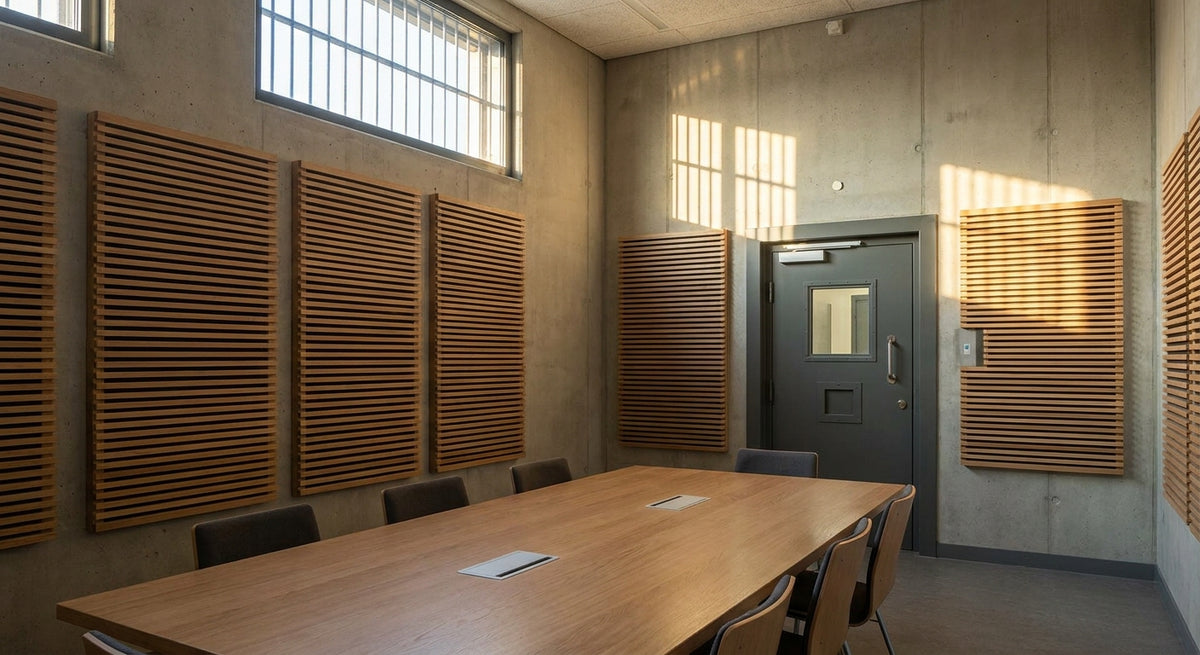
Specifying wall finishes for a prison meeting room isn't like picking panels for a boardroom — the surface has to survive daily contact, absorb enough sound to protect confidentiality, and pass a fire compliance check before anyone signs off the fit-out. This guide breaks down what actually matters for prison meeting room acoustic panels in 2026 and which finishes hold up.
- Black Oak Wall Panel is the safe pick for prison meeting room acoustic panels in 2026 - buy it.
- Grey Oak Wall Panel suits family visit rooms that need a lighter, calmer tone - buy it.
- Skip loose acoustic foam and light veneer finishes in high-contact institutional rooms.
- Hexagon acoustic panels carry a 0.75 NRC rating - fine for reception zones, not full meeting rooms.
Why this matters
A prison meeting room does two jobs at once: it has to sound private enough that a solicitor and their client can talk without the corridor picking up every word, and it has to look and feel calm enough that a family visit doesn't feel like an interrogation. Bare block walls and hard floors do neither. Sound bounces wall to wall, voices get louder to compensate, and the room reads as clinical rather than controlled.
AKU Woodpanel supplies acoustic wall panels built around a felt-backed core with a real wood veneer face, which is the construction that actually dampens reverberation instead of just decorating over it. That's the baseline any institutional specifier should be checking for, whatever brand ends up on the purchase order.
Who this is for
This guide is for facilities managers, estates teams, and approved contractors specifying interior finishes for prison meeting rooms, secure visitor centres, legal consultation rooms, and probation meeting spaces. If you're weighing acoustic wood panels against acoustic foam tiles or plain plasterboard for a room that gets used for hours every day, the criteria below are built for that decision, not for a domestic living room refit.
What to look for in acoustic panels for prison meeting rooms
Impact and scratch resistance
A meeting room in a secure facility takes more contact than an office wall ever will — chairs, tables, hands, and the occasional knock. A real wood veneer finish over a solid panel core resists scuffing better than a laminate skin, and darker tones hide the marks that do happen. This is the single biggest reason institutional buyers lean toward oak and walnut tones over pale finishes.
Sound absorption that actually reduces reverberation
The felt backing behind the veneer is what does the acoustic work, not the wood itself. In a small meeting room with hard floors and a low ceiling, untreated walls can make a conversation carry straight through to the corridor. Panels with a felt-backed core cut that reverberation and keep sensitive conversations contained to the room they happen in.
Easy, repeatable cleaning
Institutional cleaning schedules are frequent and unforgiving — wipe-downs happen daily, sometimes with stronger cleaning agents than a home would ever use. A sealed veneer surface that can be wiped without swelling or staining saves a maintenance headache six months in, when a softer finish would already be showing water marks.
Fire rating documentation you can hand to a compliance officer
Any finish going into a public sector building needs paperwork behind it before a fire officer will sign off the room. Get the fire rating documentation from the supplier before you order, not after installation — checking fire ratings for acoustic wood panels before spec is worth the extra week it takes.
Flush, glued fixing over loose or removable parts
Security teams care about this one more than aesthetics. Panels glued flat to the wall don't have edges or fixings that can be worked loose over time, which matters a great deal more here than in a domestic install. Anything that hangs, clips on, or can be pried off the wall is a liability in a room built for high-risk visits.
“If a panel can be pulled off the wall by hand, it doesn't belong in a room built for high-risk visits.”
Top picks
Black Oak Wall Panel - the safe pick. Dark 3-sided veneer hides scuffs and fingerprints better than any lighter finish, and it's available in both 240cm and 300cm formats to suit ceiling height. Verdict: Buy.
Grey Oak Wall Panel - the calming neutral. Where Black Oak reads as formal, Grey Oak softens the room without going pale enough to show every mark — a better fit for family visit rooms than for legal consultation spaces. Verdict: Buy.
Smoked Oak Wall Panel - the dark-toned alternative to Black Oak. Very similar performance profile, so pick whichever tone matches the rest of the estate's finishes. Verdict: Consider.
Hexagon acoustic panels (Black, Grey Walnut, Smoked Oak) - the accent option. These carry a 0.75 NRC sound absorption rating and work well as a feature wall in a reception or waiting zone, but the segmented hexagon shape isn't the right format for a small, fully-enclosed meeting room. Verdict: Consider for waiting areas only.
Natural Oak Wall Panel - the budget-lightweight pick. The pale veneer looks good on day one but shows scuffs and staining far faster under institutional lighting and daily contact than the darker tones. Verdict: Skip for high-contact rooms.


What to avoid
- Loose acoustic foam tiles. They peel, they can be pulled off, and foam degrades faster than a veneer-and-felt panel under daily contact.
- Glossy laminate finishes. They reflect fluorescent light hard in a small room and read as cheap next to real wood veneer, even when the acoustic performance is similar on paper.
- Any panel without fire rating paperwork ready at order time. Chasing documentation after installation delays sign-off by weeks in public sector buildings.
Verdict comparison
| Pick | Best for | Tone | Verdict |
|---|---|---|---|
| Black Oak Wall Panel | Legal consultation rooms | Dark | Buy |
| Grey Oak Wall Panel | Family visit rooms | Mid-neutral | Buy |
| Smoked Oak Wall Panel | Estates matching existing dark finishes | Dark | Consider |
| Hexagon acoustic panels | Reception and waiting zones | Mixed | Consider |
| Natural Oak Wall Panel | Low-contact admin offices only | Pale | Skip for meeting rooms |
FAQ
What's the best acoustic wall panel for a prison meeting room in 2026?
Black Oak Wall Panel is the strongest all-round pick for 2026 because the dark veneer hides daily contact marks better than lighter finishes while still delivering felt-backed sound absorption.
Are wooden acoustic panels durable enough for high-traffic institutional rooms?
Yes, a 3-sided real wood veneer over a solid panel core resists scuffing far better than laminate or foam, though darker tones hide wear marks more effectively than pale finishes.
How much sound absorption do acoustic wood panels provide?
It depends on the panel line - the hexagon acoustic range carries a 0.75 NRC rating, which measures how much sound the panel absorbs rather than reflects back into the room.
Can acoustic panels help with confidentiality in legal consultation rooms?
Felt-backed acoustic panels reduce reverberation that would otherwise carry a conversation through to a corridor or adjoining room, which matters directly for confidential legal or probation meetings.
Do acoustic wall panels need a specific fire rating for public sector buildings?
Public sector fit-outs require fire rating documentation before sign-off, so get that paperwork from the supplier at order time rather than after installation.
How do you clean wooden acoustic panels in a secure facility?
A sealed veneer surface wipes down with standard cleaning agents without swelling or staining, which matters for facilities running daily cleaning schedules.
What size acoustic panels work best for meeting room walls - 240cm or 300cm?
240cm suits standard ceiling heights while 300cm covers floor-to-ceiling installs in taller rooms - measure the wall before ordering either format.
Is real wood veneer suitable for rooms with heavy daily use?
Yes, provided the tone is chosen deliberately - dark finishes like Black Oak or Smoked Oak hold up visually under heavy daily contact far better than pale veneers.
One last thing
The detail most specifiers miss is that the hexagon acoustic panel range is built for accent walls, not full rooms - its 0.75 NRC rating is genuinely useful in a reception or waiting area, but fitting an entire meeting room in a segmented shape creates more seams and more edges than a flat panel format needs. Save the hexagon finish for the space outside the meeting room door, and put the flat veneer panels inside it.
Share:
Spin Studio Acoustic Panels: Best Picks for 2026
Cruise Ship Cabin Acoustic Panels: Best Picks 2026