

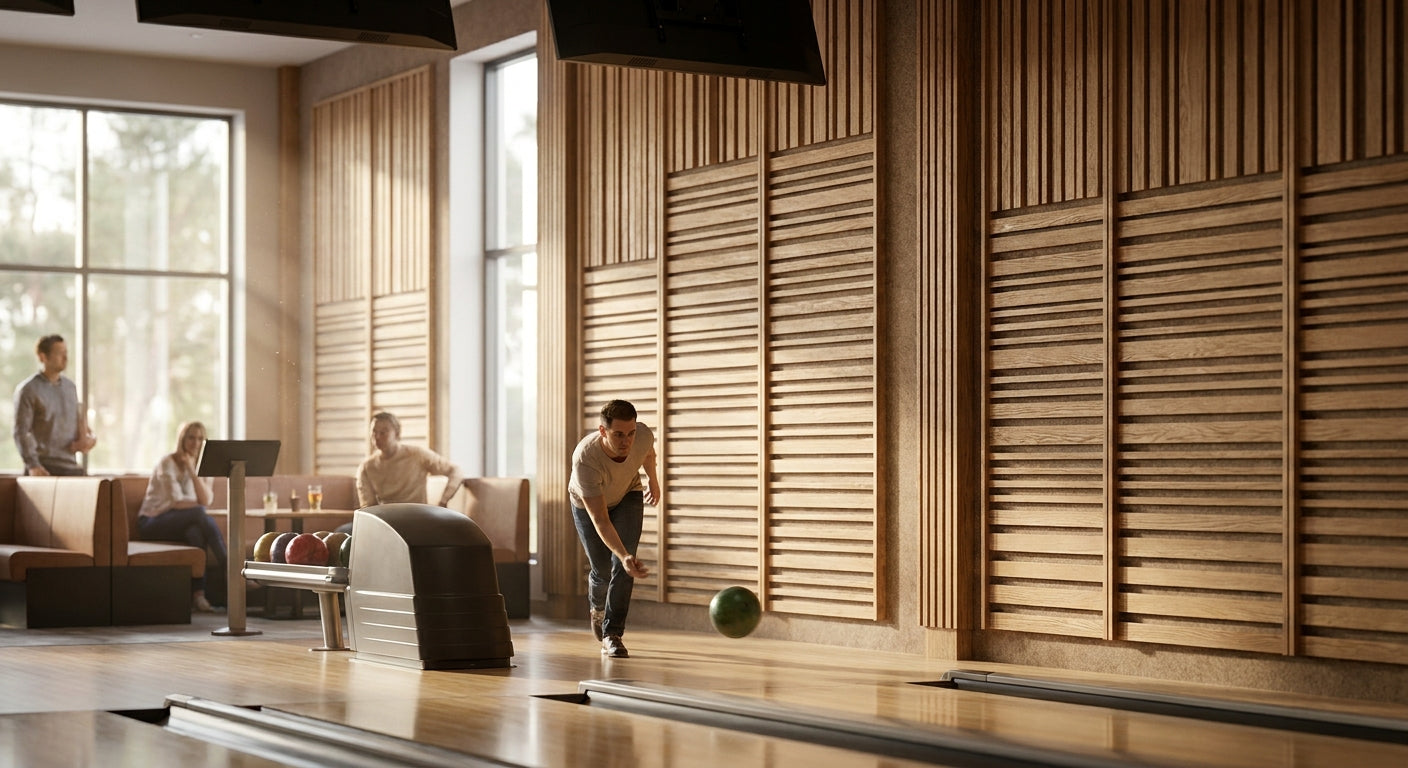
Bowling alley walls take a beating every night: pin strikes, ball roll, cheering lanes, and hard maple floors bounce sound off concrete block until the whole centre hums. Acoustic wood panels solve the echo problem without turning the building into a padded box, and the right pick depends on which wall you're covering.
- Wooden Wall Panel Natural Oak with Grey Felt covers concourse and approach walls for bowling alley acoustic panels projects — Buy for 2026 refits.
- Hexagon Acoustic Panel Grey Walnut with Grey Felt carries an NRC of 0.75, the spec that actually matters for bar and lounge walls.
- Wooden Wall Panel Black Oak hides scuffs and glare near dark lane surrounds — Buy.
- Skip plain foam tiles near lanes; they don't survive commercial cleaning cycles or foot traffic.
Why this matters
Bowling centres are some of the worst rooms in retail leisure for reverberation. Hard lanes, concrete block, high ceilings, and constant pin-strike impact push reverb times high enough that PA announcements and background music turn to mush by lane ten. Bowling alley acoustic panels aren't decoration in this setting — they're the difference between a centre customers linger in for a second game and one they walk out of after the first.
If you're unsure what a spec sheet number actually buys you, the NRC sound absorption ratings guide breaks down what a 0.75 rating means in a live commercial room versus a quiet office. Akustiq UK's panel range gives operators a way to cut mid-range noise without stripping the room of character — real wood veneer over acoustic felt, not painted foam glued to a wall.
Who this is for
This guide is for bowling centre owners, GMs handling a 2026 refurbishment, and fit-out contractors specifying materials for lanes, concourses, and bar or lounge zones. If your centre gets noise complaints during league nights or your acoustic consultant has flagged the concourse as too live, you're the buyer this covers — not a homeowner soundproofing a media room.
What to look for in acoustic panels for bowling alleys
Sound absorption rating (NRC)
An NRC rating tells you what fraction of sound energy a panel absorbs versus bounces back. In a room with concrete block and hard maple, you want panels doing real work, not just texture. The Grey Felt hexagon range in the Akustiq UK catalogue posts an NRC of 0.75 — enough to matter on a bar wall carrying conversation noise on top of lane rumble.
Panel format and wall coverage
Akustiq UK's slat panels ship in two size formats — 240cm and 300cm — which matters when you're running floor-to-ceiling on a standard bowling alley approach wall or concourse. Measure your ceiling height before ordering; a 300cm panel with minimal cutting looks cleaner than three shorter panels stacked with visible seams.
Commercial wear resistance
Bowling centres see heavier foot traffic and harder cleaning regimes than a living room. A 3-sided real wood veneer finish holds up to wipe-downs and incidental knocks better than a painted MDF slat that chips at the first cart collision.
Finish tone against lighting
Lane areas run darker for scoring displays and ball-return lighting; concourses and bars run brighter. Black Oak and Smoked Oak finishes hide scuffing under low light near lanes, while Natural Oak or Grey Oak read better under bright concourse fixtures.
Fixing method for the wall type
Most bowling centres are built on concrete block or steel-frame partitions, not standard timber stud. Confirm your fixing plan and glue compatibility before ordering panels — a mismatch here is the most common install delay on commercial jobs.
Top picks for bowling alley walls
Wooden Wall Panel Natural Oak with Grey Felt — the safe pick. This is the workhorse for concourse and approach walls: a lighter finish that reads well under bright lighting, backed by acoustic felt that does the actual absorption work. Available in the 240cm and 300cm formats so a standard ceiling height is a clean fit. Verdict: Buy for concourse walls in a 2026 refit. Wooden Wall Panel Natural Oak with Grey Felt
Wooden Wall Panel Black Oak — the low-glare pick. Dark finish near lanes hides scuffing from ball carts and reduces glare off scoring monitors, which matters more in a bowling centre than almost anywhere else. Runs the same 3-sided veneer construction as the rest of the range. Verdict: Buy for lane surrounds and dark feature zones. Wooden Wall Panel Black Oak
Hexagon Acoustic Panel Grey Walnut with Grey Felt — the lounge and bar pick. At 81cm across with an NRC of 0.75, this is built for a feature wall rather than full-room coverage — the bar, waiting lounge, or reception is where the geometric pattern earns its keep. Verdict: Consider for bar and lounge feature walls, not full lane runs. Hexagon Acoustic Panel Grey Walnut with Grey Felt
Wooden Wall Panel Smoked Oak — the moody feature-wall pick. Darker still than Black Oak, this finish suits a VIP lane section or private events area where the goal is atmosphere as much as acoustics. It carries the same felt backing as the rest of the range but reads best in a smaller accent zone rather than wall-to-wall. Verdict: Consider for a VIP or events section, not the main concourse.


What to avoid
- Plain acoustic foam tiles. They look right on a spec sheet but fail commercial durability standards — they crush, discolor, and don't survive the cleaning schedule a bowling centre actually runs.
- Unbacked slat MDF. A slat pattern without a felt or fiber backing is decoration, not acoustic treatment — it won't move the needle on reverb no matter how good it looks in a rendering.
- Full-height glass or mirror panels. Popular for concourse aesthetics in 2026 fit-outs, but they add reflective surface to a room that already has too much of it.
Verdict comparison
| Pick | Best for | Format | Verdict |
|---|---|---|---|
| Natural Oak with Grey Felt | Concourse & approach walls | 240cm / 300cm slat | Buy |
| Black Oak | Lane surrounds, low-glare zones | 240cm / 300cm slat | Buy |
| Hexagon Grey Walnut with Grey Felt | Bar & lounge feature wall | 81cm hex, NRC 0.75 | Consider |
| Smoked Oak | VIP lane / events section | 240cm / 300cm slat | Consider |
FAQ
What's the best acoustic panel for a bowling alley wall?
Wooden Wall Panel Natural Oak with Grey Felt is the strongest all-round pick for concourse and approach walls in 2026, combining a wood veneer finish with acoustic felt backing for real sound absorption. Darker finishes like Black Oak suit lane-side walls where glare control matters more.
Is wood paneling better than foam panels for bowling centres?
Wood veneer panels with a felt backing hold up to commercial cleaning and heavy foot traffic far better than foam tiles, which crush and discolor under regular contact. Foam can work in a quiet back office but isn't built for a lane-facing wall.
What size acoustic panels work best for tall bowling alley walls?
Akustiq UK panels ship in 240cm and 300cm formats, and the 300cm option minimizes visible seams on a full-height concourse or approach wall. Measure your ceiling height first to pick the format that avoids unnecessary cutting.
Do hexagon panels work as well as slat panels for noise control?
Hexagon panels with a grey felt backing carry the same NRC of 0.75 as the slat range, but their smaller 81cm size makes them better suited to a bar or lounge feature wall than full lane-length coverage. Use slat panels for large continuous walls and hexagon panels for accent zones.
How much do hexagon acoustic panels cost?
The Hexagon Acoustic Panel range runs £40.95 per panel in 2026, priced per 81cm unit rather than by square metre. Budget for coverage area plus a reasonable overage for pattern cuts around corners and fixtures.
Can acoustic wood panels handle high-traffic commercial spaces?
Yes — a 3-sided real wood veneer finish is built to hold up to wipe-downs, incidental knocks, and the traffic levels a bowling centre concourse sees daily. That durability is the main reason commercial buyers choose wood veneer over painted MDF alternatives.
How are acoustic wood panels installed on concrete block walls?
Panels fix to concrete block using a compatible high-tack panel adhesive rather than mechanical fixings alone, since block walls don't take standard timber-stud fasteners the same way. Confirm the fixing method with your installer before ordering panels for a steel-frame or block building.
One last thing
Most bowling centres over-panel the lanes and under-panel the bar. Carpet, soft seating, and bodies already absorb a share of the sound in a lounge area — the concourse and lane-approach walls, with nothing but hard maple and concrete for company, are where an NRC of 0.75 does the most measurable work in 2026.
Share:
Nightclub Acoustic Panels 2026: Best Picks & Verdicts
Train Station Acoustic Panels 2026: Top Picks & Verdicts