

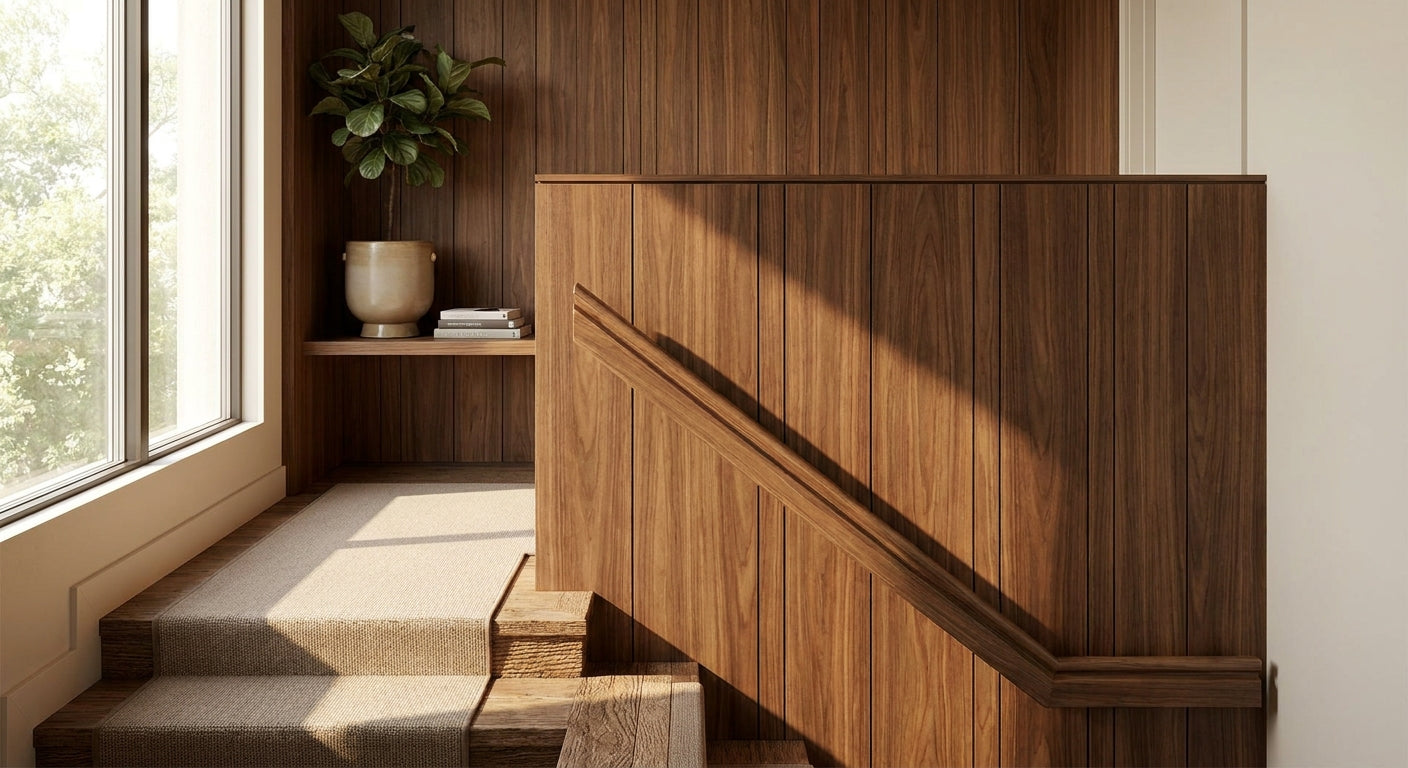
Turning a bare staircase half-wall into a feature with wood veneer panels solves two problems at once: the flat plasterboard stops looking like an afterthought, and the acoustic felt backing tames the echo that bounces off hard stairwell surfaces. This guide covers what to look for, which finishes work best on a half-wall, and what to skip.
TL;DR
For a staircase half-wall in 2026, wood veneer panels for staircase half wall projects work best in 240 cm lengths cut to the wall's rake, with a real 3-sided veneer rather than printed foil. The Natural Oak wooden wall panel is the Buy for most homes wanting a warm, light finish that suits both traditional and modern staircases. If you want something darker and more dramatic, the Walnut wooden wall panel is the standout pick. Avoid MDF-faced foil panels on a half-wall that gets knocked by bags and shoes going up and down daily — they chip.
Why this matters
A staircase half-wall takes more physical contact than almost any other wall in the house. Shoulders brush it, bags knock it, kids drag hands along the top edge on the way up. Paint scuffs within a year. Wallpaper peels at the corner where the stairs turn.
Real wood veneer panels solve the durability problem because the veneer sits on a moisture-resistant MDF core, not a thin printed layer that shows white through the first scratch. The felt backing behind the veneer also cuts the flat, hard echo you get in stairwells with tiled or laminate flooring, which is exactly the kind of reverberation Akustiq UK's acoustic panel range is built to address. On a half-wall specifically, you're usually panelling a shorter run than a full wall, so panel choice, cutting to the stair rake, and edge finishing matter more than they do on a flat living room wall.
Who this is for
This is for homeowners with an open staircase, split-level landing, or galleried half-wall who want the wood-panelled look without full wall-height cladding, and who are fitting the panels themselves or with a local joiner rather than a full contracting crew. It also suits anyone dealing with a hollow-sounding stairwell where every footstep and door slam echoes down the hall.
What to look for in wood veneer panels for a staircase half wall
Real 3-sided veneer, not printed foil
A genuine wood veneer shows real grain variation from panel to panel, which matters on a half-wall because the rake of the stairs means you'll see multiple panels edge-to-edge in one sightline. Printed foil repeats the same grain pattern every 30 cm, and on a sloped run that repetition is obvious the moment you're standing at the bottom of the stairs looking up.
Acoustic felt backing
Stairwells with hard flooring and a high ceiling void behave like an echo chamber. Felt-backed panels absorb mid-range frequencies instead of bouncing them, which noticeably softens footsteps and voices carrying between floors. This matters more on a half-wall stairwell than in a closed room, because sound travels both up and down the open stair void.
Panel length versus the half-wall's actual height
Most half-walls sit between 90 cm and 110 cm tall, well under both the 240 cm and 300 cm standard panel lengths. That means every panel gets cut, and the offcuts matter for cost and waste. Measure the exact rise-to-rise height before ordering, not the nominal "half-wall" figure, because staircases vary by 15-20 cm between builds.
Colour match to the handrail and stair treads
A half-wall panel that clashes with an existing oak handrail looks worse than no panel at all. Smoked Oak and Black Oak read cooler and darker; Natural Oak and Rustic Oak sit closer to typical UK staircase joinery tones. Bring a handrail offcut or photo when picking a finish.
Clean edge finishing at the stair rake
Because a half-wall follows the diagonal line of the stairs, every panel run ends at an angle rather than a square corner. End pieces and trims made for the same finish keep that angled edge looking deliberate instead of raw-cut MDF showing through.
Fixing strength for a load-bearing pinch point
People lean on staircase half-walls. A panel that's only lightly tacked or stuck with generic adhesive will work loose within months. A proper high-tack panel adhesive rated for interior wood veneer holds up to that daily pressure.
Top picks for a staircase half-wall
Natural Oak Wooden Wall Panel — the safe pick
This is the finish that suits the widest range of staircases, from Victorian terraces to new-build stairwells. It comes with the same 3-sided real wood veneer and acoustic felt backing across the range, in both the 240 cm and 300 cm formats. On a half-wall you'll almost always be cutting the 240 cm length down, which keeps waste lower than starting from 300 cm. Verdict: Buy for anyone unsure which tone to pick — see the Natural Oak wooden wall panel.
Walnut Wooden Wall Panel — the statement pick
Walnut reads far richer and more contemporary than oak, and on a half-wall it draws the eye without needing the full wall panelled. It works especially well where the staircase sits in an open-plan hallway next to a kitchen or living space finished in warm tones. Verdict: Buy if the staircase is the visual centrepiece of the ground floor — check the Walnut wooden wall panel.
Black Oak Wooden Wall Panel — the wildcard
Black Oak is the boldest option on this list and it either transforms a stairwell into a moody, architectural feature or overwhelms a small hallway that already gets limited natural light. Test with a sample against your actual staircase before committing a full half-wall run to it. Verdict: Consider — great in a bright, tall stairwell, riskier in a dim, narrow one.
High-Tack Panel Glue — the fixing that matters
A half-wall gets knocked and leaned on daily, and generic contact adhesive isn't rated for that kind of ongoing pressure. A dedicated high-tack panel glue formulated for wood veneer keeps panels flat against the substrate for the life of the installation. Verdict: Buy alongside whichever finish you choose — see the high-tack panel glue.
For step-by-step fitting on an angled stair wall, the guide on how to use wall panels on a staircase walks through cutting panels to the rake and handling the angled top edge.
What to avoid
- Printed foil MDF panels sold as "wood effect" — they scratch through to white core within a year on a high-contact half-wall.
- Full-height wallpaper or textured wallcoverings on the half-wall — they tear at the corner where the stairs turn, which is the single most-touched point on the whole run.
- Generic wood glue or double-sided tape for fixing — neither holds up to the lean-and-knock pressure a stair half-wall takes every single day.
Verdict comparison
| Panel | Veneer tone | Best for | Standard sizes | Verdict |
|---|---|---|---|---|
| Natural Oak | Warm, light | Most staircases, traditional or new-build | 240 cm / 300 cm | Buy |
| Walnut | Rich, dark-warm | Open-plan hallways, statement stairs | 240 cm / 300 cm | Buy |
| Black Oak | Cool, dark | Bright, tall stairwells | 240 cm / 300 cm | Consider |
| High-Tack Panel Glue | n/a | Any staircase fitting | 290 ml | Buy |
FAQ
What's the best wood veneer panel for a staircase half wall? Natural Oak is the most reliable choice for 2026 installations because its lighter tone suits both period and modern staircases and hides cut lines from resizing panels to the half-wall's height better than darker finishes.
Is real wood veneer better than printed foil for staircases? Yes — real veneer shows genuine grain variation across panels, which matters on a staircase where multiple panels sit in one continuous sightline; printed foil repeats the same pattern every 30 cm and looks artificial under stair lighting.
Do acoustic wood panels actually reduce stairwell echo? The felt backing behind the veneer absorbs mid-range sound rather than reflecting it, which noticeably softens the flat, hard echo common in open stairwells with laminate or tiled flooring.
Can I fit wood veneer panels myself on a half-wall? Most homeowners can fit them with basic tools and a mitre saw for the angled cuts along the stair rake, provided panels are measured against the actual half-wall height rather than a standard length.
What size wood panel works on a typical UK staircase half-wall? Most half-walls run 90-110 cm tall, so the 240 cm panel length gets cut down for most installs — ordering 300 cm only makes sense on taller galleried landings.
Do I need special glue for staircase panels? Yes — a high-tack panel adhesive rated for interior wood veneer holds up to the daily leaning and knocking a stair half-wall takes, unlike generic wood glue or tape.
How much does it cost to panel a staircase half-wall in 2026? Cost depends on the run length and finish chosen, and pricing varies by colour and format, so check current panel pricing directly before ordering to match it against your measured half-wall run.
Does Black Oak work on a narrow, dim stairwell? It can look heavy in low light, so test a sample panel against the actual wall before committing a full run — Natural Oak or Rustic Oak tend to read better in stairwells with limited natural light.
One last thing
Measure the half-wall at its tallest point, not its average — most staircases taper slightly toward the bottom step, and ordering to the shortest measurement leaves an ugly gap at the top where the wall is fullest height.
Share:
Reduce Noise in Open Plan Office Zones (2026 Guide)
Acoustic Panels for Phone Booth Pods: 2026 Buying Guide