

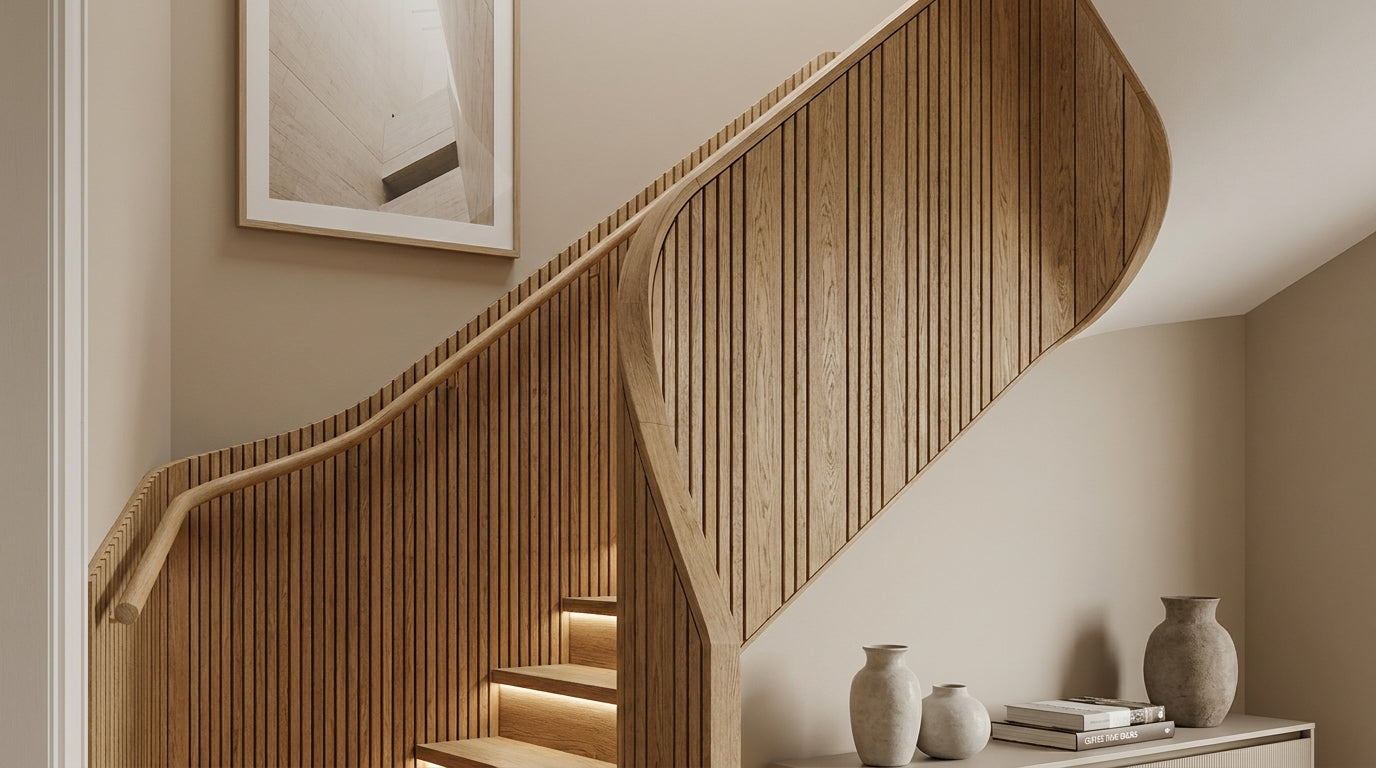
Staircase walls are one of the hardest spaces to panel well — awkward angles, variable heights, and high foot-traffic visibility mean every choice is amplified. This guide covers what to look for in wooden wall panels for a staircase, which finishes work best for different home styles in 2026, and what traps catch most buyers.
TL;DR: For staircase walls in 2026, acoustic wooden wall panels with a slatted profile outperform plain MDF cladding on both looks and sound absorption. Natural oak suits bright, open stairwells; smoked oak and black oak work for darker, contemporary schemes; walnut adds warmth to traditional interiors. Aku Wood Panel manufactures slatted acoustic panels with real wood veneer fronts — the natural oak variant is the most versatile starting point for most UK homes.
Why staircase walls need a different approach
A staircase wall is not a flat feature wall. The surface is long, diagonal, and viewed at close range every day. Sound also behaves differently here — hard plaster stairwells amplify footfall noise by up to 10 dB compared with carpeted landings. Panels that add acoustic absorption fix that problem at the same time as upgrading the look. In 2026, slatted acoustic wood panels have become the default choice for UK self-builders and renovators precisely because they solve both issues with one product.
Who this guide is for
You are refurbishing or finishing a residential staircase — either a new build that has bare plaster on the stair wall, or an older home where dated wallpaper or painted plasterboard needs replacing. You want a finish that looks intentional, lasts without constant maintenance, and does not require specialist trades to fit. You may be doing it yourself or directing a joiner. Either way, the panel specification decisions are yours.
What to look for in wooden wall panels for a staircase
Veneer quality and face thickness
A staircase wall takes more visual scrutiny than almost any surface in the house — people walk past it at arm's length, at eye level, twice a day minimum. Panels with a real wood veneer front show grain variation and depth that printed foil finishes do not. Aku Wood Panel uses a 3-sided real wood veneer on its slatted panels, which means the slat edges are finished as well as the face. That detail matters when light catches the panel at a shallow angle.
Slat profile and acoustic backing
Slatted profiles — narrow timber strips spaced a few millimetres apart over an acoustic felt backing — do two things. First, they break up flat wall reflections, reducing echo in the stairwell. Second, the felt layer behind the slats absorbs mid-frequency sound, including footfall impact noise transmitted through the structure. For a staircase, choose a panel with a felt backing rather than a plain MDF backer; the acoustic benefit is measurable and the installation weight difference is minimal.
Panel dimensions relative to stair height
Most UK residential staircases have a total wall height of 2,400 mm to 2,700 mm at the top of the flight, with the diagonal run adding further linear metres. Standard panel sizes of 600 mm x 2,400 mm work well for the upper section. The diagonal cut at the bottom of the run is unavoidable — check that the panel manufacturer supplies end pieces and finishing trims, otherwise raw MDF edges will be exposed at the skirting line. Aku Wood Panel stocks matching end piece wooden wall panel walnut and equivalent end pieces for every finish in the range.
Finish durability in a high-traffic corridor
Staircase walls get brushed by bags, touched by hands, and occasionally knocked by furniture being moved. A lacquered or UV-cured veneer surface resists scuffs better than an oiled finish. Darker finishes — smoked oak, black oak, mocca — hide minor contact marks better than pale natural oak. If the staircase is in a family home with children, factor this into your finish decision before committing to a full order.
Ease of DIY installation on an angled wall
The main difficulty with staircase panels is the diagonal cut at the bottom of the stringer. Panels that fix with construction adhesive are easier to manage on a sloped surface than clip systems, because clips require a perfectly plumb batten grid and the plaster beneath a stair wall is rarely true. A high-tack panel adhesive applied in vertical beads allows slight positional adjustment before the adhesive sets. Aku Wood Panel supplies a high-tack panel glue 290 ml white formulated for this type of application.
Colour matching across a long run
A staircase wall is typically the longest unbroken run of panelling in a house — often 4 to 6 metres of linear coverage when you account for the diagonal. Batch variation in wood veneer is normal; ordering all panels from the same batch and requesting samples before committing to a full order eliminates the risk of a mid-run colour shift. Sample panels — including the sample wooden wall panel natural oak — let you confirm the finish under your staircase's actual lighting conditions before purchase.
Top picks for staircase walls in 2026
Natural oak — the safe pick
Best for: Light, neutral, or Scandinavian-influenced interiors Natural oak's warm blonde grain reads as neutral against white walls and works with both grey and timber flooring. The wooden wall panel natural oak is the most frequently specified finish for residential staircases because it does not date quickly and photographs well for estate agents if you sell. The grey felt-backed version adds acoustic performance without changing the visual character. Verdict: Buy — the all-conditions default.
Smoked oak — the contemporary pick
Best for: Dark-palette, industrial, or mixed-material schemes Smoked oak sits between natural oak and black oak tonally. It reads as sophisticated rather than stark, and the grey-brown undertone pairs with brushed steel balustrades and dark grout tile floors that are common in post-2020 UK new builds. The smoked oak panel hides hand marks better than pale finishes. Verdict: Buy — strongest option for darker schemes.
Walnut — the warm-toned pick
Best for: Traditional or period properties with warm wood floors Deep brown walnut grain suits Victorian and Edwardian hallways where oak can look too cool. It also works well against heritage paint colours — navy, dark green, deep red. The contrast between the slat face and the shadow gap gives a richly layered effect at close range. Verdict: Buy — strong in traditional settings, less versatile in minimalist ones.
Black oak — the statement pick
Best for: Monochrome or ultra-contemporary interiors Black oak creates a high-contrast feature wall that makes the staircase the dominant architectural element of the hall. It is less forgiving if your plastering or cutting is imprecise — dark surfaces show reveals and gaps more clearly. Confirm your cutting tolerances before ordering. Verdict: Consider — bold result, higher execution standard required.
Forest oak — the textured wildcard
Best for: Biophilic or nature-led interiors Forest oak has more grain movement and tonal variation than standard natural oak, giving the panel run a livelier, less uniform appearance. In a tall stairwell with strong natural light, the variation catches the light differently at different times of day. Slightly less predictable than standard oak — order a sample first. Verdict: Consider — rewarding when it works, harder to predict without a sample.
What to avoid
- Plain MDF-faced panels without acoustic backing. They look similar in product photos but contribute nothing to sound absorption and dent more easily in a corridor. The acoustic felt layer is load-bearing for the panel's performance case.
- Panels sized only for full-height flat walls. If the supplier does not offer matching end pieces and finishing trims, you will have exposed raw edges at every angle cut. That detail undermines an otherwise well-installed run.
- Ordering without a sample in your staircase lighting. Stairwells are typically darker than living rooms and lit by a single overhead fitting. A finish that looks warm and rich on a laptop screen can read as flat or grey in the actual space. The sample step costs a few pounds and eliminates a costly return.
Verdict comparison table
| Finish | Traffic durability | Acoustic backing available | Best scheme | Verdict |
|---|---|---|---|---|
| Natural oak | Good | Yes (grey felt variant) | Neutral / Scandi | Buy |
| Smoked oak | Very good | Yes | Dark / contemporary | Buy |
| Walnut | Good | Yes | Traditional / warm | Buy |
| Black oak | Good | Yes | Monochrome | Consider |
| Forest oak | Good | Yes | Biophilic / textured | Consider |
FAQ
What are the best wooden wall panels for a staircase? Slatted acoustic wooden wall panels with a real wood veneer front and felt backing are the best choice for staircase walls in 2026. Natural oak and smoked oak are the two most popular finishes for UK homes because they suit the widest range of interior schemes and are durable enough for a high-traffic corridor.
Can you put wood panels on a staircase wall yourself? Yes. Panels fixed with high-tack construction adhesive are the most DIY-friendly method for an angled stair wall. The key steps are marking a true vertical batten line, dry-fitting panels before applying adhesive, and cutting the diagonal at the stringer with a mitre saw. Most installers complete a standard 4-metre stair run in a single day.
How many panels do I need for a staircase wall? Measure the total square meterage of the angled wall including the full diagonal run, then add 10–15% for cutting waste at the top and bottom angles. A typical UK semi-detached staircase wall runs to 6–8 m² including the upper landing section.
Do wood panels make a staircase noisier or quieter? Acoustic-backed slatted wood panels reduce reflected noise in the stairwell. The felt layer absorbs mid-frequency sound and reduces the "hard box" echo that bare plaster walls create. Plain solid panels without acoustic backing have minimal effect on sound.
Is smoked oak or natural oak better for a dark hallway? Smoked oak. Its grey-brown tones read better under warm artificial lighting, and the darker finish is more forgiving of minor contact marks from daily use. Natural oak can look washed-out in a low-light stairwell.
How do I cut wooden wall panels for a diagonal stair line? Use a mitre saw set to the angle of your stringer — typically between 30° and 42° on UK domestic stairs. Mark the cut line on the face of the panel using a spirit level and a straight edge. Score the veneer before the final cut to prevent tear-out on the visible face.
Do I need special adhesive for staircase panels? Use a high-tack panel adhesive rated for wood-to-plaster bonding. Standard grab adhesive in a 290 ml cartridge applied in vertical beads at 200 mm centres gives enough working time to adjust panel position before it sets. Mechanical fixings are not normally required for residential interior applications.
What colour panels suit a Victorian staircase? Walnut and smoked oak suit Victorian proportions and typically complement the period joinery (dark newel posts, painted spindles) better than pale natural oak. Forest oak is a strong alternative if the rest of the hallway uses earthy or heritage tones.
One last thing
The acoustic benefit of slatted wood panels on a staircase is often the last thing buyers think about and the first thing they notice after installation. A hard plaster stairwell in a typical UK semi can amplify a single footstep to 65 dB or above at landing level. Acoustic-backed panels reduce that reflection by a measurable amount — enough that the whole ground floor feels quieter when someone walks upstairs. Choosing panels with a grey felt backer rather than plain MDF is the single highest-value upgrade you can make without changing anything structural.
Share:
3 Sided Veneer Wall Panels for Feature Walls 2026
Walnut Acoustic Wall Panels for Home Offices 2026