

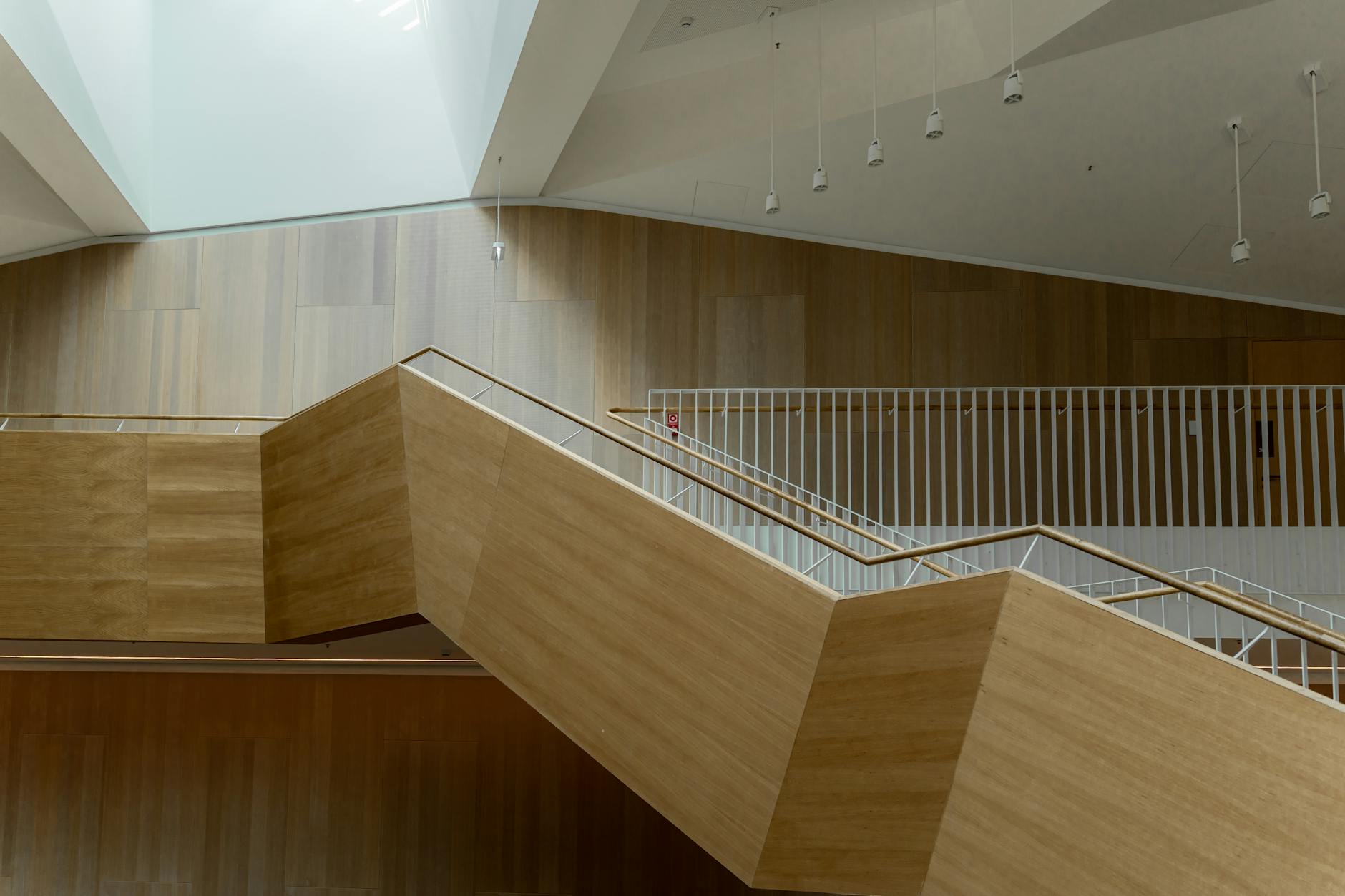
Natural oak hexagon panels bring warmth, texture, and acoustic performance to one of the most acoustically live spaces in any home — the staircase wall. If you're deciding whether this format and finish is right for your project, this guide covers exactly who benefits most, what to prioritise when specifying, and which Aku Wood Panel products deserve your attention in 2026.
TL;DR: Natural oak hexagon panels on a staircase wall work best for homeowners and interior designers who want a statement finish that doubles as acoustic treatment. The hexagon acoustic panel natural oak from Aku Wood Panel is the strongest starting point in 2026 — it pairs visible timber grain with a felt backing that reduces flutter echo in double-height stairwells. Prioritise panel depth, fixing method, and grain consistency when specifying for staircases.
Why Staircase Walls Are a Specific Challenge
Staircases create hard, angled surfaces that bounce sound at irregular angles. Add a double-height void and you get flutter echo that travels between floors. Most acoustic treatments ignore this zone entirely. Natural oak hexagon panels solve two problems at once: they add a focal-point finish to what is typically dead, painted plasterboard, and the felt backing on acoustic variants absorbs mid-frequency sound (500 Hz–4 kHz) where speech echo is most noticeable. In 2026, this dual function is driving specifiers toward hexagon formats specifically, because the geometric shape breaks up flat reflective surfaces better than rectangular slat panels of the same coverage area.
Who This Guide Is For
This page is written for three buyers:
- Self-build and renovation homeowners fitting out a new-build or refurbished home and want the staircase wall to be the strongest design moment in the house.
- Interior designers specifying feature walls for residential clients who ask for something beyond standard slat panels.
- Main contractors and fit-out teams working on premium residential schemes where acoustic performance in circulation spaces is part of the brief.
If you're tiling a staircase riser or painting a feature wall, this is not the right guide. Natural oak hexagon panels require a dry, flat substrate, a modest tolerance for visible panel joins, and a budget above entry-level decorative products.
What to Look For in Natural Oak Hexagon Panels for Staircase Walls
Oak Grade and Grain Consistency
Staircases are viewed at close range and from multiple angles as you move through the space. Inconsistent grain, blotchy staining, or veneer mismatches read immediately. Look for panels cut from the same batch of natural oak veneer, finished with a UV-cured lacquer that preserves the open-grain appearance rather than plasticising it. Aku Wood Panel's natural oak finish uses real oak veneer over an MDF or acoustic substrate — the grain is consistent across a batch order, which matters when you're covering 8–20 m² of a continuous staircase wall.
Acoustic Backing — Felt Depth and NRC Rating
A decorative panel without acoustic backing is just cladding. For a staircase wall, you want a felt or foam backing with a Noise Reduction Coefficient (NRC) of at least 0.55. The grey felt backing option available on some Aku Wood Panel products achieves meaningful absorption without altering the visible face. If your staircase is open-plan (connecting to a kitchen or living room), acoustic backing is not optional — hard stairwells amplify conversation noise by 6–9 dB compared to treated surfaces.
Panel Geometry — Hexagon Size Relative to Wall Height
Hexagon scale matters on a staircase. A 300 mm flat-to-flat hexagon reads as intricate and jewel-like on a narrow stairwell; a 600 mm panel reads bolder on a double-height void. Mismatching panel scale to wall proportion produces a cluttered result. Most UK residential staircases have a raking wall height of 2.4–3.2 m on the diagonal — a 300–400 mm hexagon tiles this space with 6–9 panels per vertical run, which gives clean rhythm without excessive cut panels at the rake.
Fixing Method — Adhesive vs. Clip System
Staircase walls are plastered, drylined, or sometimes tiled. Clip systems offer the cleanest removal and reuse, but most hexagon acoustic panels in 2026 are fixed with construction adhesive and colour-matched pins. The critical factor on a staircase is vibration: footfall transmits through the structure, and panels fixed only with adhesive can develop resonant rattle on lightly built timber-frame stairs within 2–3 years. A hybrid fix — adhesive plus two countersunk pins per panel — eliminates rattle without visible hardware.
Coverage and Waste on a Raking Surface
Staircase walls are rarely rectangular. The raking soffit line means edge panels must be cut to angle, and hexagon geometry creates more off-cuts than rectangular formats. Budget for 12–15% material waste above your net area calculation. Order from the same production batch to ensure grain and finish consistency on any replacement panels.
Finish Durability — Traffic Zone Exposure
Staircase walls are higher-traffic than any other wall in the home. Bags, pushchairs, and hands brush against the surface daily. A natural oak panel needs a hardened lacquer coat that scores at least 2H on the pencil hardness scale, or it will show scuffs within months. Ask the manufacturer for the finish specification before ordering.
Top Picks for Natural Oak Hexagon Panels on Staircase Walls
The Direct Fit — Hexagon Acoustic Panel Natural Oak
The safe pick. This is Aku Wood Panel's purpose-built hexagon acoustic product in natural oak, and it is the right starting point for the majority of staircase wall projects in 2026. The panel combines real oak veneer on the face with an acoustic felt backing that addresses the flutter echo problem specific to stairwells. It is manufactured for interior dry applications, which covers every residential staircase in the UK. Order this when the brief is clear: natural oak, hexagon format, acoustic performance required.
Verdict: Buy — hexagon acoustic panel natural oak
The Tone-Down Option — Wooden Wall Panel Natural Oak Grey Felt
The quiet alternative. If the staircase connects to a contemporary interior where warmth is wanted but the hexagon geometry feels too bold, the wooden wall panel natural oak grey felt provides the same natural oak finish with grey felt acoustic backing in a rectangular slat format. It achieves comparable NRC performance. The grey felt is visible between slats, which adds a secondary texture. Use this when the client wants natural oak acoustic treatment but has reservations about committing to a geometric statement on the staircase.
Verdict: Consider
The Contrast Move — Wooden Wall Panel Smoked Oak
The wildcard. If the staircase is the darkest zone of the house — north-facing or windowless — a natural oak finish can look washed-out under artificial light. Smoked oak deepens the grain and reads richer under warm LED. The wooden wall panel smoked oak is worth specifying when the lighting plan calls for 2700–3000 K sources and the adjacent flooring is dark. It is not a hexagon format, so you lose the geometry, but you gain a finish that photographs and presents better in low-light conditions.
Verdict: Consider if lighting conditions are poor; Skip if natural grain clarity is a priority.
The Budget Test — Wooden Wall Panel Natural Oak
The baseline. The wooden wall panel natural oak gives you the finish without the acoustic backing. For a purely decorative staircase wall where echo is not an issue — perhaps a single-storey staircase in a bungalow conversion — this panel covers the visual brief at a lower unit cost. Do not specify this on a double-height staircase where acoustic treatment is part of the design intent.
Verdict: Buy for decorative-only applications; Skip if acoustic performance is required.
What to Avoid
- Panels without a declared NRC or absorption coefficient. Any supplier listing "acoustic panel" without publishing test data is selling decorative cladding with a marketing label. On a staircase wall where performance matters, insist on a test certificate or published NRC figure.
- Full adhesive-only fixing on timber-frame staircases. Structural timber moves seasonally. Adhesive-only panels will crack at joins or pull away from the substrate within 2–5 years on a timber-frame stair. Always add mechanical fixing points.
- Mixing batch runs on a continuous wall. Ordering panels from two different production runs — even the same SKU — introduces visible colour variation across a staircase wall that cannot be corrected after installation. Order the full quantity in a single purchase.
Verdict Comparison Table
| Panel | Format | Acoustic Backing | Best Use Case | 2026 Verdict |
|---|---|---|---|---|
| Hexagon Acoustic Panel Natural Oak | Hexagon | Yes (felt) | Statement staircase, acoustic priority | Buy |
| Wooden Wall Panel Natural Oak Grey Felt | Slat | Yes (grey felt) | Contemporary interior, subtle texture | Consider |
| Wooden Wall Panel Smoked Oak | Slat | Yes | Low-light or dark-toned staircases | Consider |
| Wooden Wall Panel Natural Oak | Slat | No | Decorative-only, single-storey | Buy (decorative) |
FAQ
What are natural oak hexagon panels for staircase walls? Natural oak hexagon panels are geometric acoustic cladding panels cut in a hexagonal shape and faced with real oak veneer. On a staircase wall, they reduce echo from the hard surfaces of a stairwell while acting as a decorative feature panel.
How many panels do I need to cover a staircase wall? Measure the net area of the raking staircase wall in m², then add 12–15% for cut waste at the edges and soffit rake. A 300 mm flat-to-flat hexagon covers approximately 0.078 m² per panel including the grout joint; divide your adjusted area by 0.078 to get the panel count.
Are hexagon acoustic panels suitable for a timber-frame staircase? Yes, provided you use a hybrid fixing — construction adhesive plus two countersunk pins per panel. Adhesive-only fixing can develop rattle on timber-frame structures where seasonal movement is greater than on masonry.
What NRC should acoustic panels have for a staircase? Target an NRC of 0.55 or above for a residential staircase with a double-height void. Below 0.50, the acoustic benefit is marginal relative to the cost of treatment.
Can natural oak panels be used on a staircase wall near a window? Yes. Natural oak is stable in dry interior conditions. Avoid direct prolonged UV exposure, which will bleach the veneer over time. A UV-cured lacquer slows this process but does not eliminate it entirely on south-facing staircases with large glazing.
How do I clean natural oak hexagon panels on a staircase? Dry dusting or a barely damp microfibre cloth is sufficient for routine maintenance. Avoid solvent-based cleaners, which will strip the lacquer finish. For scuffs, the manufacturer should supply a touch-up pen matched to the specific oak batch.
Is it better to panel the full staircase wall or just a section? Full coverage gives the best acoustic result and the cleanest visual finish. Partial coverage — for example, a single rectangular section mid-wall — reads as an afterthought on a staircase and delivers less than 40% of the acoustic benefit of full-wall treatment.
How long does it take to install hexagon panels on a staircase wall? For a professional installer, 8–14 m² of hexagon panels on a raking staircase wall typically takes a full day. The raking cuts and geometric joins add roughly 30–40% to installation time compared to a flat rectangular wall of the same area.
One Last Thing
The staircase wall is the only surface in a home that is viewed at every angle — from below, from above, and in motion. In 2026, the specifiers getting the best results are using hexagon panels not as a wallcovering but as a tiling system: they run the geometry from floor level up the rake and terminate it with a clean horizontal line at the landing floor level, rather than following the raking soffit. The result reads as a deliberate architectural element rather than a decorative patch.
Share:
Hexagon Oak Acoustic Panels for Offices 2026
Outdoor Wall Panels for Garden Fencing 2026