

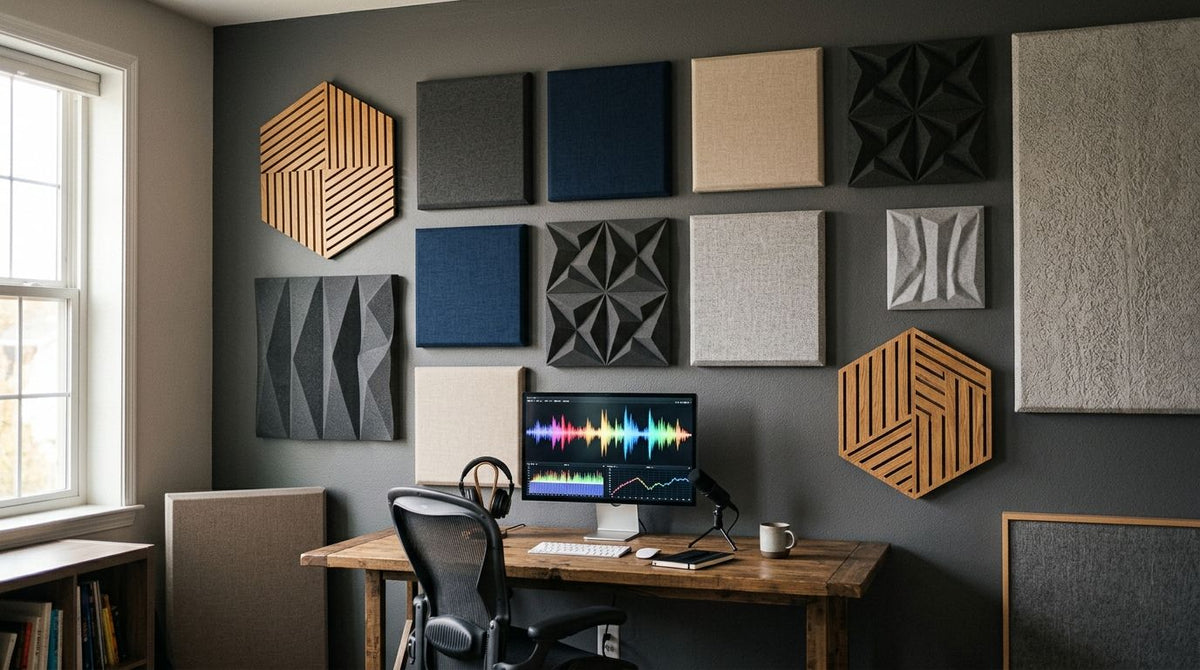
Ranking acoustic wall panels by price only works if you separate cost tier from acoustic performance first. Every finish in AKU Woodpanel's acoustic range sits on the same felt backing, so what actually changes between the cheapest and most expensive option is veneer grain, panel format and finish complexity — not how much echo it kills. This guide ranks six acoustic wall panel options from lowest to highest cost tier for 2026, with a clear verdict on which one fits your room and your budget.
- Natural Oak wall panels rank as the best acoustic wall panels by price for most first-time rooms in 2026.
- Sample panels are the cheapest way to check grain and colour before ordering a full wall.
- Rustic Oak Premium sits at the top of the range for feature walls where grain character matters more than cost.
- Every finish uses the same acoustic felt backing — price differences come from veneer and format, not sound absorption.
Why this matters
Most "best acoustic wall panels" roundups mix commercial foam, felt tiles and real wood veneer into one list, which makes price comparisons meaningless — a foam tile and a 3-sided oak veneer panel are not solving the same problem. AKU Woodpanel's acoustic range keeps the comparison honest because every panel, from the entry Natural Oak finish to the premium rustic grain, shares the same acoustic felt backing behind a real wood face.
That means the ranking below is really a ranking of finish and format complexity, not a ranking of how quiet your room gets. Knowing that before you shop stops you overpaying for a darker veneer when what you actually need is more wall coverage.
What makes the best acoustic wall panel
Before the table, here's what separates a genuinely good pick from a wall panel that just looks nice in a product photo:
- Real wood veneer, not print. A 3-sided real wood veneer face ages and finishes differently than a printed laminate — check this before comparing anything else.
- Felt backing quality. The felt behind the veneer is what actually breaks up sound reflection; a thin or sparse backing does less work regardless of how good the wood looks.
- Format flexibility. Panels in both 240 cm and 300 cm formats let you match ceiling height without wasteful cutting.
- Finish range. More finish options mean you can match an existing room instead of redesigning around the panel.
- Installation difficulty. Slat panels install faster than cut geometric formats like hexagon tiles.
- NRC-relevant construction. Panels built for sound absorption ratings rather than decoration alone perform more consistently room to room.
Acoustic wall panels at a glance
| Item | Best for | Standout feature | Key limitation |
|---|---|---|---|
| Sample – Natural Oak | Testing before you commit | Real grain and colour check | No usable wall coverage |
| Natural Oak | First feature wall | Warm, neutral veneer | Shows dust faster than dark finishes |
| Natural Oak with Grey Felt | Open-plan feature walls | Contrast felt hides dust marks | Less flexible with all-light interiors |
| Smoked Oak | Home cinemas, dark rooms | Absorbs light, hides scuffs | Can darken a small room further |
| Hexagon – Natural Oak | Geometric statement walls | Tessellating tile format | More joins, slower install |
| Rustic Oak Premium | High-spec feature walls | Heaviest grain character, 3-sided veneer | Highest cost tier in the range |
1. Sample Wooden Wall Panel – Natural Oak: best acoustic wall panel for testing before you commit
This is a cut piece of the full-size Natural Oak panel, sent out so you can hold real wood grain against your actual wall before ordering enough panels to cover a room. It's the lowest-cost way into AKU Woodpanel's acoustic range and it exists specifically to stop a costly mismatch.
Sample panel pros:
- Confirms grain and tone match your room's actual light, not a screen
- Lowest possible spend to de-risk a full order
- Ships as a single small piece, so it's quick to receive
Sample panel cons:
- Tells you nothing about acoustic performance — it's too small to test
- Can't be installed as usable wall coverage on its own
Best for: anyone who's ordered panelling online before without seeing the real veneer first and got burned.
Verdict: Buy — order this before anything else on this list.
2. Wooden Wall Panel – Natural Oak: best acoustic wall panel for a first feature wall
The core panel in the range: real oak wood veneer over acoustic felt backing, in the standard slat format. It's the panel most homeowners land on for a first echo-reducing feature wall because it reads as warm timber, not as a commercial acoustic product.
Natural Oak pros:
- Real 3-sided wood veneer, not a printed laminate
- Felt backing cuts flutter echo in bare-walled living rooms and bedrooms
- Neutral tone works across living rooms, offices and bedrooms without clashing
Natural Oak cons:
- Light tone shows dust and fingerprints faster than smoked or black finishes
- Grain variation between panels can look patchy if you order in small batches over time
Best for: a first acoustic feature wall in a living room, bedroom or home office.
Verdict: Buy.
3. Wooden Wall Panel – Natural Oak with Grey Felt: best acoustic wall panel for open-plan rooms
Same natural oak veneer, but the exposed felt between slats runs grey instead of the standard tone, giving a more contrasted slat look while keeping the same acoustic backing structure underneath. It suits rooms where the panel has to work as a design feature and not just a fix.
Natural Oak with Grey Felt pros:
- Contrast felt hides dust marks between slats better than lighter felt
- Suits open-plan living-diner zones where the wall is the visual anchor
- Same acoustic backing as the standard Natural Oak panel
Natural Oak with Grey Felt cons:
- Less flexible if you're matching an existing all-light, minimal interior
- Reads more "designed" than natural, which not every room wants
Best for: open-plan spaces where the acoustic wall doubles as the room's focal point, linked here: Natural Oak with Grey Felt.
Verdict: Buy.
4. Wooden Wall Panel – Smoked Oak: best acoustic wall panel for home cinemas and dark feature walls
A darker, smoked-tone oak veneer built on the same felt-backed acoustic construction as the rest of the range. Darker wood absorbs more visible light in the room, which matters directly behind a TV or projector screen.
Smoked Oak pros:
- Hides scuffs and light scratches far better than Natural Oak
- Reads as moody and premium in low-light rooms
- Reduces screen glare and reflection behind a TV or projector
Smoked Oak cons:
- Shows dust and lint more visibly than lighter finishes under bright daylight
- Can make an already small, dark room feel smaller
Best for: home cinema rooms and feature walls positioned behind a screen.
Verdict: Buy for dim rooms, Skip for small rooms that need brightening, not darkening.
5. Hexagon Acoustic Panel – Natural Oak: best acoustic wall panel for a geometric statement wall
The same real-wood-veneer-over-felt construction, cut into hexagon tiles instead of long slat panels. It creates a tiled, geometric look that a straight slat panel simply can't produce, while still carrying the acoustic felt backing behind each tile.
Hexagon Natural Oak pros:
- Geometric, tiled look full slat panels don't offer
- Tessellates around awkward corners and angled walls more easily
- Still built on acoustic felt backing, same as the slat range
Hexagon Natural Oak cons:
- More cut edges per square metre means more joins to align
- A bigger step up in installation time versus a straight slat panel
Best for: a single geometric statement wall rather than full-room coverage.
Verdict: Buy for a feature wall, Hold if you need to cover a large room quickly.
6. Wooden Wall Panel – Rustic Oak Premium: best acoustic wall panel for a high-spec feature wall
The top-tier finish in the acoustic range, with a heavier rustic grain veneer and the same 3-sided wood coverage that wraps panel edges so they look finished rather than raw MDF. It's the highest cost tier in this lineup because the grain and finishing work is more involved, not because the felt backing performs any differently.
Rustic Oak Premium pros:
- The most pronounced wood grain and character in the range
- 3-sided veneer wraps panel edges, so no raw board is visible
- Same acoustic felt backing as every other finish here
Rustic Oak Premium cons:
- The highest cost tier of the six panels ranked here
- The heavier grain pattern is a stronger design statement, which won't suit a plain, low-key room
Best for: a single premium feature wall where grain character matters more than keeping costs down.
Verdict: Buy for a statement wall, Skip if you want the range's most understated look.
How we ranked
The order above runs from lowest to highest cost tier based on veneer complexity, cut format and finishing work — sample first, then the standard Natural Oak slat, then the contrast-felt and dark-tone variants, then the more labour-intensive hexagon cut, ending with the heaviest-grain premium veneer. Acoustic felt backing is constant across the range, so none of the tiers below are ranked on sound absorption alone.
Which acoustic wall panel should you choose in 2026?
If you're doing this for the first time, order the Sample Wooden Wall Panel – Natural Oak first, then commit to full Natural Oak panels for the room. If the wall is open-plan and needs to read as a design feature, Natural Oak with Grey Felt is the better default. If budget genuinely isn't the constraint and the wall is meant to be the room's showpiece, Rustic Oak Premium is the pick for 2026 — everything else on this list is a step down in grain character, not in acoustic performance.
FAQ
What's the best acoustic wall panel for a first-time buyer in 2026?
Natural Oak is the best starting point for most rooms in 2026 because it pairs a neutral wood tone with the same acoustic felt backing used across AKU Woodpanel's range. Order a sample first to confirm the grain matches your room's light before buying full coverage.
Is natural oak or smoked oak better for acoustic performance?
Neither wins on acoustics — both use the same felt backing, so absorption performance is identical. The choice comes down to how the finish looks in your room: Natural Oak suits bright spaces, Smoked Oak suits dark home cinema rooms.
Do hexagon acoustic panels absorb sound as well as slat panels?
Yes, hexagon acoustic panels use the same felt-backed construction as slat panels, so absorption is comparable. The hexagon format takes longer to install because of the extra cut edges and joins.
How much wall coverage do I need for noticeable echo reduction?
There's no fixed rule, but partial coverage on one large bare wall typically softens flutter echo more than the same panels spread thinly across several walls. Start with the wall causing the most noticeable reflection, usually the largest hard, flat surface in the room.
Should I order a sample before buying full acoustic wall panels?
Yes — a sample is the cheapest way to check real wood grain and tone against your actual wall before committing to a full room order. Screen colours rarely match veneer accurately.
What's the difference between 240 cm and 300 cm panel formats?
The 240 cm format suits standard ceiling heights, while the 300 cm format is built for floor-to-ceiling coverage without horizontal joins. Picking the right format up front avoids wasteful cutting.
Are acoustic wood panels better than foam panels for a living room?
Wood veneer acoustic panels look like furniture-grade paneling rather than studio foam, which matters in a living room where appearance is part of the decision. Foam panels can offer denser absorption per square metre but rarely suit a residential room aesthetically.
Can acoustic wall panels be used in an office as well as a home?
Yes, the same felt-backed wood panels used in living rooms work in home offices and meeting rooms to reduce flutter echo during calls. Natural Oak and Grey Felt finishes both suit a professional setting without looking residential.
One last thing
The detail most buyers miss when comparing acoustic wall panels by price: the felt backing is the constant across AKU Woodpanel's entire acoustic range in 2026. Natural Oak and Rustic Oak Premium reduce echo by roughly the same amount — you're not paying more for quieter walls at the top of this list, you're paying more for grain character and finishing work. Choose the finish for the room, not for the spec sheet.
Share:
Best Acoustic Wall Boards for Soundproofing in 2026
Best Acoustic Wall Panels Ranked by NRC Rating (2026)