

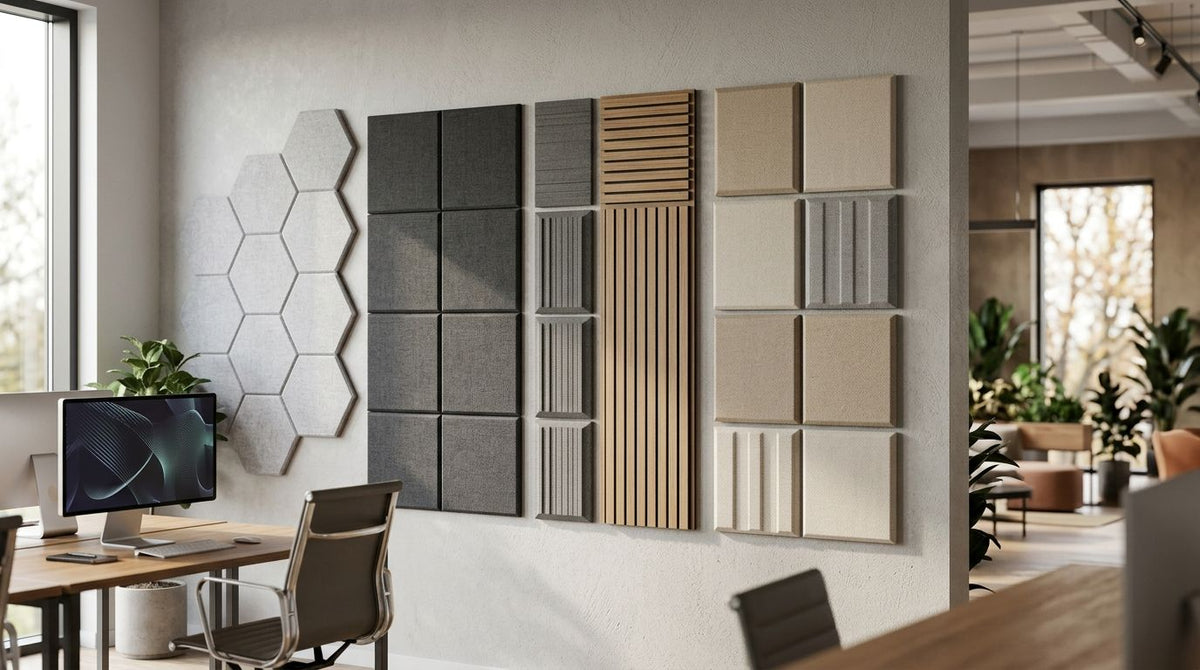
Most "acoustic wall panel" listings never print a lab-tested NRC number, so shoppers end up guessing which finish actually cuts echo and which one just looks like it should. This guide ranks AKU Woodpanel's acoustic wall panel range by how each construction type performs against the Noise Reduction Coefficient scale, and names which finish suits which room.
- The Wooden Wall Panel in rustic oak is the best overall pick for living rooms and home offices among AKU Woodpanel's 2026 acoustic wall panel range.
- Felt-backed panels absorb far more mid-frequency sound than felt-free decorative 3D panels — check for the felt layer before buying for echo control.
- NRC runs 0 to 1.0, and ISO 11654 classifies absorbers from Class A (0.90-1.00) down to Class E (0.15-0.25).
- The Hexagon Acoustic Panel wins for feature walls where sound diffusion matters as much as raw absorption.
- Decorative 3D panels like Clover Brown add texture, not acoustic performance, without a felt backing.
Why this matters
NRC (Noise Reduction Coefficient) is a real, published metric from ASTM C423 testing, averaged across four frequency bands and rounded to the nearest 0.05. ISO 11654 turns that number into a class: Class A sits at 0.90-1.00, Class E at 0.15-0.25, and anything below that is unclassified. Most decorative wood panels never get lab tested at all, which is why buyers end up comparing marketing copy instead of numbers.
That gap matters more in 2026 than it did five years ago, because open-plan living rooms and hard-floored home offices have become the default UK layout, and both amplify echo. If you want the mechanics behind the number before you shop, how to read NRC sound absorption ratings breaks down how the test itself works.
What makes the best acoustic wall panel in 2026
- Felt backing presence and density — a felt layer behind the slats is what actually absorbs sound; a veneer-only panel mostly reflects it.
- Slot or hexagon profile depth — deeper gaps between slats trap more mid-frequency sound than shallow grooves.
- Published classification context — even without a per-SKU lab certificate, a panel's construction should map to a known NRC band.
- Finish and format range — more wood finishes and both 240cm and 300cm lengths mean fewer visible seams on a real wall.
- Installation complexity — more cut edges and joints (as with hexagon tiles) means more room for gaps that leak sound instead of absorbing it.
- Use-case fit — a feature wall and a home cinema wall have different jobs; a panel built for one isn't automatically right for the other.
Acoustic wall panels at a glance
| Panel | Best for | Standout feature | Key limitation |
|---|---|---|---|
| Wooden Wall Panel (3-sided oak veneer, felt-backed) | Living rooms and home offices | Real wood veneer wraps 3 sides with acoustic felt behind the slats | No published per-finish NRC certificate |
| Wooden Wall Panel, natural oak with grey felt | Home cinemas and media rooms | Grey felt backing reads as deliberate acoustic treatment | Narrower finish choice than the standard felt range |
| Hexagon Acoustic Panel | Feature walls and diffusion | Angled hexagon profile scatters reflections, not just absorbs them | More joints per wall than a flat slat panel |
| Decorative Wall Panel (Clover Brown, handcrafted 3D) | Budget accent walls | Handcrafted 3D relief on a small 60x60cm tile | No felt backing, so acoustic gain is minor |
1. Wooden Wall Panel: best acoustic wall panel for living rooms and home offices
The rustic oak premium 3-sided wood veneer panel is AKU Woodpanel's flagship construction: a slatted real wood veneer face wrapped on three sides, with an acoustic felt backing sitting behind the grooves. It's built to go on a bare plaster or plasterboard wall and do double duty as both echo control and the room's feature wall.
Wooden Wall Panel pros:
- Real wood veneer on three sides means no visible MDF edge at the panel joints
- Acoustic felt backing actually absorbs sound rather than just diffusing it
- Available in natural oak, smoked oak, black oak, walnut, mocca and grey oak
- Sold in both 240cm and 300cm lengths, covering most UK ceiling heights without a horizontal seam
Wooden Wall Panel cons:
- No per-finish NRC lab certificate is published, so you're buying on felt backing and slot depth rather than a printed number
- Heavier than MDF-only slat panels, so wall fixings need to match the substrate
- Darker finishes like black oak show dust and fingerprints more than lighter oak tones
Best for: anyone treating a living room or home office with a genuine echo problem in 2026. Verdict: Buy.
2. Wooden Wall Panel with grey felt: best acoustic wall panel for home cinemas
This is the same 3-sided veneer slat construction as the standard range, but the felt behind the slats is grey instead of the standard tone — a small change that matters in a room where the wall itself functions as the acoustic treatment rather than a decorative extra.
Grey felt panel pros:
- Grey felt disappears into darker home cinema colour schemes instead of standing out
- Targets the same mid-frequency range that causes dialogue to blur in untreated rooms
- Natural oak face keeps the room from feeling like a padded studio box
Grey felt panel cons:
- Fewer finish options than the standard felt range
- Doesn't replace bass trapping or door seals in a dedicated cinema build
- No printed NRC figure on the listing, same limitation as the standard range
Best for: dedicated media rooms and home cinemas where dialogue clarity is the goal. Verdict: Buy for cinema and media rooms; skip it for a general living room and get the standard oak instead.
3. Hexagon Acoustic Panel: best acoustic wall panel for feature walls
The hexagon acoustic panel breaks the wall into hexagonal modules with an angled profile, scattering reflected sound in more directions than a flat slat panel does. That makes it a diffuser as much as an absorber — useful in a room you want to soften without deadening completely.
Hexagon Acoustic Panel pros:
- Modular hexagon layout works on irregular or curved wall sections a full-length slat panel can't cover cleanly
- Available in walnut, grey walnut, grey walnut with grey felt, and smoked oak
- Diffusion plus partial absorption suits open-plan rooms that still need some liveliness
Hexagon Acoustic Panel cons:
- More cut edges and joints than a single slat panel, so installation takes longer
- Absorbs less per square metre than a fully felt-backed flat panel
- Not the right pick for a room with heavy, persistent reverberation
Best for: feature walls and rooms where the look matters as much as the acoustic fix. Verdict: Buy for feature walls; skip it if echo is the room's main problem.
4. Decorative Wall Panel, Clover Brown: best budget accent wall option
This handcrafted American walnut 3D relief panel is sold as 60x60cm tiles, built for visual texture rather than as a dedicated acoustic product. It sits in the catalogue as an accent option, not a substitute for the felt-backed slat range.
Decorative Wall Panel pros:
- Handcrafted 3D relief gives a tactile, gallery-wall texture flat veneer panels don't
- Smaller 60x60cm tile size makes it easier to fit an odd-shaped wall or alcove
- Works well paired with the felt-backed range rather than replacing it
Decorative Wall Panel cons:
- No acoustic felt backing, so echo reduction versus bare plaster is minor
- More joints across a large wall than the longer slat panels
- Not the product to reach for if noise control is the actual goal
Best for: an accent wall where texture is the priority and acoustic performance is secondary. Verdict: Buy for aesthetics; skip it if reducing echo is the main goal — pick the standard Wooden Wall Panel instead.


How we ranked
Each panel is ranked against the criteria above: felt backing presence and density first, since that's the single biggest driver of real absorption, then slot or hexagon profile depth, finish and format range, installation complexity, and fit against a specific use case. The Wooden Wall Panel range ranks highest because felt backing plus deep slot grooves is the closest match to a genuine mid-frequency absorber. The Decorative Wall Panel ranks lowest on absorption specifically because it skips the felt layer entirely — it's ranked here on merit for what it does well, not penalised for what it was never built to do.
Which acoustic wall panel should you choose in 2026?
For most living rooms and home offices dealing with hard-floor echo, the standard Wooden Wall Panel in an oak or walnut finish is the default pick. Building a home cinema or media room specifically, move up to the grey felt variant. Chasing a feature wall where the visual effect matters as much as the acoustics, the Hexagon Acoustic Panel wins. If the wall in question is purely decorative and echo isn't the problem, the Decorative Wall Panel range does that job at a smaller tile size without pretending to be an acoustic product.
FAQ
What is a good NRC rating for acoustic wall panels?
A good NRC rating for home use falls in the 0.30-0.60 range under ISO 11654 (Class C to D), which noticeably reduces echo without deadening the room. Dedicated studio panels reach 0.70-0.95 for near-total absorption.
What is the best acoustic wall panel for a living room in 2026?
A felt-backed wood slat panel, such as AKU Woodpanel's standard Wooden Wall Panel range, is the best acoustic wall panel for a living room because the felt behind the slats absorbs sound instead of just reflecting it. Purely decorative 3D panels won't do the same job.
Do wood slat acoustic panels actually reduce echo?
Yes, when the slats sit over an acoustic felt backing rather than a solid MDF board. The gap between slats plus the felt layer absorbs mid-frequency sound, which is the range most responsible for speech echo in a room.
Is a hexagon acoustic panel better than a flat wooden panel?
A hexagon acoustic panel is better for diffusion on feature walls, scattering reflected sound in more directions. A flat felt-backed panel absorbs more per square metre, so it's the better choice for a room with heavy reverberation.
How much NRC absorption do felt-backed wood panels typically provide?
Felt-backed slat panels typically land in the low-to-mid NRC range (roughly Class D to Class C under ISO 11654) depending on slot depth and felt density, well below the near-total absorption of dedicated studio foam.
What's the difference between NRC and STC ratings?
NRC measures how much sound a surface absorbs within a room, reducing echo and reverberation. STC (Sound Transmission Class) measures how much sound is blocked from passing through a wall to another room — they solve different problems.
Do decorative 3D wall panels improve room acoustics?
Only marginally. Without a felt backing, a decorative 3D panel like the Clover Brown range mostly adds visual texture rather than sound absorption, so it shouldn't be the only fix for an echo problem.
How do I read an NRC rating on a product spec sheet?
Look for a single decimal number between 0 and 1.0, rounded to the nearest 0.05 under ASTM C423 testing. Higher means more absorption; a rating above 0.70 falls into ISO 11654 Class B or A territory.
One last thing
The felt layer is doing more acoustic work than the wood veneer sitting in front of it — if a listing shows a slat panel with no mention of a felt backing at all, assume it's closer to the decorative end of this ranking than the acoustic end, whatever the product name says.
Share:
Best Acoustic Wall Panels by Price, Ranked for 2026
Wall Panel Finishes Compared: Oak vs Walnut (2026)