

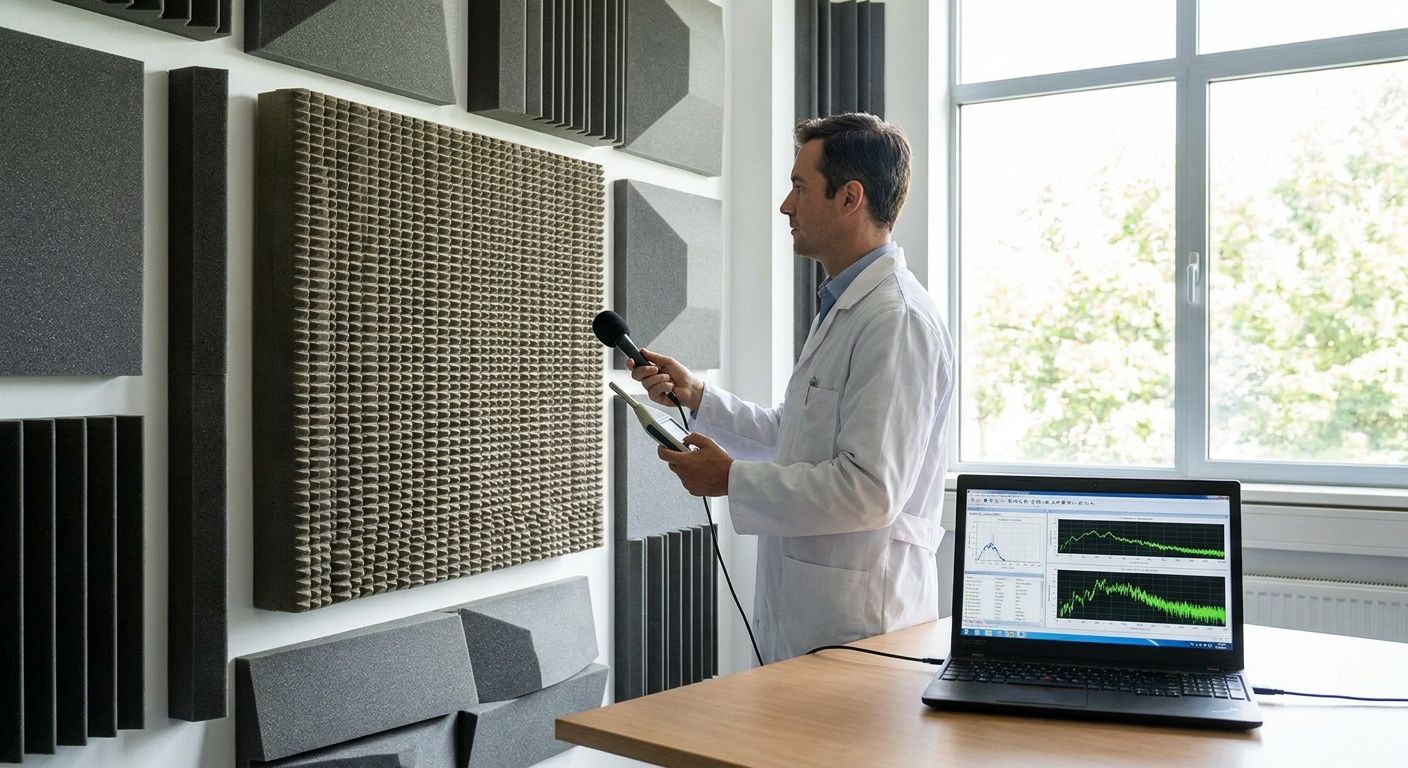
Acoustic panel NRC ratings come from a certified reverberation chamber test (ASTM C423 in the US, ISO 354 in Europe), not a tape measure or a phone app — a lab compares how fast sound decays in a room with and without the panel installed, then averages the result across four frequency bands into a single number between 0 and 1.00.
- NRC sound absorption is measured in an accredited lab per ASTM C423, never on-site with a phone or app.
- The 0-1.00 NRC scale averages only four octave bands (250Hz-2kHz) and ignores bass and treble entirely.
- UK spec sheets often quote αw instead of NRC — the two numbers aren't tested the same way.
- Solid wood veneer with no perforation reflects sound; a felt-backed, slotted panel like Akustiq UK's range absorbs it.
Why this matters
Most buyers see a number like "NRC 0.85" on a spec sheet and assume it means the room will go quiet. It doesn't work that way — NRC only tells you what happens to sound energy that hits the panel's surface directly, and it says nothing about bass rumble, footsteps, or how many panels you actually need to cover a wall.
If you're specifying acoustic wood panels for a living room, office, or best acoustic wall panels for noise reduction project in 2026, knowing how the number is generated stops you comparing apples to oranges between suppliers.
How to measure acoustic panel NRC sound absorption
The test itself happens in a reverberation chamber — a room with hard, reflective walls designed to have a very long, measurable decay time. A technician measures how long sound takes to die away in the empty room, installs a standard-sized sample of the panel, then measures the decay time again. The difference tells the lab how much sound energy the material absorbed.
That absorption coefficient gets calculated at four octave bands — 250Hz, 500Hz, 1kHz, and 2kHz — then averaged and rounded to the nearest 0.05 to produce the single NRC figure printed on a spec sheet. Full detail on how to interpret that figure sits in the NRC sound absorption ratings guide.
Here's how common surfaces compare on the same scale, using widely published acoustic reference ranges:
| Surface type | Typical NRC | Notes |
|---|---|---|
| Bare brick or concrete | 0.02-0.05 | Almost fully reflective |
| Painted drywall | 0.05 | Standard interior wall, no treatment |
| Heavy curtains | 0.15-0.50 | Depends on fabric weight and folds |
| Thick carpet with underlay | 0.45-0.55 | Absorbs mid-to-high frequencies well |
| Acoustic felt-backed wood panel | 0.70-0.95 | Range depends on core density and mounting |
A panel sitting at the top of that range isn't automatically the right pick — an office with hard floors and a bare ceiling needs a different absorption strategy than a carpeted bedroom.
Why NRC ratings vary between panels
NRC isn't a fixed property of "wood panels" as a category — it swings hard depending on construction. The factors that actually move the number:
- Core thickness — a thicker absorptive core catches lower frequencies that a thin one lets pass through. Panel thickness affects sound absorption more than most buyers expect.
- Air gap behind the panel — mounting on battens with a standoff gap improves low-frequency absorption versus fixing flat to the wall.
- Backing material density — felt, mineral wool, or foam behind the veneer each absorb differently at different densities.
- Surface facing — a slotted or perforated front lets sound reach the absorptive core; a solid, unbroken veneer face reflects it.
- Mounting method — direct-to-wall, batten-mounted, and suspended installs each test differently in a lab.
- Sample size and edge conditions — labs test panels edge-sealed or edge-open depending on the mounting type specified, which shifts the result slightly either way.
“A solid wood veneer panel with no perforation reflects sound instead of absorbing it — the veneer is decorative, not acoustic.”
Does real wood veneer reduce NRC compared with fabric-wrapped panels?
A slotted or grooved wood veneer facing lets sound pass through to the absorptive core behind it, so a well-built wood-faced panel can absorb close to what a fabric-wrapped panel does. Akustiq UK's slat-style panels, including the Natural Oak Grey Felt panel, pair a 3-sided real wood veneer face with a felt backing specifically so the gaps between slats do the acoustic work while the veneer handles the look. A completely solid, gap-free wood surface with no felt behind it will absorb far less — that's decorative panelling, not an acoustic product, regardless of what it's called.
What NRC rating do you need for a home office or living room?
Domestic rooms rarely need to chase studio-grade NRC numbers — the goal is cutting flutter echo and speech fatigue, not achieving anechoic silence. Covering one or two hard, parallel walls with an absorptive panel and pairing it with a rug or curtains solves most home echo complaints without needing to max out every wall's NRC rating.
Is a higher NRC rating always better?
No — over-absorbing a room makes speech sound flat and "dead," and NRC only covers 250Hz-2kHz, so it says nothing about bass rumble from traffic, a soundbar, or footsteps overhead. A balanced room mixes absorption with some reflective surface rather than treating every wall at maximum NRC.
FAQ
What does NRC stand for on an acoustic panel spec sheet?
NRC stands for Noise Reduction Coefficient, a single number from 0 to 1.00 showing the average fraction of sound energy a material absorbs across four mid-range frequency bands. It's generated in a certified reverberation chamber test, never measured on-site.
How much sound absorption is good for a domestic room in 2026?
There's no single target NRC for a home, because the right amount depends on floor covering, ceiling height, and how many hard parallel surfaces the room already has. Treating one or two reflective walls with an absorptive panel usually resolves everyday echo without over-treating the space.
Can you measure acoustic panel NRC yourself without a lab?
No, you cannot get an accurate NRC figure without an accredited reverberation chamber and calibrated equipment. Phone apps and DIY reverb-time tests can give a rough sense of a room's echo but don't produce a certifiable NRC number.
What's the difference between NRC and αw?
NRC is the US measure from ASTM C423, averaged across four octave bands and rounded to the nearest 0.05; αw is the European equivalent from ISO 354, calculated with a different weighting curve. The two numbers are not directly interchangeable even when they look similar.
Does panel thickness change the NRC rating?
Yes, thickness has a direct effect on NRC because a deeper absorptive core catches lower frequencies that a thin core lets pass through untouched. Two panels that look identical from the front can carry different NRC ratings purely because of core depth.
Is NRC the same as soundproofing?
No, NRC measures sound absorption inside a room, not sound blocking between rooms. A panel with a high NRC rating reduces echo and reverberation but won't stop noise passing through a wall the way mass-loaded insulation does.
How often are acoustic panel NRC ratings retested?
Manufacturers typically retest when a product's construction, core material, or facing changes, since NRC is tied to the exact build tested in the lab. A rating on an old spec sheet doesn't automatically carry over if the product has been updated.
Does mounting method affect the tested NRC value?
Yes, mounting matters because labs test panels under a specified condition — flat to a rigid backing, on battens with an air gap, or edge-sealed — and each method changes the result. A panel installed differently on-site than in the lab test won't perform to the exact rating printed on the sheet.
One last thing
The NRC scale only covers 250Hz to 2kHz — it excludes everything below and above that range entirely. That means a panel's NRC rating tells you nothing about how it handles bass frequencies from a soundbar, traffic rumble, or footsteps upstairs, which is exactly why a room can carry a wall of high-NRC panels and still feel "boomy." If low-frequency noise is the actual complaint, NRC alone is the wrong number to chase — thickness and air gap behind the panel matter more than the headline figure.
Share:
Install Wall Panels In a Rented Flat, No Damage (2026)
Acoustic Panels for Data Centre Control Rooms (2026)