

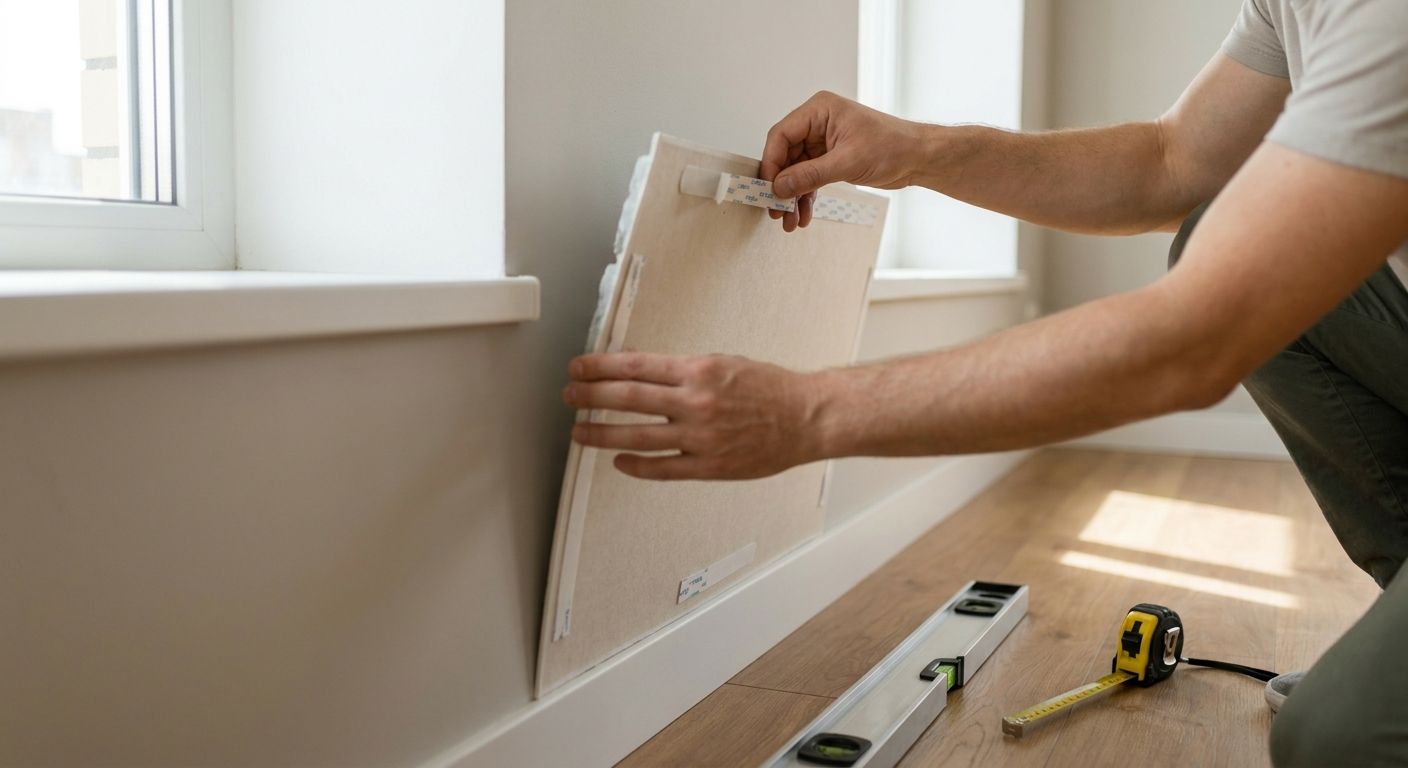
Fitting wall panels in a rented flat without damage means skipping drills and wall plugs altogether and using panel adhesive or a removable fixing method instead — the panel goes up, the wall goes back to bare plaster when you move out. The catch most guides skip: adhesive residue and batten holes behind skirting still count as "damage" to some letting agents, so the fixing method has to match what your tenancy agreement actually allows, not just what's easiest to install.
- Panel adhesive with no nails is the safest route to install wall panels in a rented flat with no damage in 2026.
- Akuwood Panel's 290 ml high-tack glue holds real wood veneer panels on plasterboard without screws or plugs.
- Lightweight 30x30 cm 3D wood tiles are easier to remove cleanly than full 240 cm or 300 cm acoustic panels.
- Battens screwed into skirting board hide small holes but still count as fixings under some tenancy agreements.
Why this matters
Most rental agreements in the UK treat drilled holes, wall plugs, and screw fixings as damage that comes out of a deposit. Adhesive marks and residue are a grey area landlords argue about constantly, which is exactly why the fixing method you pick matters more than the panel finish you pick.
Akuwood Panel gets this question from tenants and landlords fitting out let properties for 2026 lets, and the honest answer is that no single method suits every wall. A guide built specifically for rented flats covers wall-by-wall differences in more depth than this page can, but the core decision tree is below.
How do you install wall panels in a rented flat without damage?
Four fixing methods come up again and again for tenants. Here's how they compare on actual damage risk, not marketing copy.
| Method | Wall damage | Works on | Verdict |
|---|---|---|---|
| Panel adhesive (e.g. high-tack panel glue) | None beyond a thin glue film, no holes | Plasterboard, painted brick, MDF | Buy |
| Battens screwed into skirting board or architrave | Small holes hidden once skirting is refitted | Timber-framed stud walls | Hold |
| Removable double-sided mounting strips | None if removed correctly | Lightweight tiles under roughly 1 kg per piece only | Wait |
| Drilling and wall plugs | Permanent holes in the wall | Any solid wall | Skip for rentals |
Adhesive wins for most rented flats because it leaves no holes and no visible fixing points once the panel is removed. High-tack panel glue is formulated for real wood veneer panels and goes on with a standard caulking gun, no specialist tools needed.
Battens are the fallback when a wall is uneven or when you're covering a full 240 cm or 300 cm panel run rather than small tiles — the trade-off is a handful of screw holes that need filling later, so check the tenancy agreement before choosing this route.
Why the right no-damage method varies
- Wall substrate — plasterboard takes adhesive well; bare brick or heavily textured render needs a stronger bond or a batten frame.
- Panel weight and size — a 30x30 cm real-wood tile is far easier to glue and peel off cleanly than a full 240 cm or 300 cm veneer panel.
- Tenancy agreement wording — some contracts specifically bar adhesive residue, others only bar drilling; read the clause before you buy anything.
- Deposit protection scheme rules — most UK schemes treat filled screw holes as fair wear and tear if disclosed at move-in, but undisclosed damage is disputed more often.
- Cure time — panel adhesive needs time to set before the panel takes any weight, so rushing the install is the most common cause of panels sagging off the wall.
- Room humidity — bathrooms and kitchens push adhesive bonds harder than a living room or bedroom wall.
For anyone testing a finish before committing to a full room, ordering a sample first avoids gluing up a wall you end up disliking.


Can you install wooden wall panels without losing your rental deposit?
Yes, provided you use adhesive rather than drilled fixings and disclose the install to your landlord before you start. Filled, undamaged plasterboard after adhesive removal is rarely flagged by deposit protection schemes in 2026, but undisclosed drill holes almost always are.
Do wall panels need nails to go up?
No — panel adhesive holds real wood veneer panels without a single nail or screw. Akuwood Panel's 290 ml high-tack glue is built for exactly this fixing method and works on plasterboard, painted brick, and MDF backing.
What's the best glue for wall panels on plasterboard?
A high-tack panel adhesive made for wood veneer, applied in beads across the back of the panel, is the standard choice for plasterboard. It sets without mechanical fixings and leaves no holes once the panel is removed at the end of a tenancy.
FAQ
How do you install wall panels rented flat no damage in 2026?
Panel adhesive applied directly to the wall is the standard no-damage method in 2026, with no nails, screws, or wall plugs involved. It works on plasterboard, painted brick, and MDF, and leaves no holes once the panel is removed.
Is adhesive strong enough to hold a full-size wall panel?
Yes, high-tack panel glue is designed to hold full 240 cm and 300 cm acoustic wood panels once fully cured. Give the adhesive its full cure time before hanging anything on the panel or leaning furniture against it.
Can you remove glued wall panels without damaging paint?
Most panel adhesives release cleanly from painted plasterboard with gentle, patient pressure rather than a hard pull. A thin residue sometimes remains and can usually be wiped or lightly sanded away.
Are battens better than glue for rented walls?
Battens work better on uneven walls or full-length panel runs, but they involve small screw holes that glue avoids entirely. For a genuinely no-damage install, adhesive is the safer default.
What size wall panels are easiest to remove in a rental?
Small 30x30 cm real-wood tiles are easier to remove cleanly than full 240 cm or 300 cm panels because there's less surface area and less adhesive per piece. They're a lower-risk starting point if you've never fitted panels before.
Do wall panels work on bare brick without damage?
Panel adhesive bonds to painted or sealed brick reasonably well, but bare, dusty brick needs priming first or the bond fails. Battens are usually the more reliable option on unfinished masonry.
How long does panel adhesive take to cure?
Cure time varies by product and room conditions, so check the tube instructions before hanging anything heavy on the panel. Rushing this step is the most common reason glued panels come loose.
Should you tell your landlord before fitting wall panels?
Yes, disclosing the install before you start is the simplest way to avoid a deposit dispute at the end of the tenancy. A written note or email confirming the adhesive method used is enough in most cases.
One last thing
Most deposit disputes over wall panels come down to disclosure, not the fixing method itself — a landlord told in advance that adhesive is being used rarely objects, while an undisclosed install found at checkout almost always gets flagged. Photograph the bare wall before you start and again after removal; it's the cheapest insurance against a dispute you'll ever buy.
Share:
Wood Cladding Garden Studio Exterior: 2026 Buyer Guide
How to Measure Acoustic Panel NRC Ratings (2026 Guide)