

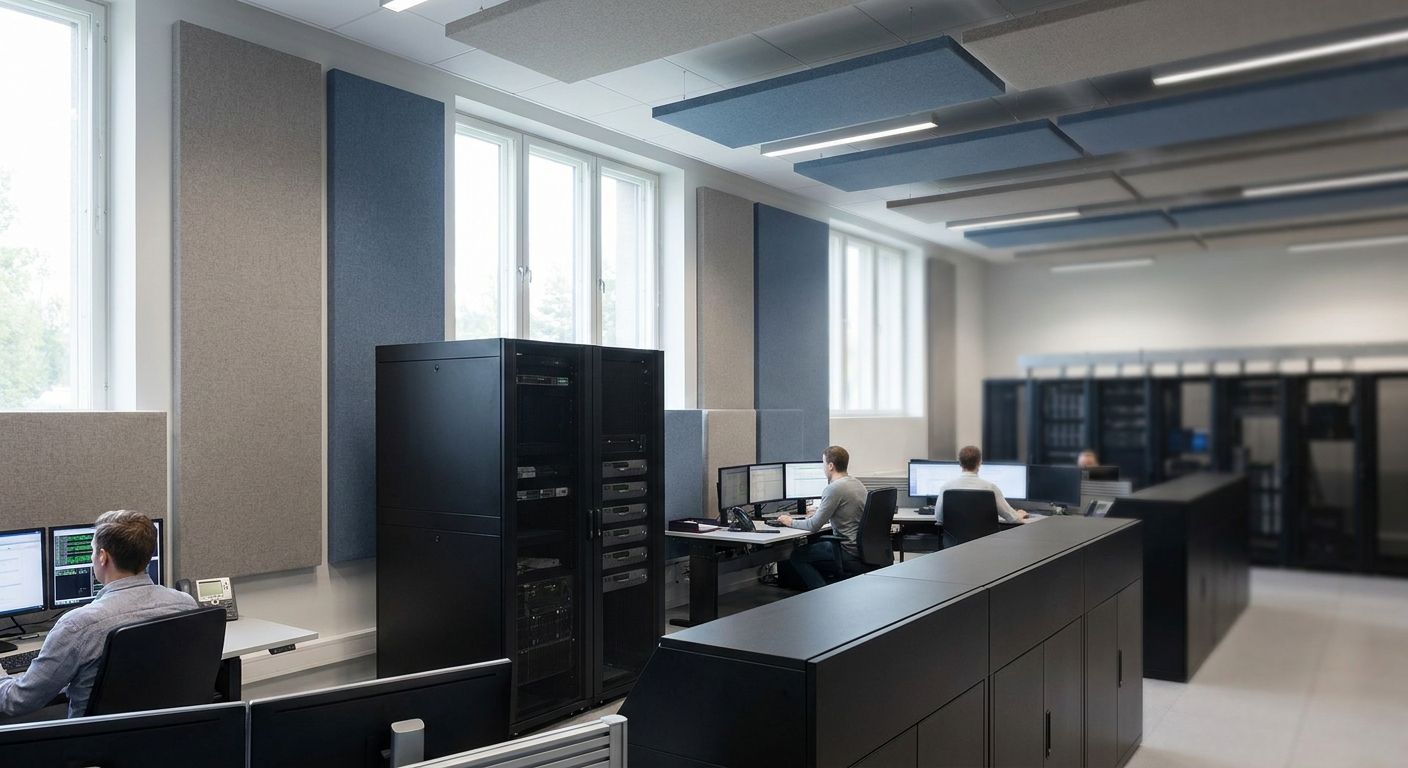
Acoustic panels for data centre control rooms cut reflected noise from hard floors, glass partitions and cooling equipment so operators can hear alarms, phone traffic and shift handovers without straining. Control rooms and NOCs run 24/7 with constant HVAC drone and server hum layered under human conversation, which is a different acoustic problem than a normal open-plan office. The fix starts with wall treatment, not carpet or curtains, because most control rooms can't add soft furnishings without breaking cable management or cleanliness rules.
- Wood veneer acoustic panels with an NRC rating of 0.75 cut reflected noise on hard control room walls without adding clutter near equipment racks.
- Treat the walls behind operator desks and opposite video walls first — ceiling-only treatment misses most of the reflected sound in a control room.
- Dark finishes like smoked oak or black reduce screen glare on monitor walls better than pale natural oak in low-light NOCs.
- Fire rating documentation and phased, out-of-hours installation matter more in a live control room than in a standard office.
- Acoustic panels for data centre control rooms start from £40.95 per hexagon panel in 2026, with foam and fabric-wrapped alternatives priced by supplier.
Why acoustic treatment matters for data centre control rooms
A control room is a listening environment before it's anything else. Operators need to catch an alarm tone over the hum of CRAC units, confirm a ticket over the phone during a shift handover, and read a video wall without glare bouncing off a hard finish behind it. None of that works well in a room built from concrete block, raised floor tile and glass meeting-room partitions, because those surfaces reflect sound rather than absorb it.
Most data centre and NOC fit-outs specify acoustics late, after the racks, the raised floor and the video wall are already locked in. That's backwards for anyone specifying acoustic wall panels for architects and specifiers, because retrofitting wall panels around fixed equipment is harder than planning for them from the layout stage. Getting this right in 2026 fit-outs means treating acoustics as a design input, not a punch-list item.
Verdict: for a live control room, wood veneer acoustic wall panels rated at NRC 0.75 are the practical fix — they cut reflected noise on hard walls without adding soft furnishings that clash with a clean, equipment-heavy room.
Step 1: Audit the room's actual noise sources
Walk the room during a live shift, not an empty one. Reverberation and equipment hum behave very differently once the room is occupied and racks are running.
- CRAC and CRAH unit fan noise near the room's perimeter
- Server and UPS hum bleeding through partition walls
- Hard floor and hard ceiling reflections bouncing conversation across the room
- Phone and radio traffic at operator desks
- Glass meeting-room or NOC-viewing partitions reflecting sound back into the main floor
- Keyboard and alarm-tone clatter at dense desk clusters
Step 2: Set a reverberation target before buying anything
Most control rooms don't need a studio-grade RT60 figure — they need speech to stay intelligible across the room during an incident call. Use a free room-acoustics calculator or a basic clap test before spending on treatment.
- Note ceiling height and total wall area of hard, untreated surfaces
- Count operator desks and distance between them
- Flag any glass walls or windows that reflect sound directly
- Record where alarms and paging speakers are mounted
- Mark corridors or ante-rooms that carry noise into the main floor
Step 3: Cover the worst reflective surfaces first, cheaply
Before ordering panels, deaden the loudest reflection points with whatever's on hand. This tells you where treatment actually moves the needle before you commit budget.
- Hang heavy blankets or moving pads temporarily on the worst wall
- Add a felt pinboard or noticeboard where budget allows
- Lay a rubber-backed mat under the loudest keyboard cluster
- Close any open cable trays that channel fan noise across the room
If the clap test or a quick listen-back during a shift shows a real improvement from these temporary fixes, that wall is a priority for permanent treatment.
Step 4: Install acoustic wood wall panels on the primary reflection walls
Once you've confirmed which walls matter, this is where a manufactured panel earns its place over a blanket. A panel like the Hexagon Acoustic Panel Natural Oak carries an NRC rating of 0.75 and a real wood veneer finish, so it absorbs sound without looking like acoustic foam bolted to a server room wall.
- Wall directly behind the main operator desk cluster
- Wall facing or adjacent to the video wall, where reflections bounce screen glare and sound together
- Return walls in corridors leading into the control room
- Partition walls shared with plant rooms or CRAC units
Step 5: Match the panel finish to glare and light conditions
Control rooms run low ambient light so monitor walls stay readable, and a pale, high-sheen finish can reflect screen glow back at operators. A darker finish like the Hexagon Acoustic Panel Smoked Oak sits better on walls opposite video walls than a light natural oak.
- Use darker finishes (smoked oak, grey walnut, black) on walls facing screens
- Reserve lighter finishes for perimeter walls away from monitor sightlines
- Avoid gloss lacquer finishes near any video wall
- Keep finish consistent across a wall run so patching later is straightforward
Step 6: Check fire rating and compliance paperwork before you specify
Data centres carry stricter fire compliance requirements than a standard office fit-out, and this step gets skipped more than any other. Ask for documentation before the order goes in, not after.
- Request fire rating and material data sheets from the supplier in writing
- Confirm requirements with the building's fire engineer or M&E consultant
- Check whether the room falls under stricter local authority or insurer rules for critical infrastructure
- Keep documentation on file for the facility's next compliance audit
Step 7: Plan installation around live, 24/7 operations
A NOC rarely goes fully dark for a refit. Installation has to work around shift patterns instead of shutting the room down.
- Phase the install wall by wall, not the whole room at once
- Schedule noisy fixing work for the lowest-traffic shift
- Use adhesive fixing where drilling near live cable runs isn't practical
- Brief the incoming shift on which walls are mid-install so alarms aren't confused with construction noise
“If operators repeat themselves twice during a shift handover, the room has an echo problem, not a training problem.”
Comparing acoustic treatment options for control rooms
| Option | Best for | Starting price | Key limitation |
|---|---|---|---|
| Wood veneer acoustic wall panels (hexagon or slat) | Control rooms wanting real wood finish plus sound absorption | From £40.95 per panel (2026) | Wall-mounted only, needs a flat, dry substrate |
| Acoustic foam wedges | Fast, cheap deadening tucked behind equipment racks | Varies by supplier | Looks industrial, unsuited to visitor-facing NOCs |
| Fabric-wrapped fibreglass panels | Large flat walls needing high absorption | Varies by supplier | Fabric traps dust, harder to wipe down in a server environment |
| Suspended acoustic ceiling baffles | Rooms with cable trays limiting wall space | Varies by supplier | Needs ceiling void access, more complex install |
Verdict: wood veneer panels win for any control room where the room is also used for tours, audits or client visits — foam and fabric options are cheaper but read as industrial, not professional.


Common mistakes control rooms make with acoustic treatment
- Treating the ceiling void and ignoring the walls. Cable-tray baffles help, but most of the reflected noise operators complain about comes off hard side walls at desk height.
- Picking a gloss or pale finish opposite the video wall. It solves the noise problem and creates a new glare problem on the monitors.
- Ordering before checking fire compliance. Re-specifying mid-project after a fire engineer flags the material costs more time than checking upfront.
- Installing across the whole room in one shutdown window. Live NOCs rarely get a full outage; phased, wall-by-wall installs avoid disrupting shift handovers.
- Under-specifying panel count for room volume. A handful of panels on one wall won't move reverberation in a large open control floor — measure wall area first.
FAQ
What NRC rating do acoustic panels need for a data centre control room?
An NRC rating around 0.75 is a solid target for control room walls in 2026 fit-outs, which is what AKU Woodpanel's hexagon acoustic panels carry. Higher isn't always better once speech intelligibility during alarms and calls is the actual goal.
Where should acoustic panels go in a control room?
Start with the wall behind the main operator desk cluster and the wall facing the video wall, since those two surfaces reflect the most sound and glare. Ceiling treatment matters less than wall treatment in most rectangular control rooms.
Are wood veneer acoustic panels fire rated for data centre use?
Fire rating requirements vary by building and insurer, so request material data sheets from the supplier and confirm with the site's fire engineer before ordering. Data centres typically carry stricter compliance rules than standard office fit-outs.
How much do acoustic panels for a control room cost?
Hexagon acoustic wood panels start at £40.95 per panel as of 2026, with total cost depending on wall area and finish. Foam and fabric-wrapped alternatives are priced by supplier and can run higher or lower depending on spec.
Can acoustic panels be installed without shutting down a live control room?
Yes, phased wall-by-wall installation lets a NOC stay operational during the fit-out. Scheduling the noisiest fixing work for low-traffic shifts avoids confusing construction noise with real alarms.
Do dark or light acoustic panels work better near a video wall?
Darker finishes like smoked oak or black reduce glare bouncing off the wall behind or opposite a video wall better than pale natural oak. Reserve lighter finishes for perimeter walls away from monitor sightlines.
What size acoustic wall panels are available for commercial rooms?
AKU Woodpanel's wooden wall panels come in 240 cm and 300 cm size formats, covering most standard and floor-to-ceiling commercial wall heights. Larger rooms typically mix panel runs to match available wall width.
Is acoustic foam or wood veneer paneling better for a NOC?
Wood veneer paneling suits any control room that hosts visitors, audits or client tours, since it reads as a finished interior rather than industrial foam. Foam wedges are cheaper and faster where the room is never seen by outsiders.
One last thing
The detail most facility teams miss: reflected sound off a video wall's glass or acrylic surround does as much damage to speech clarity as the ceiling ever does. Treat the wall behind and beside the video wall before spending on ceiling baffles — it's the cheaper fix and the one operators actually notice by the end of their first treated shift.
Share:
How to Measure Acoustic Panel NRC Ratings (2026 Guide)
Wooden Wall Panels Kitchen Feature Walls: 2026 Guide