

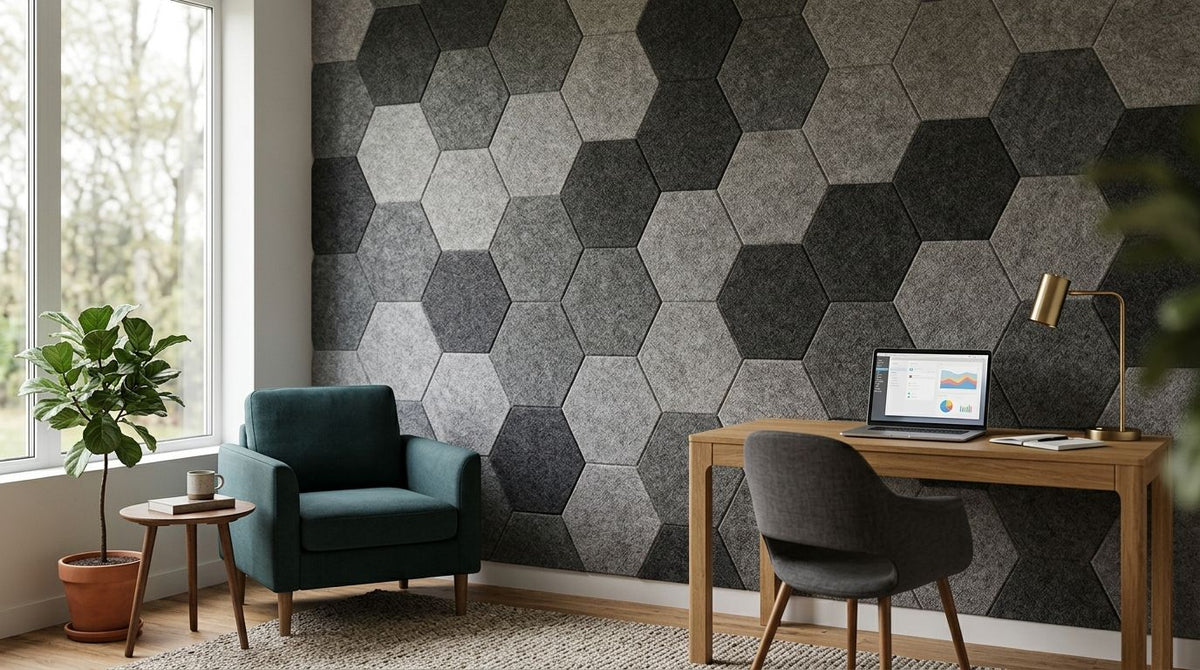
Acoustic wall boards cut echo and flatten harsh room noise without a full soundproofing rebuild, and the right board depends entirely on the room you're fixing. Best overall for living rooms: the Natural Oak Wooden Wall Panel. Best for home offices and boardrooms: the Natural Oak Wall Panel with Grey Felt. Best for home cinema rooms: the Smoked Oak Wooden Wall Panel. Best for bedroom feature walls: the Hexagon Acoustic Panel in Walnut. Best for large open-plan rooms: the Rustic Oak Premium 3-Sided Veneer Panel in the 300 cm format.
- Natural Oak Wooden Wall Panel is the best all-round acoustic wall board for living rooms in 2026.
- Grey felt-backed oak suits offices and boardrooms that need a cooler, less domestic tone.
- Smoked Oak absorbs stray light as well as sound, which is why it works around cinema screens.
- Hexagon Acoustic Panel in Walnut breaks up a flat bedroom wall while still cutting reverb.
- Rustic Oak in the 300 cm format covers open-plan walls with fewer joins than the 240 cm size.
Why this matters
Most echo in a home or office comes from bare plaster and glass bouncing sound back and forth, not from noise coming through the wall itself. Acoustic wall boards solve that specific problem: a real wood veneer panel with a felt backing behind it absorbs the sound wave instead of reflecting it, which is why rooms with hard floors and minimal soft furnishing benefit most.
The wrong pick is a cosmetic panel with no felt layer at all — it looks the part but does nothing for reverberation. That distinction is the whole reason a ranked comparison matters more than picking whatever finish looks best in a photo.
What makes the best acoustic wall boards
- Real wood veneer over printed laminate — veneer keeps its grain and colour depth for years; laminate finishes can look flat and start to peel at the edges.
- Felt backing density — the felt layer is what actually absorbs sound; the wood face is cosmetic on top of it.
- Panel format — 240 cm or 300 cm lengths change how many horizontal joins a wall needs.
- Finish tone — lighter oaks lift a dim room, darker oaks work better where you want less light bounce.
- Fixing method — tongue-and-groove or click-fit panels install faster than boards that need full adhesive coverage.
- Coverage per order — how much wall a single delivery clears before you need to reorder and match batches.
Acoustic wall boards at a glance
| Panel | Best for | Standout feature | Key limitation |
|---|---|---|---|
| Natural Oak Wooden Wall Panel | Living rooms | 3-sided real oak veneer over acoustic felt | Light tone won't suit a deliberately dark room |
| Natural Oak Wall Panel, Grey Felt | Home offices, boardrooms | Cooler grey felt backing reads more corporate | Grey felt shows dust and marks sooner than darker felt |
| Hexagon Acoustic Panel, Walnut | Bedroom feature walls | Geometric hexagon shape breaks up a flat wall | More offcuts and waste on long, uninterrupted runs |
| Smoked Oak Wooden Wall Panel | Home cinema rooms | Dark finish absorbs stray light near screens | Scuffs and fingerprints show more on dark wood |
| Rustic Oak Premium 3-Sided Veneer | Large open-plan rooms | Available in the 300 cm format for fewer joins | Longer boards need two people to fit safely |
1. Natural Oak Wooden Wall Panel: best acoustic wall board for living rooms
This is Akuwood Panel's flagship board: a 3-sided real oak veneer bonded to an acoustic felt backing, sold in the 240 cm and 300 cm formats. It's built for the room where echo is most noticeable day to day — the living room, where a TV, hard flooring and bare plaster combine to make voices and dialogue harder to follow.
Natural Oak pros:
- Real wood grain, not a printed pattern, so it doesn't flatten out under lamp light
- Felt backing does the acoustic work while the veneer stays purely decorative on top
- Works in both size formats depending on your ceiling height
Natural Oak cons:
- A light, warm tone that won't suit a room aiming for a darker, moodier look
- Needs a level wall behind it, or gaps show along the join lines
Best for: living rooms with hard floors and minimal soft furnishing. Verdict: Buy.
2. Natural Oak Wall Panel with Grey Felt: best acoustic wall board for home offices and boardrooms
Same oak veneer construction as the standard version, but the felt backing swaps to grey instead of the warmer tone underneath the standard finish. That single change shifts the whole panel from domestic to corporate, which is why it turns up more in home offices and small boardrooms than living rooms.
Grey Felt pros:
- Reads as neutral and professional rather than decorative
- Same acoustic felt performance as the standard Natural Oak version
- Suits video-call backdrops where a busy pattern would be distracting
Grey Felt cons:
- Grey felt shows dust and scuff marks sooner than a darker felt backing
- Less warmth than natural oak, so it can feel cold in a small windowless room
Best for: home offices, boardrooms and video-call rooms. Verdict: Buy.
3. Hexagon Acoustic Panel, Walnut: best acoustic wall board for bedroom feature walls
The hexagon format breaks the wall into a honeycomb pattern instead of straight horizontal runs, which is why it gets used on feature walls rather than full-room coverage. The walnut finish is darker and richer than oak, and it still carries the same felt-backed construction behind each hexagon.
Hexagon Walnut pros:
- Decorative geometric pattern that reads as a feature wall on its own
- Walnut tone works well behind a bed or as a headboard backdrop
- Individual hexagons make partial repairs or swaps easier than full boards
Hexagon Walnut cons:
- More cutting and offcuts than a straight panel when covering a full long wall
- Pattern can look busy in a small bedroom if it covers too much wall
Best for: bedroom feature walls and headboard backdrops. Verdict: Buy — for a feature wall, not whole-room coverage.
4. Smoked Oak Wooden Wall Panel: best acoustic wall board for home cinema rooms
Smoked Oak takes the same 3-sided veneer and felt construction as the Natural Oak board but in a darker, smoked finish. Dark surfaces absorb stray light as well as sound, which is the reason this finish turns up around projector screens and media walls more than any other.
Smoked Oak pros:
- Dark tone cuts light bounce around a screen, useful for projector setups
- Same felt-backed acoustic performance as the lighter oak finishes
- Pairs well with black trim and low-light cinema seating
Smoked Oak cons:
- Fingerprints and light scuffs show more visibly than on lighter wood
- Can make a small room feel darker than intended if overused
Best for: home cinema rooms and media walls. Verdict: Buy.
5. Rustic Oak Premium 3-Sided Veneer Panel: best acoustic wall board for large open-plan rooms
This is the panel to reach for on a long, open-plan wall, mainly because it's available in the 300 cm format rather than being capped at 240 cm. Fewer joins across a long run means fewer visible seams and less wall prep to get everything level.
Rustic Oak Premium pros:
- 300 cm length format means fewer joins across a long open-plan wall
- Rustic grain hides minor wall imperfections better than a smooth, uniform veneer
- Same acoustic felt backing as the standard-length boards
Rustic Oak Premium cons:
- Longer boards need two people to lift and fit safely
- Rustic grain won't suit a room going for a clean, minimalist look
Best for: large open-plan living or dining rooms with long, unbroken walls. Verdict: Buy.
How we ranked these acoustic wall boards
Each board above was matched to one room type rather than ranked on a single scale, because a panel that's right for a home cinema is often wrong for an office. The criteria were consistent throughout: veneer quality, felt backing, size format flexibility, finish tone, fixing method and coverage per order.
If you want to understand what the felt backing is actually doing acoustically before you buy, the guide on how to read NRC sound absorption ratings on acoustic panels breaks down what the ratings mean in practice.
Which acoustic wall board should you choose in 2026?
For most homes, the Natural Oak Wooden Wall Panel is the default answer — it handles the most common problem (echo in a living room with hard floors) without committing to a dark or decorative finish you might regret. If the room is an office, go grey felt. If it's a cinema, go Smoked Oak. If the wall is long and open-plan, take the 300 cm Rustic Oak format so you're not fighting joins halfway across the room.
FAQ
What's the best acoustic wall board for soundproofing in 2026?
The Natural Oak Wooden Wall Panel is the best all-round acoustic wall board for 2026, combining a 3-sided real wood veneer with an acoustic felt backing that suits most living rooms. Darker or grey-felt finishes suit cinema rooms and offices better.
Are acoustic wall boards actually effective against echo?
Yes, when the board has a felt or fibre backing behind the decorative face — the felt layer absorbs sound waves instead of reflecting them. A purely cosmetic panel with no backing layer does very little for reverberation.
Is real wood veneer better than laminate for acoustic panels?
Real wood veneer keeps its grain and colour depth for years, while printed laminate finishes tend to look flat and can peel at the edges over time. Veneer is the better long-term choice for a visible feature wall.
What size acoustic wall panels should I buy, 240 cm or 300 cm?
Choose 300 cm for long, open-plan walls where fewer joins matter, and 240 cm for standard room heights and smaller walls. The 300 cm format needs two people to fit safely because of the extra length.
Can acoustic wall boards go in a bathroom or kitchen?
Wood veneer acoustic boards are designed for dry living spaces like living rooms, bedrooms and offices, not high-moisture rooms. For wet areas, a different wall panel category built for humidity is the safer choice.
Do acoustic wall panels need professional installation?
Most tongue-and-groove or click-fit acoustic panels are designed for DIY fitting on a level wall. Longer 300 cm boards are heavier and easier to fit with two people rather than one.
What's the difference between acoustic wall boards and decorative wall panels?
Acoustic wall boards have a felt or fibre backing that absorbs sound, while purely decorative panels are chosen for pattern and texture without that backing layer. Check for the felt layer specifically if noise reduction is the goal.
Is a hexagon acoustic panel as effective as a standard rectangular board?
Yes, hexagon acoustic panels use the same felt-backed construction as rectangular boards; the shape only changes the visual pattern, not the acoustic performance per panel.
One last thing
Most people put an acoustic feature wall behind the sofa and expect the echo problem solved — it rarely is. A single feature wall barely dents reverberation in a room with hard floors and three other bare walls; covering two adjoining walls, even partially, cuts far more echo than covering one wall completely. If echo is the actual complaint, spread the panel budget across two walls rather than maxing out one.
Share:
Drone Racing Arena Acoustic Panels: 2026 Verdict
Best Acoustic Wall Panels by Price, Ranked for 2026