

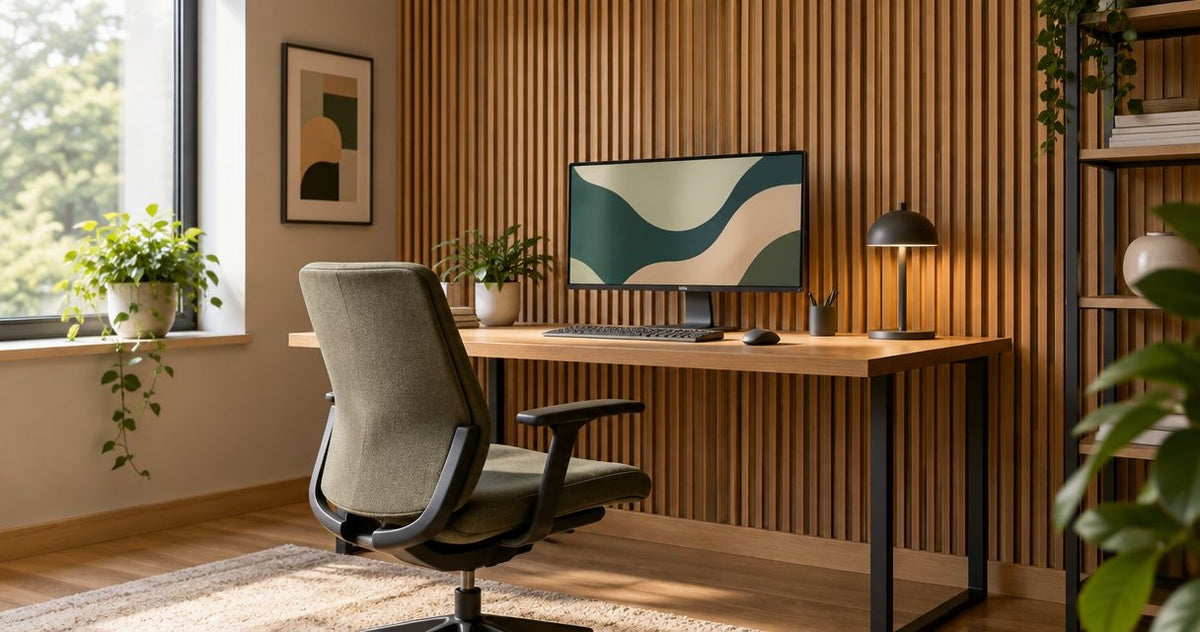
Yes, acoustic wood panelling is worth it in 2026 if you want to reduce room echo and add a wood-finished feature wall. It is not a substitute for soundproofing, and the finished project involves more than panels: wall preparation, suitable fixings, cutting and edge details all need planning.
- Is acoustic wood panelling worth it? Yes for room echo and a wooden feature wall; not for soundproofing.
- Akustiq UK acoustic wood panels suit homeowners who want real wood veneer and acoustic felt backing.
- Choose between 240 cm and 300 cm formats by measuring your wall, not by assuming the ceiling height.
- Compare acoustic test evidence and installation requirements before choosing panels for a performance-led project.
Why this matters
A room that sounds harsh is not necessarily letting too much sound through its walls. Bare walls, glazing and hard floors reflect sound within the room; noise from a neighbouring property is a different problem.
Confusing those problems leads to the wrong purchase. Before choosing Akustiq UK acoustic wood panels, use the guide to reading sound absorption ratings to understand what acoustic evidence actually describes.
Is acoustic wood panelling worth it in 2026?
Acoustic wood panelling earns its place when you need sound absorption and want the wall finish itself to be part of the room design. Its value is weaker when you only want decoration, already have comfortable room acoustics, or need to stop noise travelling between rooms.
Start with the problem you can hear. Speech that lingers after someone stops talking points towards reverberation; intelligible conversations coming through a shared wall point towards sound transmission.
| Option | Best for | Main advantage | Main limitation |
|---|---|---|---|
| Acoustic wood panelling | Combining room treatment with a wooden feature wall | Brings an absorptive backing and wood finish into the same wall treatment | Performance depends on the product, coverage and installation |
| Curtains, rugs and upholstered furniture | Adding absorption while furnishing a room | Treats the room without committing to a panelled wall | Changes the furnishing scheme and does not suit every surface |
| Decorative panelling without acoustic evidence | Changing the appearance of a wall | Lets you choose primarily for appearance | A textured surface alone does not prove useful absorption |
| A designed soundproofing system | Reducing sound transfer between spaces | Addresses the separating construction and sound paths | Requires a different scope of work from decorative wall treatment |
These approaches are not mutually exclusive. A living room can use curtains and acoustic panelling together, while a shared office can need both room absorption and improved partitions.
What counts as a worthwhile result?
Set a practical goal before buying. In a living room, that might mean less lingering sound during conversation; in a home office, it might mean a less reflective space around your microphone.
Do not treat those goals as guaranteed results from a particular quantity of panels. Room volume, existing furnishings, panel construction and mounting all affect the outcome, so a product photograph cannot tell you how your room will sound.
For a 2026 refurbishment, write down the acoustic goal and the appearance goal separately. If only the appearance goal matters, assess the panelling as an interior finish rather than justifying it with an unverified noise-reduction claim.
Why the value of acoustic wood panelling varies
The same panel can make sense in one room and be unnecessary in another. These factors determine whether the installation addresses your actual needs:
- Noise problem: Reflections within a room call for absorption; sound entering through walls, floors or doors calls for a sound-transmission assessment.
- Existing surfaces: A sparsely furnished room with exposed hard surfaces presents a different starting point from a carpeted room with curtains and upholstery.
- Treated area: A narrow decorative strip and a substantial panelled area do not expose the same amount of absorbing material.
- Mounting method: Acoustic test results apply to the tested arrangement, so check the backing, cavity and fixing details before comparing claims.
- Wall condition: Uneven surfaces, damp, sockets and awkward returns add preparation or detailing work that a straight wall does not require.
- Finish expectations: Veneer coverage, visible edges, panel joins and the way the finish works with existing furniture affect the decorative value.
Compare complete installations, not panel faces alone. A finish you like is only part of the decision; you also need a workable layout and evidence appropriate to the result you expect.
Which rooms make acoustic wood panelling worthwhile?
Living rooms: best for echo and a feature wall
Acoustic wood panelling is a sensible option when conversation sounds reflective and you also want a permanent wall feature. It lets you introduce absorption without making every design decision revolve around soft furnishings.
The limitation is placement and coverage. A small panelled section chosen solely to frame a television should not carry the expectation of treating an entire open-plan space.
Home offices: best for controlling room reflections
A reflective home office can make speech sound less clear within the room and in microphone recordings. Acoustic treatment addresses those reflections, although microphone position and the rest of the room still matter.
A panelled video-call backdrop is not automatically an effective acoustic layout. Choose the treatment position for the sound problem as well as the camera view, and do not expect it to create speech privacy through a lightweight partition.
Bedrooms: best for a functional headboard feature
A bedroom feature wall can combine a wood finish with additional absorption. That is useful when you like a restrained furnishing scheme but find the room sounds bare.
The case is weaker in a bedroom that already sounds comfortable. If the problem is traffic, neighbours or footsteps overhead, identify the transmission route before buying wall panels.
How do you check whether panels are right for your room?
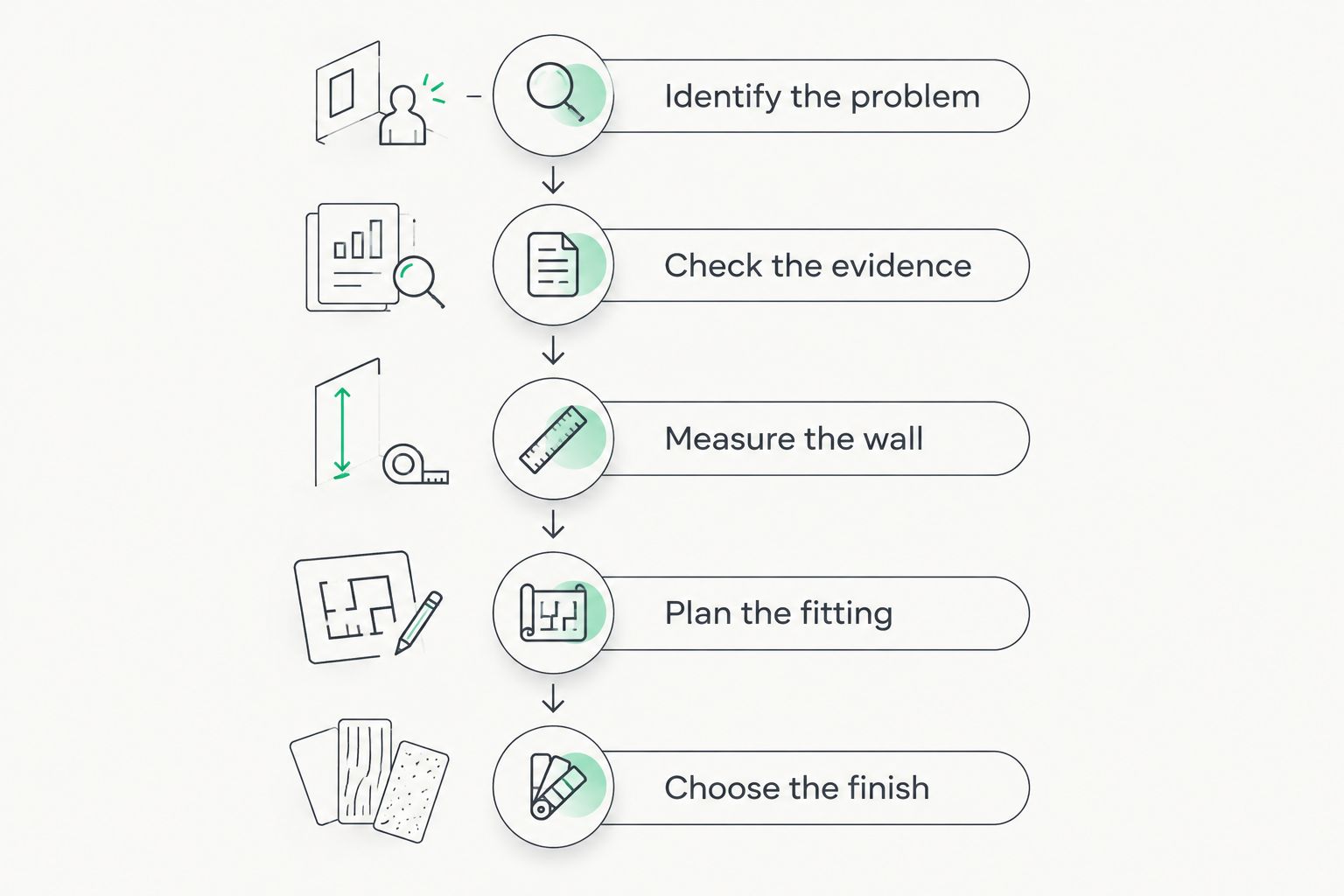
Use this sequence before committing to an installation. It separates a decorative decision from an acoustic specification without making a straightforward home project unnecessarily complicated.
- Identify the problem. Listen during normal use: conversation, television or calls. Note whether sound lingers inside the room or arrives from somewhere else.
- Check the evidence. Ask for acoustic documentation for the exact panel construction. Match the mounting arrangement to the one you intend to use.
- Measure the wall. Record height, width, openings, sockets and visible returns. Plan where panels stop and where cuts will remain visible.
- Plan the fitting. Follow the manufacturer's requirements for the substrate, fixings and any backing arrangement. Include preparation and finishing work in the scope.
- Choose the finish. Assess a physical sample against your flooring, furniture and lighting before committing to a full wall.
A hand clap can reveal an obvious lingering reflection, but it is not a substitute for an acoustic survey or a product test. For a commercial space with defined performance requirements, have the treatment area and installation specified against those requirements.
Keep the same discipline when reviewing products in 2026. An absorption rating describes a tested sample and arrangement, not a promise that every room will achieve the same result.
240 cm panels: best for walls that fit the shorter format
A 240 cm panel format makes sense when your measured layout fits within that length. Check the actual wall from the intended starting point to the finishing point, including any skirting or ceiling detail you plan to retain.
The benefit is avoiding an unnecessarily long panel where a shorter format does the job. The limitation is straightforward: if the required run exceeds 240 cm, you need a different format or a planned join.
300 cm panels: best for taller wall layouts
A 300 cm panel gives you 60 cm more length than a 240 cm panel. That additional length is useful when it allows the intended vertical run without an intermediate join.
Longer is not automatically better. If your wall does not need the extra length, consider the cutting, handling and offcuts rather than treating size as evidence of better acoustic performance.
| Panel | Best for | Useful feature | Check before choosing |
|---|---|---|---|
| Wooden Wall Panel, Natural Oak 240 cm | A measured wall layout that fits the shorter format | Three-sided wood veneer in a 240 cm format | Whether the intended run fits without an unwanted join |
| Wooden Wall Panel, Natural Oak 300 cm | Taller layouts needing the longer format | Three-sided wood veneer in a 300 cm format | Access, handling, cutting and the amount of unused length |
Akustiq UK acoustic wood panels are best for homeowners who want real wood veneer and acoustic felt backing in one wall finish. The flagship indoor range has three-sided veneer, but the decorative specification does not replace checking acoustic evidence for your intended installation.


Will acoustic wood panelling stop me hearing my neighbours?
Acoustic wood panelling is not a replacement for a soundproof separating wall. Absorbing reflected sound inside your room is different from restricting sound passing through the building.
Neighbour noise needs an assessment of the wall, adjoining floors, ceilings, doors and other sound paths. Do that first; otherwise, a visually successful feature wall can leave the original problem unresolved.
Do I need to cover every wall with acoustic panels?
You do not need to assume every wall requires panelling, but there is no universal coverage figure that suits every room. The required treatment depends on the room, the material's tested absorption and the acoustic goal.
For your 2026 project, avoid buying by a generic coverage percentage alone. Plan the area and location around the room's use, then check whether the proposed arrangement supports the result you need.
Is acoustic wood panelling better than curtains or rugs?
Acoustic wood panelling is better suited to a permanent wooden wall feature; curtains and rugs serve different furnishing needs. None is universally better for room acoustics without considering the material, area and placement.
Start with furnishings you already want, then assess the remaining echo. Adding panels to a room that already sounds comfortable is primarily a decorative choice, which is a valid reason to buy without overstating the acoustic benefit.
FAQ
Is acoustic wood panelling worth it in a small living room?
Yes, acoustic wood panelling is worth considering in a small living room when you hear unwanted reflections and want a wooden feature wall. Room size alone does not establish whether treatment is needed; existing surfaces and furnishings matter too.
Will acoustic wood panels soundproof my bedroom?
No, acoustic wood panels should not be treated as a bedroom soundproofing system. They address reflections within the room rather than replacing the construction needed to restrict sound transmission.
Are Akustiq UK panels made with real wood veneer?
Akustiq UK's flagship indoor acoustic panels feature a three-sided real wood veneer finish and acoustic felt backing. Check the specification of the exact panel you select rather than applying that description to every decorative wall product.
Should I choose 240 cm or 300 cm acoustic panels?
Choose 240 cm or 300 cm acoustic panels according to your measured wall layout. The 300 cm format provides 60 cm more length, but additional length does not by itself establish better acoustic performance.
Can I put acoustic wood panels behind my television?
A television wall is a possible location for acoustic wood panels, but placement should suit the room's reflections as well as its appearance. Plan fixings, cable access and equipment ventilation separately, following the relevant manufacturers' instructions.
How can I tell whether acoustic panelling will work?
Check acoustic test evidence for the exact panel and the installation arrangement you intend to use. Product appearance, wood finish and the word acoustic do not establish the result in your room.
Is acoustic wood panelling worth buying just for its appearance?
Yes, you can choose acoustic wood panelling primarily as an interior finish. Judge the veneer, edges, joins and overall layout on their decorative merits rather than assuming you need acoustic treatment.
One last thing
The most attractive wall is not automatically the most useful wall to treat. A feature wall hidden behind substantial furniture exposes less panel surface to the room than the same layout left clear.
Before ordering for a 2026 installation, mark the proposed panel area on a room sketch and add the furniture. Check what will actually remain exposed, where the edges will land and whether your chosen finish still works from the doorway—not just in a close-up sample.
Share:
Can acoustic wood panels reduce noise from neighbours?
Is composite cladding better than timber cladding?