


Acoustic wood panels can reduce reflected sound inside your room, but they are not a reliable standalone solution for noise coming through from neighbours. For your 2026 project, use panels to tackle echo; investigate the separating wall, floor, ceiling and gaps when the problem is sound travelling between homes.
- Can acoustic panels reduce noise from neighbours? Not reliably on their own; sound absorption and soundproofing solve different problems.
- Akustiq UK acoustic wood panels suit echo control, not a standalone barrier against neighbouring voices, bass or footsteps.
- Identify the noise route before choosing wall panels, a soundproofing system or treatment at the source.
- An absorption rating does not tell you how much neighbour noise a finished wall will block.
Can acoustic wood panels reduce noise from neighbours?
Acoustic wood panels treat sound within a room; soundproofing treats sound travelling between spaces. Panels can absorb some sound after it enters your home, but that does not mean they stop it crossing the boundary.
If voices through a party wall are your main problem, start with the construction and sound paths. The guide to soundproofing a shared wall in a terraced house covers that separate task.
| Approach | Best for | Main benefit | Main limitation |
|---|---|---|---|
| Acoustic wood panels | Echo in a living room, bedroom or office | Absorb some reflected sound within the room | Do not replace a sound-insulating wall or ceiling |
| Designed soundproofing system | Sound transmitted between adjoining rooms | Addresses transmission through the treated construction | Needs suitable detailing and attention to alternative sound routes |
| Treatment at the source | Identifiable speakers, appliances or impact noise | Addresses noise before it travels into neighbouring spaces | Requires access or cooperation and must match the source |
These approaches are not interchangeable. A room can have little echo yet poor sound insulation, or good sound insulation yet uncomfortable reverberation.
Why this matters
Buying wall panels for the wrong problem leaves you with a finished feature wall and the same disturbance. A bedroom can look better and sound less hollow while neighbouring speech remains audible.
Before specifying materials in 2026, decide what success means: clearer conversation inside your room, less sound entering from next door, or fewer vibrations from upstairs. Those goals require different evidence and different work.
Do not use a decorative finish as proof of sound insulation. The relevant question is how the complete construction performs against the noise you actually hear.
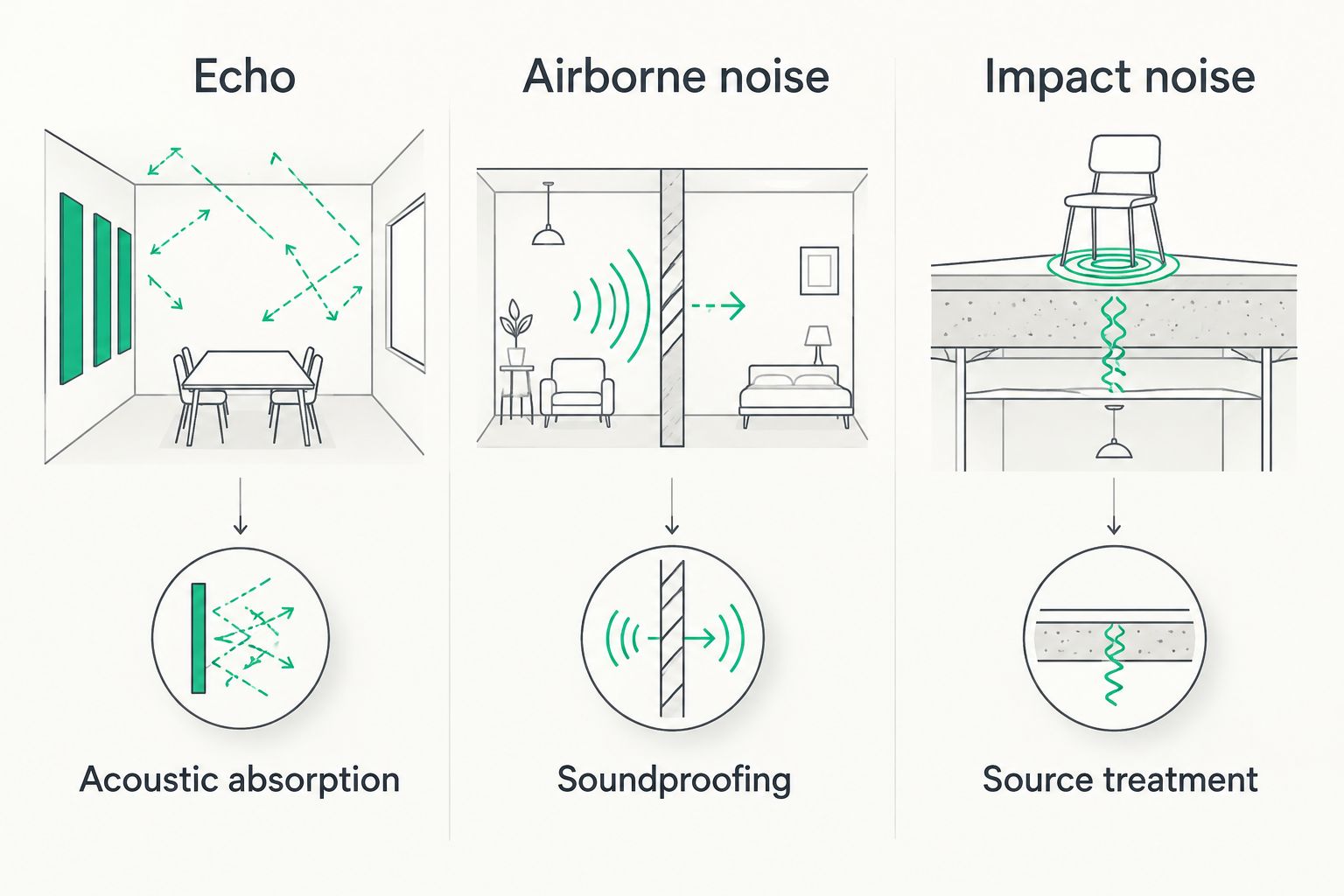
Echo, airborne noise and impact noise need different treatment
Echo: best for acoustic absorption
Echo and reverberation happen when sound reflects around your room. Bare walls, glazing and hard floors contribute to those reflections, making conversation or television sound less clear.
Acoustic absorption is relevant here because it reduces reflected sound energy. The limitation is straightforward: improving the room's internal acoustics does not establish that less sound passes through its boundaries.
Airborne noise: best for a sound-insulating construction
Speech, television and music start as airborne sound. They can pass through a separating wall or floor, through gaps, or along connected building elements.
Soundproofing must address those routes rather than just cover the visible surface. Its benefit is reduced transmission through a suitably designed construction; its limitation is that an untreated alternative route can restrict the overall result.
Impact noise: best for source and structural assessment
Footsteps and furniture movement can set floors and connected structures vibrating. The sound you hear downstairs is not simply an echo that needs absorbing.
Treatment at the source, such as an appropriate floor build-up, addresses a different mechanism from wall panelling. Where source access is unavailable, a specialist must assess the receiving room and structure before recommending ceiling work.
Why the effect on neighbour noise varies
The result depends on the building and the noise, not simply on whether a panel is described as acoustic. Check these factors before deciding where to spend your effort:
- Noise type: speech, music bass and footsteps involve different frequency content and transmission mechanisms.
- Sound route: noise can travel directly through a boundary or indirectly through connected floors, ceilings and side walls.
- Existing construction: the separating wall or floor, its connections and its condition affect sound transmission.
- Gaps and penetrations: openings around services and poorly detailed junctions can provide paths for airborne sound.
- Room reflections: a hard, sparsely furnished receiving room adds reverberation, which absorption addresses without necessarily improving the boundary itself.
- Installation details: acoustic performance belongs to a particular material arrangement and mounting method, not just the visible panel face.
A loud patch near a wall junction is a useful observation, not a diagnosis. Sound spreads through rooms and structures, so the apparent direction does not prove the only route.
How do you identify the problem before buying panels?
Use this sequence to prepare a useful brief. It helps separate observations you can make yourself from conclusions that require an acoustic assessment.
- Describe the sound. Record whether the disturbance is understandable speech, music, a low rumble, footsteps or a repeated mechanical noise. Avoid describing every problem simply as a thin wall.
- Record the location. Note which rooms are affected and where the sound seems strongest. Include ceiling edges, side walls, doors and service areas rather than inspecting only the party wall.
- Separate echo from intrusion. Listen to your own conversation when the neighbouring noise is absent. A lingering, hollow sound suggests an internal reflection problem, but it does not measure the wall's sound insulation.
- Discuss the source where practical. Moving a speaker away from a shared boundary or addressing a vibrating appliance targets the cause. Agree changes cooperatively rather than assuming your neighbour knows the disturbance exists.
- Set the treatment brief. State whether you need room absorption, reduced transmission or both. Ask a competent specialist to assess persistent transmission problems before covering the construction.
Keep dates and descriptions in your noise record. A phone recording can help explain the character of a disturbance, but it is not a substitute for controlled sound-insulation measurements.
What acoustic evidence should you ask for in 2026?
Ask for evidence that measures the outcome you need. Sound absorption and sound insulation have different test methods, and a result for one cannot stand in for the other.
The noise reduction coefficient, or NRC, is an absorption measure defined under ASTM C423. It uses absorption results at 250 Hz, 500 Hz, 1,000 Hz and 2,000 Hz; it does not state how much neighbour noise a wall blocks.
Those frequencies describe the scope of the rating, not a guaranteed result in your bedroom. In particular, an NRC figure is not a promise about bass transmission or footsteps.
For a soundproofing proposal, request the relevant wall or floor assembly test evidence and its construction details. Check the substrate, layers, cavities, connections and sealing rather than accepting an isolated material claim.
A laboratory result also needs context. Your home includes junctions, workmanship and alternative transmission routes that a material sample alone cannot represent.
Useful questions for a supplier or installer include:
- Does this result measure absorption or transmission?
- What complete assembly was tested?
- Does the proposed installation match that assembly?
- Which noise routes will remain untreated?
- How will the finished work be checked against the brief?
Where acoustic wood panels make sense
Acoustic wood panels are relevant when your living room, bedroom or home office sounds excessively reflective. They combine a wall finish with an absorptive element, so the decision is about room acoustics as well as appearance.
Akustiq UK acoustic wood panels are best for homeowners tackling room echo, not for standalone soundproofing against neighbours. That distinction keeps the recommendation tied to the job the material is intended to do.
The flagship indoor panels have a 3-sided real wood veneer finish and an acoustic felt backing. Akustiq UK offers 240 cm and 300 cm formats; those dimensions help you plan the wall layout, not predict noise reduction through a party wall.
The benefit is a wood-finished surface that supports an echo-control scheme. The limitation is that neither the veneer nor the format establishes the sound insulation of the wall behind it.
If you need both soundproofing and a decorative finish, settle the soundproofing design first. Any later panel installation must preserve the specified layers, junctions and service details.

What should a neighbour-noise plan include in 2026?
A useful plan names the disturbance, identifies the likely transmission routes and explains why the proposed construction addresses them. It also separates necessary sound-insulation work from optional room finishes.
For a shared wall, the plan should consider adjoining floors, ceilings and side walls rather than treating the visible wall as an isolated sheet. For noise from above, it should distinguish airborne sound from impacts before choosing a ceiling treatment.
Ask the installer to explain the junctions and service details. Adding layers while leaving an important bypass untreated is not the same as completing a soundproofing system.
Confirm permissions before alterations, especially in rented accommodation or where work affects shared construction. Do not seal required ventilation, disturb electrical fittings or change fire-resisting details as an improvised acoustic fix.
Get the noise-control specification right before choosing the finish. That order avoids asking decorative panels to solve a problem that belongs to the building construction.
Will covering the whole party wall stop next door's television?
Covering the whole party wall with acoustic wood panels does not establish that television sound will stop entering your room. A larger absorptive area treats more of the room surface, but surface coverage is not a sound-insulation specification.
If television noise remains distinct and intrusive, investigate transmission through the wall and surrounding construction. Do not assume that adding more of the same decorative treatment changes its purpose.
Should acoustic panels go in your room or your neighbour's room?
Acoustic panels in either room treat reflections in the room where they are installed. Absorption in the source room can reduce its reverberant sound field, but it does not replace a sound-insulating boundary.
Choose placement according to the acoustic brief, not a rule that panels must always face the neighbour. Addressing a particular speaker or impact source can require a different intervention altogether.
FAQ
Can acoustic panels reduce noise from neighbours in a flat?
Acoustic panels are not a reliable standalone way to block neighbour noise in a flat. They treat room reflections, while transmitted noise requires attention to the separating construction and other sound paths.
Will wooden acoustic panels stop footsteps from upstairs?
Wooden acoustic panels are not a standalone treatment for upstairs footsteps. Footsteps generate impact vibration, so assess the floor construction, source treatment and possible ceiling measures.
Does a high NRC rating mean a panel is soundproof?
A high NRC rating does not mean a panel is soundproof. NRC describes sound absorption, not the sound insulation of a wall or floor.
Are acoustic wood panels useful behind my bed?
Acoustic wood panels behind your bed are relevant to room echo and the wall finish. Do not treat a panelled headboard wall as proof that neighbouring voices will be blocked.
Can I fit acoustic panels over a soundproofed wall?
Acoustic panels can form a decorative finish over a soundproofed wall when the specified system permits that installation. Confirm fixing methods and preserve the soundproofing and fire-resisting details.
Are Akustiq UK acoustic wood panels right for neighbour noise?
Akustiq UK acoustic wood panels suit an echo-control brief, not a standalone neighbour-noise barrier. Investigate sound transmission first if adjoining speech, music or footsteps are the main disturbance.
What should I check before choosing neighbour-noise treatment in 2026?
Identify the sound type and likely transmission routes before choosing treatment in 2026. Ask for evidence covering the proposed complete construction rather than relying on an absorption rating.
One last thing
The wall where you hear noise is not necessarily the only route carrying it. Connected floors, ceilings and side walls can bypass a wall treatment, so the most useful next step is often a better diagnosis rather than another layer of panelling.
If neighbour noise is the problem, investigate transmission first; if echo is the problem, specify absorption. Keep those briefs separate even when the finished room needs both.
Share:
How long does it take to install acoustic wall panels?
Is acoustic wood panelling worth it in 2026?