

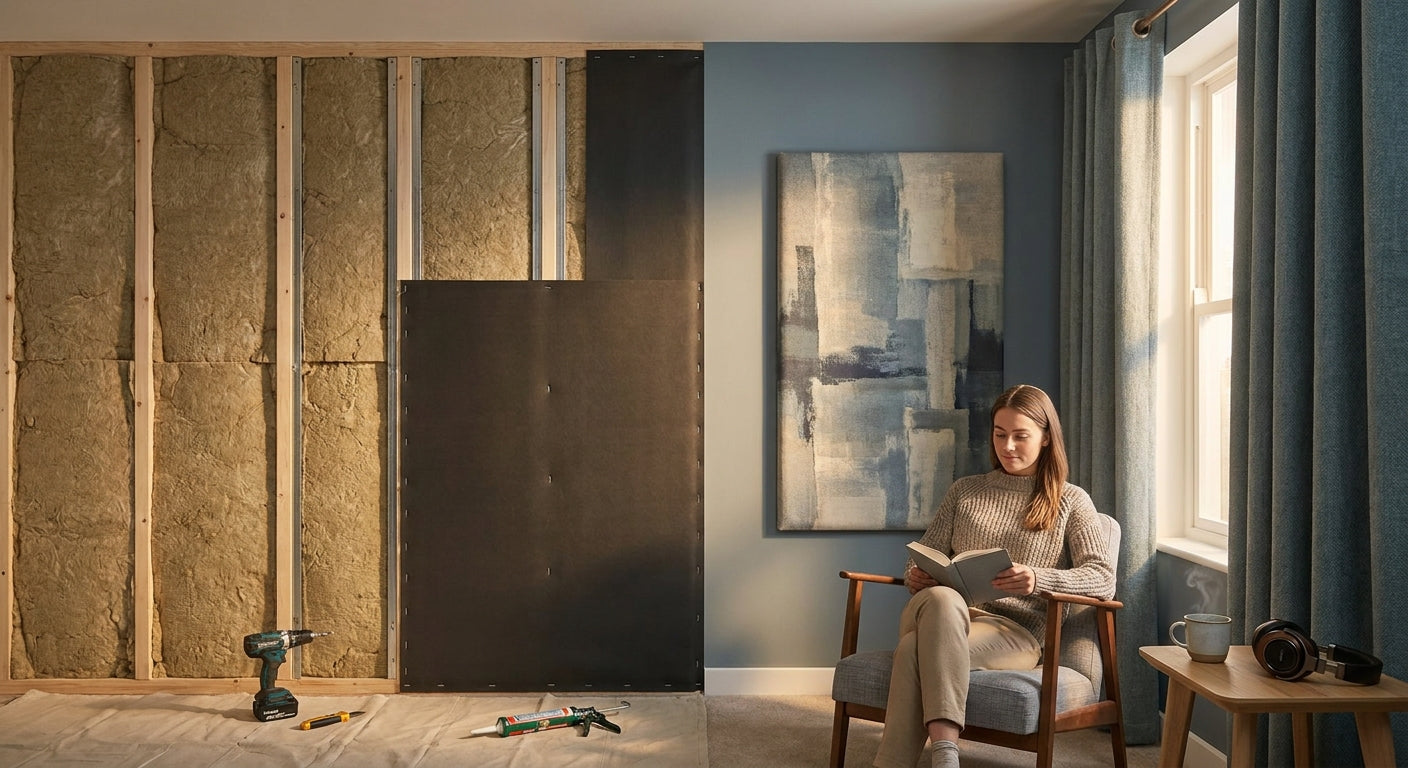
Thin partition walls in a UK flat carry footsteps, TV bass and neighbour arguments straight through the plasterboard — and the fix isn't more curtains, it's mass, decoupling and absorption applied in the right order.
TL;DR
How to make walls soundproof in a flat comes down to three layers: mass-loaded vinyl or acoustic plasterboard to block sound, an air gap or resilient bars to decouple the structure, and acoustic wood panels or foam to absorb reflected noise inside the room. For renters or anyone who can't touch the stud wall, acoustic wooden slat wall panels from Akuwood Panel are the fastest legal upgrade in 2026, cutting reverberation without a full rebuild. Full soundproofing (blocking noise from next door) needs structural work; acoustic treatment (fixing echo and harshness) is a weekend job. Verdict: Buy panels for absorption, budget separately for mass if you're dealing with a genuinely thin party wall.
Why this matters
Most people conflate two different problems. Soundproofing stops sound crossing a boundary — your neighbour's subwoofer, their kids running around at 7am. Acoustic treatment stops sound bouncing around inside your own room, which is what makes a flat feel harsh, tinny or exhausting to have a conversation in.
A typical 1990s-2010s UK flat partition is 100mm of plasterboard on timber studs with little to no insulation. That construction has a sound reduction index around 40-45 dB, which sounds fine on paper but lets through voices, bass and impact noise easily. You can't change the building's structure as a tenant in most leases, but you can control what happens on your side of the wall — and that's where acoustic wooden panels do real work in 2026.
What you'll need
- Acoustic wooden wall panels (240 cm or 300 cm lengths, felt-backed) — covers the absorption side
- Mass-loaded vinyl (MLV) or heavy acoustic curtains — only if you're targeting sound transfer through a party wall
- A stud finder and spirit level
- Panel glue rated for interior wall fixing, or battens and screws if you're mounting to studs
- Acoustic sealant/caulk for gaps around skirting, sockets and the ceiling line
- A tape measure, pencil, fine-tooth saw, and roughly a weekend of free time
- If you rent: removable fixing methods (Command strips rated for weight, or freestanding battens) so the wall goes back to original
Budget two to four hours per wall for panel fitting once the layout is measured, longer if you're also fitting MLV underneath.
The steps
1. Diagnose which noise problem you actually have
Stand in the room and clap once. If the sound rings and decays slowly, you have a reverberation problem inside the room — treatable with panels. If you can hear specific words or bass thumps from next door regardless of what you do to your own walls, you have a transmission problem — that needs mass, not just absorption. Most flats have both, but the split changes what you buy first.
Common mistake: buying foam tiles expecting them to block a neighbour's music. Foam and slat panels absorb reflected sound inside your room; they do very little to stop sound entering through the structure.
2. Measure the wall and plan panel coverage
Measure width and height, then decide whether you're covering a full feature wall or a partial band (waist-height to ceiling works well behind a headboard or TV). Full coverage gives the biggest acoustic improvement; partial coverage still cuts noticeable echo at a lower cost.
For a typical UK flat living room wall around 3.6m wide, panels in 300 cm lengths minimise waste versus 240 cm sections. Common mistake: measuring only the wall and forgetting sockets or radiators, which forces awkward cuts mid-panel.
3. Choose a finish that suits the room
Darker finishes like natural oak wooden wall panels read warmer in living rooms and bedrooms, while lighter tones open up small box rooms common in converted flats. The felt backing on Akuwood Panel's range is what does the acoustic work — the veneer is the finish, the felt is the function.
Order a sample before committing to a full wall. A single wrong-toned panel across 3.6 metres is an expensive mistake to notice after installation.
4. Prep the wall surface
Clean the wall of dust and grease, fill any large holes, and let filler cure fully — usually 24 hours. If the wall is uneven, battens correct that better than glue alone.
Common mistake: gluing directly onto fresh paint or wallpaper. Adhesion fails within weeks because the panel is bonding to the paint layer, not the wall itself.
5. Fix the panels using the right method for your tenancy
Owners and long-term leaseholders can glue panels directly using panel glue, applied in a zigzag bead across the back and pressed firmly for 60 seconds. Renters should use battens screwed into studs, or a freestanding frame that panels clip onto — reversible, and the wall comes back to magnolia in an afternoon when you move out.
Work left to right, checking level every second panel. Common mistake: rushing the first panel out of level — every panel after it inherits the error.
6. Seal gaps and treat the ceiling line
Run acoustic sealant along the top and bottom edges where the panel meets ceiling and skirting. Gaps here let sound leak around the treatment rather than through it, undermining the whole job.
If noise is coming through the ceiling from a flat above, treat that boundary too — a felt-backed panel run across the top third of the wall near the ceiling junction catches more of that transfer than panels lower down.
7. Add mass if transmission is still the problem
If step 1 told you this is a transmission issue, layer mass-loaded vinyl or a heavy stud-and-plasterboard skin behind the panels, with an air gap of at least 25mm between the new layer and the old wall. This is the only step that meaningfully blocks sound crossing a party wall — panels alone won't do it, no matter how many you fit.
Common mistake: skipping the air gap. MLV bonded directly to the existing wall barely improves sound reduction versus MLV with a decoupled air gap, which can add several dB of real-world isolation.
Troubleshooting
- Panels sound hollow when tapped — usually means an air gap behind the panel with no batten support; add a batten at the tap point and re-glue.
- Still hearing conversations through the wall after fitting panels — you treated the wrong problem; panels fix echo, not transmission, so revisit step 7.
- Glue isn't holding on textured or painted plaster — sand back the paint layer to a key surface, or switch to a batten-mounted approach.
- Panel gaps show daylight or draughts — the wall behind may be uneven; shim with thin packers before final fixing.
- Landlord won't allow permanent fixing — see the guide on adding wall panels to a rented flat without damage for reversible methods.
- Echo persists even after a full wall of panels — check the floor and ceiling too; hard laminate floors reflect as much sound as bare plaster.
Tools and resources
- Acoustic wooden wall panel range — start here to compare finishes and sizes
- High tack panel glue for permanent fixing on stable walls
- Stud finder, spirit level, fine-tooth saw
- Acoustic sealant for skirting and ceiling junctions
- A sample panel ordered before the main purchase
What to do next
Once the acoustic side of the wall is sorted, read best acoustic panels for noise reduction in flats for finish and coverage comparisons specific to flat layouts, and soundproof wall panels for apartment bedrooms if the bedroom wall is the priority.
FAQ
What's the best way to make walls soundproof in a flat? Combine mass (MLV or an additional stud skin with an air gap) for blocking sound with felt-backed acoustic wood panels for absorbing echo inside the room. Panels alone treat reverberation; mass treats transmission through the party wall.
Is soundproofing the same as acoustic treatment? No. Soundproofing stops sound crossing a wall boundary; acoustic treatment absorbs sound already inside your room. Most flats need both, but they're solved with different materials.
How much does it cost to soundproof a flat wall in 2026? Costs vary by wall size, finish and whether structural mass is added, so check current panel pricing and glue costs on the Akuwood Panel site for an accurate figure against your wall dimensions.
Can renters soundproof a flat without damaging the wall? Yes — batten-mounted or freestanding acoustic panel frames avoid glue on the original plaster and can be removed at the end of a tenancy.
Do acoustic wood panels actually reduce noise from neighbours? They reduce echo and harshness inside your own room effectively, but they do little against sound crossing through the party wall itself — that needs mass-loaded vinyl or an additional stud layer.
What thickness of panel makes the biggest acoustic difference? The felt backing thickness matters more than the wood veneer thickness for absorption; check the specification on the individual product page before buying.
Should I panel the whole wall or just part of it? Full coverage gives the strongest reduction in reverberation; partial coverage (waist-height to ceiling) still noticeably improves a room and costs less.
Can I fit acoustic panels myself or do I need a professional? Most UK flat walls can be panelled in a weekend with basic tools; only step 7 (adding mass-loaded vinyl behind stud work) benefits from a tradesperson if you're not confident with construction.
One last thing
The single biggest mistake in flat acoustics isn't the wall at all — it's the floor. A hard laminate floor with no rug reflects almost as much sound back into a room as bare plaster, which is why a fully panelled wall in 2026 can still sound harsh if the floor underneath is untreated. Fix the floor and the wall together, and the improvement compounds rather than just adding up.
Share:
Acoustic Panels for Theatre Walls 2026: Best Picks
Soundproof a Shared Wall in a Terraced House: 2026 Guide