

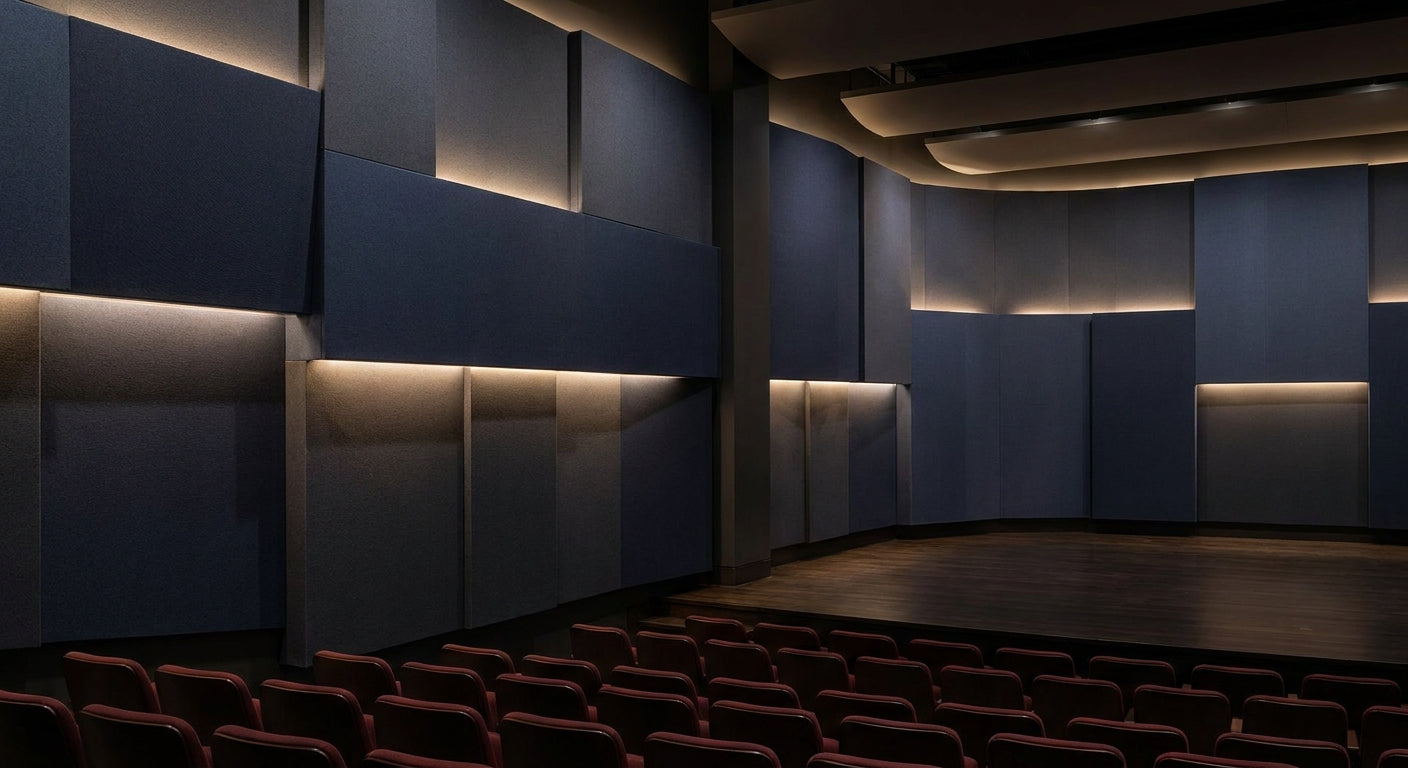
Theatre and auditorium walls have to do three jobs at once: tame flutter echo across rows of hard seating, survive years of stage lighting heat and foot traffic, and still look right under a follow spot. This guide covers what actually matters when you spec acoustic panels for theatre walls in 2026, with specific picks from Akustiq UK's wood veneer range.
TL;DR
For theatre and auditorium walls, look for slatted wood panels with an acoustic felt backing rather than flat veneer boards — the felt is doing the absorption work, the slats are doing the diffusion. The Hexagon Acoustic Panel in Natural Oak with grey felt is the strongest pick for side walls and rear auditorium walls needing genuine mid-to-high frequency control, verdict: Buy. Darker finishes like Black Oak and Smoked Oak suit stage-adjacent walls where light reflectance needs to stay low. Skip flat decorative panels with no felt backing — they look the part but do almost nothing for reverberation. Full breakdown, comparison table and installation notes below.
Why this matters
A bare plaster or block wall in an auditorium reflects sound almost entirely. In a 200-seat hall that means consonants blur, dialogue from downstage gets swallowed by reflections off the side walls, and anyone past row J starts leaning forward. Acoustic wood panels solve this without turning the room into a recording booth — the hexagon acoustic panel in natural oak with grey felt combines a wood veneer face with a felt layer that absorbs the frequencies where speech intelligibility lives, while the slats still scatter rather than fully deaden the sound. That balance matters more in a theatre than almost any other room type, because you want clarity without killing the liveliness of a live performance.
Getting this wrong is expensive to fix later — retrofitting a panelled wall after seating and rigging are installed costs far more in labour than specifying it correctly at fit-out stage.
Who this is for
This guide is written for venue managers, theatre technical directors, architects specifying fit-outs, and contractors working on community halls, school auditoriums, and small-to-mid scale performance spaces. If you're deciding between acoustic panel types for a stage, wings, or rear auditorium wall in 2026, the criteria below apply whether you're fitting a 120-seat black box or a 500-seat civic theatre.
What to look for in acoustic panels for theatre walls
Absorption at mid and high frequencies
Speech clarity lives in the 500Hz–4kHz range, and that's exactly where a felt-backed slat panel earns its keep. A flat wood veneer board with no felt layer looks similar on a spec sheet but reflects almost as much sound as bare plaster — the felt backing is the part doing the work, not the wood face.
Panel format matched to wall height
Akustiq UK's panels come in two size formats, 240cm and 300cm. A 300cm panel runs floor-to-ceiling on most standard auditorium walls with a single cut, which means fewer joints, fewer visible seams under stage lighting, and less waste on a large wall run. Measure your wall height before ordering — a mismatched format means unnecessary horizontal joints across a wall that's meant to read as one continuous surface.
Finish and light reflectance
Stage-adjacent walls and wings benefit from darker finishes that don't bounce light back toward performers or audience sightlines. Rear auditorium walls have more flexibility since they're rarely lit directly. This is one of the few acoustic decisions that's also a lighting decision, so loop in whoever runs the rig before locking a finish.
Mounting system for large contiguous runs
Large wall runs in a theatre need a mounting approach that won't telegraph through the veneer or loosen under vibration from bass-heavy sound design. High-tack panel glue is built for exactly this — a strong initial grab that holds full-height panels in place while the bond cures, without battens eating into limited wing space.
Durability under low light and heavy traffic
Backstage corridors and wings get knocked, wheeled through, and rarely lit brightly enough to spot damage early. A 3-sided real wood veneer finish holds up to this kind of wear far better than a painted or laminate surface, and scuffs are less visible against a natural wood grain than against a flat painted colour.
Top picks for theatre and auditorium walls
The acoustic specialist — Hexagon Acoustic Panel, Natural Oak with grey felt. Geometric hexagon shape gives more edge diffusion per square metre than a straight slat panel, and the grey felt backing pairs neutrally with most stage lighting rigs. Best suited to rear auditorium walls and side walls that need real acoustic treatment rather than decoration. Buy.
The safe pick — Black Oak wall panel. Low light reflectance makes this the obvious choice for stage-adjacent walls and wings where you don't want light bouncing back into a performer's eyeline. Available in the 240cm and 300cm formats, so most standard wall heights need a single cut. Buy.
The wildcard — Smoked Oak wall panel. Warmer and more textured than Black Oak, this works well on a rear wall or foyer-facing wall where you want the panelling to read as a design feature as much as an acoustic one. Less forgiving under harsh white stage light than Black Oak. Consider.
The foyer upgrade — Walnut wall panel. Richer grain than the oak finishes, better suited to front-of-house and vestibule areas than backstage walls, since it's a finish that photographs well for marketing but doesn't need to survive the same knocks as a wing wall. Consider for foyer, Skip for backstage corridors.
The budget starter — Natural Oak wall panel. A solid entry point for a small community hall or school hall on a tighter budget, but for a full-scale auditorium with serious reverberation problems, the felt-backed hexagon panel does more actual acoustic work per square metre. Consider for small halls, Skip if genuine reverberation control is the priority.
What to avoid
- Flat decorative panels with no felt backing. They look identical to acoustic panels in photos but do close to nothing for reverberation — read the product description carefully, not just the surface finish.
- Full-gloss or high-sheen finishes near the stage. Anything reflective throws light back at performers and audience alike; matte wood veneer finishes are the safer default for stage-facing walls.
- Mixing panel formats on one continuous wall without planning the join. Running 240cm and 300cm formats on the same wall without a deliberate break point creates an obvious seam that's hard to unsee once an audience spots it.
Verdict comparison
| Pick | Best for | Light reflectance | Verdict |
|---|---|---|---|
| Hexagon Acoustic Panel, Natural Oak grey felt | Side walls, rear wall — acoustic priority | Low-medium | Buy |
| Black Oak wall panel | Stage-adjacent walls, wings | Low | Buy |
| Smoked Oak wall panel | Rear wall, foyer transition | Medium | Consider |
| Walnut wall panel | Foyer, front-of-house | Medium-high | Consider |
| Natural Oak wall panel | Small halls, tight budget | Medium | Consider |
FAQ
What's the best acoustic panel finish for a theatre auditorium? A felt-backed slat or hexagon panel in a darker finish like Black Oak or Smoked Oak is generally the best fit for stage-adjacent walls, since it combines genuine sound absorption with low light reflectance. Rear auditorium walls have more flexibility on finish since they sit outside the main lighting throw.
Do wood slat panels actually reduce echo in a theatre? Yes, when they carry an acoustic felt backing behind the slats — the felt absorbs mid-to-high frequency reflections that cause flutter echo between hard parallel walls. A flat veneer board with no felt layer won't do this.
Is 240cm or 300cm the better panel size for auditorium walls? Use 300cm on standard theatre wall heights to minimise horizontal joints, and reserve 240cm for lower walls, dado-height treatments, or spaces with structural constraints. Fewer joints means a cleaner look under stage lighting.
How much wall coverage do you need for noticeable acoustic improvement? There's no universal percentage that fits every room, since it depends on the existing reflective surfaces and the wall geometry — a room with hard parallel side walls needs coverage on both of those first before touching the rear wall. Start with the walls causing the most direct flutter echo, then expand from there.
Can acoustic wall panels handle stage lighting heat? Wood veneer panels are a standard fit-out material and tolerate ambient heat from typical stage lighting rigs without issue, but panels shouldn't be mounted in direct contact with hot fixtures or lensed instruments. Keep a sensible clearance from any lighting position, as you would with any wall finish.
Do these panels meet fire safety requirements for public venues? Fire rating requirements vary by venue type, capacity, and local building control, so always check current fire performance documentation for the specific panel range before specifying for a public assembly building. Confirm requirements with your venue's fire safety officer or building control before ordering.
How are wood acoustic panels installed on auditorium walls? High-tack panel glue is the standard fixing method for full-height panel runs, giving a strong initial bond without battens taking up depth in tight wings or corridors. Surface prep matters more than the glue itself — walls need to be clean, dry, and reasonably flat before panels go up.
What's the cost difference between wood acoustic panels and acoustic foam for auditoriums? Foam is typically the cheaper upfront option but doesn't hold up visually in a front-of-house space the way a wood veneer finish does, and most venues want the acoustic treatment to double as the design finish. For any wall the audience actually sees, a felt-backed wood panel does both jobs at once.
One last thing
Most theatre acoustic problems aren't actually about total absorption — they're about flutter echo between two hard parallel walls, which is a geometry problem before it's a materials problem. Treating just one of the two parallel side walls with a felt-backed panel, rather than spreading a thin layer of treatment across every surface, often fixes the worst of the flutter echo with less material and lower cost than a full-room treatment plan.
Share:
Acoustic Panels for Estate Agent Office Walls (2026)
How to Make Walls Soundproof in a Flat (2026 Guide)