

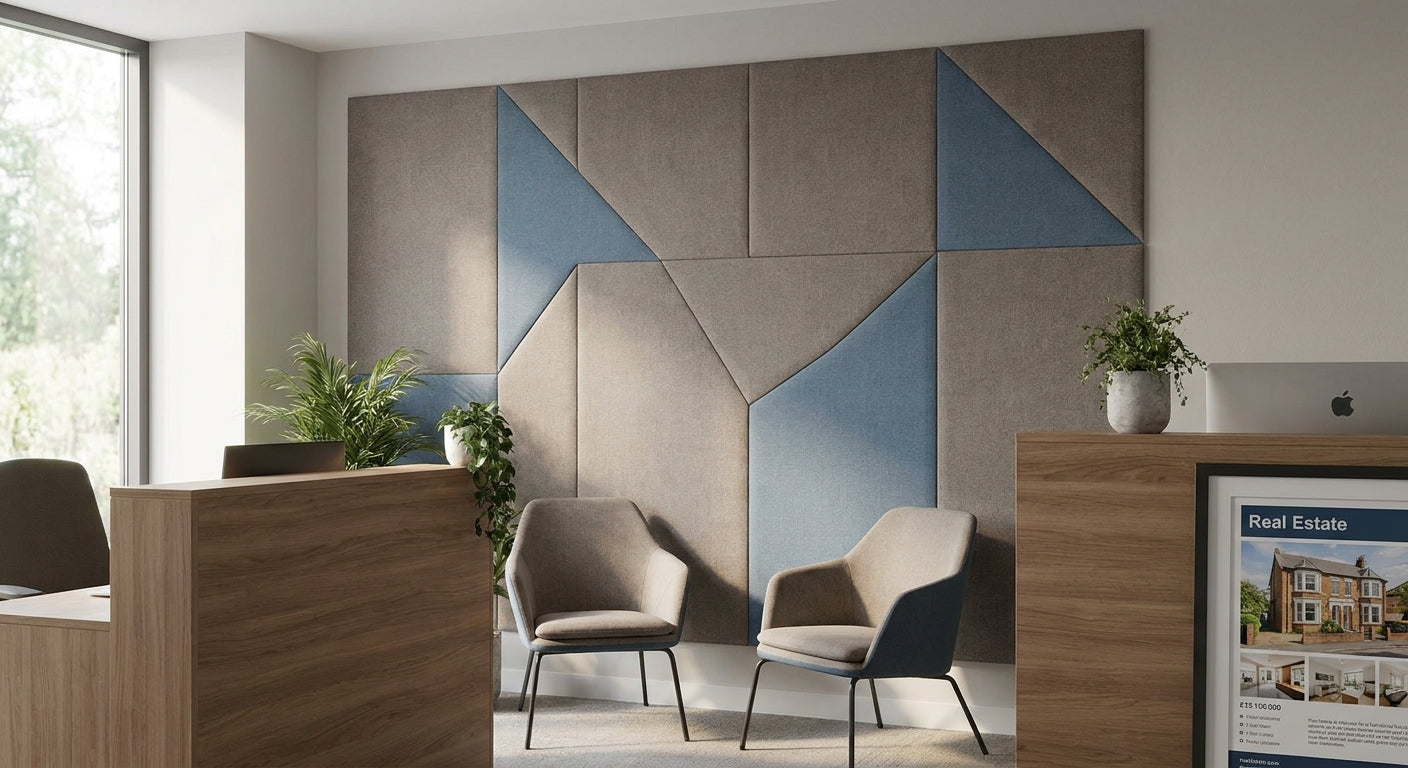
Estate agent offices run on phone calls, valuation appointments, and walk-in clients — and most of them sit behind a glass shopfront that bounces every word straight back at the front desk. Acoustic wood panels cut that noise while making the branch look like it charges premium fees, not discount ones.
TL;DR
For acoustic panels for estate agent office walls in 2026, wooden slat panels with a felt backing beat foam tiles and fabric boards on both looks and durability. The Wooden Wall Panel Natural Oak is the safe pick for a reception area that needs to look premium without going dark, the Wooden Wall Panel Black Oak suits branches chasing a bolder, boutique-agency look, and the Hexagon Acoustic Panel Natural Oak works as a feature wall behind the front desk. All three ship in 240 cm and 300 cm panel lengths with a 3-sided real wood veneer over acoustic felt. Skip foam tiles — they don't survive a working office and they don't match a brand that's trying to look like it sells six-figure houses.
Why this matters
Estate agent branches are some of the worst rooms in retail for sound. Hard floors, a glass frontage, a bank of desks taking calls at once, and a waiting client sat three feet from a negotiation about someone's chain — every surface bounces sound back into the room instead of absorbing it. That's a trust problem as much as a comfort problem: clients overhearing another buyer's offer, or straining to hear the agent on the phone, don't feel like they're in a well-run office.
Wood slat panels with felt backing solve this without turning the office into a recording studio. The slats break up reflected sound, the felt behind them absorbs it, and the veneer finish reads as a design choice rather than an acoustic fix — which matters when the wall in question is the first thing a client sees when they walk in. Branches doing this well tend to treat the reception wall behind the desk the same way a black oak reception feature wall gets used: as branding and acoustic control at once.
Who this is for
This guide is for branch managers and estate agency owners fitting out a high street unit, letting agents converting a leased shopfront, or franchise owners refreshing a tired-looking office ahead of a rebrand. If your desks sit in an open-plan layout with a glass front and you've had a client comment on how loud the office is, this is written for you.
What to look for in acoustic panels for estate agent offices
Real wood veneer, not printed laminate
A client-facing wall gets touched, leaned on, and photographed for the agency's own marketing. Printed laminate scratches and shows wear within a year in a high-footfall office; a 3-sided real wood veneer finish ages the way solid timber does, which matters when the wall is doing double duty as brand backdrop.
Felt backing that actually absorbs sound
Slats alone look the part but don't do much for echo — the acoustic felt sitting behind the veneer is what's doing the absorption work. If a panel is described as decorative only, with no felt layer, it's not solving the noise problem you're fitting it for.
Panel size against your wall height
Most estate agent offices have a standard 2.4 m to 2.7 m ceiling, so the 240 cm panel format covers a typical wall in a single run with minimal cutting, while the 300 cm format suits taller units or double-height reception walls without an extra horizontal join.
Colour that matches the brand, not just the trend
A natural oak or grey oak finish reads warm and approachable — good for a high street agency built on local relationships. Black oak or smoked oak reads sharper and more premium, which works for branches positioning themselves against corporate competitors. Pick the tone that matches how the branch actually markets itself, not whatever's trending on Instagram.
Fixing method for leased premises
Most estate agent units are leased, not owned, so the fixing method matters as much as the finish. Panel systems that use an adhesive rather than heavy mechanical fixing — a proper panel glue rather than screws through plasterboard — leave a cleaner exit route at the end of a tenancy.
Maintenance under daily footfall
A reception wall in a busy branch gets bumped by bags, umbrellas, and the occasional dropped keyset. A real wood veneer with a sealed finish wipes clean; a raw fabric-wrapped acoustic board stains and doesn't come back from it.
Top picks for estate agent office walls
Wooden Wall Panel Natural Oak — the safe pick
One spec that matters: light natural oak tone with acoustic felt backing, available in the 240 cm panel format for standard ceiling heights. It reads warm and approachable at the front desk without competing with agency branding on the wall behind it, and it's the finish that photographs well for listing-day marketing shots taken inside the branch. Verdict: Buy — this is the default choice for a branch that wants the office to look brighter, not moodier.
Wooden Wall Panel Black Oak — the bold pick
One spec that matters: the same 3-sided veneer construction in a near-black tone, built for branches wanting a boutique, premium-agency feel rather than a high street default. It works particularly well on a single feature wall rather than wrapping the whole room, since a fully black-panelled reception can shrink the sense of space in a smaller unit. Verdict: Consider — strong for a rebrand, riskier in a small footprint office with low natural light.
Hexagon Acoustic Panel Natural Oak — the wildcard
One spec that matters: a hexagon-cut panel format in natural oak, designed as a feature treatment rather than full wall coverage. It suits the wall directly behind the reception desk where a client's eye lands first, giving the branch a distinctive look competitors with standard flat panels won't have. Verdict: Consider — best used as an accent rather than the only acoustic treatment in the room, since hexagon layouts cover less total wall area per panel than a straight slat run.
What to avoid
- Foam acoustic tiles. They absorb sound reasonably well but look like a call centre, not an estate agency, and they mark and dent within months in a high-traffic office.
- Solid decorative panels with no felt backing. These look identical to acoustic panels in photos but do nothing for echo — if the product description doesn't mention a felt layer, it's decorative only.
- Full black oak coverage in a small, low-light unit. It looks striking in a large showroom but can make a compact high street branch feel smaller and darker than it already is.
Verdict comparison
| Panel | Tone | Best wall | Fixing suits leased units | Verdict |
|---|---|---|---|---|
| Wooden Wall Panel Natural Oak | Light | Full reception wall | Yes | Buy |
| Wooden Wall Panel Black Oak | Dark | Single feature wall | Yes | Consider |
| Hexagon Acoustic Panel Natural Oak | Light | Accent behind desk | Yes | Consider |
FAQ
What is the best acoustic panel for estate agent office walls in 2026? The Wooden Wall Panel Natural Oak is the strongest all-round choice for 2026 because it balances a bright, client-friendly look with acoustic felt backing, and it fits the 240 cm panel format most standard office ceilings need.
Do wood slat panels actually reduce echo or are they decorative? Only panels with an acoustic felt backing behind the veneer do meaningful sound absorption — pure decorative slat panels without felt are a visual product, not an acoustic one.
Can acoustic panels be fitted in a rented estate agency unit? Yes, panels fixed with a purpose-built panel adhesive rather than heavy mechanical fixings leave a cleaner wall at the end of a lease than panels drilled and screwed through plasterboard.
What size acoustic panel works best for office reception walls? The 240 cm format suits most standard office ceiling heights in a single run, while the 300 cm format is better for taller units or double-height reception walls.
Is black oak too dark for a small estate agent branch? Full black oak coverage can feel heavy in a small, low-light unit — it works better as a single feature wall than wrapped around the whole reception in a compact branch.
How many panels does an average estate agent office need? It depends entirely on wall length and height, but most single-desk reception walls in a standard high street unit are covered by one run of the 240 cm format plus end pieces for a clean finish.
Do acoustic panels need extra soundproofing behind them? For typical office echo — hard floors, glass fronts, open-plan desks — felt-backed wood panels are enough on their own; extra soundproofing behind the wall is a different problem to noise transfer between rooms, not in-room echo.
Can hexagon panels work in a small estate agent reception? Yes, as an accent treatment behind the desk rather than full coverage — hexagon layouts read as a feature rather than a wall-to-wall acoustic solution.
One last thing
The detail most branches get wrong isn't the panel, it's the glue. A stud wall in a leased unit doesn't want screws through it every 30 cm, and a proper adhesive built for wall panel fitting holds a 240 cm panel flat without the fixings showing through the veneer — worth checking before ordering panels rather than after they arrive.
Share:
Acoustic Panels for Hotel Bedroom Walls 2026
Acoustic Panels for Theatre Walls 2026: Best Picks