

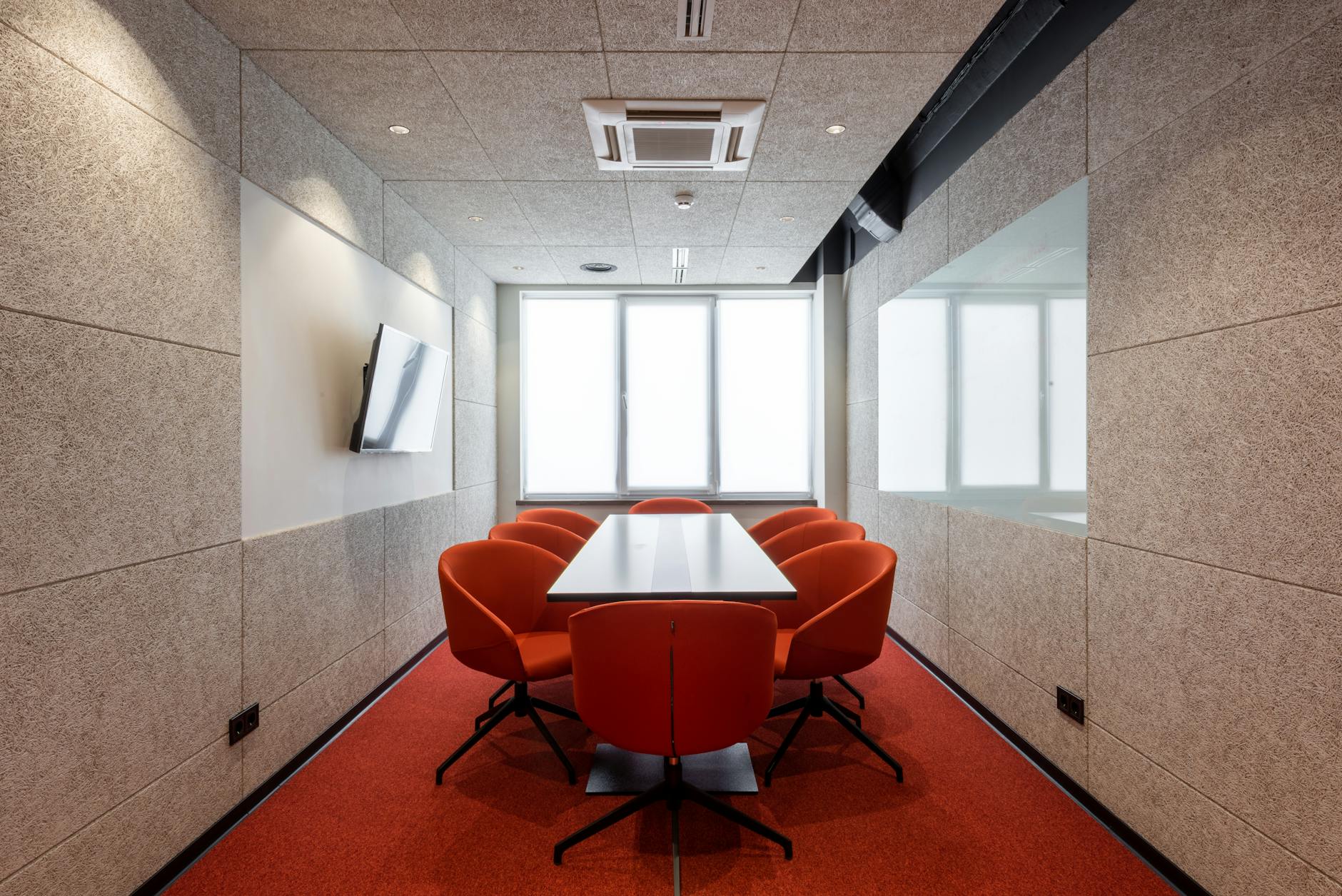
Grey acoustic wall panels are one of the most effective upgrades you can make to a noisy office — they cut reverberation, sharpen speech intelligibility, and look considered rather than clinical. This guide ranks the best options for 2026 office fitouts, with a specific focus on panels that pair acoustic grey felt with real wood slatting.
TL;DR: The best grey acoustic wall panels for offices in 2026 combine a grey felt acoustic backing with a real-wood slat face. Akuwoodpanel's Wooden Wall Panel Natural Oak Grey Felt is the strongest all-round pick — it absorbs mid-to-high frequency noise, ships ready to install, and works in open-plan and private office settings. If you want a darker, more design-forward finish, the Smoked Oak panel is worth considering. Skip bare foam tiles unless your budget is genuinely zero.
Why this matters
Open-plan offices are acoustically hostile. Hard floors, glass partitions, and low ceilings create reverberation times above 0.8 seconds — well above the 0.4–0.6 second range that supports clear conversation and focused work. Wall panels are the single highest-impact intervention because they treat the largest surface area in the room. Grey colourways specifically dominate 2026 commercial fitout specs because they read as neutral against almost any furniture palette and satisfy most corporate brand guidelines without a custom order.
How we ranked
This ranking evaluates panels against five criteria relevant to office environments: acoustic performance (NRC rating or equivalent absorption data), material quality (real wood versus MDF-look laminate), install complexity (clip systems versus adhesive-only), finish durability under daily office conditions, and value per square metre. Panels without a real acoustic-absorbing layer — not just a decorative slat face — are excluded. All pricing references are 2026 UK retail.
Ranked: Best Grey Acoustic Wall Panels for Offices in 2026
1. Wooden Wall Panel Natural Oak Grey Felt
The safe pick for most offices
This panel pairs real natural oak slats with a grey acoustic felt backing — the combination that defines the category in 2026. The felt layer does the acoustic work, absorbing mid-frequency sound that dominates office noise (keyboards, phone calls, HVAC hum), while the oak slats provide a finish that reads as premium rather than functional. The panel ships as a ready-to-install board, which means a fit-out crew can cover a meeting room wall in under two hours without specialist tools.
The grey felt colour sits at a neutral mid-tone — dark enough to contrast cleanly with pale oak, light enough to avoid dominating a room. This makes it the default recommendation for boardrooms, focus pods, and open-plan breakout walls.
Verdict: Buy — Wooden Wall Panel Natural Oak Grey Felt
2. Wooden Wall Panel Natural Oak
The wildcard — acoustic performance depends on your install
The natural oak panel without grey felt backing is a strong visual product, but its acoustic contribution in an office depends entirely on what you mount it against. Against a bare plasterboard wall it adds minimal absorption. Against a 50mm mineral wool substrate it performs well. If your fitout specification already includes a batten-and-insulation wall build, this panel delivers the same real-oak finish at a lower panel cost.
For most office buyers who want a one-product acoustic solution, this is the wrong choice — but for architects specifying a layered wall system, it is worth pricing.
Verdict: Hold — buy only if your wall build already includes an absorptive substrate.
3. Wooden Wall Panel Smoked Oak
The design-forward pick for dark-palette offices
Smoked oak reads as charcoal-brown rather than grey, but it photographs as nearly grey in low-contrast lighting and pairs naturally with anthracite furniture and dark-frame glazing — both common in 2026 premium fitouts. The smoked finish is applied to real oak, so the grain depth and tactile quality match the natural oak range.
This panel suits creative agencies, legal and finance offices aiming for a club-like atmosphere, and any space where the brief says "warm but modern." It is less versatile than natural oak grey felt in standard corporate environments.
Verdict: Consider — strong pick for dark-palette briefs, too directional for general use.
4. Hexagon Acoustic Panel Natural Oak
The feature-wall wildcard
Hexagon format panels break the linear geometry that dominates most acoustic wall treatments. In an office context, they work best as a single feature wall behind a reception desk or at the end of a corridor — not as a whole-room acoustic strategy, because coverage per panel is lower and installation time per square metre is higher than rectangular boards.
The natural oak finish on the hexagon panel is the same quality as the rectangular range. Acoustic absorption per installation hour is lower, so this is a premium aesthetic choice rather than a performance-led one.
Verdict: Consider — use as one accent wall, not as primary acoustic treatment.
5. Exterior Wall Cladding Panel Birch
Not for offices — here for completeness
The birch exterior cladding panel is engineered for weather resistance, not interior acoustic performance. Its surface density is higher than the interior slat panels, which actually reduces sound absorption. Listed here because buyers searching grey acoustic panels occasionally land on cladding products by mistake.
Verdict: Skip — wrong product category for office acoustic treatment.
Comparison Table
| Panel | Real wood face | Acoustic backing | Best office use | Verdict |
|---|---|---|---|---|
| Natural Oak Grey Felt | Yes — oak | Grey felt | All-round office, meeting rooms | Buy |
| Natural Oak | Yes — oak | None (substrate-dependent) | Layered wall systems | Hold |
| Smoked Oak | Yes — smoked oak | Check spec | Dark-palette fitouts | Consider |
| Hexagon Natural Oak | Yes — oak | Check spec | Reception feature walls | Consider |
| Exterior Birch Cladding | Yes — birch | None | Not applicable | Skip |
What to avoid
Panels with PVC or paper-laminate "wood" faces. These look comparable in product photography but delaminate at panel joints within 12–18 months in a heated office environment. The slat gap reveals the substrate edge — at that point you are looking at real wood versus printed foil and the difference is obvious.
Adhesive-only fixing systems on rental tenancies. Most office leases require reinstatement. Panels fixed with construction adhesive directly to plasterboard make reinstatement expensive. Prefer clip or track systems that allow panel removal without surface damage.
Single-layer foam tiles marketed as acoustic panels. Open-cell foam absorbs high frequencies adequately but does almost nothing for the 250–1000 Hz range where office speech and HVAC noise sits. They are also a fire risk in commercial spaces without Class B or better reaction-to-fire certification.
Where to buy
- Direct from the manufacturer. Akuwoodpanel supplies direct to trade and retail in the UK, which removes distributor margin and means you are buying the actual specification rather than a rebranded equivalent.
- Check lead times before ordering for a fitout. Manufactured panels on standard profiles typically ship within a normal production window, but confirm availability against your project programme — do not assume ex-stock.
- Order a sample before committing to large quantities. Grey felt tone and oak grain vary between batches. A physical sample under your office's lighting conditions is the only reliable colour check.
FAQ
What is the best grey acoustic wall panel for an office in 2026? The Wooden Wall Panel Natural Oak Grey Felt from Akuwoodpanel is the best all-round choice for offices in 2026. It combines real oak slatting with a grey acoustic felt backing that absorbs mid-frequency office noise, and it installs without specialist tools.
Do acoustic wall panels actually reduce noise in open-plan offices? Yes, when panels cover a meaningful proportion of wall area — typically 20–30% of total wall surface — they reduce reverberation time measurably. The reduction in echo makes speech clearer and reduces the cognitive load of working in a noisy environment.
Is grey felt or foam better for office acoustic panels? Grey felt performs better for office use. Foam tiles absorb high frequencies but are largely ineffective in the 250–1000 Hz speech range. Felt-backed slat panels address the frequencies that matter in offices and carry appropriate fire ratings for commercial use.
How many square metres of panels does an office meeting room need? A 20 square metre meeting room typically needs 8–12 square metres of acoustic panel coverage to reach a reverberation time under 0.6 seconds. Covering one full wall and two partial walls is a practical starting point.
Can grey acoustic panels be removed without damaging the wall? This depends on the fixing system. Panels installed on a clip or track system can be removed cleanly. Panels fixed with permanent adhesive cannot. Always confirm the fixing method before ordering if your tenancy requires reinstatement.
Are wood slat acoustic panels fire-safe for commercial offices? Real-wood slat panels must carry Class B or Class C reaction-to-fire certification to comply with UK building regulations for commercial interiors. Always request a fire performance data sheet before specifying panels for a commercial project.
What is the difference between natural oak and smoked oak acoustic panels? Natural oak has a pale golden-tan tone with visible grain. Smoked oak is treated to darken the timber to a warm charcoal-brown. Both use real oak. The choice is aesthetic — smoked oak suits darker, moodier office palettes; natural oak suits lighter, more neutral schemes.
Do grey acoustic panels work in home offices as well as commercial ones? Yes. The same absorption principles apply at any scale. A single panel on the wall behind a monitor or behind a webcam position reduces echo on video calls noticeably. See Akuwoodpanel's guide on natural oak wall panels for home offices for room-specific advice.
One last thing
The grey felt in acoustic slat panels is not decorative filler — it is typically a polyester fibre material with an NRC (Noise Reduction Coefficient) in the 0.6–0.85 range depending on thickness. That means it absorbs 60–85% of incident sound energy rather than reflecting it. The oak slats act as a diffuser as well as a visual screen, scattering what the felt does not absorb. The combination outperforms either material alone, which is why this construction has become the standard in 2026 commercial acoustic fitouts.
Share:
Oak Wall Panels for Restaurants: Top Picks 2026
Grey Oak Felt Wall Panels for Living Rooms (2026)