

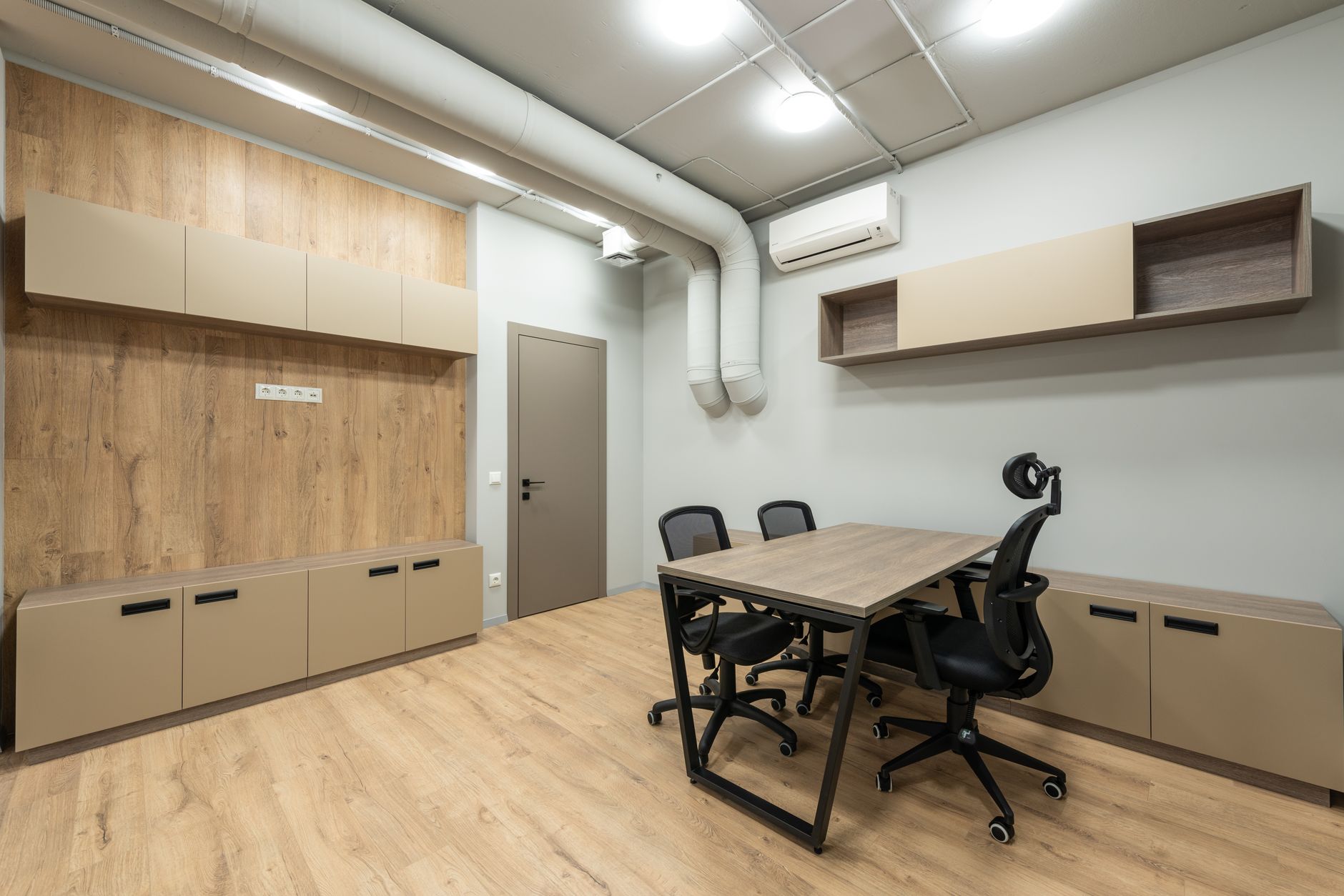
Smoked oak acoustic wall panels bring two things offices genuinely need in 2026: sound control and a finish that looks considered rather than corporate. This guide covers what to look for, which specs actually matter for office environments, and how to buy without wasting budget on panels that underperform acoustically or look wrong on the wall.
TL;DR: For offices in 2026, smoked oak acoustic wall panels hit the right balance of NRC performance (look for 0.75 or above) and visual weight — dark enough to anchor a boardroom or breakout zone without dominating. Aku Wood Panel's wooden wall panel smoked oak is the most direct match for this spec. If budget or lead time is tight, the natural oak with grey felt backing is the closest alternative. Avoid purely decorative wood cladding sold as "acoustic" — real NRC data is non-negotiable.
Why this matters in 2026
Open-plan offices and hybrid working have made reverberation a productivity problem, not just an aesthetics one. A hard-walled 200 m² open plan space typically sits at RT60 values above 1.0 second — well above the 0.4–0.6 second range recommended for speech intelligibility in workplaces (BB93 and WELL Building Standard, both applicable to UK commercial fit-outs in 2026). Wood-finish acoustic panels do the acoustic work while meeting the brief that designers and facilities managers are held to: interiors that photograph well for employer brand and recruitment.
Smoked oak specifically reads as premium and neutral — it pairs with concrete, steel, plaster, and carpet without competing. That makes it low-risk for spec across multiple zones in one fit-out.
Who this is for
This guide is written for office designers, fit-out contractors, and facilities managers sourcing acoustic panels for commercial interiors in 2026 — boardrooms, open-plan floors, breakout areas, phone booths, and reception walls. If you are fitting out a single home office rather than a commercial space, the performance requirements are lower; see the natural oak wall panels for home offices guide instead.
What to look for in smoked oak acoustic wall panels for offices
NRC rating
Noise Reduction Coefficient is the single most important number. A panel rated NRC 0.75 absorbs 75% of incident sound energy at mid-frequencies. For offices, NRC 0.70 is the minimum worth specifying; NRC 0.85+ is appropriate for boardrooms and recording-grade meeting rooms. Any supplier who cannot provide an NRC figure tested to ISO 354 or ASTM C423 is selling decoration, not acoustics.
Panel construction — slat spacing and felt backing
Smoked oak acoustic panels work because the timber slats sit in front of an acoustic felt or fabric backing. The gap between slats determines which frequencies are absorbed. Narrower gaps (10–15 mm) favour mid-to-high frequency absorption, which is exactly where speech intelligibility lives. Wider gaps shift absorption toward lower frequencies. For offices, a mid-range slat gap with a dense black or charcoal felt backing is the standard — and it suits the smoked oak aesthetic without looking mismatched.
Formaldehyde and VOC compliance
Commercial offices in the UK require COSHH compliance and increasingly BREEAM or WELL credits. Specify panels with E0 or E1 formaldehyde emission ratings. Smoked oak veneers involve staining or heat treatment; confirm the finishing process does not add VOC load above the base substrate. This matters at contractor handover when air quality testing is done.
Panel dimensions and coverage rate
Standard acoustic slat panels run around 2400 × 600 mm per board, covering roughly 1.44 m² each. Calculate your wall area, deduct windows and doors, then add 10% for cuts. Buying short and having to reorder from a different batch is the fastest way to get a visible colour mismatch — smoked oak has natural variation, and batch consistency matters more here than with painted surfaces.
Fire rating
Class B-s1,d0 or better (Euroclass) is required for commercial escape routes and many office common areas under Approved Document B. Confirm the rating covers the full assembly — panel face, backing felt, and adhesive — not just the timber face alone.
Installation method
Direct-fix adhesive panels are fastest but permanent. Click-system or concealed bracket panels allow removal for services access, which facilities managers value on active floors. Smoked oak panels with a concealed fixing system are worth the small cost premium in any tenanted office where churn or reconfiguration is likely.
Top picks
The direct spec: Aku Wood Panel Smoked Oak
The safe pick for commercial smoked oak. Aku Wood Panel's smoked oak slat panel is purpose-built for exactly this application — the dark, heat-treated oak veneer over acoustic felt backing delivers the NRC performance offices require, not just the finish. The 2400 × 600 mm format works efficiently across standard commercial ceiling heights of 2.4–3.0 m, and the smoked finish is consistent across boards within a batch.
Spec it for: boardrooms, feature walls in reception, acoustic break-up panels on open-plan floors.
Verdict: Buy — wooden wall panel smoked oak is the primary recommendation for office smoked oak acoustic specification in 2026.
The lighter-tone alternative: Natural Oak with Grey Felt
The wildcard for spaces that need warmth without the drama of smoked tones. The natural oak with grey felt backing hits a similar acoustic brief but reads lighter on the wall. In south-facing offices with strong natural light, smoked oak can look heavier than intended; the natural oak variant keeps the acoustic performance while letting the space breathe. The grey felt backing ties it visually to smoked oak installations without requiring a full redesign.
Verdict: Consider — wooden wall panel natural oak grey felt when lighting conditions or client brief call for a lighter palette.
The feature-wall accent: Hexagon Acoustic Panel Natural Oak
The statement piece. Hexagon panels don't replace flat slat panels for broad coverage — they're too labour-intensive and expensive per m² to use at scale. But a cluster of hexagon panels on a reception wall or behind a reception desk breaks the grid, adds texture, and reads as considered design rather than functional fix. Pair with flat smoked oak slat panels on adjacent walls for coherence.
Verdict: Consider for accent use — see hexagon acoustic panel natural oak for single-feature applications. Skip for high-coverage acoustic treatment.
The plain natural oak: Standard Natural Oak Slat
The value pick when smoked oak is over-budget. Natural oak without the smoked finish costs less and is more widely stocked. The acoustic performance is identical — the finish is the only difference. On floors where the brief is functional rather than design-led (server rooms, back-of-house collaboration areas), this is the sensible choice.
Verdict: Consider — wooden wall panel natural oak when budget is constrained and the smoked finish is not client-facing.
What to avoid
- Decorative wood panels with no NRC data. Dozens of suppliers sell slat wall panels as "acoustic" based on the visual look alone. If there is no ISO 354 or ASTM C423 test certificate, the panel has not been tested — and in most cases, it absorbs less than 0.30 NRC, which is barely better than a painted wall.
- Thin veneers on MDF with no felt or fabric backing. The acoustic mechanism in slat panels is the backing material plus the cavity behind the slats. A solid MDF board with a thin veneer face is a hard, reflective surface regardless of how it looks. Check the construction drawing, not just the product photo.
- Mixing batches without confirming colour match. Smoked oak involves either heat treatment or staining. Two batches from the same supplier, six months apart, can vary by several delta-E units — enough to be visible in finished photography and under directional office lighting. Order the full quantity in one purchase.
Comparison table
| Panel | Finish | Felt backing | Best use | Verdict |
|---|---|---|---|---|
| Smoked Oak Slat | Dark, heat-treated | Yes | Boardrooms, reception, feature walls | Buy |
| Natural Oak + Grey Felt | Mid-tone | Yes (grey) | Open-plan, south-facing rooms | Consider |
| Natural Oak Slat | Light, natural | Yes | Value-driven fit-outs | Consider |
| Hexagon Natural Oak | Light, natural | Yes | Single accent panels | Consider (accent only) |
| Generic decorative slat (no NRC) | Varies | No | — | Skip |
FAQ
What NRC rating do I need for an office acoustic wall panel? For general open-plan offices, specify NRC 0.70 minimum. Boardrooms and meeting rooms where speech privacy matters should hit NRC 0.80 or above. Any panel without a published NRC figure tested to ISO 354 should not be counted in your acoustic calculation.
Is smoked oak darker than natural oak acoustic panels? Yes. Smoked oak panels have a significantly darker, grey-brown tone compared to the warm honey of natural oak. The difference is meaningful in lit commercial spaces — smoked oak reads as anchoring and contemporary, natural oak reads as warmer and more residential. Both finishes are available from Aku Wood Panel in 2026.
How many acoustic panels do I need to treat an office? A rough starting point: cover 20–25% of total wall surface area with NRC 0.75+ panels to bring RT60 down into the 0.4–0.6 second range in a mid-sized open-plan room. A 100 m² floor with 2.7 m ceilings has roughly 120 m² of wall area; 25–30 m² of acoustic panel coverage is a practical minimum.
Do smoked oak acoustic panels meet UK fire regulations for offices? Class B-s1,d0 (Euroclass) is the standard required for most commercial office applications under Approved Document B. Always confirm the fire rating covers the full assembly — panel, backing, and fixing adhesive — and request the test certificate. Check with your principal designer for project-specific requirements.
Can smoked oak acoustic panels be installed over existing plasterboard? Yes. Direct adhesive fixing to sound plasterboard is the most common method. Ensure the substrate is dry, flat to within 3 mm over 2 m, and free of loose paint or contamination. For services-access requirements, a concealed bracket system is preferable. Detailed installation guidance is available in the how to install natural oak wall panels article.
How do smoked oak panels perform compared to fabric acoustic panels? Fabric-wrapped panels typically achieve higher NRC values (0.85–1.0) but sacrifice the visual warmth and premium finish of wood. Smoked oak slat panels sit in the 0.70–0.85 range depending on slat spacing and backing density — enough for most office acoustic briefs while delivering a finish that fabric panels cannot match.
What is the lead time for smoked oak acoustic panels in the UK in 2026? Lead times vary by supplier and order volume. For standard commercial quantities (20–100 m²), two to three weeks is typical from a UK-based manufacturer. Order your full quantity in one batch to guarantee colour consistency across the job.
Can smoked oak acoustic panels be used in open-plan offices as well as boardrooms? Yes — and combining both is common practice. Use smoked oak as feature walls at the perimeter of an open-plan floor (two or three walls at 20–30% coverage), and run full-height smoked oak in the boardroom for both visual continuity and higher acoustic performance. The dark finish absorbs directional lighting without creating visual fatigue.
One last thing
Smoked oak gets its colour from either ammonia fuming (a traditional technique that reacts with tannins in the wood) or heat treatment. Heat-treated smoked oak is more dimensionally stable and more consistent batch-to-batch than ammonia-fumed variants — a practical consideration for large commercial installations in 2026 where colour consistency across 50–100+ boards is non-negotiable. When ordering, ask the supplier to confirm the smoking method and request a sample cut from the production batch you will receive, not a display sample.
Share:
Smoked Oak Wall Panels for Feature Walls 2026
How to Style Smoked Oak Wall Panels (2026 Guide)