

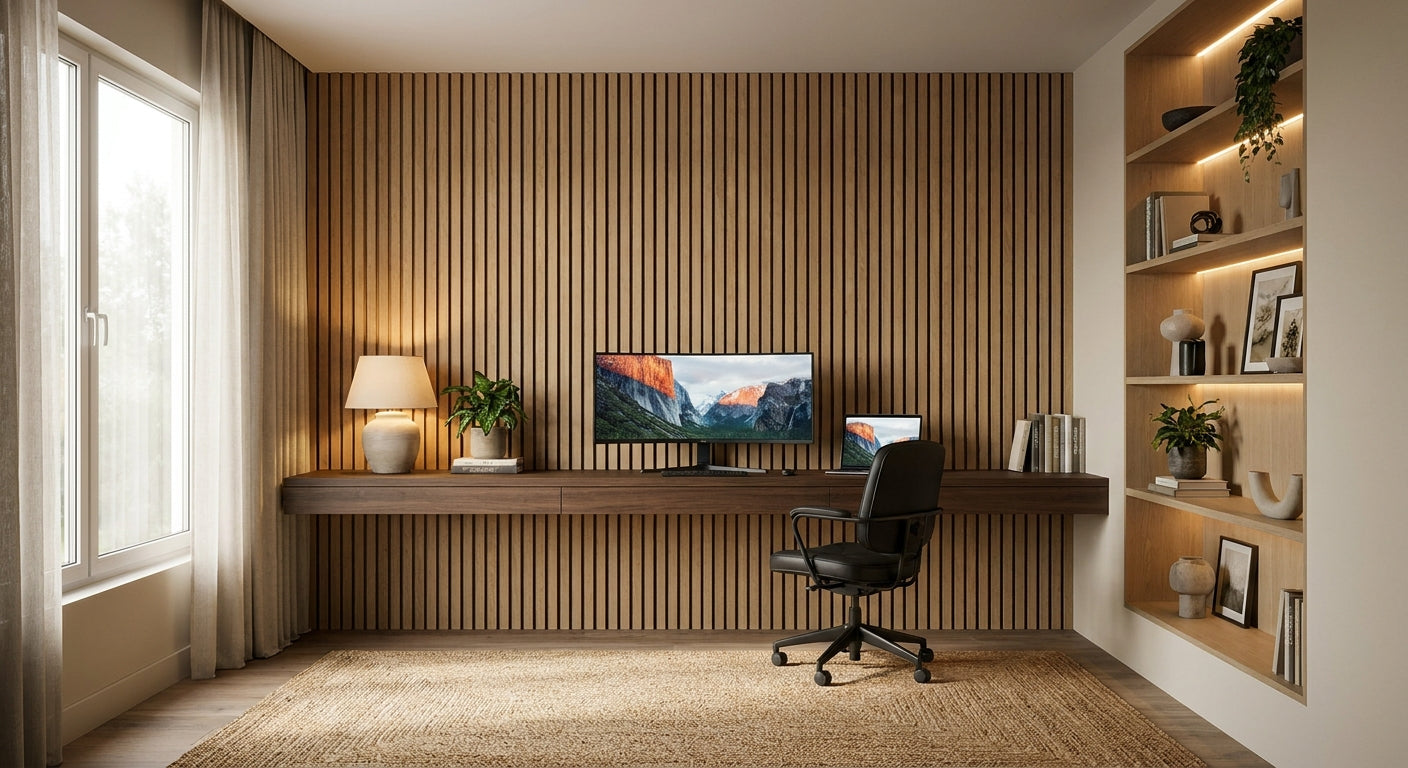
Oak wall panels transform a home office from a generic spare room into a space that actually helps you think — and the species and finish you choose determines whether that panel also cuts echo, adds warmth, or does both at once.
TL;DR: For a home office in 2026, natural oak wall panels outperform painted MDF and plain plasterboard on every dimension that matters at a desk: acoustic dampening, visual calm, and long-term durability. Aku Wood Panel's wooden wall panel natural oak is the straight buy for most setups. If background echo on calls is the priority, the grey-felt-backed variant wins. Budget at least one full accent wall — typically 8–12 m² for a standard home office — before pricing the project.
Why this matters in 2026
Home offices are no longer temporary. The average UK remote worker now spends over 200 days per year at their home desk, and the workspace directly affects concentration, video-call quality, and perceived professionalism. Hard, parallel walls — the default in most spare bedrooms — create flutter echo that fatigues the voice and muddies audio on calls. Natural oak panels address both the acoustic and the aesthetic problem simultaneously, which is why demand for acoustic wood panelling in residential interiors has risen sharply since 2023.
Who this is for
This guide is written for the homeowner or remote worker fitting out a dedicated home office — not a developer kitting out 40 flats. You're likely working with one accent wall or two facing walls, a budget measured in hundreds rather than thousands, and a strong preference for a finish that still looks sharp on a video call background five years from now. If you're managing calls daily, recording content, or simply tired of a room that sounds like a bathroom, oak wall panelling is the most practical single upgrade available.
What to look for in oak wall panels for a home office
Acoustic performance
A panel that is purely decorative does nothing for echo. Look for products where the oak veneer or slat sits over a felt or mineral-wool backing — this is what actually absorbs mid-frequency sound (the range where human voices sit). The wooden wall panel natural oak grey felt pairs natural oak slats with a grey felt substrate specifically to achieve this. One covered accent wall (roughly 8–10 m²) is enough to reduce flutter echo to an acceptable level in a room under 20 m².
Veneer and finish quality
Home offices see direct, sustained light from monitors and task lamps — finishes that look good in a showroom can yellow or check under that exposure within 18 months. Natural oak with a UV-stable lacquer or an oiled finish holds colour far better than stained alternatives. Check whether the product ships pre-finished or requires site-applied sealing; pre-finished panels save time and guarantee an even coat.
Panel system and installation method
For a solo DIY fit, tongue-and-groove or clip-track systems cut installation time to a single afternoon per wall. Panels that require adhesive-only fixing are faster but permanent — avoid these if you rent or expect to reconfigure. Slat-style panels are more forgiving on walls that are not perfectly flat, which covers most UK Victorian and Edwardian terrace stock.
Coverage and batch consistency
Oak is a natural material. Panels from different production batches can show visible grain variation. For a home office accent wall, order your full m² requirement from a single batch. Most suppliers, including Aku Wood Panel, batch-code products; confirm this before splitting an order across delivery dates.
Weight and substrate compatibility
Standard plasterboard carries around 20 kg/m² before fixings become a structural consideration. Solid-wood slat panels can approach or exceed this, depending on thickness and backing. Confirm the panel weight per m² against your wall type — dot-and-dab plasterboard walls, common in UK new-builds, have a different load limit than solid brick or block.
Long-term sourcing and replaceability
If you damage one panel three years from now, can you still buy a matching replacement? Manufacturing suppliers who hold continuous stock of a core SKU are lower risk than one-off importers. Aku Wood Panel manufactures and supplies its acoustic wood panels as a direct-to-construction-and-interior operation, which generally means better stock continuity than retail intermediaries.
Top picks for home office oak wall panels
The straight buy — Wooden Wall Panel Natural Oak
Hook: The default choice for most home offices. Clean natural oak grain, pre-finished, acoustic-ready without the felt backer if your room is already reasonably quiet.
- Relevant spec: natural oak veneer or slat over a substrate designed for interior wall application
- Verdict: Buy. Works for 80% of home office setups, installs in a single session, and photographs well as a video call background. Wooden wall panel natural oak — start here.
The acoustic upgrade — Wooden Wall Panel Natural Oak Grey Felt
Hook: The right pick if you're on calls more than 2 hours a day or record any audio or video content.
- Relevant spec: oak slats bonded over a grey felt acoustic backing — the felt layer is doing active acoustic work, not just aesthetic work
- Concrete number: felt-backed slat panels typically achieve NRC (Noise Reduction Coefficient) values between 0.50 and 0.75 depending on slat spacing and room geometry
- Verdict: Buy if echo is a problem. Wooden wall panel natural oak grey felt is the single best upgrade for a call-heavy home office in 2026.
The tonal contrast — Wooden Wall Panel Smoked Oak
Hook: For offices with dark furniture, concrete-effect flooring, or a deliberate moody palette — where natural oak reads as too light.
- Relevant spec: smoked oak finish gives a darker, cooler grain without paint or stain; the underlying wood structure and acoustic properties are the same as natural oak variants
- Verdict: Consider. Not the universal pick, but the wooden wall panel smoked oak earns its place in darker, more deliberate interiors. Skip if your room is already low-light.
The statement piece — Hexagon Acoustic Panel Natural Oak
Hook: Geometric format that treats the wall as a design feature rather than a background surface.
- Relevant spec: hexagonal tile format in natural oak with acoustic properties; can be arranged in clusters rather than full-wall coverage
- Concrete number: hexagon panels let you achieve acoustic treatment with as little as 3–4 m² of coverage, placed strategically behind the primary reflection points
- Verdict: Consider for creatives and content producers who want a distinctive visual. The hexagon acoustic panel natural oak is a higher-effort install but a stronger visual statement than flat slat panels. Skip if you want a clean, minimal look.
What to avoid
- PVC wood-effect panels sold as acoustic products. These look like oak in a product photo and cost 30–40% less, but the acoustic absorption is negligible and the surface degrades under sustained UV. You'll be replacing them within 3 years.
- Solid hardwood planks without acoustic backing. Solid wood is durable and beautiful, but a flat dense surface reflects sound rather than absorbing it. In a hard-walled home office, adding a reflective surface makes the room louder, not calmer. Unless you're specifically after a decorative-only finish and the room acoustics are already managed, avoid solid-plank systems with no backing layer.
- Oversized panels for a solo DIY install. Panels wider than 600 mm become difficult to manage alone on a wall without a second pair of hands or temporary support battens. Check panel dimensions before ordering; slat-format products in the 200–400 mm width range are far more manageable for a single-person fit.
Verdict comparison
| Panel | Acoustic performance | Visual character | DIY install ease | Best for |
|---|---|---|---|---|
| Natural Oak | Medium | Neutral, bright grain | High | Most home offices |
| Natural Oak Grey Felt | High | Neutral, slight texture depth | High | Call-heavy / recording setups |
| Smoked Oak | Medium | Dark, cool grain | High | Dark-palette interiors |
| Hexagon Natural Oak | Medium–High | Geometric statement | Medium | Creative / content-producer offices |
FAQ
What are the best oak wall panels for a home office in 2026? For most home offices, the natural oak slat panel with a felt backing is the strongest all-round choice in 2026 — it handles both aesthetics and call acoustics in one product. If echo is not a concern, the standard natural oak panel covers the brief at a simpler price point.
Do oak wall panels actually reduce echo on video calls? Yes, but only if the panel includes an acoustic backing layer. Decorative-only oak panels (solid veneer on a hard substrate) reflect sound and can make a room marginally worse. Felt-backed or mineral-wool-backed slat panels absorb mid-frequency sound — the range that carries voice — and one accent wall of 8–10 m² is enough to produce a noticeable improvement in a standard spare bedroom.
How much does it cost to panel a home office wall with oak panels in 2026? A standard 10 m² accent wall in a UK home office using acoustic slat panels typically costs between £400 and £900 in materials, depending on panel format and backing specification. Add £100–£200 for battens, fixings, and finishing trims if you're DIY-installing.
Can I install oak wall panels myself, or do I need a joiner? Most slat-format panels with a clip-track or tongue-and-groove system are DIY-accessible. A 10 m² wall takes most people 4–6 hours on a first install. Hexagonal formats take longer due to layout planning. You need a track saw or jigsaw for cuts, a spirit level, and a stud finder if fixing to plasterboard.
Is natural oak or smoked oak better for a home office? Natural oak suits bright rooms and lighter furniture palettes; the grain reads warm and neutral on camera. Smoked oak suits darker interiors or a deliberate industrial aesthetic. Neither is acoustically superior to the other — the difference is purely visual.
How many square metres of panelling does a home office need? For acoustic improvement, one wall of 8–12 m² is sufficient in a room under 20 m². For pure aesthetics, even a single 3–4 m² feature section behind a desk reads well on video. More coverage improves acoustic performance proportionally, but the first wall delivers the biggest return.
Will oak wall panels fade or change colour over time? Natural oak lightens slightly with UV exposure over the first 12–18 months, then stabilises. Pre-finished panels with a UV-stable lacquer slow this process. Smoked oak, being darker, shows early light exposure more noticeably before reaching a stable tone. Oiled finishes require periodic re-oiling (typically every 2–3 years) to maintain appearance.
Are acoustic wood panels suitable for rented home offices? Panel systems using a batten-and-clip track are reversible — the battens fix to the wall but leave only small fixings when removed, which is within standard UK tenancy repair obligations in most cases. Adhesive-direct systems are not reversible; avoid these in rented properties without landlord consent.
One last thing
Oak's grain direction matters more than most buyers realise. Vertical slats in a standard-height room (2.4 m) make ceilings feel higher and the space feel more focused — which is measurably better for sustained concentration work. Horizontal slats on the same wall make the room feel wider but lower. For a home office where you're sitting and looking forward at a screen, vertical orientation is almost always the stronger call.
Share:
How to Install Oak Wall Panels — 2026 Guide
How to Install Oak Wall Panels — 2026 Guide