

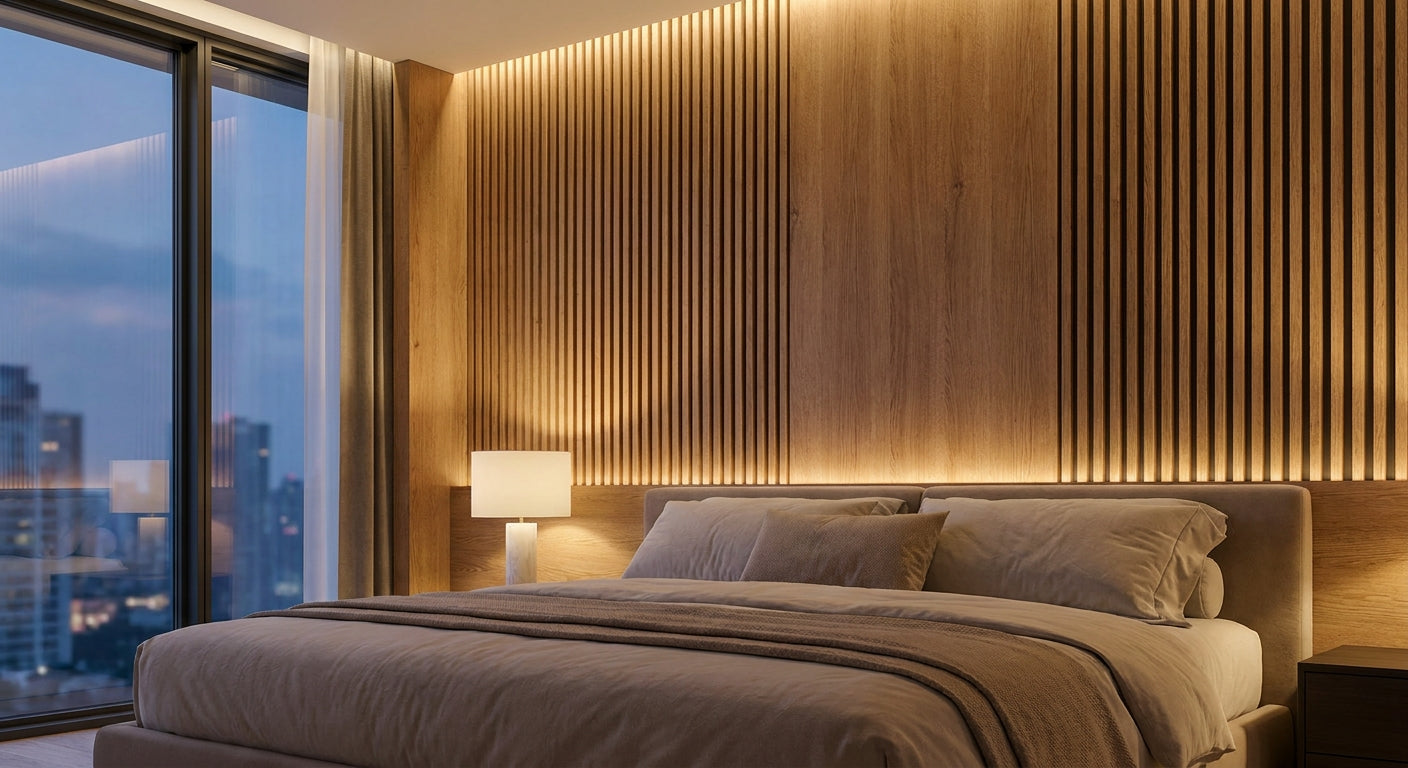
Acoustic panels for hotel bedroom walls serve two purposes at once: they cut reverberation that makes rooms feel cheap and noisy, and they deliver the warm, textured aesthetic that guests photograph and remember. This guide covers what to look for, which Akustiq UK panels suit hotel bedrooms best, and what to avoid when specifying for commercial use in 2026.
TL;DR: Hotel bedroom walls need acoustic panels that absorb mid-frequency echo, survive housekeeping cycles, and look premium enough to justify the room rate. Akustiq UK's wooden slat wall panels — featuring a 3-sided real wood veneer finish over an acoustic felt backing — are the standout choice for headboard walls and alcoves in 2026. Natural Oak and Walnut finishes photograph best; Black Oak works for boutique or moody-aesthetic properties. Order samples before committing to a full room specification.
Why acoustic panels matter in hotel bedrooms in 2026
Guest review platforms increasingly cite noise and echo as top complaints — ahead of bed comfort in several 2026 hospitality surveys. Hard plaster walls, tiled en-suites, and minimal soft furnishings create reverberation times that make every sound intrusive: the TV bleeds into conversation, voices carry through walls, and HVAC hum becomes exhausting. A single treated feature wall — typically the headboard wall — can reduce reverberation time measurably without requiring structural work or specialist contractors.
Wood slat acoustic panels sit at the intersection of performance and interior design. The slat geometry and the felt backing absorb sound across the mid-frequency range (roughly 500 Hz–2 kHz), which is where speech intelligibility is most affected. They also read as a deliberate design choice rather than a remedial fix, which matters for guest perception and photography.
Who this guide is for
This guide is written for hotel owners, interior designers, and fit-out contractors specifying acoustic panels for hotel bedroom walls — whether that's a 20-room boutique property, a serviced apartment block, or a branded hotel refurbishment. If you're sourcing panels for a single room or running a pilot before a full rollout, the sample options listed below let you verify finish and scale before ordering in volume.
What to look for in acoustic panels for hotel bedroom walls
Real wood veneer, not printed film
Printed film finishes delaminate under the humidity cycles that come with daily en-suite use. A 3-sided real wood veneer holds its appearance through years of housekeeping and seasonal humidity changes. The veneer also photographs with authentic grain variation — no two panels look identical — which is a practical advantage in rooms that guests will share on social media.
Acoustic felt backing
The felt layer is what turns a decorative panel into a functional acoustic treatment. Without it, slatted wood panels are purely visual. For hotel bedrooms, look for panels where the felt is bonded to the panel substrate rather than a separate layer installed behind — this simplifies installation and prevents the felt from shifting over time.
Panel dimensions suited to standard room heights
Most UK hotel bedrooms have ceiling heights between 2.4 m and 3.0 m. Panels available in both 240 cm and 300 cm lengths mean you can achieve a floor-to-ceiling run without horizontal joins on the headboard wall — joins read as DIY rather than designed in a hospitality context. The 300 cm format is particularly useful in older properties with higher ceilings.
Finish durability across multiple finishes
A hotel bedroom specification often uses 2–3 finishes across different rooms or zones. Sourcing from a single supplier with consistent colour matching across Natural Oak, Walnut, Smoked Oak, Black Oak, and other finishes means the panels read as a coordinated design language across the property rather than a patchwork of different products.
Low-mess installation
Hotel fit-outs run to tight programmes. Panels that fix directly to plasterboard with panel adhesive — without requiring battens, specialist fixings, or wet trades — reduce install time per room significantly. End pieces that cap exposed slat ends cleanly matter here too: a ragged edge on a headboard wall fails a snag inspection.
Finish sampling before full order
What reads as "Natural Oak" on a screen can look entirely different under warm LED downlights at 2,700 K versus cool lighting at 4,000 K. Sampling individual finishes before committing to a room count is non-negotiable for commercial specifications. Akustiq UK offers individual sample wooden wall panel natural oak and equivalent samples across the finish range, which is the correct starting point for any hotel project.
Top picks for hotel bedroom walls
Natural Oak — the safe specification
Natural Oak is the finish that works across the widest range of hotel bedroom styles: Scandi-minimal, soft contemporary, and country-house boutique. The warm grain reads as premium under both warm and neutral lighting, and it ages gracefully if panels are exposed to direct sunlight near windows. The wooden wall panel natural oak is available in both 240 cm and 300 cm lengths, covering most UK hotel ceiling heights without a join.
Verdict: Buy. The default specification for headboard feature walls in 2026.
Walnut — the premium upgrade
Walnut's deeper, darker grain reads as more expensive than oak at the same price point — a useful trick when you need a room to feel like a higher category than its square footage suggests. It pairs well with brass hardware, dark joinery, and upholstered headboards in charcoal or deep green. The wooden wall panel walnut suits four- and five-star properties where the aesthetic brief calls for warmth without going as dark as Black Oak.
Verdict: Buy. Strong choice for suites and signature rooms.
Smoked Oak — the design-led option
Smoked Oak sits between Natural Oak and Black Oak on the tone spectrum: grey-brown with visible grain, it photographs with strong contrast under directional lighting. It suits boutique properties with a raw, textural brief — exposed concrete, linen textiles, matte black ironmongery. The wooden wall panel smoked oak is the right panel for properties that want something more distinctive than oak without committing to a fully dark room.
Verdict: Buy. Ideal for boutique and design-led hotel refurbishments in 2026.
Black Oak — the wildcard
Black Oak is a deliberate aesthetic statement. Used on a full headboard wall it creates a dramatic, cocoon-like quality that works well in city-centre boutique hotels and converted industrial properties. It requires confident lighting design — warm, directional sources — to avoid the room feeling oppressive. The wooden wall panel black oak is not a safe default, but in the right brief it is the most photographed finish in the range.
Verdict: Consider. Right for specific briefs; sample under your lighting conditions first.
Grey Oak with Grey Felt — the acoustic-first pick
Where acoustic performance is the primary driver — adjacent to plant rooms, lift shafts, or noisy corridors — the wooden wall panel natural oak grey felt offers a visible grey felt reveal between slats that signals the acoustic intent. The grey felt reads well in contemporary rooms with grey or neutral palettes and reinforces the panel's functional purpose visually.
Verdict: Consider. Best when acoustic performance needs to be demonstrable rather than hidden.
What to avoid
- Foam-backed acoustic tiles. Foam degrades under cleaning products and looks institutional. A hotel bedroom is not a recording studio — the finish matters as much as the absorption coefficient.
- Panels without end-piece trims. Exposed MDF or substrate edges on a headboard wall fail even a basic snag inspection. Always specify matching end pieces alongside panels — they are available per finish in the Akustiq UK range.
- Installing without sampling under room lighting. The single most common specification error in 2026 hotel fit-outs is approving a finish from a screen or a showroom with different lighting conditions than the actual room. Order samples, fix one to the wall, and view it under the room's actual luminaires at both day and night settings.
Comparison table
| Finish | Tone | Best room type | Acoustic felt | 300 cm format | Verdict |
|---|---|---|---|---|---|
| Natural Oak | Warm mid | All bedroom types | Yes | Yes | Buy |
| Walnut | Warm dark | Suites, premium rooms | Yes | Yes | Buy |
| Smoked Oak | Cool grey-brown | Boutique, design-led | Yes | Yes | Buy |
| Black Oak | Dark, dramatic | City boutique, industrial | Yes | Yes | Consider |
| Natural Oak Grey Felt | Warm + grey reveal | High-noise adjacencies | Yes (visible) | Yes | Consider |
FAQ
What are the best acoustic panels for hotel bedroom walls in 2026? Wooden slat panels with a real wood veneer and acoustic felt backing are the best acoustic panels for hotel bedroom walls in 2026. They absorb mid-frequency reverberation, survive commercial use, and read as a designed feature rather than a remedial treatment.
How many panels do you need for a hotel headboard wall? A standard UK hotel headboard wall of 1.8 m wide by 2.4 m high requires approximately 3–4 panels depending on panel width. Use the 300 cm format if your ceiling height exceeds 2.4 m to avoid horizontal joins.
Do acoustic wood panels actually reduce noise in hotel rooms? They reduce reverberation — the echo and linger of sound within the room — rather than blocking sound transmission through the wall structure. For a guest, the practical effect is a quieter-feeling room with less TV bleed and clearer conversation. For sound transmission between rooms, structural isolation measures are required in addition.
Which wood finish works best for hotel bedrooms? Natural Oak is the safest specification across the widest range of hotel styles. Walnut suits premium and suite-level rooms. Smoked Oak and Black Oak are correct for boutique and design-led properties with confident lighting schemes.
Can hotel maintenance staff repair or replace individual panels? Yes. Panels installed with panel adhesive can be replaced individually without disturbing adjacent panels. Ordering 5–10% extra panels per finish at the time of the original order means replacements are available without a lead-time delay.
Are these panels suitable for rooms with en-suite humidity? The panels are designed for indoor wall use. They should not be installed in direct splash zones or steam-heavy areas. For an en-suite wall or a wall adjacent to a wet area, maintain a clear zone of at least 300 mm from the water source.
How long does it take to panel a hotel bedroom headboard wall? A single headboard wall — 4 panels, clean plasterboard substrate — takes an experienced fitter approximately 2–3 hours including adhesive cure time. This makes panelling viable within a standard hotel room turnaround during a phased refurbishment.
Do you need to batten the wall before fitting acoustic wood panels? Not for plasterboard substrates in good condition. Panels fix directly with panel adhesive, which eliminates the need for battening and keeps the installation programme on schedule.
One last thing
Hotel guests spend roughly 7–8 hours in a bedroom in near-silence. That is the environment in which poor acoustics are most noticeable — and where a well-treated headboard wall makes the biggest perceptible difference. A single wall of acoustic slat panels costs a fraction of a mattress upgrade, yet it addresses one of the top-rated guest complaints on review platforms in 2026. Specify the samples first, confirm the finish under your room lighting, and the installation follows straightforwardly.
Share:
Acoustic Panels for Office Breakout Rooms 2026
Acoustic Panels for Estate Agent Office Walls (2026)