

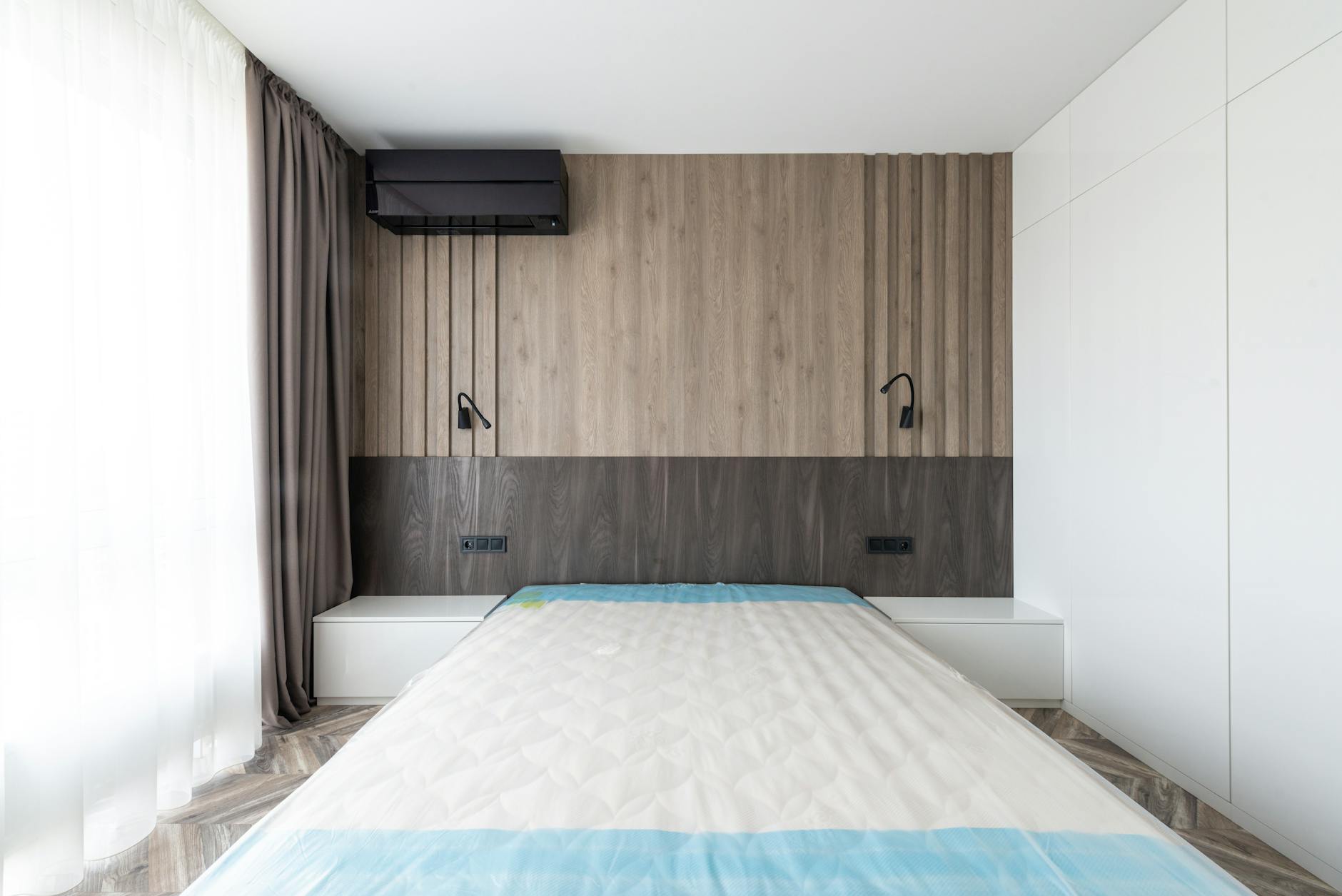
Smoked oak wall panels are one of the most effective ways to create a bedroom accent wall that feels designed rather than decorated — and in 2026, the demand for darker, more tactile finishes in sleeping spaces has never been stronger.
TL;DR: For a bedroom accent wall in 2026, smoked oak wall panels deliver the warmth of real timber with a darker, moodier tone that plain oak cannot match. Aku Wood Panel's wooden wall panel smoked oak is the standout pick for most bedrooms — real oak slats over acoustic felt backing, combining visual depth with noise-dampening performance. If your room runs light and you want contrast without committing fully to smoke, the natural oak with grey felt version is the sensible alternative. Skip raw MDF "wood-effect" panels entirely — they sag, they don't absorb sound, and they look cheap within 18 months.
Why this matters in 2026
Bedroom design has shifted away from plain feature-wall paint and mass-market wallpaper. Homeowners and interior designers across the UK are specifying real-wood slat panels for the behind-the-bed wall because they perform two jobs at once: they add visual texture that anchors the room, and the acoustic felt backing cuts flutter echo and low-frequency room noise — genuinely useful in a sleeping environment. Smoked oak specifically sits in the sweet spot between the pale Scandi look (natural oak) and full dark panelling (painted MDF), making it versatile across bedroom palettes from warm grey to deep navy to off-white.
Who this guide is for
This page is written for homeowners, interior designers, and self-builders who are planning a bedroom accent wall in 2026 and want real wood — not foil-wrapped board, not vinyl, not printed paper. You are probably fitting a single feature wall behind a bed head, you care about finish quality and longevity, and you want panels that look as good in five years as they do on day one. If you are also fitting panels in a home office or living room in the same project, the related guides at the bottom of this page will cover those rooms.
What to look for in smoked oak panels for a bedroom
Real wood veneer or solid slats — not foil
Smoked oak finish on real timber holds colour through the grain, resists peeling, and ages in a way that looks intentional. Foil-wrapped board mimics the look for about 12–18 months before edges lift, especially on walls that experience any temperature variation — which bedrooms do, near radiators and windows. Always confirm the spec sheet says "oak veneer" or "solid oak slats" before ordering.
Acoustic felt backing
A bedroom is where sound quality matters most. Panels with an acoustic felt layer behind the slats absorb mid-frequency sound — the range that carries voices and TV audio through walls and ceilings. This is not a marginal benefit: a full accent wall of acoustic-backed panels on the bed-head wall measurably reduces the echo in the room, which improves sleep quality. Panels without backing do nothing acoustically.
Slat spacing and shadow lines
The visual rhythm of a panel comes from the gap between slats. Narrow gaps (8–10 mm) read as dense and formal; wider gaps (12–16 mm) feel more relaxed and let more of the dark felt backing show through, which deepens the smoked-oak effect. For a bedroom, wider spacing often works better — the contrast between the dark backing and the smoked timber grain creates a layered depth that photographs well and looks considered in person.
Panel dimensions and waste calculation
Standard UK bedrooms run 2.4 m ceiling height. Panels designed for full-height installation in 2400 mm lengths eliminate horizontal joins, which would interrupt the vertical slat line. Confirm panel height before ordering, and add 10% to your measured wall area for cutting waste, particularly around sockets, switches, and coving.
Finish durability
The smoked finish on oak is achieved through a fuming or staining process that penetrates the timber. UV exposure bleaches lighter finishes over time, but smoked oak — being darker — retains its tone much longer in normal interior conditions. Matte or satin lacquer over the top extends durability further. Ask whether the panels come pre-finished or raw.
Ease of installation
For a DIY fit on a single bedroom wall, tongue-and-groove or clip-rail mounting systems are significantly faster than direct adhesive methods, and they allow individual panels to be removed if damaged. Check whether the system includes a mounting rail or requires separate battening.
Top picks for bedroom accent walls
The benchmark pick — Aku Wood Panel Smoked Oak
Hook: The straightforward choice for anyone who wants smoked oak done properly.
Real oak slats, smoked finish, acoustic felt backing — this panel covers all three non-negotiable criteria for a bedroom accent wall. The felt layer handles sound absorption; the smoked oak grain gives you the moody, warm-dark finish that works against white, grey, or bold bedroom colour schemes. In 2026, this is the panel most interior designers in the UK are specifying for behind-the-bed feature walls.
The spec delivers full-height panels suited to standard UK ceiling heights, pre-finished surface, and a mounting system designed for a single-person fit.
Verdict: Buy. This is the panel the rest of this guide is measured against. See the wooden wall panel smoked oak for full dimensions and pricing.
The lighter alternative — Natural Oak with Grey Felt
Hook: For bedrooms where smoked oak reads too dark against the existing palette.
If your bedroom is already working with warm timber furniture, natural flooring, or a lot of earthy tones, full smoked oak can compete rather than complement. The wooden wall panel natural oak grey felt gives you the same acoustic-backed construction — felt layer, real oak slats, identical dimensions — but the lighter natural oak finish keeps the wall from dominating. The grey felt backing still shows through the slat gaps, giving a cooler visual tone that bridges the gap between natural and smoked.
Verdict: Consider if your room is warm-toned or small and you are worried smoked oak will make the space feel enclosed.
The texture wildcard — Hexagon Acoustic Panel Natural Oak
Hook: Breaks the vertical-slat convention entirely; best used as a partial accent rather than a full wall.
The hexagon acoustic panel natural oak is a different shape category — tiled geometric panels rather than floor-to-ceiling slats. On a full bedroom accent wall it can read as busy, but as a panel cluster above a bed head or in a recessed alcove, it creates a focal point that linear slat panels cannot. Still acoustic-backed, still real oak.
Verdict: Consider for partial or feature-within-a-feature applications. Not a direct substitute for smoked oak slats on a full-height wall.
What to avoid
- MDF "smoked oak effect" panels. The foil finish looks passable in a showroom under controlled lighting. In a bedroom with natural light shifting through the day, the flatness of the printed grain is obvious at an angle. These panels also have zero acoustic benefit.
- Panels sold without an acoustic backing option. In a bedroom, unlined slat panels are decorative-only. They do not reduce room echo, and you will notice the difference on the first night with hard surfaces around you.
- Panels shorter than your ceiling height. A horizontal join mid-wall on a bedroom feature wall is very hard to make look intentional. Measure your ceiling height before ordering, confirm panel lengths, and order custom lengths if your room runs over 2400 mm.
Comparison table
| Panel | Real oak | Acoustic felt | Smoked finish | Full height | Best for |
|---|---|---|---|---|---|
| Smoked Oak Slat Panel | Yes | Yes | Yes | Yes | Most bedrooms — Buy |
| Natural Oak Grey Felt | Yes | Yes | No | Yes | Warm-toned rooms — Consider |
| Hexagon Natural Oak | Yes | Yes | No | No (tile format) | Partial accent — Consider |
| MDF foil "wood effect" | No | No | Printed only | Varies | Skip |
FAQ
What are smoked oak wall panels for bedrooms? Smoked oak wall panels are real-timber slat panels with a darkened, grain-rich oak finish, typically mounted on acoustic felt backing. In 2026 they are one of the most popular choices for bedroom accent walls in UK homes because they combine visual depth with sound-absorbing performance.
Are smoked oak wall panels hard to install in a bedroom? A single bedroom accent wall is a realistic DIY project in a day. Panels with a clip-rail or tongue-and-groove mounting system are the easiest to fit; direct-adhesive methods are faster but do not allow removal. The how to install natural oak wall panels guide covers the full process step by step.
How many panels do I need for a bedroom accent wall? Measure the wall width and height, multiply for total area, then add 10% for cuts and waste. A standard UK behind-the-bed wall — typically 3.6 m wide by 2.4 m high — is 8.64 m², so order for roughly 9.5 m² minimum.
Do smoked oak wall panels reduce noise in a bedroom? Panels with an acoustic felt backing absorb mid-frequency sound and reduce flutter echo. A full accent wall does make a measurable difference in a bedroom, particularly where hard floors and plasterboard walls are involved. Panels without backing provide no acoustic benefit.
Is smoked oak darker than natural oak? Yes. The smoking or fuming process darkens the grain and gives the timber a rich, warm-brown-to-charcoal tone depending on the finish. Natural oak sits in the pale golden range; smoked oak reads as 30–50% darker in most interior lighting conditions.
Will smoked oak panels fade in a bedroom? Darker finishes like smoked oak are more UV-stable than lighter stains. In a bedroom with indirect natural light, a pre-finished panel should hold its colour for many years without retreatment. South-facing rooms with significant direct sun exposure may need periodic re-oiling after 5–7 years.
Can I use smoked oak panels on all four bedroom walls? Technically yes, but visually the effect is usually strongest on a single accent wall. Four smoked oak walls in a standard UK bedroom can feel heavy unless the room is large (above 18 m²), has high ceilings, and is balanced with lighter furnishings and good lighting.
What colour bedroom works best with smoked oak wall panels? Smoked oak panels are most versatile against white, off-white, warm grey, or deep navy walls. They also work with terracotta and dusty-pink palettes in 2026 bedroom trends. Avoid pairing with very warm orange-toned timbres on other furniture — the contrast becomes muddy rather than intentional.
One last thing
Smoked oak gets its distinctive colour not from paint or stain in the conventional sense, but from the ammonia-fuming process originally used by Arts and Crafts furniture makers in the late 19th century to darken quarter-sawn oak. The chemical reaction between ammonia vapour and the tannins naturally present in oak — not an applied pigment — creates the colour. That means the finish runs through the wood fibre rather than sitting on top of it, which is why smoked oak panels hold their tone through surface scratches that would expose raw wood on a stained or foil-finished panel.
Share:
How to Style Smoked Oak Wall Panels (2026 Guide)
Grey Felt Acoustic Panels for Recording Studios 2026