

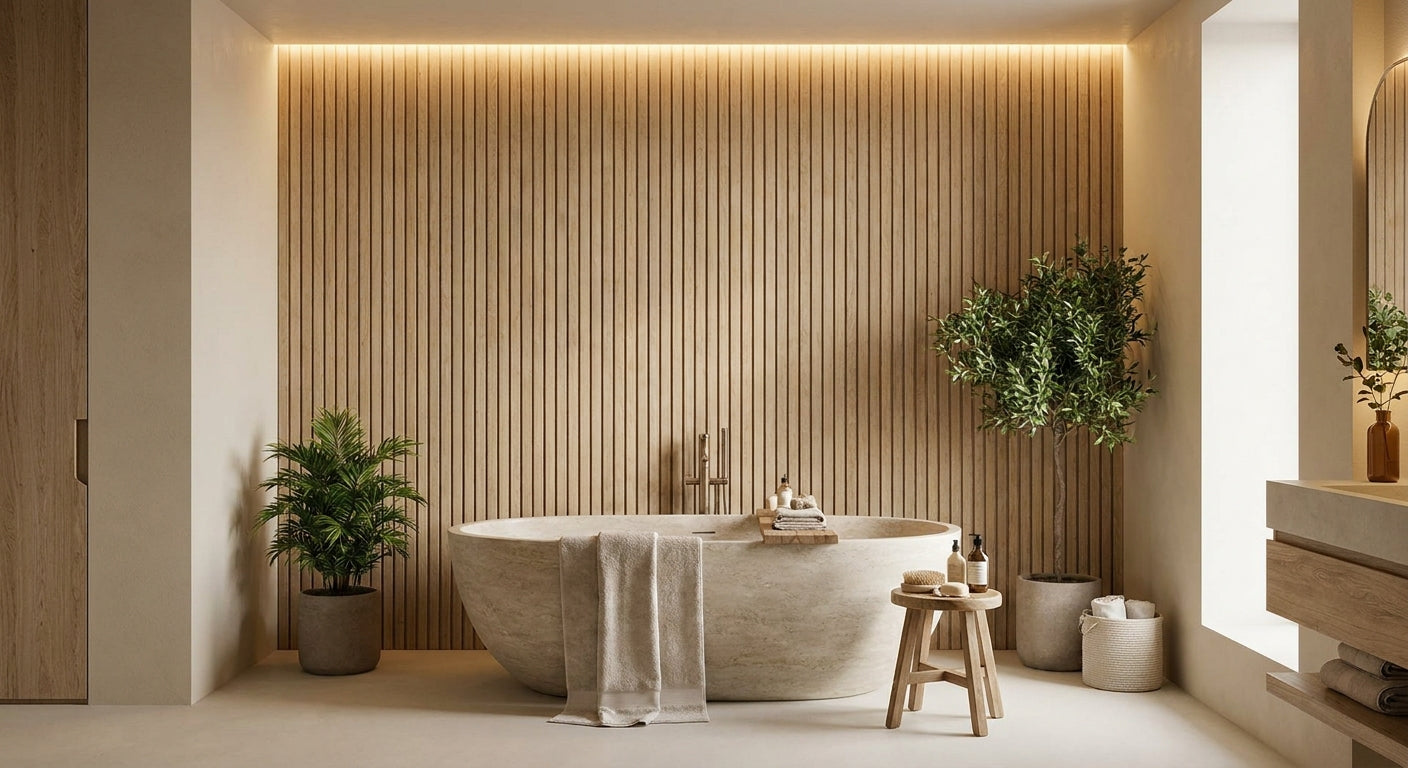
Wall panels for spa room settings need to do more than look good — they must handle humidity, absorb sound, and create the sensory calm that makes a wellness space worth the investment.
TL;DR: For spa and wellness room interiors in 2026, acoustic wood panels are the strongest choice. Natural oak and smoked oak finishes deliver the biophilic warmth that relaxation rooms demand, while the slatted construction diffuses sound and reduces echo without mechanical intervention. Aku Wood Panel supplies acoustic wood panels in four core spa-ready finishes — natural oak, smoked oak, walnut, and grey oak — each rated for interior installation. Buy natural oak or smoked oak for the majority of spa walls; consider walnut for feature walls and treatment room headwalls.
Why wall material matters more in a spa than anywhere else
A spa room asks more of its surfaces than a lounge or office. Humidity from steam, heat from infrared panels, and the acoustic requirement to kill hard reverb all converge on the same four walls. Hard tile or painted plaster reflects sound and creates a clinical echo — the opposite of what a wellness space needs. Untreated solid wood warps. The answer that holds up in 2026 is engineered acoustic wood panels: a slatted front face over a sound-absorbing felt backing, dimensionally stable, and available in finishes that read as natural timber without the maintenance burden of solid wood.
Sound absorption is not decorative. A typical tiled wet room has a reverberation time above 1.5 seconds. Acoustic slat panels with grey felt backing reduce that figure significantly, making spoken guidance, relaxation audio, and ambient music perceptibly cleaner at low volume.
Who this guide is for
This page is written for interior designers, spa fit-out contractors, and private homeowners converting a room into a dedicated wellness or treatment space. If you are specifying panels for a commercial spa, a garden-room sauna annex, or a home steam room with a dry relaxation zone, the criteria below apply directly to your project.
What to look for in wall panels for a spa room
Dimensional stability under humidity
Spa rooms cycle between ambient temperature and elevated heat and moisture. Solid timber expands and contracts visibly across this range. Engineered acoustic panels use an MDF or composite core with a real-wood veneer or laminate face — this construction resists the racking and cupping that ruins solid boards. Check that the panel you specify is rated for interior use and that the manufacturer confirms the core material before ordering.
Acoustic performance
The felt backing layer is what separates a decorative slat panel from a functional acoustic one. Panels with a grey felt backer absorb mid and high frequencies, reducing flutter echo between parallel hard surfaces — a common problem in rectangular spa rooms. For a room under 20 m², a single feature wall treated with acoustic panels measurably shortens reverberation. For larger wellness suites, treat two opposing walls.
Finish and tone — biophilic warmth vs. drama
Natural oak reads light and Scandinavian — the default choice for rooms designed around calm and restoration. Smoked oak shifts the palette darker, adding depth without losing the warmth of wood grain. Walnut is the richest option, best used on a single headwall or behind a treatment bed rather than across every surface. Grey oak sits between natural and smoked, pairing well with concrete, stone, and matte metal fittings that appear frequently in contemporary wellness design in 2026.
Panel width and slat pitch
Narrower slats create visual busyness; wider slats read calmer. For spa rooms, a wider slat pitch is almost always the right call — it reduces the optical complexity of the wall and lets the wood grain rather than the repetition become the visual point. Confirm slat dimensions in a physical sample before committing to full coverage; colours and scale read differently at room scale than on a screen.
Ease of installation in confined spaces
Treatment rooms and home spa conversions are typically small. Panels that click or bond directly to a prepared wall surface with panel adhesive are considerably easier to fit in tight spaces than screw-fixed battened systems. Aku Wood Panel's range installs with high-tack panel adhesive, which is workable for a single fitter in a room where swinging a nail gun is impractical.
Sample availability before full order
No finish looks identical on a screen and in situ under LED or warm lighting. Every finish in the Aku Wood Panel range is available as a cut sample, which lets you hold the actual veneer against your wall, floor, and light source before ordering 20 or 30 panels. This step eliminates the most common and costly mistake in spa fit-outs: committing to a finish that conflicts with the tile, stone, or sanitaryware already specified.
Top picks for spa and wellness room wall panels in 2026
Natural Oak — the safe pick
Hook: The default specification for spa designers who want warmth without risk.
Natural oak veneer over an acoustic felt-backed core. The grain is straight and pale, reading as clean and organic under both warm and neutral white light. This is the finish that photographs well in wellness branding and ages without clashing with updates to soft furnishings.
Verdict: Buy — correct for the majority of spa walls, steam room dry zones, and relaxation lounges. Order a sample wooden wall panel natural oak before committing to the full run.
Smoked Oak — the atmospheric pick
Hook: For spa rooms designed around low light, candlelight, and intentional drama.
Smoked oak applies a heat-treatment process to the veneer that darkens the grain and shifts the tone towards amber-brown. In 2026, this is the panel of choice for infrared sauna rooms, flotation tank ante-rooms, and any wellness space targeting a luxury hotel aesthetic. It absorbs light rather than reflecting it, which reinforces the sense of enclosure that deep relaxation requires.
Verdict: Buy — especially where lighting is controlled and the brief calls for a high-end feel. The wooden wall panel smoked oak is the most popular darker finish in this category.
Walnut — the feature wall pick
Hook: Too rich for every surface; perfect for one.
Walnut veneer is the most visually commanding option in the Aku Wood Panel acoustic range. The chocolate-brown tone with darker streaking draws the eye immediately. Used across four walls it becomes heavy; used on the wall behind a treatment bed or opposite the entry point, it anchors the room and creates a focal hierarchy that interior designers describe as intentional rather than accidental.
Concrete number: Walnut panels are the same dimensions as natural and smoked oak, so a single feature wall in a 3 m × 3 m room requires roughly 9 m² of panel — a manageable quantity.
Verdict: Consider — strong for headwalls, less suited to full room coverage in most spa layouts.
Grey Oak — the minimalist pick
Hook: The finish that bridges warm wood and cool contemporary.
Grey oak sits at the cooler end of the wood spectrum, reading almost like weathered driftwood in certain lights. It pairs directly with polished concrete, pale stone tiles, and matte black or brushed steel fixtures — the material palette of Nordic and Japanese-influenced wellness design. In 2026, grey oak is increasingly specified for meditation rooms and sound bath spaces where the intent is emptiness rather than warmth.
Verdict: Consider — strong when the rest of the room is cool-toned; less effective against warm terracotta or cream stone.
What to avoid when specifying wall panels for a spa room
- Untreated solid timber boards. They look correct in photographs and fail in practice. Moisture cycling causes splitting and gap formation within 18 months in a spa environment.
- High-gloss or lacquered finishes. Reflective surfaces amplify echo and create visual tension. A spa room requires matte or satin surfaces that absorb rather than bounce light and sound.
- Panels without a felt or foam acoustic backer. A decorative slat panel with no backing layer does nothing for reverberation. The visual effect is similar to an acoustic panel; the acoustic effect is close to zero. Confirm the backing material before ordering.
Comparison table — spa panel picks in 2026
| Finish | Tone | Best use | Acoustic backer | Full-room suitable | Verdict |
|---|---|---|---|---|---|
| Natural Oak | Warm, pale | Relaxation rooms, reception | Yes (grey felt option) | Yes | Buy |
| Smoked Oak | Dark amber | Sauna, flotation, treatment | Yes | Yes | Buy |
| Walnut | Rich brown | Feature walls, headwalls | Yes | Use sparingly | Consider |
| Grey Oak | Cool grey | Meditation, Nordic-style spa | Yes | Yes | Consider |
FAQ
What are the best wall panels for a spa room in 2026? Acoustic wood slat panels in natural oak or smoked oak are the strongest choice. They combine genuine wood veneer with a sound-absorbing felt backing, are dimensionally stable in interior spa conditions, and are available in finishes suited to every wellness aesthetic currently in demand.
Are wood wall panels suitable for a steam room? Acoustic wood panels with an engineered core are more stable than solid timber but are not rated for direct steam exposure. Fit them in the dry relaxation zone adjacent to the steam room rather than inside the steam enclosure itself, where waterproof cladding is the correct specification.
How many wall panels do I need for a spa room? For a typical 3 m × 3 m room with 2.4 m ceilings, treating all four walls requires approximately 29 m² of panel, minus door and window openings. Treating one or two walls for acoustic effect requires 9–15 m². Use a panel calculator or contact the supplier for a room-specific estimate.
Do acoustic wood panels actually reduce noise in a spa room? Yes. Slatted acoustic panels with a felt backer absorb mid and high frequencies, measurably reducing reverberation time compared to bare plaster or tile. The effect is most pronounced when panels cover at least 25% of the total wall surface area.
Can I fit wood wall panels myself in a home spa conversion? Yes, using panel adhesive on a clean, dry, flat substrate. High-tack adhesive is workable for a single installer and avoids the need for visible fixings. Allow 24 hours curing time before the room is used.
Which wood finish is best for a dark spa room? Smoked oak is the correct call for low-light and deliberately dramatic spa spaces. Walnut works for a single feature wall. Avoid natural oak in very dark rooms — the pale grain reads washed-out under dim amber lighting.
Is natural oak or walnut better for a spa treatment room? Natural oak for the general wall treatment; walnut for the headwall behind the treatment bed. This combination creates hierarchy without the heaviness of full walnut coverage.
How do I order samples before buying spa wall panels? Aku Wood Panel offers individual cut samples for every finish in the acoustic range. Order a sample first, hold it under your actual room lighting, and confirm the tone against your floor, ceiling, and fixture choices before placing a full panel order.
One last thing
The single most common mistake in spa room panelling projects in 2026 is ordering without a physical sample. Screen rendering of wood veneer is consistently inaccurate — the same smoked oak finish looks warm amber under halogen, grey-brown under LED, and almost black under very low ambient light. A sample costs almost nothing and eliminates a four-figure mistake. Order the sample first, every time.
Share:
How to Order Acoustic Wall Panel Samples Online (2026)
Best Acoustic Panels for Nursery Walls 2026