

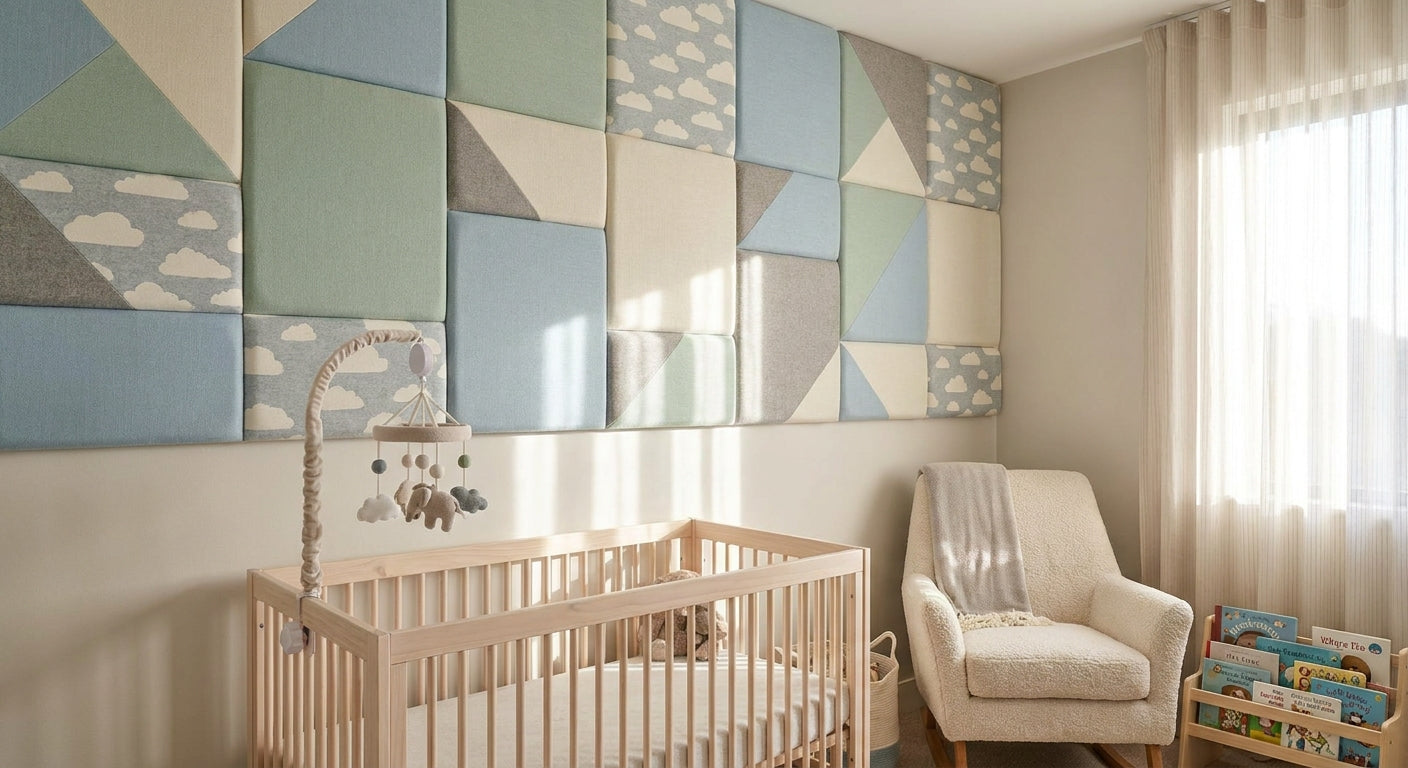
Acoustic panels for nursery walls do two jobs at once in 2026: they cut the echo and reverb that disrupt sleep, and they look warm enough to belong in a carefully designed baby room. This guide covers what to look for, which Aku Wood Panel formats suit a nursery, and what to avoid.
TL;DR: The best acoustic panels for nursery and baby room walls in 2026 combine real-wood slats with a felt backing that absorbs mid-frequency sound — the range where voices, crying, and household noise land. Natural Oak and Grey Oak finishes from Aku Wood Panel work especially well: pale enough for a nursery, acoustically effective, and free of harsh industrial aesthetics. Hexagon panels add a playful shape without sacrificing absorption. Order samples before committing to a full wall.
Why nursery acoustics actually matter
Newborns sleep between 14 and 17 hours a day, and the quality of that sleep is directly tied to the acoustic environment. Hard plaster walls reflect sound at rates above 90%, which means a single footstep or a muffled conversation in an adjacent room bounces around the space rather than being absorbed. Acoustic panels with a fibreglass or polyester felt backing typically achieve a Noise Reduction Coefficient (NRC) of 0.65–0.85, which halves the energy of reflected sound in the mid-frequency range (500 Hz–2 kHz). In a room measuring 3 m × 3 m, covering one feature wall — roughly 9 m² — is enough to produce a measurable reduction in reverberation time.
Who this guide is for
This guide is for parents, interior designers, and nursery fit-out contractors choosing wall panels for a baby or toddler room in 2026. You want acoustic performance, but you also need materials that are visually calm, easy to maintain, and safe to install in a room occupied by a small child. If you are specifying a commercial nursery or childcare setting, the same criteria apply — scale up panel coverage to 20–30% of total wall surface area.
What to look for in acoustic panels for a nursery
Safe materials and low VOC emissions
A nursery is a small, often under-ventilated room. Panels with high VOC (volatile organic compound) emissions off-gas into the air a baby breathes continuously. Look for panels constructed from sustainably sourced wood with a felt backing that carries no added formaldehyde. Aku Wood Panel's slat panels use an MDF substrate and polyester felt — polyester does not off-gas, and MDF sourced to E1 emission standards keeps formaldehyde levels well below EU limits.
Felt backing depth and NRC rating
The felt layer is where absorption happens. Thinner felt (under 9 mm) produces usable absorption only above 1 kHz — it misses the low-mid frequencies where crying and conversation sit. Panels with a 10–12 mm felt backing start absorbing meaningfully from around 500 Hz. Check that the product page states an NRC or sound absorption class rather than a vague "acoustic" claim.
Finish tone and nursery-appropriate colour
Deep, dark finishes — Smoked Oak, Black Oak, Mocca — can work in adult spaces but visually compress a small nursery. For a baby room, pale and mid-tone finishes keep the space feeling open and calm. Natural Oak and Grey Oak are the two strongest options: Natural Oak brings warmth without being heavy; Grey Oak sits between cream and ash and pairs cleanly with white furniture and pastel accents common in nursery schemes.
Panel format and visual scale
Full slat panels — typically 2400 mm × 600 mm per board — cover large wall areas efficiently, but they can feel architectural in a small room. Hexagon panels offer the same acoustic backing in a shape that reads as decorative and playful. A cluster of 6–9 hexagons on the wall behind the cot gives acoustic benefit at the most critical point (directly behind where the baby sleeps) without covering the entire wall.
Installation method and wall surface compatibility
Nursery walls are usually plasterboard or painted plaster. Slat panels fix directly using panel adhesive — Aku Wood Panel's high tack panel glue is formulated for this substrate and holds without mechanical fixings, which removes the risk of screws near a baby's sleeping area. Confirm the adhesive is fully cured (typically 24–48 hours) before bringing the baby back into the room.
Edge finishing and sharp-corner risk
Raw panel edges at low height create a hazard once the child is mobile. End-piece trims cap the exposed edges of slat panels flush and smooth, eliminating the splintered risk. Factor end pieces into your order from the start — cutting panels without finishing the cut edge is the most common installation mistake in domestic nursery fits.
Top picks from Aku Wood Panel for a nursery
Natural Oak — the safe pick
Natural Oak is the most nursery-compatible finish in the Aku Wood Panel range. The pale, warm tone photographs well in baby rooms, pairs with virtually every cot colour on the market, and the felt backing delivers reliable mid-frequency absorption. Verdict: Buy. Order a sample wooden wall panel — Natural Oak before committing to full panels to confirm the tone matches your lighting conditions.
Natural Oak with Grey Felt — the textural upgrade
The same Natural Oak slat on a grey felt backing rather than black. The grey felt shows between the slats, giving a softer, two-tone effect that works especially well in Scandinavian-influenced nursery schemes. The grey reads as neutral in almost all lighting. Verdict: Buy. This finish is the strongest all-round choice for 2026 nursery interiors where the walls need to do double duty as a focal point.
Grey Oak — the minimalist option
Grey Oak sits closer to ash than oak in tone, giving a cooler, more contemporary result. If the rest of the nursery leans Nordic — white walls, natural linen, light grey furniture — Grey Oak integrates without competing. The acoustic performance is identical to Natural Oak. Verdict: Buy for neutral or cool-toned nursery schemes.
Hexagon panels — the wildcard
Hexagon acoustic panels from Aku Wood Panel are available in Natural Oak, Smoked Oak, Walnut, and Grey Walnut, each with an optional grey felt variant. A group of hexagon acoustic panels in Natural Oak with grey felt installed above the cot creates a focused acoustic zone without covering the full wall. The shape is inherently more playful than a rectangular slat run — appropriate for a child's room in a way that a full boardroom-style acoustic wall is not. Verdict: Consider if you want targeted absorption and a decorative result on a partial wall.
Dreams finish — the statement choice
The Dreams finish is a softer, lighter-toned panel in the Aku Wood Panel range — the name and aesthetic position it closer to a lifestyle or boutique interior than the standard oak finishes. It works in a nursery where the design brief is deliberately dreamy or pastel-forward. Verdict: Consider if the room's colour palette is already built around soft, muted tones.
What to avoid
- Dark finishes in a small nursery. Black Oak, Smoked Oak, and Mocca absorb light and make small rooms feel enclosed. They also make dust and fingerprints more visible — a daily reality in any room with a baby.
- Panels without a felt or acoustic backing. Purely decorative slat panels — no felt, no fibreglass, no mineral wool — produce zero meaningful sound absorption. The slat geometry alone does not trap sound. Confirm the product has a backing layer and a stated NRC before ordering.
- Skipping end pieces on cut edges. Any panel trimmed to fit around a window, socket, or corner leaves a raw MDF edge. At skirting height, that edge is within reach of a crawling child by 9–12 months. Order end pieces to match your panel finish from the start.
Comparison table
| Finish | Tone | Felt backing | Best for | 2026 verdict |
|---|---|---|---|---|
| Natural Oak | Warm pale | Black felt | Most nurseries | Buy |
| Natural Oak — Grey Felt | Warm pale | Grey felt | Scandinavian schemes | Buy |
| Grey Oak | Cool ash | Black felt | Nordic / minimalist | Buy |
| Hexagon Natural Oak — Grey Felt | Warm pale | Grey felt | Partial wall / cot zone | Consider |
| Dreams | Soft mid | Black felt | Pastel-forward schemes | Consider |
| Black Oak | Deep black | Black felt | Nursery use | Skip |
| Smoked Oak | Dark brown | Black felt | Nursery use | Skip |
FAQ
What are the best acoustic panels for a nursery in 2026? Natural Oak slat panels with a felt backing are the strongest choice in 2026. They absorb mid-frequency sound — where crying and speech land — and the pale tone keeps a nursery feeling open rather than heavy.
Do acoustic panels actually help babies sleep? Yes, in a measurable sense. Acoustic panels reduce reverberation time — the duration a sound lingers in the room. Shorter reverberation means sudden noises decay faster and are less likely to wake a sleeping baby. A single treated feature wall in a 3 m × 3 m room produces a meaningful difference.
Are wood slat acoustic panels safe for a baby's room? Panels constructed from E1-rated MDF with a polyester felt backing carry no meaningful off-gassing risk once installed and cured. Avoid panels with no emissions rating stated. Always allow 24–48 hours after adhesive installation before the baby re-occupies the room.
How many acoustic panels do I need for a nursery? Covering one feature wall — typically 6–10 m² in a standard UK nursery — produces a noticeable reduction in echo. That equates to roughly 3–5 standard panels (each 2400 mm × 600 mm). For a more treated room, cover 20–25% of total wall surface area.
Can I use panel glue to fit acoustic panels in a nursery? Yes. High-tack panel adhesive is the standard method for plasterboard and painted plaster walls. It avoids mechanical fixings and holds panels flat without bowing. Allow the adhesive to cure fully before the room is occupied.
What colour acoustic panel works best in a baby room? Natural Oak and Grey Oak are the strongest choices. Both are pale enough to keep the room light, and neither competes with nursery furniture or décor. Dark finishes such as Smoked Oak and Black Oak are better suited to adult rooms.
Is it worth ordering samples before buying acoustic panels for a nursery? Always. Nursery lighting — often a warm-toned lamp rather than daylight — shifts how a finish reads on the wall. A sample tile lets you confirm the tone before committing to 8–10 panels. Aku Wood Panel offers sample tiles for every finish in the range.
Can hexagon acoustic panels work in a nursery? Yes — a cluster of 6–9 hexagons above the cot gives targeted absorption where it matters most without committing to a full slat wall. The shape is also more decorative and child-friendly than a run of rectangular panels.
One last thing
The wall directly behind the cot is acoustically the most important surface in the room. Sound from adjacent spaces — a hallway, a living room on the other side of a stud wall — transmits through that surface first. A single treated feature wall on the cot-side elevation, using panels with a 10–12 mm felt backing, reduces reflected energy at that exact point by more than any other single intervention in the room. Start there, not on the ceiling.
Share:
Wall Panels for Spa Rooms: Best Picks 2026
Best Acoustic Panels for Meeting Rooms 2026 | Aku Wood