

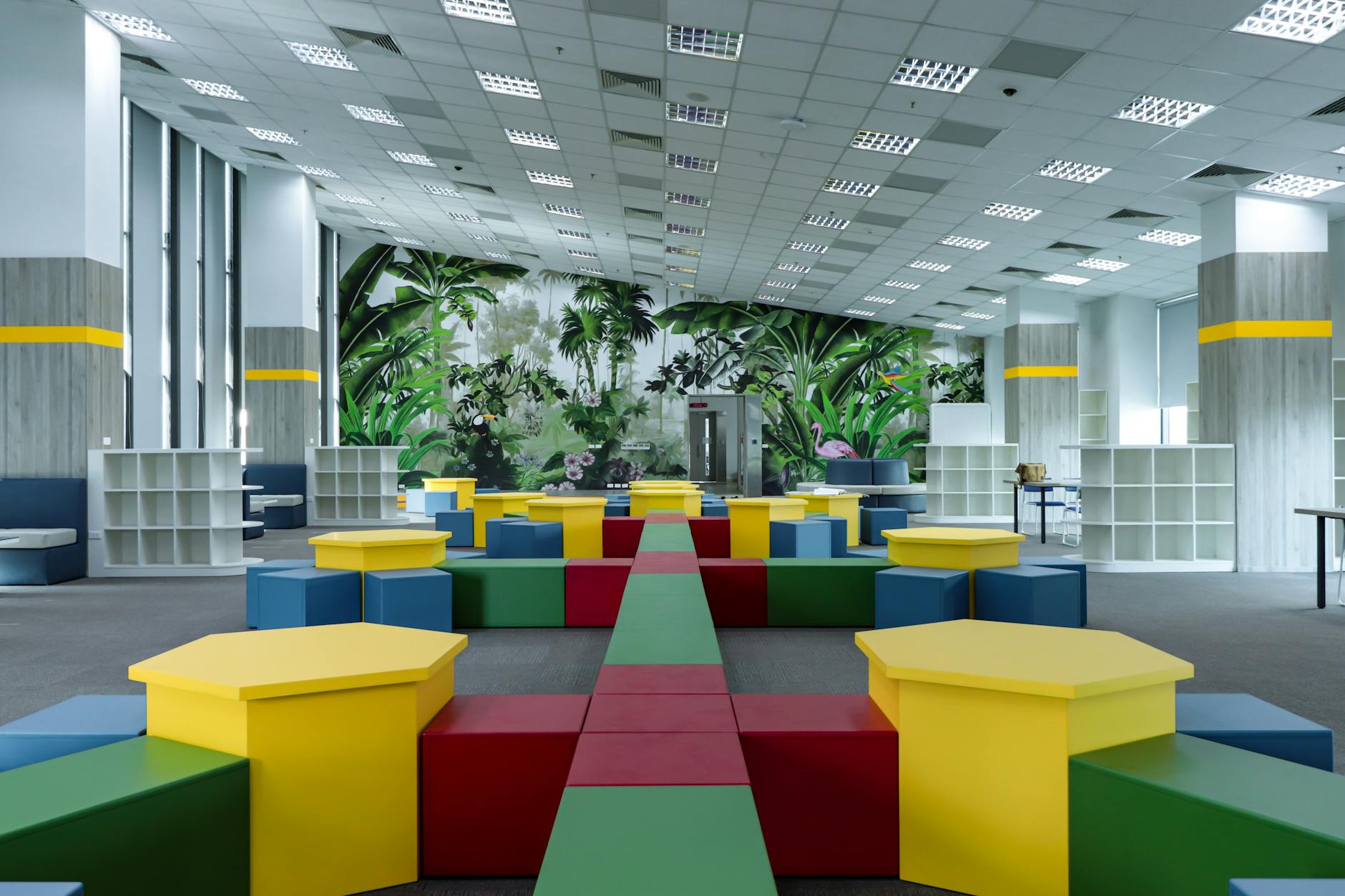
A playroom is one of the loudest rooms in any home — hard floors, parallel walls, and children in full voice create a reverb problem that standard décor cannot fix. Hexagon acoustic panels designed for playrooms solve that problem while adding visual character that kids and parents both appreciate.
TL;DR: For a children's playroom in 2026, hexagon acoustic panels are the most practical wall treatment available. They cut mid-frequency echo — the range that dominates children's voices and toy noise — while sitting flush and looking intentional rather than clinical. Aku Wood Panel's hexagon acoustic panel natural oak is the strongest single-product fit: real oak veneer over an acoustic felt core, geometric shape that reads as playful, and a surface children can touch without damaging. The primary keyword "hexagon acoustic panels playroom" points directly at this intersection of function and form.
Why playroom acoustics matter more than you think
Children's voices peak at 2,000–4,000 Hz. That frequency range bounces off plasterboard, glass, and laminate flooring with almost no absorption. A typical 4m × 4m playroom with no soft furnishings can sustain a reverberation time (RT60) above 0.8 seconds — long enough that overlapping voices become cognitively exhausting for both children and adults in earshot. Acoustic panels with a felt or mineral wool core target exactly that mid-frequency band. The hexagon format distributes absorption across the wall surface without requiring full coverage, which keeps material costs and installation time manageable. In 2026, more UK homes are converting spare bedrooms into dedicated play spaces, which makes the hexagon acoustic panels playroom category one of the fastest-growing interior acoustic niches.
Who this is for
This guide is written for parents and interior designers fitting out a dedicated playroom — whether that is a converted spare bedroom, a loft room, or a garden room addition. You want panels that absorb noise without looking like a recording studio, survive the occasional impact from a thrown toy, and install without professional help. You are not retrofitting a school or nursery (which has different fire-rating requirements); you are treating a private residential space where the primary driver is liveability.
What to look for in hexagon acoustic panels for a playroom
Core material and NRC rating
The Noise Reduction Coefficient (NRC) tells you what fraction of incident sound the panel absorbs, expressed from 0 to 1. A panel with an NRC of 0.85 absorbs 85% of mid-frequency sound that hits it. For a playroom, target an NRC of 0.7 or above. Panels backed with grey acoustic felt consistently hit this range. Foam-backed panels can achieve similar numbers but dent more easily — a meaningful drawback when children are nearby.
Surface durability
Playroom surfaces take more contact than any other room in the house. Real wood veneer over an MDF substrate is far more impact-resistant than printed paper wraps or thin laminates. Look for panels where the veneer is at least 0.6 mm thick and the substrate is at minimum 9 mm MDF. That combination resists fingernail marks, light scuffs, and the occasional toy impact without visible damage.
Shape and sizing
The hexagon format is not purely aesthetic. The irregular edge profile means acoustic absorption is distributed non-uniformly across the wall, which breaks up standing wave patterns more effectively than rectangular tiles placed in a grid. Standard hexagon panels for residential use run between 290 mm and 360 mm point-to-point. Smaller panels give more layout flexibility on narrow walls; larger panels cover area faster and reduce the number of fixings required.
Fixing system
A playroom wall should be easy to modify as the child grows and interests change. Panels that use a peel-and-stick adhesive pad or a concealed clip system allow removal and repositioning without replastering. Panels requiring direct liquid adhesive bonded to the plasterboard are a permanent choice — workable, but factor in the cost of redecoration when the room changes use.
Colour and finish suitability
Natural oak reads warm and neutral — it works with primary colours, pastel schemes, and the kind of eclectic toy-based décor most playrooms accumulate. Smoked oak reads darker and more dramatic; it suits playrooms with a moodier or more mature design intent (teenager transition rooms, for example). Grey felt-backed panels, where the felt is partially visible at the edges, introduce a second texture that can complement neutral or Scandi-influenced interiors.
Safety and VOC emissions
Children spend extended time in playrooms, often close to walls. Panels finished with water-based lacquers and low-VOC adhesives are the appropriate choice. Avoid panels where the manufacturer does not disclose the finish chemistry. In the UK, look for products that reference EN 717-1 formaldehyde emission classification E1 or better.
Top picks
The primary recommendation — Aku Wood Panel Hexagon Natural Oak
Hook: The safe, versatile pick for most playroom briefs in 2026.
Aku Wood Panel's hexagon acoustic panel natural oak pairs real oak veneer with an acoustic felt backing that targets mid-frequency absorption directly. The natural oak finish sits neutrally against virtually any wall colour, which matters in a room where painted walls or murals are common. The hexagon geometry makes an installation look considered rather than accidental — parents frequently treat it as a feature wall rather than a purely functional treatment.
Verdict: Buy. This is the product to specify first for a UK residential playroom.
The textural alternative — Natural Oak Grey Felt
Hook: Better acoustic depth, different aesthetic.
The wooden wall panel natural oak grey felt introduces visible grey felt between the oak slats, which increases the exposed acoustic surface area compared with a flush-face panel. The two-material visual — warm wood against cool grey — works well in rooms with white or light grey walls. It is a rectangular slat panel rather than a hexagon, so the geometry reads differently; consider it when a client wants maximum acoustic performance over decorative geometry.
Verdict: Consider when acoustic performance is the primary brief and hexagon geometry is secondary.
The tonal contrast option — Smoked Oak
Hook: The grown-up playroom or teenage room transition.
The wooden wall panel smoked oak delivers the same acoustic construction as the natural oak range but with a darker, richer veneer that reads more architectural. In a playroom that doubles as an older child's study or creative space, smoked oak prevents the room from looking juvenile once the primary-colour toys are gone. The finish absorbs light rather than reflecting it, which can make a small room feel smaller — account for room size before specifying.
Verdict: Consider for rooms that will transition use within 3–5 years, or for parents who want a more sophisticated aesthetic from day one.
What to avoid
- Foam tiles with fabric covers: These hit acceptable NRC numbers but dent permanently on impact, show grease marks from small hands within months, and cannot be wiped clean. They are designed for studios, not rooms where children play on the floor under the wall.
- Thin decorative hexagon panels (under 6 mm total depth): Panels marketed primarily as wall décor with minimal acoustic backing have NRC values below 0.3. They look identical to acoustic panels in product photography but deliver a fraction of the absorption. Always verify the substrate thickness and felt/mineral wool core depth before ordering.
- Full-wall adhesive bonding in a rental or likely-to-change room: If there is any chance the room reverts to a bedroom within five years, permanent adhesive installation locks you into a redecorating cost. Use a mechanical fixing or removable adhesive pad system instead.
Comparison table
| Panel | Format | Core | Finish | Best for |
|---|---|---|---|---|
| Hexagon Acoustic Panel Natural Oak | Hexagon | Acoustic felt | Natural oak veneer | Primary playroom recommendation |
| Wooden Wall Panel Natural Oak Grey Felt | Slat | Acoustic felt | Oak + grey felt | Maximum absorption, neutral aesthetic |
| Wooden Wall Panel Smoked Oak | Slat | Acoustic felt | Smoked oak veneer | Older child / transitional room |
| Generic foam fabric tiles | Tile | Open-cell foam | Fabric wrap | Skip — not durable for children |
| Thin decorative hexagon (under 6 mm) | Hexagon | Minimal/none | Various | Skip — NRC too low |
FAQ
What are hexagon acoustic panels and do they actually reduce noise? Hexagon acoustic panels are wall-mounted tiles with a sound-absorbing core — typically acoustic felt or mineral wool — behind a decorative face. Yes, they reduce echo and reverberation meaningfully. In a hard-surfaced room, covering 25–40% of one wall with panels rated NRC 0.7 or above can cut RT60 by 30–50%, which is audible and measurable.
How many hexagon acoustic panels do I need for a playroom? For a standard 3.5m × 3.5m playroom, covering 25–35% of one feature wall — roughly 3–5 square metres of panel — produces a noticeable reduction in echo. Full perimeter coverage is not necessary and often not practical around shelving and windows.
Are hexagon acoustic panels safe for children's rooms? Panels with E1-rated MDF substrates and water-based lacquer finishes are appropriate for children's rooms. Confirm VOC disclosure and formaldehyde class before ordering. Aku Wood Panel's acoustic panels use MDF and felt construction consistent with residential interior use.
Can hexagon acoustic panels be installed without professional help? Yes. Most residential acoustic panels — including hexagon formats — install with adhesive pads or concealed clips onto standard plasterboard. A single feature wall of 3–4 square metres takes 2–3 hours for a competent DIYer with a spirit level and a pencil template.
What is the best colour for hexagon acoustic panels in a playroom? Natural oak is the most flexible: it reads warm, pairs with bright toy colours, and does not date quickly. Grey felt-backed panels introduce a neutral two-tone look. Smoked oak suits rooms where the design intent skews more sophisticated or the child is older.
Is a hexagon acoustic panel better than a rectangular slat panel for a playroom? For pure acoustic performance, both formats are comparable when the core material and NRC rating are equal. The hexagon wins on aesthetics in a play context — the geometric shape reads as playful and decorative, which suits the room better than rows of parallel slats.
How do I clean acoustic wood panels in a room used by children? Wipe oak veneer surfaces with a slightly damp cloth. Avoid abrasive cleaners or prolonged moisture. The felt backing is not exposed on the room side for most panel designs, so cleaning is a surface-only task. Do not steam-clean or use solvent-based products on veneer.
What does a hexagon acoustic panel playroom project cost in 2026? Material costs for a residential feature wall treatment (3–4 square metres) using quality oak acoustic panels typically run £200–£450 depending on panel type and coverage. Installation materials (adhesive pads, fixings) add £20–£40. Professional installation, if used, adds a day-rate labour cost.
One last thing
The hexagon shape earns its place in playrooms on acoustic grounds, not just visual ones. A perfect grid of square or rectangular panels creates nodes where sound can still resonate between parallel tile edges. The six-sided geometry staggered across a wall disrupts those nodes. It is a small effect compared to the bulk NRC performance, but it means you get marginally better acoustic behaviour at the same coverage percentage — something worth knowing when you are trying to hit a performance target without covering every available wall surface.
Share:
Hexagon Oak Acoustic Panels for Offices 2026
Hexagon Oak Acoustic Panels for Offices 2026