

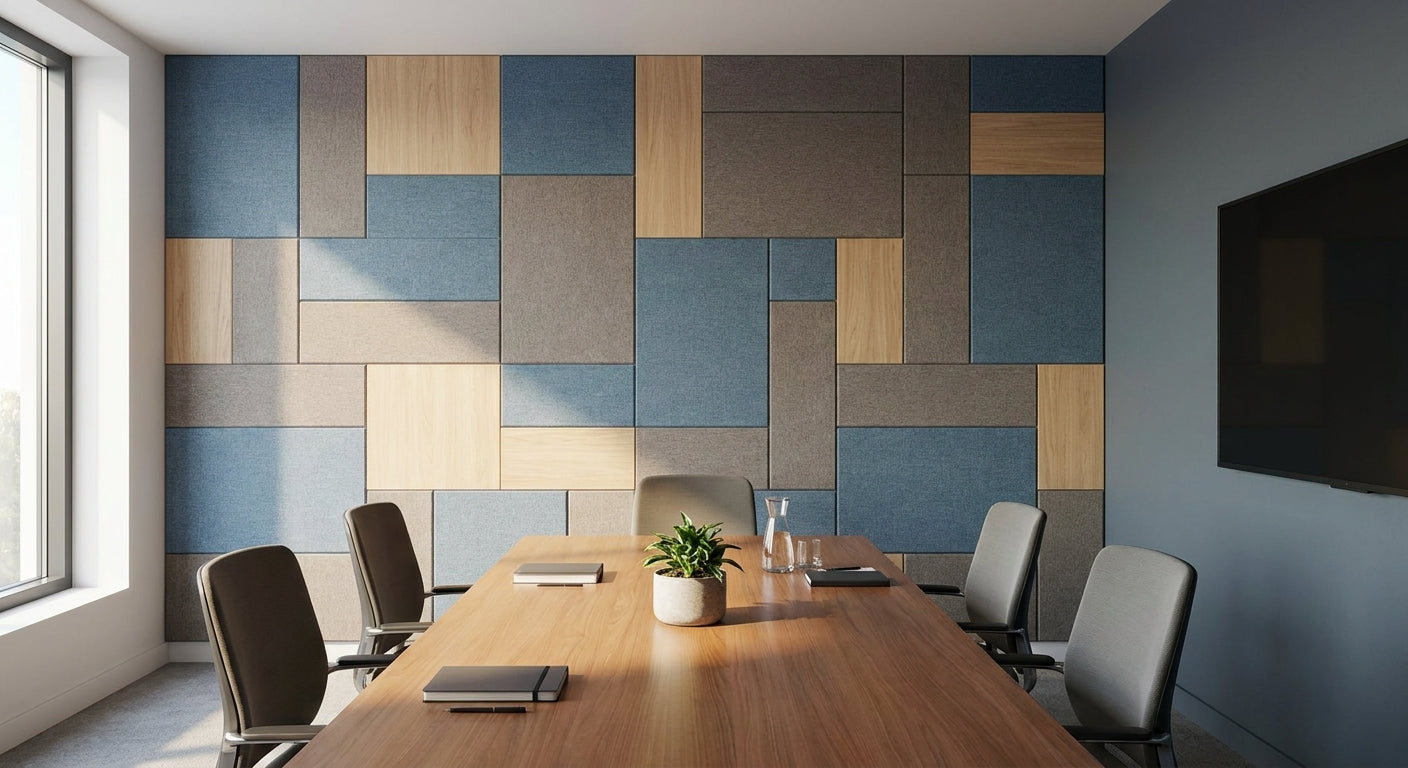
Acoustic panels for meeting room walls do two jobs at once: they kill the echo that makes voices blur on calls, and they give the space a finish that looks considered rather than functional. This guide covers who needs what, which panel specs matter, and which Aku Wood Panel options to put on the wall first.
TL;DR: The best acoustic panels for meeting room use in 2026 combine a slatted wood face with an acoustic felt backer — the slats diffuse mid-to-high frequencies while the felt absorbs them. For most UK meeting rooms, Natural Oak with grey felt is the safe default; Smoked Oak suits darker, more formal boardrooms; Black Oak works for AV-heavy rooms where light reflection is a problem. Order samples before committing to a full wall.
Why meeting room acoustics fail
A standard plasterboard meeting room with a glass wall, a hard floor, and a ceiling tile grid has a reverberation time (RT60) of roughly 0.6–0.9 seconds. The WELL Building Standard targets 0.5 seconds or below for conference rooms. That gap — even at 0.1 seconds — is audible as a persistent smear on speech. Hard parallel walls are the main culprit: sound bounces back and forth at the same frequency every time, building standing waves that make certain voices boom and others disappear.
Wood slat panels break that cycle. The gaps between slats scatter sound at different angles, preventing clean reflections. The felt backing — typically 9 mm polyester — absorbs the energy that passes through. Together they target the 500 Hz–4 kHz range where speech intelligibility lives.
Who this is for
This guide is written for office managers, fit-out contractors, and interior designers specifying acoustic panels for meeting room walls in 2026 — specifically rooms of 15–60 m², with at least one hard reflective surface (glass, plasterboard, or concrete) and a video-conferencing setup where speech clarity matters. If you are fitting a recording studio or a home cinema, the panel specs differ; those applications need deeper absorption at lower frequencies than a meeting room requires.
What to look for in acoustic panels for meeting room use
Noise Reduction Coefficient (NRC)
NRC is a single number between 0 and 1 that summarises how much sound a material absorbs across four frequencies (250 Hz, 500 Hz, 1 kHz, 2 kHz). For a meeting room, target panels with an NRC of 0.55 or above. Bare plasterboard sits at around 0.05 — panels in this range represent a tenfold improvement in absorption at the frequencies that matter most for speech.
Slatted face vs. solid face
Solid wood panels look beautiful but reflect rather than absorb sound. Slatted panels — with gaps of 3–5 mm between slats — let sound pass through to the felt backing while the wood itself diffuses the angle of reflection. For a meeting room, always choose slatted construction. A solid decorative panel belongs on a feature wall in reception, not on a surface where calls happen.
Felt backing colour and thickness
Grey felt is acoustically identical to black felt at the same thickness, but grey reads lighter through the slat gaps — which matters in rooms without abundant natural light. 9 mm polyester felt is the standard for speech-range absorption. Thicker felt (12 mm+) improves low-frequency performance but is overkill for meeting rooms; the cost difference is better spent on coverage area.
Panel coverage per room
Acoustic treatment works by percentage of surface area covered. In a 30 m² meeting room with 2.7 m ceilings, you have roughly 32 m² of wall surface. Covering 25–30% of that — 8–10 m² — produces a meaningful drop in RT60. Under-treating is the most common mistake: one accent wall of panels looks good but moves the dial by almost nothing acoustically.
Finish and veneer quality
Meeting rooms sit in professional environments. Panels with a 3-sided real wood veneer — rather than a foil wrap — hold their appearance over a 10-year commercial lifecycle. The veneer shows grain variation that reads as premium material, not laminate. For boardrooms or client-facing spaces, this is the specification to hold to.
Installation method
Panel glue is the standard fix for plasterboard and concrete. For stud walls, mechanical fixings through the panel into the stud give better long-term pull-out resistance. Either method works, but confirm the substrate before ordering accessories. A 290 ml cartridge of high-tack panel glue covers approximately 3–4 m² of panel, so calculate adhesive quantities at the same time as panel quantities.
Top picks for meeting room walls in 2026
Natural Oak with Grey Felt — the default spec
The safe pick. Natural oak is the most universally accepted wood tone in UK commercial interiors in 2026 — it reads warm without being heavy, and it works against white, grey, or off-white paint. The grey felt backer shows through the slat gaps as a neutral tone that does not compete with the veneer. This is the panel to specify when you need a decision that satisfies every stakeholder in the room.
Order a sample wooden wall panel natural oak grey felt before committing to full panels — the grey felt changes the perceived warmth of the oak noticeably under different light temperatures.
Verdict: Buy for most UK meeting rooms.
Smoked Oak — the boardroom spec
The considered upgrade. Smoked oak reads darker and denser than natural oak — closer in tone to walnut without the red undertone. In a formal boardroom with dark furniture and low ambient lighting, it creates coherence rather than contrast. The acoustic performance is identical to natural oak panels; you are paying for a finish decision, not a spec difference.
Verdict: Buy for client-facing boardrooms and executive suites.
Walnut — the warmth option
The character pick. Walnut panels carry a richer, redder grain than either oak variant. They work well in meeting rooms that lean into a hospitality aesthetic — creative agencies, boutique offices, co-working spaces. The grain variation between individual panels is higher than oak, so inspect a sample before specifying a large run. Pair with warm-white LED at 2700–3000 K for best result.
Verdict: Consider if the room has a deliberate warm-tone brief.
Black Oak — the AV room spec
The technical pick. Black oak absorbs ambient light rather than reflecting it, which reduces glare on screens and cameras during video calls. In a room where the screen or camera is the focal point, a dark back wall matters more than most fit-out teams realise. The acoustic performance is the same as other slat panels; the finish decision is driven by light management.
Verdict: Consider for rooms with a large display wall or permanent camera setup.
Natural Oak (standard, no felt) — accent use only
The budget stretch. Standard natural oak panels without the felt backer are better suited to decorative accent walls in corridors or reception areas. In a meeting room, they provide minimal acoustic benefit compared to the felt-backed version. The price difference between felt and non-felt is small; there is no reason to choose the non-felt version for an acoustic brief.
Verdict: Skip for primary acoustic treatment. Use felt-backed panels instead.
Comparison table
| Panel | Finish tone | Felt backer | Best room type | 2026 verdict |
|---|---|---|---|---|
| Natural Oak + Grey Felt | Warm neutral | Yes | General meeting rooms | Buy |
| Smoked Oak | Dark, formal | Optional | Boardrooms | Buy |
| Walnut | Warm, rich | Optional | Creative/hospitality offices | Consider |
| Black Oak | Dark, minimal | Optional | AV/camera rooms | Consider |
| Natural Oak (standard) | Warm neutral | No | Accent walls only | Skip for acoustic use |
What to avoid
- Foam acoustic tiles. They look functional and industrial, which is fine in a recording studio and wrong in a client-facing meeting room. Their NRC performance in the speech range is comparable to slatted wood panels, but they degrade faster and cannot be specified to match a design scheme.
- Treating only one wall. A single accent wall of panels covers perhaps 8 m² in a standard room. That is 25% surface coverage if you are lucky — the minimum threshold for audible improvement. If budget forces a single wall, make it the wall behind the primary speaker position, not the camera-facing wall.
- Ignoring end pieces and trims. Raw panel edges at corners and wall terminations look unfinished and collect dust. End pieces are a small line item that determines whether the installation looks specified or improvised. Factor them into the order at the planning stage, not as an afterthought.
FAQ
What are the best acoustic panels for a meeting room in 2026? Slatted wood panels with a polyester felt backer — targeting NRC 0.55 or above — are the best acoustic panels for meeting room use in 2026. Natural oak with grey felt is the most widely applicable choice for UK commercial interiors.
How many acoustic panels does a meeting room need? Cover at least 25% of total wall surface area for an audible improvement in speech clarity. In a 30 m² room with 2.7 m ceilings, that means 8–10 m² of panelled wall as a minimum.
Do wood slat panels actually reduce echo? Yes. The gaps between slats scatter sound at multiple angles, preventing clean reflections, while the felt backing absorbs energy in the 500 Hz–4 kHz range. That is the frequency band that governs speech intelligibility.
Is smoked oak or natural oak better for a meeting room? Natural oak suits bright, modern offices with light furniture and neutral walls. Smoked oak suits darker, more formal spaces. Acoustic performance is identical between the two.
Can I install acoustic wall panels myself? Yes. Panel glue applied to a clean, dry plasterboard wall is the standard method. A 290 ml cartridge covers 3–4 m². Most installers complete a standard meeting room wall — 10–12 m² — in a half day.
What is the difference between acoustic panels with and without felt? Panels without a felt backer are primarily decorative. The felt is what provides absorption — without it, slotted wood panels reflect and scatter sound but absorb very little. For a meeting room acoustic brief, felt-backed panels are non-negotiable.
Do acoustic panels help with video call quality? Directly. Echo and reverberation are the primary causes of degraded call audio. Reducing RT60 from 0.8 to 0.5 seconds produces a clear improvement in how voices register on the far end of a call.
How do I order samples before buying? Aku Wood Panel supplies individual panel samples for all main finishes. Order a sample of your shortlisted finish before specifying full quantities — veneer grain and felt colour read differently under artificial lighting than in product photography.
One last thing
The most acoustically effective wall in a meeting room is the one directly behind the camera — the wall that the far-end participant sees on every call. Most fit-outs treat the wall behind the screen instead, which improves the experience for people in the room but does nothing for the people on the call. Flip the priority: treat the camera wall first, make it look deliberate, and you solve both the acoustic and the visual problem in one specification.
Share:
Best Acoustic Panels for Nursery Walls 2026
Best Wall Panels for Office Reception 2026