

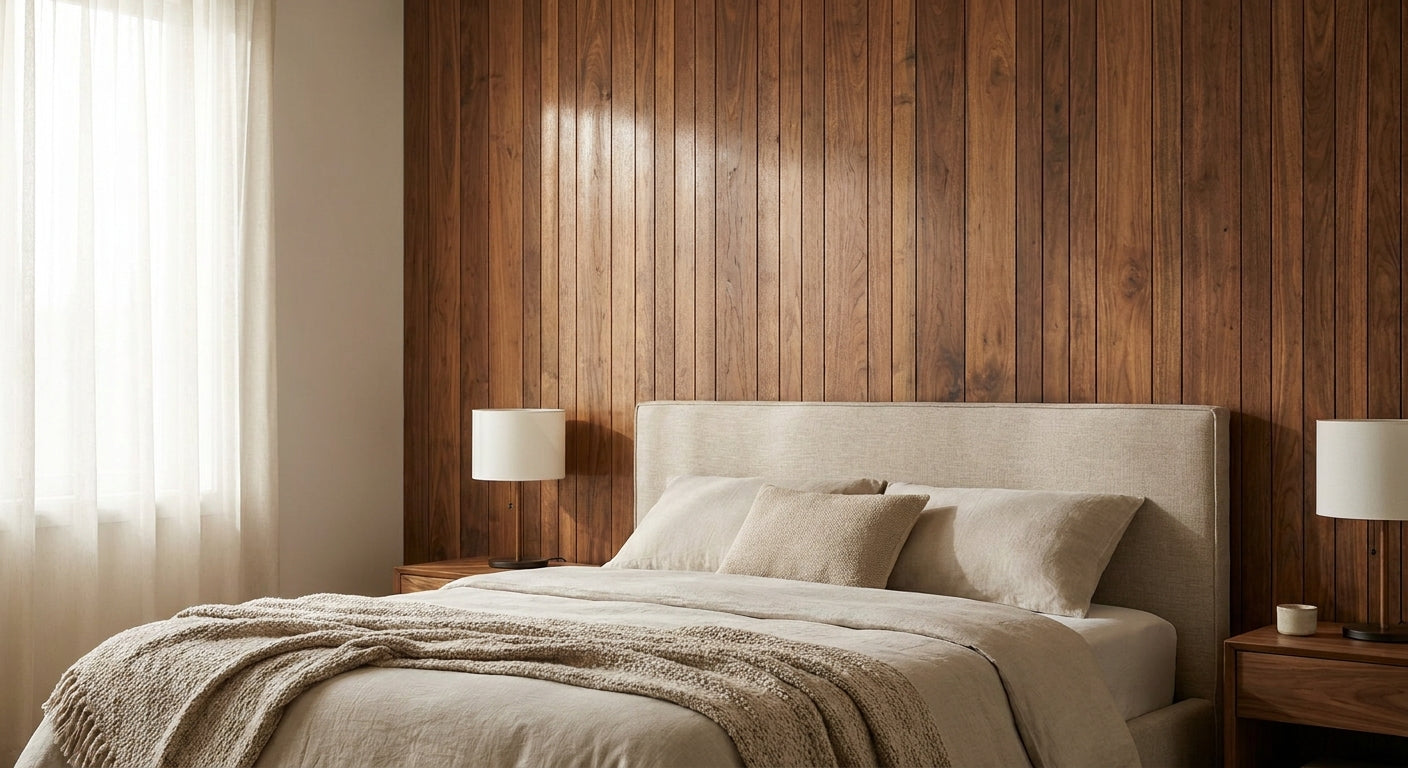
Wooden wall panels for a headboard wall transform an ordinary bedroom into a space with genuine visual weight — and when the panels carry acoustic backing, they do it quietly too.
TL;DR: The best wooden wall panels for a headboard wall in 2026 combine a real-wood finish with a felt or MDF acoustic backing that softens bedroom echo without adding bulk. Natural oak reads light and airy; smoked oak and walnut read warm and dramatic; black oak is the boldest statement. Aku Wood Panel manufactures slatted acoustic wood panels in all four finishes, sized to cover a standard king headboard wall in 6–8 panels. Order a sample before you commit to a full run.
Why the headboard wall is different from every other wall in the house
Every other feature wall in your home is background. The headboard wall is what you look at for the last ten minutes before you sleep and the first thing you register when you wake up. It sits at eye level when you're propped up, it's lit by bedside lamps from close range, and it frames the bed in every photo you'll ever take of the room. Those three facts change everything about what you should put on it.
Colour contrast matters more here than anywhere else. Texture at close range reads differently than texture across a room. And in 2026, the most-searched bedroom upgrade in UK homes is a panelled headboard wall — not a painted accent wall, not wallpaper.
Who this guide is for
This guide is written for homeowners and renters fitting a feature wall behind a double, king, or super-king bed — with or without a freestanding headboard. It also covers anyone doing a bedroom makeover in a buy-to-let or a new-build where the walls are plasterboard and you want something that goes up without structural work.
If you are a contractor fitting multiple bedrooms in a development, the same product choices apply; you will just be calculating panel quantities across several rooms rather than one.
What to look for in wooden wall panels for a headboard wall
Finish and grain direction
Vertical slat panels elongate the wall and make ceiling height look greater — the right move for most UK bedrooms, which average 2.4 m floor-to-ceiling. Horizontal panels widen a narrow room but can feel compressed in a space already short on height. The grain direction of the veneer should run the same way as the slats: mismatched grain and slat direction produces a restless look at close range.
Acoustic backing
A bedroom headboard wall is one of the few interior applications where acoustic performance is as important as appearance. Hard surfaces bounce sound — you hear early morning traffic, a partner's alarm, HVAC hum. Panels with a grey felt backing absorb mid-frequency noise rather than reflecting it. The difference in a 12 m² bedroom is audible, not just measurable. If you share a wall with a neighbour, prioritise panels with felt backing over bare MDF cores.
Panel depth and projection
Headboard walls sit directly behind pillows. A panel that projects more than 22 mm from the wall surface can catch hair, pillowcases, and lamp cables. Slatted acoustic panels in the 20–21 mm depth range fit the use case; chunky 3D relief panels that project 30 mm or more are better suited to living rooms and hallways where you are never within arm's reach of the wall surface.
Colour temperature relative to your lighting
Bedroom lighting is almost always warm-white (2700–3000 K). Natural oak panels read yellow-gold under warm light — inviting, but the effect can feel saccharine if your bedding and furniture are already warm-toned. Smoked oak and walnut go darker under warm light, which anchors the wall rather than brightening it. Grey oak and the grey-felt-backed natural oak variants balance the warmth and read cooler and calmer at night.
Ease of installation without specialist tools
Most UK plasterboard bedroom walls accept panel adhesive without rawlbolts or battening, provided the wall is flat and primed. The critical spec is bond time: a fast-grab adhesive (grab in under 60 seconds) lets you hold each panel in position without propping. A slow-cure product means you spend 20 minutes per panel with your arms above your head. Check the adhesive is rated for MDF-to-plasterboard bonding, not just tile or stone.
Sample availability before full order
Veneer colours vary between product photography and reality — especially smoked and dark finishes, which shift depending on monitor calibration. Any supplier worth ordering from stocks individual samples at low cost. Aku Wood Panel offers samples in every finish, so you can pin a 30 cm square to the wall, live with it for 48 hours under your actual bedroom lighting, and decide before committing to 8–12 full panels.
Top picks for headboard walls in 2026
Natural oak — the safe pick
The most-ordered finish for UK bedrooms in 2026. The pale, consistent grain works with white, grey, and green bedding without competing. Under 2700 K warm light it reads honey rather than yellow. Pair it with brushed brass bedside hardware and linen bedding for a finish that photographs well and lives well.
Verdict: Buy — wooden wall panel natural oak
Walnut — the warm statement
Rich mid-brown with visible grain movement. On a headboard wall it reads like a high-end hotel suite — but it demands that your other furniture does not also fight for attention. Best used behind a bed with a low, upholstered headboard in cream or stone, not a dark wood bed frame. Cover the full wall floor-to-ceiling for maximum impact; stopping at shoulder height looks unresolved.
Verdict: Buy — wooden wall panel walnut
Smoked oak — the considered choice
Darker than natural oak, cooler than walnut. Smoked oak sits in the grey-brown register that dominates 2026 UK interior design trends. It reads masculine without going black, and it works in rooms that already have a lot of white — it does the job of an accent wall without the risk of looking like a DIY feature.
Verdict: Buy — wooden wall panel smoked oak
Black oak — the wildcard
High drama. Black oak on a headboard wall requires commitment: white or pale walls on the flanking sides, light bedding, and confident lighting. In 2026 it is increasingly common in urban UK bedrooms — especially new-builds with high ceilings and minimal architectural detail. If you want a room that looks like a set design, this is the pick. If you are not certain, get the sample first.
Verdict: Consider — wooden wall panel black oak
Natural oak with grey felt — the acoustic upgrade
All the visual warmth of natural oak with a grey felt backing that actively absorbs sound. This is the pick if you share a wall with a neighbour, live near a road, or are simply a light sleeper. The felt backing is visible between the slats and reads as a dark shadow line that adds depth. Functionally and visually, this is the most complete headboard wall panel in the range for 2026.
Verdict: Buy — wooden wall panel natural oak grey felt
Comparison table
| Finish | Tone | Acoustic backing | Best for | Verdict |
|---|---|---|---|---|
| Natural oak | Warm, pale | Optional | Most bedrooms | Buy |
| Walnut | Warm, mid-brown | No | Hotel-style rooms | Buy |
| Smoked oak | Cool, grey-brown | No | Contemporary rooms | Buy |
| Black oak | Dark, bold | No | High-contrast rooms | Consider |
| Natural oak + grey felt | Warm, pale | Yes (grey felt) | Sound-sensitive rooms | Buy |
What to avoid on a headboard wall
- 3D relief panels with deep projection. Anything over 25 mm sticks out into the space where your pillow sits. You will feel it before you see it as a problem.
- Untreated or unfinished wood panels. Raw timber collects dust and oils from skin contact, especially at the height where pillows and hands rest. Factory-finished veneer panels clean with a dry cloth; unfinished panels do not.
- Mixing two different slatted finishes on the same wall. A horizontal walnut section and a vertical smoked oak section sounds creative in theory. In practice, the eye cannot settle and the room feels unresolved. If you want to mix finishes, reserve the second finish for a different wall entirely — the guide on how to mix different wood panel finishes in one room covers the rules for doing it well.
Installation: what you actually need
For a standard UK king-size headboard wall (approximately 1.5 m wide × 2.4 m high):
- 6–8 panels depending on panel width
- 1–2 cartridges of high-tack panel adhesive rated for MDF-to-plasterboard
- A straight edge, a spirit level, and a fine-tooth saw for any edge cuts
- End pieces to finish exposed vertical edges cleanly
The wall surface must be clean, dry, and flat. If you are fitting over existing wallpaper, strip it first — adhesive on paper over plasterboard will fail within 6 months.
FAQ
What are the best wooden wall panels for a headboard wall in 2026? Natural oak and smoked oak are the most-ordered finishes for UK bedroom headboard walls in 2026. Both work with a wide range of bedding and furniture colours, and both are available with acoustic felt backing if noise reduction is a priority.
How many panels do I need to cover a king-size headboard wall? A standard UK king headboard wall — 1.5 m wide and 2.4 m high — typically requires 6 to 8 slatted acoustic panels, depending on individual panel width. Use the room's full floor-to-ceiling height for the cleanest result rather than stopping mid-wall.
Do wooden wall panels on a headboard wall reduce noise? Panels with a felt acoustic backing do reduce ambient noise in the room. A grey felt-backed panel absorbs mid-frequency sound rather than reflecting it, which reduces early morning echo and traffic noise in a 10–15 m² bedroom. Panels without felt backing are decorative only and do not improve room acoustics.
Is it safe to fit wall panels directly behind a bed? Yes, provided the panel depth does not exceed approximately 22 mm. Panels in that depth range sit flush enough that pillows, bedding, and lamp cables do not catch on them. Avoid deep 3D relief panels on headboard walls.
Can I fit wooden wall panels on a plasterboard wall without a contractor? Yes. Most slatted acoustic panels adhere directly to flat, primed plasterboard with a high-tack panel adhesive. No rawlbolts, no battening, and no specialist tools beyond a spirit level and a fine-tooth saw for edge cuts.
What colour wood panel works best in a dark bedroom? In a bedroom with limited natural light, natural oak reflects more ambient light than walnut or black oak and keeps the room from feeling enclosed. If you prefer a darker finish, smoked oak reads as a warm neutral rather than going fully dark — and avoids the high-maintenance look of black oak in a low-light space.
Should I order a sample before buying headboard wall panels? Always. Panel colours shift significantly under warm bedroom lighting compared with product photography. Order a sample, pin it to the wall for 48 hours, and check it in the morning light and evening lamplight before committing to a full order.
How do I finish the edges of panels at the end of a headboard wall? Use end pieces designed to match your panel finish. They clip or adhere to the exposed vertical edge and give the installation a clean, factory finish rather than a visible cut edge.
One last thing
A headboard wall does not need to be floor-to-ceiling to work — but it looks significantly better when it is. The most common regret from UK homeowners who panel a headboard wall in 2026 is stopping the panels at 1.8 m or 2 m because they wanted to save material. The gap between the panel top and the ceiling draws the eye upward to bare paint and makes the panelling look like an afterthought. Spend the extra panels. Take it to the ceiling.
Share:
Best Wall Panels for Office Reception 2026
Exterior Cladding for Balcony Walls: Best Picks 2026