

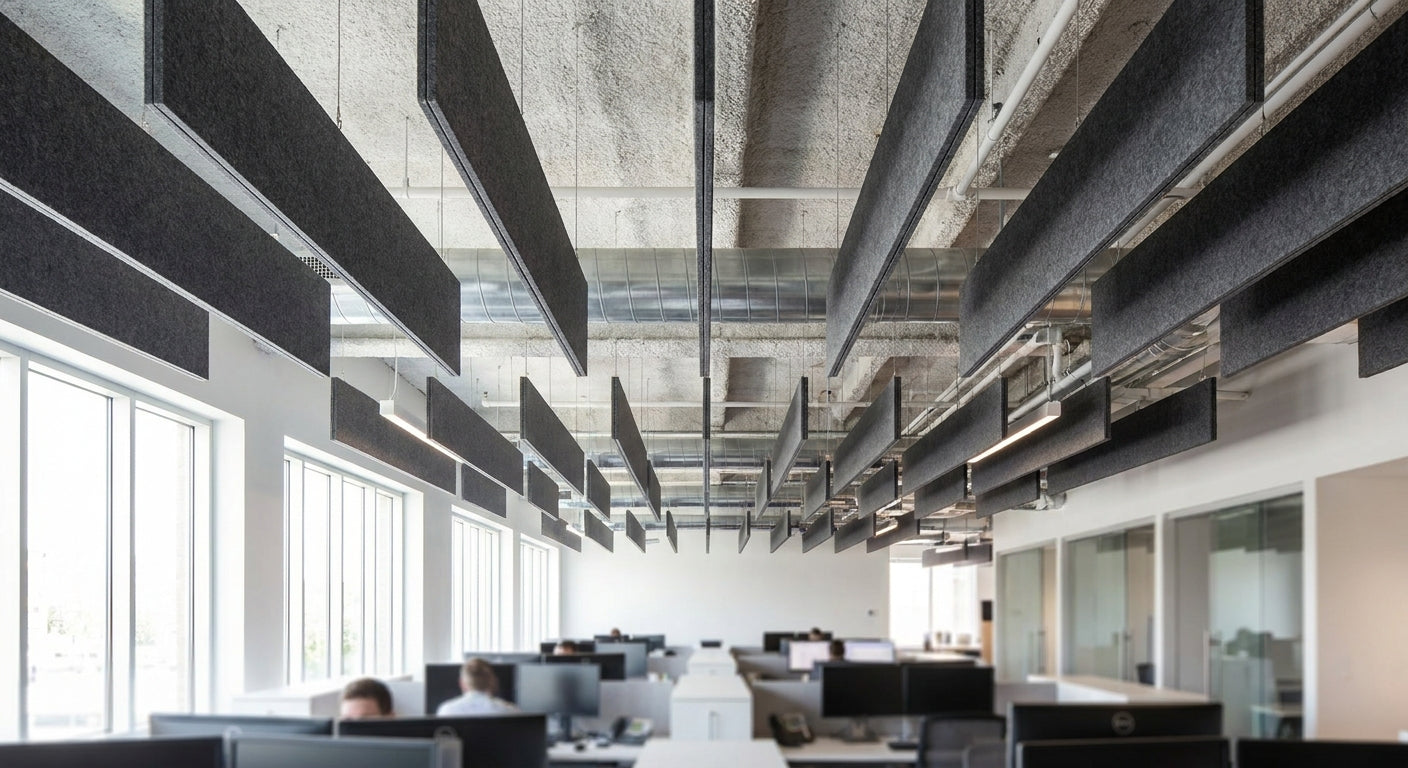
Open ceilings look sharp in a converted warehouse or a loft office, right up until a phone call, a meeting, or the extractor fan starts bouncing off exposed joists and steel decking. There's no suspended grid to hide treatment behind, so the fix has to work in plain sight.
- Acoustic baffle panels cut reverb in open ceilings, but felt-backed wood panels with NRC 0.75 work directly on exposed joists too.
- Hexagon Acoustic Panel Natural Oak with Grey Felt at £40.95 is the safe buy for offices and garden rooms with visible rafters.
- Hexagon Acoustic Panel Black suits exposed steel decking - Buy for 2026 industrial fit-outs.
- Skip painted foam baffles on exposed timber ceilings - they fail fire checks and look wrong against real wood.
- Treat the ceiling and one wall together, not the ceiling alone, for faster reverb reduction.
Why this matters
An open ceiling is a hard, parallel surface with nothing above it to absorb sound before it hits the floor and bounces back. In a room with a suspended ceiling, tiles do that job invisibly. In an open-plan office, a mezzanine, or a garden room with exposed rafters, whatever you fix to the ceiling is on permanent display, so the acoustic performance and the finish both have to earn their place.
Acoustic baffle panels are usually sold as hanging fabric or foam strips that drop below the structure to break up sound waves. They work, but they're not the only route, and on a timber or steel open ceiling they often look bolted-on rather than designed-in. Felt-backed wood panels mounted flush to battens across the joists do the same absorption job while reading as a finished ceiling rather than a retrofit. AKU Woodpanel's hexagon range, for instance, carries an NRC of 0.75, which puts it in the same absorption bracket as a mid-range fabric baffle, without the maintenance headache of exposed fabric collecting dust in a warehouse mezzanine. Details on fixing panels above an open structure are covered in how to install acoustic panels above a suspended ceiling, which applies just as well to a fully exposed grid.
Who this is for
This guide is for anyone managing a room where the ceiling structure is visible - a converted warehouse office, a mezzanine above a workshop, a loft conversion with exposed rafters, or a garden room built with a vaulted roof. If your ceiling has tiles, drop it and look at wall-mounted panels instead; if it's open, keep reading.
What to look for in acoustic baffle panels for open ceiling soundproofing
Sound absorption rating that matches the room volume
An NRC of 0.75 means the panel absorbs 75% of the sound energy that hits it, which is enough for most offices and garden rooms but tight for a double-height warehouse floor. Bigger, taller open spaces need more coverage or a higher-rated product, not just more panels of the same rating spread thinner.
A mounting system built for exposed joists and steel decking
Baffle panels made for suspended grids often assume a T-bar to clip into. On an open ceiling you're fixing into timber joists, steel purlins, or battens you install yourself, so check the panel is designed to sit flat on a batten frame rather than hang from a grid that isn't there.
Fire-rated construction for commercial ceilings
Any panel going above head height in a workshop, office, or public space needs a fire rating that's actually documented, not implied by the material. The details worth checking before ordering are in how to check fire ratings for acoustic wood panels.
Panel format that fits your ceiling bay without excess cutting
Standard bay widths rarely match panel sizes exactly. AKU Woodpanel's wall and hexagon panels come in formats built around 240 cm and 300 cm runs, and picking the right one before you order saves a stack of offcuts and uneven joints on a ceiling everyone can see.
A finish that reads intentional against exposed structure
Foam and fabric baffles disappear against a suspended ceiling but stand out against real timber or steel. A 3-sided wood veneer finish sits naturally next to exposed joists because it's the same material family, not a foreign object clipped underneath it.
Weight per panel your fixings can carry safely
Every kilogram matters when you're fixing overhead into timber or thin steel decking rather than a robust wall stud. Confirm the fixing method and panel weight with the supplier before ordering enough panels to cover a full mezzanine ceiling.
Top picks for open ceiling soundproofing in 2026
Hexagon Acoustic Panel Natural Oak with Grey Felt - the safe pick. NRC 0.75, 81 cm hexagon format, £40.95 per panel. This is the panel to reach for on a home office with exposed rafters or a garden room where you want warmth without a dark, heavy look. Buy - it's the least risky choice for a first open-ceiling job. See the natural oak hexagon panel.
Hexagon Acoustic Panel Black - the industrial pick. Same NRC 0.75 rating, £40.95, but the black finish sits properly against exposed steel decking or blackened joists in a warehouse conversion instead of fighting the existing palette. Buy for 2026 industrial fit-outs where the ceiling is meant to look raw. Check the black hexagon panel.
Wooden Wall Panel Smoked Oak - the wall-side complement. Ceiling panels alone rarely fix reverb in a double-height room; pairing ceiling coverage with one treated wall in Smoked Oak closes the gap between the two hardest parallel surfaces in the room. Consider it if the ceiling treatment isn't cutting the echo on its own. View the Smoked Oak wall panel.
Hexagon Acoustic Panel Grey Walnut with Grey Felt - the wildcard. Same £40.95 price point and 0.75 NRC, but the grey walnut tone splits the difference between the natural oak and black options for mixed-material rooms. Consider for a Scandinavian or Japandi-leaning open-plan space where neither light nor black quite fits.


What to avoid
- Painted foam baffles on a timber-exposed ceiling. They pass acoustically but usually can't produce a fire rating a commercial job needs, and they look like an afterthought against real wood.
- Fabric baffles hung from clips screwed straight into thin steel decking. Without proper load-rated fixings, that's a panel waiting to come down; check the fixing spec before it goes overhead.
- Covering only the ceiling and calling it done. In a double-height room, an untreated hard floor and an untreated wall will keep bouncing sound the ceiling panels alone can't absorb.
Verdict comparison
| Product | NRC rating | Format | Best for | Verdict |
|---|---|---|---|---|
| Hexagon Acoustic Panel Natural Oak with Grey Felt | 0.75 | 81 cm hexagon | Home offices, garden rooms | Buy |
| Hexagon Acoustic Panel Black | 0.75 | 81 cm hexagon | Warehouse conversions, exposed steel | Buy |
| Wooden Wall Panel Smoked Oak | Felt-backed | 3-sided veneer wall panel | Wall-side complement to ceiling panels | Consider |
| Hexagon Acoustic Panel Grey Walnut with Grey Felt | 0.75 | 81 cm hexagon | Mixed-tone, Japandi-style rooms | Consider |
All four sit at the same £40.95 price point in 2026, so the decision comes down to finish and where the panel sits, not budget.
FAQ
What are acoustic baffle panels used for?
Acoustic baffle panels absorb and scatter sound in rooms with hard, exposed ceilings, cutting the echo that builds up when there's no suspended tile ceiling to soak it up. They're common in warehouse offices, open-plan studios, and loft conversions with visible rafters.
Do acoustic wood panels work as well as fabric baffles on an open ceiling?
A felt-backed wood panel rated at NRC 0.75 sits in the same absorption bracket as a mid-range fabric baffle. The wood panel mounts flush to battens rather than hanging, which suits exposed timber or steel structures better visually in 2026 fit-outs.
What NRC rating do I need for an open ceiling office?
Most small to mid-size offices with an open ceiling do well with panels rated around NRC 0.70 to 0.80. Larger, taller spaces like warehouse floors typically need more surface coverage at that rating rather than a higher-rated panel alone.
Can I fix acoustic panels directly to exposed joists?
Yes, panels designed for wall mounting can go onto timber joists using a batten frame, provided the fixings are rated for overhead loads. Steel purlins need a different fixing approach, so check the mounting spec before ordering.
How much does it cost to treat an open ceiling in 2026?
At £40.95 per 81 cm hexagon panel, covering a typical home office ceiling bay runs into several hundred pounds before fixings, depending on how much of the ceiling you treat. Larger commercial ceilings scale up from there.
Is 240 cm or 300 cm better for ceiling mounting?
It depends on your joist spacing and bay width - a 300 cm panel run suits floor-to-ceiling or long open bays, while 240 cm fits standard ceiling heights with less cutting. The comparison is broken down in the 240 vs 300 cm panel guide.
Do acoustic ceiling panels need a fire rating?
Any panel installed overhead in a commercial or shared space should carry a documented fire rating, not just a fire-resistant claim on the packaging. Ask for the certificate before installing across a warehouse mezzanine or office ceiling.
How many panels do I need for a warehouse mezzanine office?
Coverage depends on ceiling area and how much reverb you're starting with, but partial coverage combined with one treated wall usually outperforms full ceiling coverage alone. Measure the ceiling area first, then calculate panel count against the format you're using.
One last thing
Covering every inch of an open ceiling isn't usually the fastest route to a quieter room. Treating the ceiling and one wall - the two hardest parallel surfaces bouncing sound back and forth - cuts flutter echo faster than spreading the same number of panels thin across the ceiling alone. Start there before buying enough hexagon panels to blanket the whole roofline.
Share:
Acoustic Partition Walls for Offices: 2026 Buying Guide
Tambour Wood Panels for Curved Walls: 2026 Buying Guide