

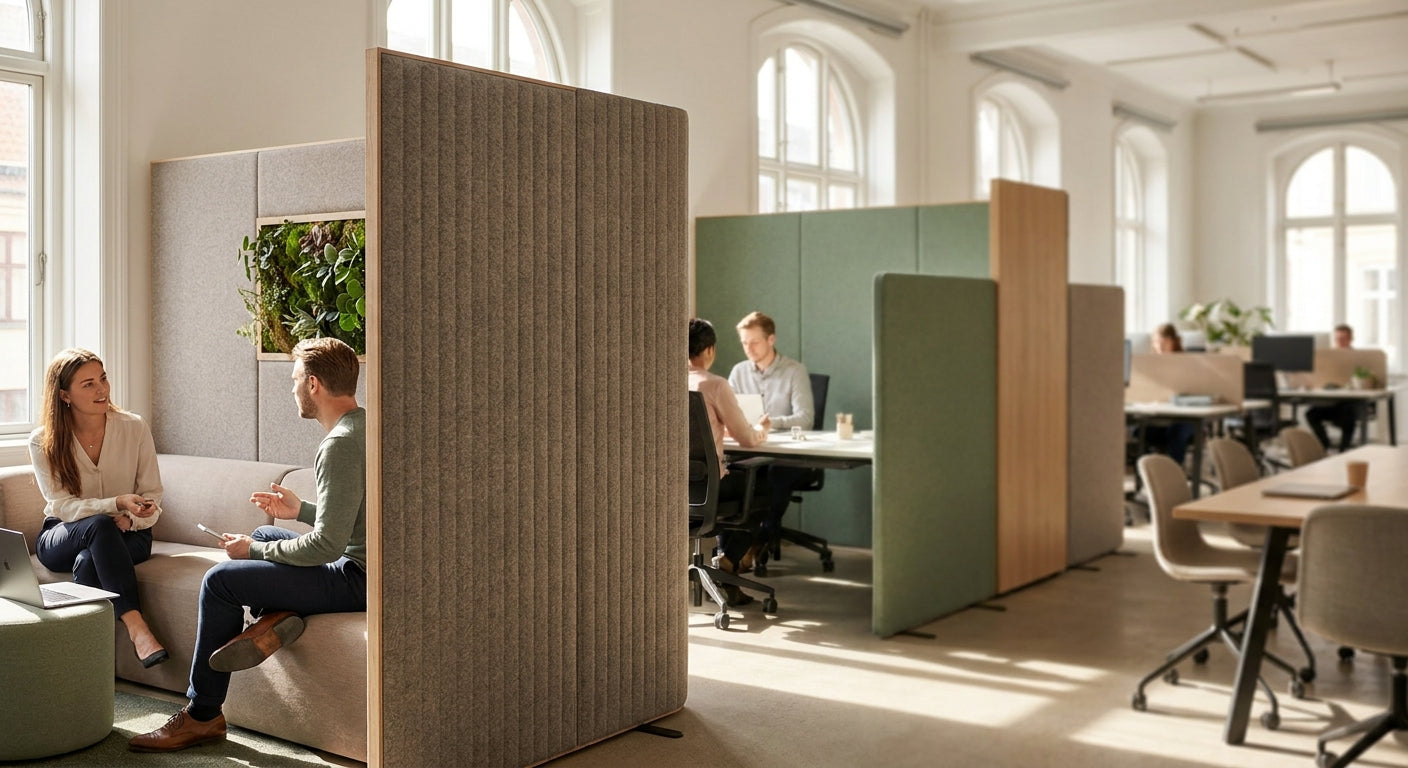
Open-plan offices and co-working floors turn every phone call and keyboard click into background noise that travels wall to wall — acoustic partition walls stop that bleed without turning a shared floor into a maze of cubicles.
- Felt-backed oak panels with a 0.75 NRC rating are the strongest acoustic partition walls for shared offices in 2026 — buy.
- Hexagon acoustic panels at 81cm and £40.95 each work as a phased or feature partition before committing to a full wall.
- Black Oak veneer partitions suit reception-facing zones; skip unbacked decorative panels for anything doing real acoustic work.
- Match panel length to ceiling height: 240cm for standard commercial units, 300cm for floor-to-ceiling runs.
Why this matters
Reverberation, not volume alone, is what wears people down on a shared office floor. Hard partition studs, glass dividers and painted plasterboard reflect sound instead of absorbing it, so a 40-desk floor with three glass meeting pods can measure louder at 3pm than at 9am. A felt-backed panel wall breaks up that reflection right where noise crosses from one zone to the next.
If hot-desk rows and phone booths are already fighting each other for quiet, the fix usually isn't more glass — it's swapping the divider itself. How to reduce noise bleed between open-plan work zones covers the mechanics behind that swap in more depth.
Who acoustic partition walls are for
This is for facilities managers, co-working operators and SME office leads converting one open floor into two or three usable zones — hot-desking on one side, calls and breakout meetings on the other. It's also for anyone specifying a serviced office or multi-tenant business centre refurbishment in 2026, where acoustic separation between tenants shows up in the lease as often as it shows up as a design preference. If the floor plan has more people than private rooms, this is the buying decision that matters most this year.
What to look for in acoustic partition walls for shared offices
Sound absorption rating (NRC), not just the word "acoustic"
Plenty of panels get marketed as acoustic with no published Noise Reduction Coefficient attached. Akustiq UK's felt-backed oak panels carry an NRC of 0.75, meaning three-quarters of the sound hitting the panel gets absorbed rather than bounced back into the room. A partition wall without that number stated is decorative, not acoustic.
Real wood veneer versus printed laminate
Shared offices get touched, leaned on and wheeled past by furniture dozens of times a day. A 3-sided real wood veneer finish holds up to that traffic without peeling at the edges the way printed foil laminate does after a year on a busy floor. If the partition sits near a corridor or a kitchen breakout, veneer durability matters more than how the finish photographs online.
Panel length matched to your partition height
Akustiq UK's indoor panels come in 240cm and 300cm lengths. A standard 2.4m ceiling in a converted commercial unit takes the 240cm format edge to edge with almost no offcut; a full floor-to-ceiling divider in a warehouse or mezzanine conversion needs the 300cm option to avoid a visible horizontal seam at eye level.
Fixing method for your actual wall type
Stud walls, glass partition frames and breeze block all take fixings differently. Panel glue works on a solid backing; mechanical fixings or a batten system suit stud or plasterboard runs that flex under foot traffic. Get this wrong on a shared floor and panels loosen within months, not years.
Fire rating for commercial fit-outs
A multi-tenant building or a co-working floor under a commercial lease usually has fire compliance written into the fit-out sign-off. Confirm the fire rating on the specific finish before ordering a partition run for a business centre, not after the wall goes up.
Top picks for shared office partition walls
The safe pick — Natural Oak with Grey Felt
The safe pick. Natural Oak with Grey Felt backing carries the 0.75 NRC rating in a light finish that keeps a shared floor looking bright rather than boxed in. It suits hot-desk zones bordering breakout rooms, where the wall needs to absorb noise without darkening the space. Verdict: Buy for general open-plan zoning — Natural Oak with Grey Felt panel.
The bold statement pick — Black Oak
The bold statement pick. Black Oak's 3-sided veneer finish reads as a design feature rather than a noise fix, which makes it the right call for the wall between reception and the first row of desks — the one visitors actually see. Verdict: Buy for reception-to-floor transitions — Black Oak wall panel.
The wildcard — hexagon acoustic panels
The wildcard. Hexagon acoustic panels in Grey Walnut with Grey Felt run £40.95 per 81cm unit and let you build a partition in a geometric pattern rather than a flat panel run — useful for a pilot zone before committing to a full floor-to-ceiling wall. Verdict: Consider for a phased rollout or a single feature partition rather than a whole floor.
The one to skip — unbacked decorative panels
The one to skip. A decorative wall panel with no felt backing looks similar in a product photo but does almost nothing for reverberation — it's a finish, not a noise solution. Fine for a hallway accent wall, the wrong choice for a partition doing acoustic work. Verdict: Skip for any wall separating two working zones.


What to avoid when specifying acoustic partition walls
- Buying by finish name alone — order a sample before committing to a multi-panel run; a screen render of Smoked Oak looks nothing like felt-backed board under office lighting.
- Specifying full-height partitions without checking the fire rating for the specific finish, not the range in general.
- Mixing panel batches from different orders on one continuous partition — veneer grain and felt colour vary slightly between production runs, and it shows on a long wall.
Quick verdict comparison
| Pick | Backing / NRC | Best for | Verdict |
|---|---|---|---|
| Natural Oak Grey Felt | Felt, 0.75 NRC | Hot-desk to breakout zoning | Buy |
| Black Oak | Felt, 0.75 NRC | Reception-facing partitions | Buy |
| Hexagon Grey Walnut w/ Grey Felt | Felt, 0.75 NRC | Phased or feature partitions | Consider |
| Unbacked decorative panel | None disclosed | Accent walls only | Skip |
FAQ
What's the best acoustic partition wall for a shared office in 2026?
Felt-backed oak panels with a published 0.75 NRC rating are the strongest option for shared offices in 2026. They absorb reflected sound at the point it crosses between zones, which glass and painted plasterboard don't do.
Do acoustic partition walls actually reduce noise, or just look like they do?
Only panels with a disclosed NRC rating reduce noise meaningfully; unbacked decorative panels are a finish, not a fix. Check the data sheet for the coefficient before ordering, not just the marketing copy.
Is 240cm or 300cm the right panel length for an office partition?
240cm suits a standard 2.4m commercial ceiling with minimal offcut. 300cm suits floor-to-ceiling partitions in taller conversions where a horizontal seam at eye level would be visible.
How much do acoustic partition panels cost?
Hexagon acoustic panels at 81cm run £40.95 per unit as of 2026, useful for pricing out a phased or feature partition before a full wall run. Full panel pricing varies by finish and format.
Can acoustic partition walls go on a stud wall in a rented office?
Yes, with mechanical fixings or a batten system rather than panel glue alone, since stud and plasterboard runs flex under foot traffic. Confirm the fixing method against the wall type before ordering.
What's the difference between acoustic partition walls and glass partitions for noise control?
Glass reflects sound back into the room, which is why glass-heavy floors often measure louder in the afternoon. Felt-backed wood panels absorb sound at the surface instead of bouncing it around the zone.
Do I need a fire rating for partition walls in a multi-tenant office building?
Most multi-tenant leases require a fire rating sign-off for any fit-out, including partition walls. Confirm the rating on the specific finish you're ordering, since it can vary between veneer colours.
How many acoustic panels does a typical office partition need?
That depends on the wall's total length and whether you're using 240cm or 300cm format panels — measure the run first and work backward from panel width. A phased hexagon layout needs fewer units to start.
One last thing
A lot of "acoustic" partition dividers sold into shared offices in 2026 still don't publish an NRC figure anywhere on the product page. That's the single fastest filter: if a panel range won't state a coefficient, assume it's closer to zero than to 0.75 and treat it as decoration, not noise control.
Share:
Acoustic Screens for Offices: 2026 Buying Guide & Verdicts
Acoustic Baffle Panels for Open Ceilings (2026 Guide)