

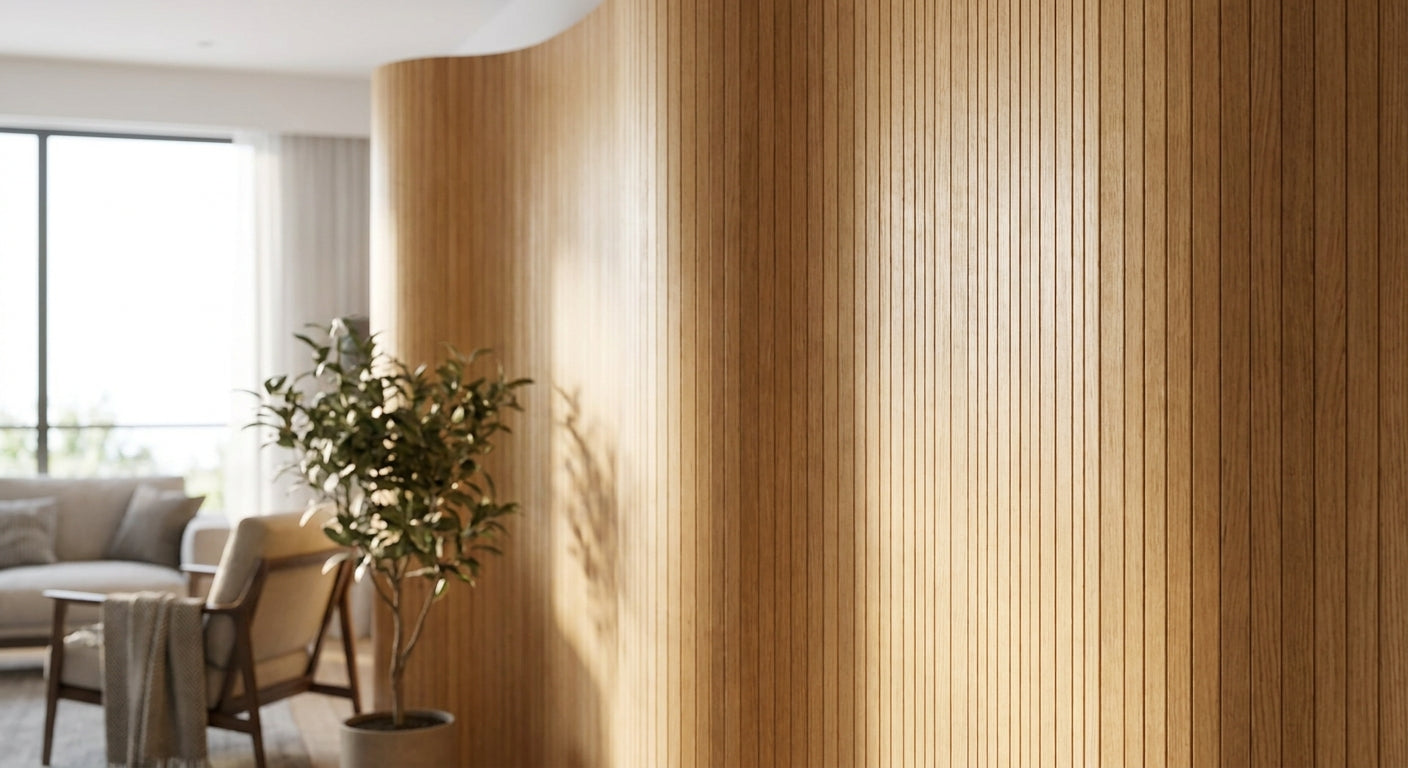
Tambour wood panels turn a flat stud wall into a curved feature wall without burying the timber grain under laminate or paint. This guide covers which oak finish, size format and fixing approach actually hold up on a radius wall in 2026, and which pick to buy first.
- Natural Oak wooden wall panels handle tight curves best at £84.95 per panel - Buy.
- Black Oak works on dark feature walls but grain runs vertical across curved seams - Buy.
- Rustic Oak's heavier texture hides joint lines on a curve better than smooth finishes - Consider.
- Tambour wood panels for curved feature walls need the 240cm format, not 300cm, on tight radii.
- Grey Oak suits minimalist curves but shows panel joins more under side light - Consider.
Why this matters
A curved wall reads as a design feature only if the timber grain stays continuous around the bend. Slat-style wood panels, the kind that behave like tambour paneling, are built from narrow real-wood strips on a backing rather than one solid sheet, which is exactly why they can wrap a radius that a flat MDF board cannot.
Get the finish or fixing method wrong and the curve looks patched rather than built. This is a longer read on decorative panels for curved and angled walls if you want the fitting detail behind the buying advice below.
Who this is for
This guide is for homeowners and small commercial fit-out buyers planning a curved reception desk surround, a rounded stairwell wall, a bowed TV wall, or a plinth that needs real wood veneer rather than a printed laminate. If your wall is dead flat, a standard slat panel install is simpler and this guide is overkill.
What to look for in tambour wood panels for curved feature walls
Slat width relative to the curve radius
Narrower individual slats bend around a tighter radius with less visible flexing at the joints. On a shallow curve this matters less, but on a stairwell bend or a rounded desk front, slat width decides whether the panel sits flush or fights the substrate.
Veneer finish and grain continuity
Real wood veneer on three sides means the grain reads correctly even at panel edges, which is what separates a finished curved wall from one with visible seams. Darker finishes like Black Oak show grain breaks more obviously than lighter, busier grains like Rustic Oak.
Backing type and acoustic performance
Most wooden slat panels in this category run on an acoustic felt backing, which does double duty on a curved feature wall in an open-plan room: it softens reverberation while the timber does the visual work. If the wall backs onto a living room or office with hard flooring, this backing is doing more than decoration.
Panel size format versus curve length
Panels ship in two length formats, 240cm and 300cm, and the shorter format is easier to score, cut and fit around a tight bend without wasting offcuts. Longer panels suit a gentle sweep across a wider wall but get awkward on a pronounced curve.
Fixing method for a curved substrate
Battens or a curved plywood former under the panel give you a consistent fixing surface; panel glue alone works on a flat wall but struggles on anything with real curvature. Plan the substrate before you order panels, not after.
Batch and finish consistency
Oak veneer varies panel to panel because it's real wood, not a printed pattern. On a curved wall where panels sit edge to edge around a bend, ordering from one batch matters more than on a flat wall where a mismatch is less visible.
Top picks for curved feature walls
Natural Oak Wooden Wall Panel — the safe pick. Light, even grain at £84.95 per panel, 3-sided veneer, felt-backed. This finish hides curve joints better than darker tones because the grain variation is subtler across a bend. Buy this if you're unsure and want the lowest-risk option: Natural Oak wooden wall panel.
Black Oak Wooden Wall Panel — the bold pick. Same £84.95 price point, dark tone, 3-sided veneer. It reads as a statement wall but the grain break at each panel joint shows more on a curve than it does on a flat wall, so plan tighter batten spacing if you go this route. Buy this for a moody feature wall with a gentle curve, not a sharp bend: Black Oak wooden wall panel.
Rustic Oak Wooden Wall Panel — the textured pick. At £84.95, the heavier grain and knot detail in this 3-sided veneer camouflages joint lines on a curve better than a clean, uniform finish. Consider this for a farmhouse or industrial-style curved wall where a slightly busier grain works with the room rather than against it: Rustic Oak wooden wall panel.
Grey Oak Wooden Wall Panel — the minimalist pick. Priced at £80.95, this is the lightest-toned option in the range and suits a Scandinavian or Japandi curved wall. It shows panel joins more clearly under side lighting than the busier grains above, so Consider it only where the curve is gentle and the lighting is soft.


What to avoid
- Rigid MDF slatwall sold as a curve solution. If the panel is one solid board with slat grooves routed into the face rather than individual strips on a flexible backing, it will crack or gap at a bend.
- Mixing finish batches mid-curve. Ordering half your panels now and the rest in a few months risks a visible tone shift exactly where you need continuity most.
- 300cm panels on a tight radius. The longer format is built for long, straight or gently swept runs, not a sharp bend around a desk or stairwell corner.
Verdict comparison
| Panel | Finish tone | Price | Curve suitability | Verdict |
|---|---|---|---|---|
| Natural Oak | Light, even | £84.95 | Best for tight curves | Buy |
| Black Oak | Dark, bold | £84.95 | Gentle curves only | Buy |
| Rustic Oak | Heavy grain, textured | £84.95 | Good, hides joints | Consider |
| Grey Oak | Light, minimalist | £80.95 | Gentle curves, soft light | Consider |
FAQ
What are tambour wood panels used for?
Tambour-style wood panels use narrow real-wood slats on a flexible backing to wrap curved or angled surfaces such as feature walls, desk fronts and column casings. They keep the timber grain continuous where a solid board would crack or need visible seams.
How much do wooden wall panels cost for a curved wall in 2026?
Oak veneer slat panels run £80.95 to £84.95 per panel in 2026, depending on finish. A curved wall typically needs more panels per linear metre than a flat wall because of trimming at the bend.
Is Natural Oak or Black Oak better for a curved feature wall?
Natural Oak hides joint lines on a curve better because its grain is subtler across panel breaks. Black Oak looks bolder but shows the same joints more clearly on a bend.
Can you cut wood slat panels to fit a curved wall?
Yes, panels can be scored and cut to follow a curved substrate, though tighter radii need narrower offcuts and more fixing points than a straight wall.
Do curved wood panel walls still work as acoustic panels?
Yes, felt-backed slat panels keep their sound-absorbing backing regardless of wall shape, so a curved feature wall still cuts reverberation in an open-plan room.
Should I use 240cm or 300cm panels on a curve?
Use 240cm panels on tight curves since they're easier to cut and waste less material. Save 300cm panels for long, gentle sweeps.
What backing goes under curved wood panels?
Battens or a curved plywood former give a consistent fixing surface. Panel glue alone works on flat walls but is unreliable on real curvature.
Do all panels in an order match in grain and tone?
Real wood veneer varies slightly panel to panel, so ordering from one batch matters more on a curved wall where panels sit edge to edge around a visible bend.
One last thing
The detail buyers miss most often: a curved wall needs roughly 10-15% more panel material than the same flat wall footprint once you account for trim waste at the bend, so order the extra before the job starts, not mid-install when the batch may have shifted tone.
Share:
Acoustic Baffle Panels for Open Ceilings (2026 Guide)
Plywood Wall Panels for Workshop and Garage: 2026 Guide