

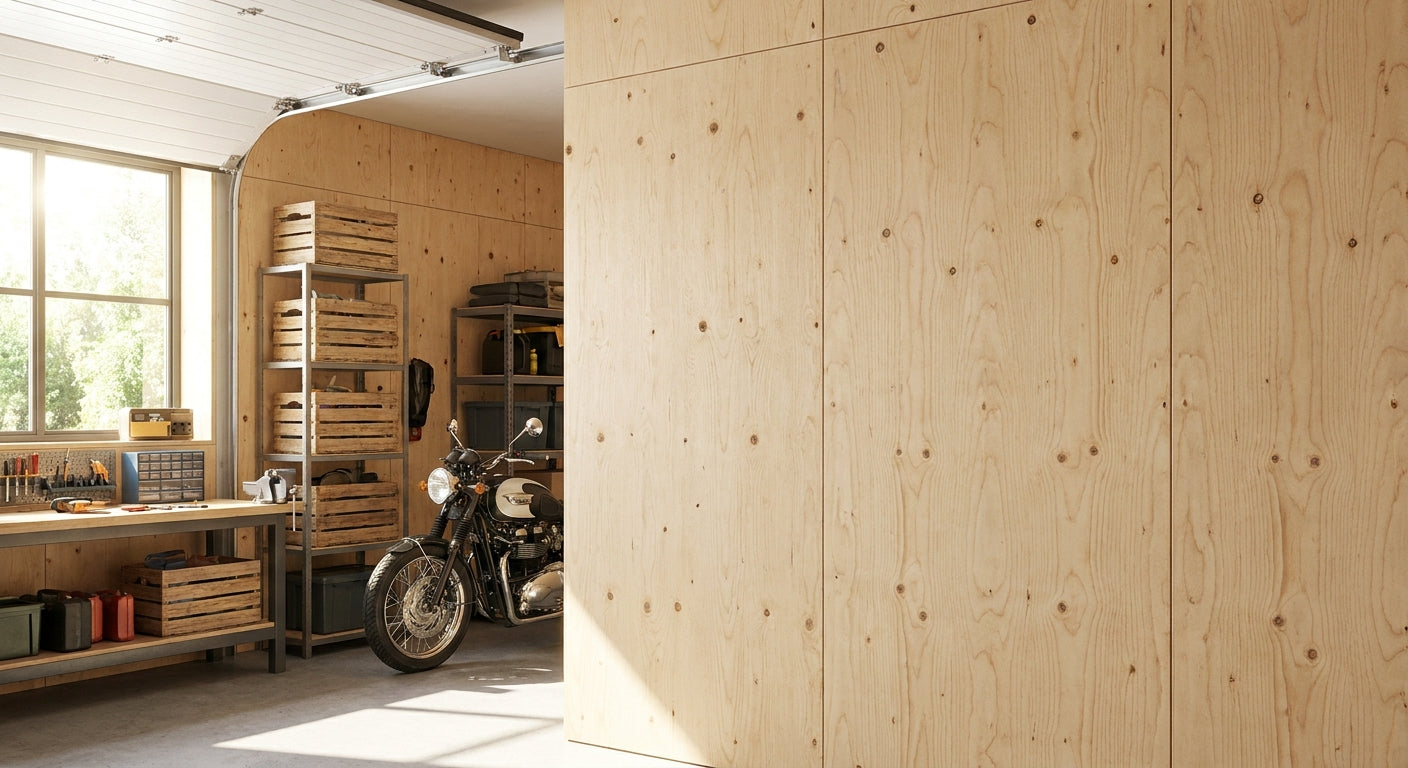
Garages and workshops get lined for one reason: bare studs, block, or breeze wall are cold, ugly, and dent every time a ladder swings past. This guide covers what actually holds up on a workshop or garage wall in 2026 — plywood grades for the impact zone, and where a finished wood panel earns its place over raw board.
- 18mm WBP throughout plywood is the right call for impact zones in a workshop — Buy for durability.
- 6mm interior-grade plywood warps in an unheated garage within a year — Skip it for garage wall panels.
- Akuwood Panel's Black Oak wall panel adds acoustic felt backing for a garage-to-office conversion — Buy.
- Exterior Wall Cladding Panel Black works as both an outer garage finish and an interior feature wall — Consider.
- OSB3 handles occasional damp but needs a vapour barrier behind it in an unheated garage.
Why this matters
A workshop wall takes a different beating than a living room wall. Drills clip it, tools lean on it, dust settles into it, and in an unheated UK garage, condensation sits on it through winter. Choosing the wrong plywood wall panels means re-boarding in two years instead of ten.
Garages are also increasingly doing double duty — half workshop, half office, half gym. If yours is turning into a shared workshop and office space, the wall build-up has to handle noise as well as knocks, and plain plywood doesn't do that on its own.
Who this is for
This is for anyone lining a garage, home workshop, or converted outbuilding wall — DIYers boarding a workbench zone, tradespeople fitting out a van bay or storage unit, and homeowners turning a garage into a hybrid workshop-office where they also take calls. If your wall only needs to look good and never sees a drill press, a decorative panel guide is a better fit than this one.
What to look for in plywood wall panels for a workshop or garage
Moisture resistance
Most garages aren't heated or ventilated to the same standard as the rest of a house, so damp cycles through the wall constantly. Interior-grade plywood absorbs that moisture, swells, and delaminates. WBP (weather and boil proof) grades or exterior-rated board are the baseline for any garage wall in 2026, not an upgrade.
Impact resistance and thickness
A 6mm sheet dents the first time a socket set drops on it. For a working wall, 12mm is the practical minimum and 18mm is where most trade fit-outs land for benches and tool zones. Thicker board also holds screws for shelving brackets without splitting.
Fixing method
How the panel goes up matters as much as what it's made from. Battened walls let you run cable and insulation behind the board and keep it off a damp floor slab — direct-fix to block without a batten gap is the most common reason garage panelling fails early.
Fire and heat exposure
If welding, grinding, or a wood burner sits anywhere near the wall, the fire behaviour of the board matters more than its finish. Cheap MDF and untreated softwood ply are the wrong call near heat sources; treat that zone separately from the rest of the room.
Sound control
A workshop with power tools running next to a home office wall needs mass and absorption, not just a hard surface. This is where a plain plywood sheet loses to an acoustic wall panel — flat board reflects noise straight back into the room instead of soaking it up.
Finish and cleanability
Oil, dust, and metal filings settle into raw plywood grain fast. A pre-finished or veneered surface wipes clean; bare structural ply needs sealing or painting before it earns a place anywhere near a workbench.
Top picks for lining a workshop or garage wall
The workhorse — 18mm WBP throughout plywood. This is the standard trade choice for the impact zone around a workbench or tool wall. It holds screws, shrugs off knocks, and survives damp cycles that would ruin interior-grade sheet. It has no acoustic value and no finished look, so it belongs behind cladding or paint, not as the visible surface in a converted space. Buy for the working half of the wall.
The garage-to-office upgrade — Black Oak wall panel. Akuwood Panel's indoor panels carry a 3-sided real wood veneer finish over an acoustic felt backing, and this is the finish that makes sense once a corner of the garage becomes a desk, a call zone, or a hobby room. It comes in two size formats — 240cm and 300cm — so it fits standard and taller garage wall heights without extra cutting. Buy for the finished, working-from-home end of the space.
The exterior-to-interior crossover — Black exterior cladding panel. Built as exterior wall cladding, this panel also reads well as a feature wall inside a converted garage that keeps an industrial look — dark timber tone against exposed block or steel shelving. It's not an acoustic product, so pair it with soft furnishing or a felt-backed panel if the space needs noise control too. Consider it for the visible, non-acoustic wall of a garage conversion.
The shelving and bench backer — Birch cladding board. A cladding board reads as a middle ground between raw plywood and a full decorative panel — enough finish to look intentional, robust enough to take fixings for shelving brackets. It's not rated as an acoustic product, so treat it as a look-and-durability choice rather than a noise-reduction one. Consider for utility walls that still need to look tidy.
The budget damp-zone board — OSB3. OSB3 costs less than marine ply per sheet and handles occasional moisture better than standard chipboard, which makes it a reasonable base layer behind a finished panel in an unheated garage. Left exposed, it's rough, hard to clean, and looks unfinished next to anything veneered. Consider it only as a hidden backing layer, never as the visible wall.
"If you can dent it with a knuckle, it's too thin for a workshop wall."
What to avoid
- 6mm interior plywood in an unheated garage. It looks fine on the shelf and warps within a year once damp cycles through it.
- Peel-and-stick plywood-effect wallpaper on a workshop wall. It reads well in photos and lifts at the seams the first time a tool leans against it.
- Direct-fix panelling with no batten gap on a solid block wall. Skipping the gap traps moisture behind the board and starts rot or mould before year one is out.
Verdict comparison
| Option | Moisture resistance | Impact resistance | Acoustic value | Best zone |
|---|---|---|---|---|
| 18mm WBP throughout plywood | High | High | None | Workbench / tool wall |
| Black Oak wall panel | Moderate | Moderate | High (felt-backed) | Home office corner |
| Black exterior cladding panel | High | Moderate | None | Feature wall, garage conversion |
| Birch cladding board | Moderate | Moderate | None | Shelving / utility wall |
| OSB3 | Moderate | High | None | Hidden backing layer |
FAQ
What is the best plywood for a garage wall?
18mm WBP (weather and boil proof) throughout plywood is the best plywood for a garage wall in 2026 because it resists the damp cycles that warp interior-grade sheet. Use it for the impact zone around a workbench and cover the rest with a finished panel.
Can I use plywood wall panels in an unheated garage?
Yes, but only exterior or WBP-rated plywood — standard interior plywood swells and delaminates in an unheated garage within a year. Fix panels to battens rather than direct to block so moisture doesn't sit behind the board.
Is 12mm or 18mm plywood better for a workshop wall?
18mm plywood holds up better around a workbench because it resists denting from dropped tools and takes shelving screws without splitting. 12mm is fine for lower-traffic garage walls away from the bench.
Do plywood wall panels reduce noise in a garage workshop?
No, plain plywood reflects sound rather than absorbing it. An acoustic wood panel with a felt backing, like Akuwood Panel's indoor range, cuts reverberation far more than flat plywood sheet.
How much does it cost to line a garage wall with plywood in 2026?
Cost depends on grade and thickness, with WBP plywood sitting above standard interior ply and finished wood panels above raw board. Check current pricing directly on the product pages before ordering a full run.
Should I paint or seal plywood before using it as a workshop wall panel?
Yes, seal or paint exposed plywood before it goes up in a workshop, since raw grain absorbs oil, dust, and moisture. A pre-finished veneered panel skips this step entirely.
Can I turn a garage into a home office with wood wall panels?
Yes — a felt-backed wood panel like the Black Oak wall panel handles both the finished look and the acoustic control a garage-to-office conversion needs. Keep raw plywood confined to the workshop side of the space.
What thickness of OSB is best for a garage wall?
OSB3 is the moisture-resistant grade suited to a garage wall, but it should sit as a backing layer behind a finished surface rather than as the visible wall. It handles damp better than standard OSB2 or chipboard.
One last thing
Most garage panelling failures don't come from the wrong board — they come from skipping the batten gap. A wall built with cheap OSB on battens will outlast expensive plywood fixed flat to damp block, every time.
Share:
Tambour Wood Panels for Curved Walls: 2026 Buying Guide
OSB Wall Panels for Site Hoarding: What to Buy in 2026