

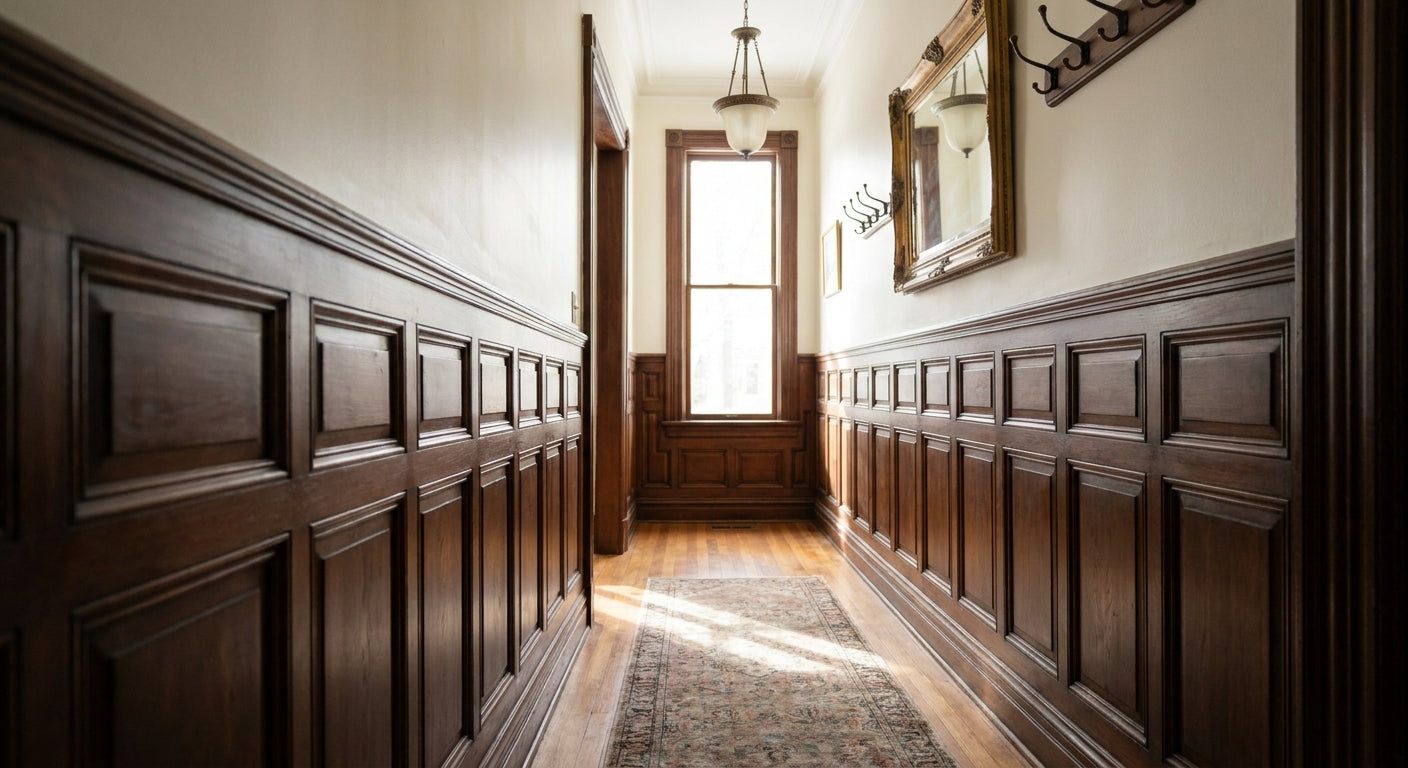
Wainscoting panels for period home hallways have to do two jobs at once: look like they belong in a Victorian or Edwardian terrace, and survive a corridor that takes daily hits from coats, prams and dog leads. This guide names the finishes, sizes and fixing approaches that hold up in a 2026 hallway, and flags the options that look right in a showroom but fail within a year.
- Natural Oak wood-veneer panels at £84.95 win for most period hallways in 2026 - buy.
- Black Oak suits dark, narrow corridors that need to hide daily scuffs - buy.
- Full-height painted MDF panelling marketed as wainscoting panels skips acoustic backing - skip.
- 300cm panels only make sense above 250cm ceiling height; below that, order 240cm.
Why this matters
A period hallway is a hard-surfaced, high-traffic corridor with a floor that reflects sound straight back up bare plaster walls. Bare walls plus tiled or wood flooring means every closing door and every dropped shoe echoes. Traditional raised-panel wainscoting solves the look but does nothing for the noise; a felt-backed wood panel solves both. If you're weighing painted joinery against a manufactured panel, tongue-and-groove wall panels for period home interiors covers the joinery side in more depth - this guide is about the veneer-and-felt route.
Who this is for
This is for owners of pre-1930s terraces, semis and townhouses who want the dado-height, panelled-wall look in a hallway without commissioning bespoke carpentry. It's for anyone dealing with hard-floor echo in a corridor, and for renovators who want a finish that survives contact damage better than painted plaster. It is not for anyone chasing a strict period-accurate raised-panel replica for a listed building - that's a joinery job, not a panel-off-the-shelf job.
What to look for in wainscoting panels for a period hallway
Panel height and proportion
Traditional wainscoting sits at dado height, roughly a third of the wall. In a hallway with a picture rail or original dado, match that line rather than running panels floor-to-ceiling - floor-to-ceiling reads as modern cladding, not period panelling. Getting the proportion wrong is the single fastest way to make a hallway look like a hotel corridor instead of a period home.
Real wood veneer over printed foil
A 3-sided wood veneer finish shows genuine grain variation panel to panel; printed foil repeats the same grain pattern every 60cm and it's obvious under hallway sidelight. Grain authenticity matters more in hallways than any other room because hallway lighting is usually a single overhead source raking across the wall at an angle that exposes repeats.
Acoustic felt backing
Hard floors plus bare plaster is the classic echo combination in period hallways. A felt-backed panel absorbs reflected sound instead of bouncing it, which matters more here than in a carpeted living room. Skip the felt backing and you've bought decoration, not an acoustic fix.
Fixing method for original walls
Lath-and-plaster and solid brick behind old render don't take screws the way modern plasterboard does. Confirm whether the panel system is designed for adhesive fixing, batten fixing, or both before you order - retrofitting a fixing plan after delivery costs more time than getting it right first.
Colour depth against existing joinery
Skirting, doors and staircase spindles in a period home are usually a fixed colour you can't easily change. A panel finish that clashes with 100-year-old stained oak skirting looks worse than no panelling at all - order a sample against your actual skirting board before committing to a run.
Sample before you commit
A £2.50 sample panel costs less than a coffee and tells you more than any product photo. Hallway light shifts through the day - north-facing corridors go cool and grey, south-facing ones go warm - and a sample held against the wall at 9am and 5pm settles the decision fast.
“If a hallway is narrower than 90cm, run panels to dado height only - full-height panelling closes the space in.”
Top picks for period home hallways
Natural Oak wall panel - the safe pick. Real 3-sided wood veneer at £84.95 per panel, available in the 240cm and 300cm size formats, and light enough to brighten a north-facing corridor rather than darken it further. It reads as traditional oak panelling from three feet away and holds up to scuffs better than painted MDF. Buy for any hallway where you want the classic wainscoting look without committing to a dark finish. See the Natural Oak wall panel.
Black Oak wall panel - the moody pick for dark corridors. Same £84.95 price point and 3-sided veneer construction, but the dark tone hides scuff marks and shoe scrapes far better than any light finish - a genuine advantage in a hallway that gets hit daily. It works best in hallways with a strong secondary light source, since black tones can swallow a dim corridor entirely. Buy if your hallway gets decent natural light and heavy daily traffic. Check the Black Oak wall panel.
Smoked Oak - the wildcard. At £80.95 it's the cheapest of the wood-veneer range and sits between Natural Oak and Black Oak in tone, which makes it forgiving if you're not sure which direction to go. It photographs warmer than it looks in person, so a sample matters more here than with the other two finishes. Consider it if you want a middle-ground tone and haven't settled on light versus dark yet.
Rustic Oak - the textured pick. The rougher grain pattern suits farmhouse-style period conversions better than smooth Georgian or Victorian terraces, where a cleaner grain reads more authentically. It's a strong option for a converted barn hallway, weaker for a formal townhouse entrance. Consider for character properties with exposed beams or brick; skip for a smooth-plastered Victorian hall.
What to avoid
- Full-height painted MDF tongue-and-groove sold as "wainscoting" - it has no acoustic backing, and mitred corners crack on the uneven walls common in pre-1930s builds.
- 300cm panels in a low-ceiling hallway. Most period terrace hallways run under 250cm ceiling height, and a 300cm panel forces a horizontal cut that ruins the vertical grain line. Order the 240cm format instead.
- High-gloss white finishes in a narrow corridor. Gloss shows every scuff and fingerprint within a season of daily traffic - matte wood veneer wears far better in a space nobody stops to clean twice a day.


Verdict comparison
| Pick | Price | Format | Acoustic backing | Best for | Verdict |
|---|---|---|---|---|---|
| Natural Oak | £84.95 | 240cm / 300cm | Yes | North-facing, formal hallways | Buy |
| Black Oak | £84.95 | 240cm / 300cm | Yes | High-traffic, well-lit corridors | Buy |
| Smoked Oak | £80.95 | 240cm / 300cm | Yes | Undecided on light vs dark | Consider |
| Rustic Oak | Premium range | 240cm / 300cm | Yes | Barn conversions, farmhouse halls | Consider |
FAQ
What's the best wainscoting panel for a Victorian hallway?
Natural Oak wood-veneer panels at £84.95 suit most Victorian hallways because the lighter tone works with the low natural light typical of terrace corridors. Black Oak is the better call if the hallway already gets strong daylight from a fanlight or side window.
Is wainscoting panelling better than painted MDF panelling for period homes?
A felt-backed wood-veneer panel outperforms painted MDF on both echo reduction and daily wear, since MDF has no acoustic backing and shows scuffs on painted edges. MDF wainscoting is cheaper upfront but needs repainting within a few years in a high-traffic hallway.
How much does wainscoting panelling cost per panel in 2026?
Wood-veneer panels run £80.95 to £84.95 per panel in 2026, depending on finish, plus around £10.95 for panel adhesive if you're fixing without battens. A £2.50 sample lets you check the finish against your skirting before ordering full panels.
Do acoustic wood panels work as wainscoting in a narrow hallway?
Yes - felt-backed wood panels absorb the reflected sound that bare plaster and hard flooring create in narrow corridors, which traditional raised-panel wainscoting does not address. Stick to dado height in hallways under 90cm wide so the panelling doesn't visually close the space in.
What size wainscoting panels fit a standard UK hallway ceiling?
Most period terrace hallways have ceilings under 250cm, which fits the 240cm panel format without cutting. Reserve the 300cm format for hallways with higher ceilings, typically Georgian or Edwardian builds with original cornicing.
Can you fit wainscoting panels over an existing dado rail?
You can panel up to an existing dado rail and use it as the natural stopping line, which keeps the period proportion intact. Removing the rail first gives a cleaner run but means patching plaster before fixing panels.
How do you fix wainscoting panels to an original lath-and-plaster wall?
Lath-and-plaster walls generally need panel adhesive rather than screws, since plaster keys can crumble under fixings. Check the panel's recommended fixing method before ordering - some finishes support batten fixing as an alternative on uneven walls.
Do wainscoting panels need to match the skirting board colour?
They don't need to match exactly, but a strong clash between panel tone and 100-year-old stained skirting reads as a mistake rather than a design choice. Order a sample and hold it against the actual skirting in daylight before committing to a full run.
One last thing
Most period hallway panelling projects fail on proportion, not finish - a beautiful oak veneer run floor-to-ceiling in a 90cm-wide corridor still looks wrong. Stop at dado height, keep the panel line consistent with any picture rail already on the wall, and the £2.50 sample will save more money than any discount on the full panel run.
Share:
Best Slatwall Panels for Retail Shop Fitouts 2026
Acoustic Ceiling Rafts for Suspended Ceilings: 2026 Verdict