

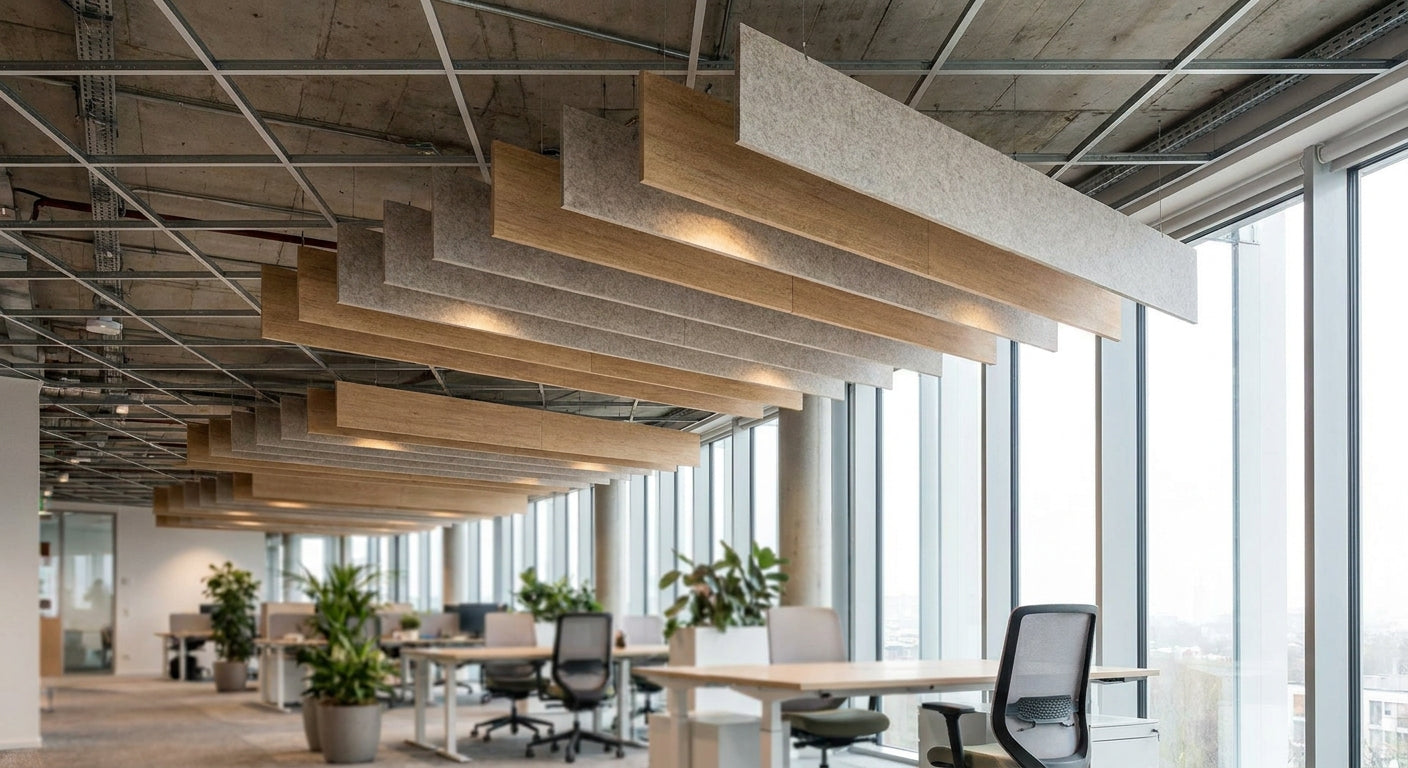
Suspended ceilings absorb almost nothing on their own, which is why open-plan offices and drop-ceiling rooms echo no matter how much carpet you throw down. Acoustic ceiling rafts fix that by adding absorptive surface area above head height — but rafts aren't the only route to a quieter room in 2026, and for a lot of UK fit-outs a direct-fix wood veneer panel does the same job for less hassle.
- Acoustic ceiling rafts reduce reverberation in suspended-ceiling rooms, but true suspended raft systems need grid clearance most retrofits don't have.
- Hexagon Panel Natural Oak with Grey Felt (NRC 0.75, 81 cm, £40.95) is the direct-fix alternative for offices and meeting rooms — Buy.
- Hexagon Panel Walnut with Grey Felt matches the same NRC 0.75 rating for darker, exposed-soffit ceilings — Buy.
- Pair ceiling treatment with a felt-backed wall panel like Black Oak for full-room reverberation control, not just overhead — Consider.
Why this matters
A suspended ceiling is a hard, flat plane that bounces sound instead of soaking it up. In a meeting room or open-plan office this shows up as people asking "sorry, what?" through video calls and as fatigue by 3pm. Acoustic ceiling rafts solve this by hanging absorptive panels below the grid, but they need clearance most retrofit projects simply don't have, and they carry an industrial, exposed look that not every brief wants in 2026.
A direct-fix acoustic panel — mounted flush to the grid infill or an exposed soffit — gets you most of the same reverberation control without the hanging hardware. If you're weighing that trade-off, the installation guide for panels above a suspended ceiling walks through where flush-mount actually beats a raft, and where it doesn't.
Who this is for
This guide is for facilities managers and office fit-out contractors comparing acoustic ceiling rafts against panel alternatives for a 2026 refurbishment, and for homeowners with an exposed soffit or a low suspended ceiling who want the wood-veneer look instead of foam baffles. If your ceiling void has less than 100mm of clearance, or the brief calls for a warm finish rather than an industrial hanging system, keep reading.
What to look for in acoustic ceiling rafts for suspended ceilings
Sound absorption rating (NRC)
NRC — the Noise Reduction Coefficient — tells you how much sound energy a panel absorbs versus reflects. A rating of 0.75 means three-quarters of incident sound is absorbed rather than bounced back into the room, which is the range you want for meeting rooms and open-plan offices carrying constant conversation.
Mounting method and ceiling clearance
True suspended rafts hang on wires below the grid and need real void depth. A direct-fix panel mounts to the grid infill or an exposed soffit with no hanging hardware, which matters most in retrofit projects where the ceiling void is already tight.
Panel size and coverage speed
Larger sheet sizes cover a room faster with fewer joints. AKU Woodpanel's wooden wall panels ship in 240cm and 300cm formats for wall and larger ceiling runs, while the hexagon range comes in 81cm units for patterned, modular ceiling and wall layouts.
Finish and how it reads from below
A raft system usually shows an exposed felt or foam face. A wood veneer panel with a felt backing gives you the acoustic performance with a finished, furniture-grade look overhead — worth weighing if the ceiling is visible from a reception desk or lobby.
Fire rating documentation
Commercial fit-outs need fire rating paperwork before anything goes on a ceiling, full stop. Check the fire rating guidance for acoustic wood panels against your building's requirements before you specify anything, panel or raft.
Cost per panel versus coverage
Compare the price per unit against the area it actually covers, not just the sticker price. A £40.95 hexagon panel covering roughly 0.5m² costs more per square metre than a full 240cm sheet — do that math before you commit to a pattern-heavy layout.
Top picks for ceiling and near-ceiling acoustic treatment
The direct-mount raft alternative — Buy
The Hexagon Panel Natural Oak with Grey Felt carries an NRC of 0.75 and comes in 81cm units at £40.95 each. It fixes flush to a grid infill or exposed soffit with no wire suspension, which makes it the practical swap when a genuine raft system won't fit the ceiling void. Buy it for offices and meeting rooms where clearance is the limiting factor.
The dark-toned pick for exposed soffit ceilings — Buy
The Hexagon Panel Walnut with Grey Felt matches the same NRC 0.75 rating at £40.95 per 81cm unit, but the walnut finish reads darker overhead — useful when the ceiling is exposed structure rather than a bright suspended grid. Buy it if the room is going for a moody, exposed-soffit look rather than a bright office ceiling.
The wall-companion pick for full-room control — Consider
Ceiling treatment alone won't fix a room where the walls are also bare and hard. The Black Oak Wooden Wall Panel has a real wood veneer face with an acoustic felt backing and ships in the 240cm and 300cm formats, so it pairs the same visual language on the walls as the hexagon panels do overhead. Consider it as a second-phase spend once the ceiling treatment is in and you're still hearing flutter echo off the walls.


The wildcard for pattern-heavy ceilings — Consider
The Hexagon Panel Grey Walnut with Grey Felt shares the same NRC 0.75 rating and 81cm format as the other hexagon panels but reads cooler on a ceiling plane, which suits rooms already leaning grey or Scandi. Consider it when the room brief calls for a lighter, less warm-wood ceiling than natural oak or walnut give you.
What to avoid
- Skip installing any acoustic panel over a suspended grid without checking the fire rating first — a good-looking finish means nothing if it fails building compliance on a commercial job.
- Skip treating the ceiling alone in a room with bare, hard walls — reverberation bounces off every hard surface, and a ceiling-only fix in a room with glass or plaster walls will still sound live.
- Skip assuming a raft system fits every void — measure your ceiling clearance before specifying anything that hangs on wires; a direct-fix panel is the fallback when it doesn't.
Verdict comparison
| Option | Absorption | Mounting | Format | Best for | Verdict |
|---|---|---|---|---|---|
| Suspended acoustic raft (generic) | Varies by spec sheet | Hangs below grid on wires | Various tile sizes | New-build ceilings with real void depth | Consider |
| Hexagon Panel Natural Oak w/ Grey Felt | NRC 0.75 | Direct-fix to soffit/grid infill | 81 cm hexagon | Offices, meeting rooms | Buy |
| Hexagon Panel Walnut w/ Grey Felt | NRC 0.75 | Direct-fix | 81 cm hexagon | Exposed soffit, dark palettes | Buy |
| Black Oak Wooden Wall Panel | Felt-backed veneer | Wall-mount, pairs with ceiling | 240/300 cm sheet | Full-room reverb control | Consider |
FAQ
What are acoustic ceiling rafts used for?
Acoustic ceiling rafts hang below a suspended ceiling grid to absorb sound that would otherwise bounce off the flat ceiling plane. They're common in open-plan offices in 2026 where reverberation from hard-surface ceilings makes conversation and calls harder to follow.
Can I use acoustic wall panels on a ceiling instead of a raft?
Yes, direct-fix panels with a felt backing and NRC rating of 0.75, like the AKU Woodpanel hexagon range, work flush against a grid infill or exposed soffit and don't need the wire suspension a raft system requires.
How much clearance do acoustic ceiling rafts need?
Suspended raft systems typically need real void depth below the grid to hang on wires, which most retrofit ceilings don't have. If your void is under 100mm, a direct-fix panel is the practical option instead.
Is NRC 0.75 a good sound absorption rating?
An NRC of 0.75 means roughly three-quarters of the sound hitting the panel gets absorbed rather than reflected, which puts it firmly in the useful range for meeting rooms, offices, and open-plan spaces dealing with echo in 2026.
Do I need to treat both the ceiling and the walls for echo control?
In most rooms, yes. Reverberation bounces off every hard surface, so a ceiling-only fix in a room with bare plaster or glass walls will still sound live even after the ceiling treatment goes in.
What size are hexagon acoustic panels?
AKU Woodpanel's hexagon acoustic panels measure 81cm across and come with a grey felt backing carrying an NRC of 0.75, sold individually so you can build a modular ceiling or wall pattern.
Do acoustic panels need a fire rating for commercial ceilings?
Yes. Any material specified for a commercial ceiling needs fire rating documentation checked against the building's requirements before installation, regardless of whether it's a raft system or a direct-fix panel.
What's the difference between a suspended raft and a direct-fix panel?
A suspended raft hangs below the ceiling grid on wires and needs void clearance, while a direct-fix panel like AKU Woodpanel's hexagon range mounts flush to the grid infill or an exposed soffit with no hanging hardware.
One last thing
Most people spec the ceiling first and the walls second, but the room usually sounds worse after the ceiling goes in and the walls are still bare — the ear notices the mismatch between a treated ceiling plane and untreated vertical surfaces more than it notices an untreated room overall. Budget for both surfaces from the start of the 2026 project, even if the wall panels go in a second phase.
Share:
Wainscoting Panels for Period Hallways: 2026 Verdict
Acoustic Screens for Offices: 2026 Buying Guide & Verdicts