

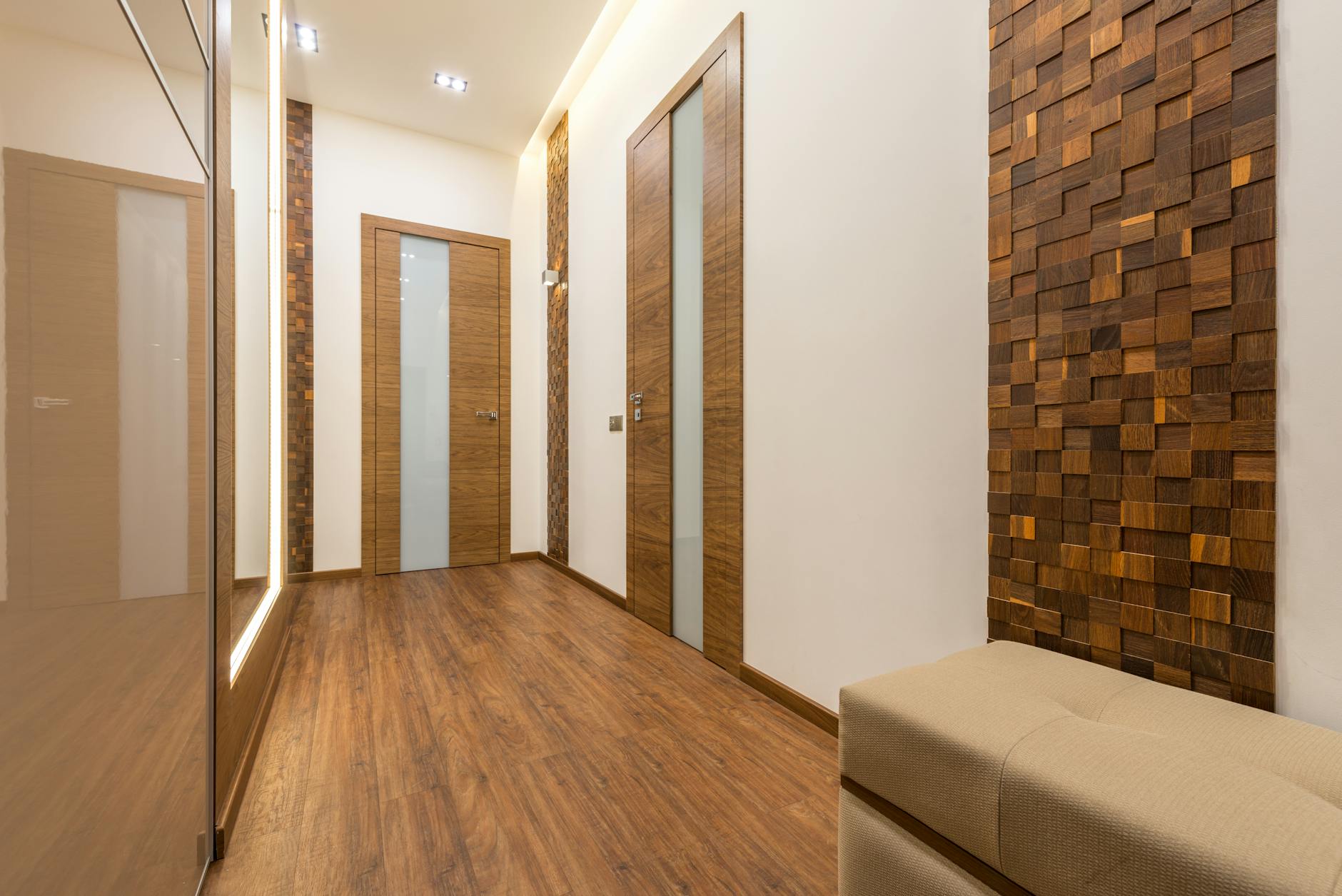
Hallways are the hardest room to panel well — narrow, high-traffic, and lit by whatever light reaches from the front door. These are the best decorative wall panels for hallways in 2026, ranked by finish durability, acoustic benefit, and how well each works in the tight proportions a hallway demands.
TL;DR: For most UK hallways in 2026, the best decorative wall panels are acoustic slatted wood panels in natural oak or smoked oak — they absorb echo from hard flooring, survive daily brushes from bags and coats, and install in an afternoon with panel adhesive. Aku Wood Panel manufactures all panels listed below in the UK supply chain, with samples available before you commit to full packs. If you want warmth without heaviness, natural oak wins. If you want drama on a feature wall, black oak or smoked oak is the call.
Why hallway panelling is different from every other room
Hallways echo. Hard floors, bare plaster walls, and a tube-shaped room create flutter echo that makes your home sound hollow. Decorative panels that also carry acoustic felt backing cut that echo without a separate acoustic treatment budget. A hallway panel also takes more physical punishment than a living room feature wall — shoulders, bags, pushchairs — so surface hardness and edge protection matter in a way they simply do not in a bedroom.
In 2026, the dominant choice for UK residential hallways is slatted acoustic wood panels: real wood veneer slats over an MDF or felt substrate. They land better acoustically than plain MDF moulding panels, and they read as higher-spec than PVC alternatives at similar price points.
How these panels were ranked
Rankings are based on four criteria specific to hallway use: acoustic absorption (does the backing material reduce echo?), surface durability (real veneer or painted surface — how does it handle contact?), finish versatility (light or dark — works with the hallway's natural light level), and installation method (adhesive or mechanical fixing — hallway walls are often plasterboard over brick, so adhesive systems matter). Aku Wood Panel's range covers all four criteria across multiple finishes; picks below draw from that catalogue with explicit verdicts.
Ranked: best decorative wall panels for hallways in 2026
1. Natural Oak Wooden Wall Panel — the safe pick
Hook: The panel most hallways need, in the finish that suits the widest range of decors.
Natural oak veneer over grey felt backing. The felt layer provides meaningful acoustic damping — useful in any hallway with stone, tile, or hardwood flooring underfoot. The warm mid-tone of natural oak reads well in both north-facing and south-facing halls, and it pairs with white woodwork without effort.
Installation uses high-tack panel adhesive; no drilling into plasterboard required. Order a sample wooden wall panel natural oak before committing to full packs — the veneer tone shifts slightly between batches and screen colours are unreliable.
Why now: Natural oak slatted panels have been the top-selling interior finish in UK new-build developments throughout 2025 and into 2026. Availability is currently good and lead times are short.
Verdict: Buy
2. Smoked Oak Wooden Wall Panel — the drama pick
Hook: Adds depth to a north-facing hall without making it feel smaller.
Smoked oak veneer gives you a mid-dark finish that photographs well and reads as intentional. Where natural oak can disappear into a beige hallway, smoked oak anchors the space. Grey felt backing is standard, maintaining the same acoustic benefit as the natural oak variant.
Best used on a single feature wall — the wall you face as you enter — rather than all four walls. In a narrow hall, full wrap in a dark finish reduces perceived width.
Verdict: Buy for feature wall use. Hold if the hall is under 900 mm wide.
3. Black Oak Wooden Wall Panel — the bold pick
Hook: The right call for contemporary and monochrome schemes; wrong for anything traditional.
Black oak veneer is a surface-stained real wood finish, not a painted MDF. It holds its edge definition better than paint under daily contact and does not show scuffs the way a gloss surface would. It works best in hallways with black ironmongery, dark tile grout, or a charcoal front door.
If your hallway has existing warm timber (stair treads, skirting in pine), black oak will fight it. Neutral-finish halls only.
Verdict: Buy for modern interiors. Skip for traditional or warm-toned schemes.
4. Rustic Oak Premium 3-Sided Wood Veneer Panel — the texture pick
Hook: The only panel in the range with three-sided real wood veneer — the most tactile option for a statement hallway.
The rustic oak premium 3-sided wood veneer panel wraps veneer on three sides rather than face only. That detail matters in a hallway: when light catches the slat edges at a low angle — common near a door or window — the depth reads as genuinely crafted rather than printed. The rustic oak tone introduces visible grain variation, which works well in period properties.
Verdict: Buy if you want the highest-texture result. Hold if budget is tight — it prices above the standard range.
5. Decorative Wall Panel Snowdrop Cadet Blue — the wildcard
Hook: The one non-wood option worth considering for a hallway feature wall.
The Snowdrop panel in cadet blue is a 3D decorative panel — textured surface, not slatted wood. It suits a hallway where you want one strong visual moment rather than full-wall panelling. Cadet blue sits in the cool-neutral range and pairs well with brass or brushed steel door furniture common in 2026 UK interiors.
Not acoustic. Do not use it expecting echo reduction.
Verdict: Consider for a single feature wall with no acoustic requirement. Skip if you need noise damping.
Comparison table
| Panel | Finish tone | Acoustic backing | Best use | Verdict |
|---|---|---|---|---|
| Natural Oak | Warm mid | Grey felt | Full wall, any hall | Buy |
| Smoked Oak | Mid-dark | Grey felt | Feature wall | Buy |
| Black Oak | Dark | Grey felt | Contemporary feature | Buy |
| Rustic Oak 3-sided veneer | Warm rustic | Standard | Statement hallway | Buy |
| Snowdrop Cadet Blue | Cool blue | None | Decorative accent | Consider |
What to avoid in hallway panelling
- High-gloss PVC panels. They show every fingerprint and scuff within a week, and the plastic edge degrades faster than veneer under repeated contact.
- Oversized tile-format panels in narrow halls. A 1200 mm panel module in a 1000 mm wide hall creates awkward cut lines that read as afterthought. Slatted panels cut cleanly at any width.
- Panels without acoustic backing when you have hard flooring. Bare-face MDF panels on a hallway wall do nothing for echo — you end up with decoration and a noise problem you still have to solve separately.
Where to buy
All panels above ship from Aku Wood Panel direct. Three practical rules:
- Order samples first. Every finish listed has a sample SKU. Veneer tones vary under different light temperatures — a sample costs a few pounds and prevents a full pack return.
- Buy end pieces at the same time. Hallway walls have door frames, architraves, and awkward corners. End pieces finish raw slat edges neatly; ordering them in a second delivery adds lead time.
- Use the panel adhesive in the kit. Aku Wood Panel's high-tack adhesive is formulated for MDF-backed panels on plasterboard. Third-party grab adhesives sometimes react with the felt backing and cause delamination within 12 months.
FAQ
What are the best decorative wall panels for a hallway in 2026? Acoustic slatted wood panels in natural oak or smoked oak are the best choice for most UK hallways in 2026. They absorb echo, handle daily contact better than paint or PVC, and install without drilling.
Are wood wall panels suitable for a hallway? Yes. Real wood veneer panels are more durable in high-contact areas than painted plaster or PVC. The key is choosing a panel with a hard veneer surface rather than a printed film finish.
Do decorative wall panels reduce noise in a hallway? Panels with grey felt or acoustic backing reduce flutter echo noticeably in hard-floored hallways. They do not achieve the same reduction as purpose-built acoustic foam, but they are the most practical dual-purpose solution for residential use.
How do you fix wall panels in a hallway? High-tack panel adhesive is the standard method for plasterboard walls. It avoids visible fixings, allows minor alignment adjustment, and holds permanently once cured — typically within 24 hours.
What thickness of wall panel is best for a hallway? Most slatted acoustic wall panels run between 21 mm and 23 mm overall depth including the felt backing. That depth is sufficient for acoustic benefit without projecting far enough to narrow the walkway.
Is natural oak or smoked oak better for a dark hallway? Smoked oak adds contrast and depth to a dark hallway and photographs better in low light. Natural oak can feel washed out in a north-facing hall with no supplementary lighting.
Can you use decorative panels in a rented property? Adhesive-fixed panels are removable with a heat gun or panel release tool. Some landlords accept them; always check your tenancy agreement before installation.
How much do hallway wall panels cost per square metre? Aku Wood Panel's slatted range prices vary by finish and veneer type. Ordering samples before full packs is the most cost-effective way to confirm the correct finish before committing.
One last thing
Slatted acoustic wall panels in hallways do something no purely decorative panel does: they change the sound of your home the moment you open the front door. Visitors notice it before they notice the visual. That combination — acoustic function plus the warmest finish in the range — is why natural oak has been the top recommendation for UK hallways consistently through 2025 and into 2026. The aesthetic is easy to justify; the acoustic benefit is the thing that actually improves daily life.
Share:
Facade Cladding Panels for Commercial Buildings 2026
Best Wall Cladding Panels for Garden Rooms 2026