

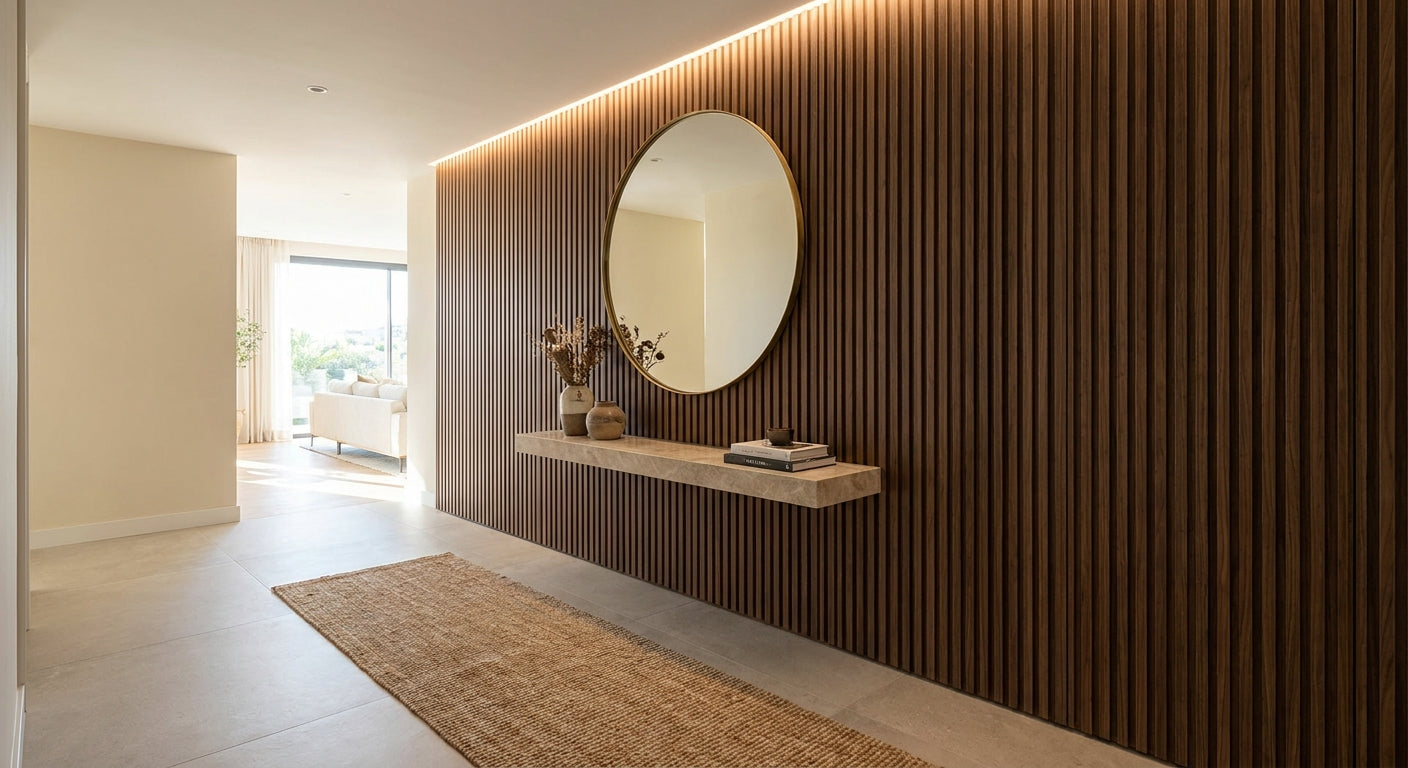
Decorative wall panels turn a hallway from a corridor into the first proper room of your home — and in 2026, the options have moved well beyond painted MDF.
TL;DR: For a hallway feature wall in 2026, acoustic wood panels are the strongest choice. They add warmth, absorb echo (a real problem in narrow corridors), and install without specialist trades. Aku Wood Panel manufactures slatted wood panels across finishes including Natural Oak, Walnut, Smoked Oak, and Black Oak, plus 3D decorative panels in patterns like Lobelia and Crimson. The right pick depends on your hallway width, existing floor tone, and whether you want flat slats or a sculptural surface.
Why hallways need different panels to any other room
Hallways are acoustically harsh. Hard floors, bare walls, and a tube-like shape create flutter echo — that clipped, ringing quality when someone speaks near the front door. A decorative wall panel that also absorbs sound fixes two problems at once rather than one.
Hallways also take more physical punishment than living rooms. Bags brush the wall, coats catch it, small hands trail along it. Panel density and surface finish matter far more here than in a bedroom. In 2026, the UK market for interior wood cladding has expanded significantly, with slatted acoustic panels becoming the dominant format for residential feature walls — partly because they photograph well, partly because they genuinely perform.
Who this guide is for
You are a homeowner or interior designer choosing decorative wall panels for a hallway feature wall in a UK property. You want a panel that looks considered rather than off-the-shelf, installs without requiring a joiner, and holds up to daily contact. You are not fitting a full room — a single chimney-breast-width wall, or one end wall, is typical.
What to look for in decorative wall panels for hallways
Acoustic performance
Slatted panels with a felt backing reduce mid-frequency echo by absorbing sound between the slats. In a hallway — typically 1.2–1.8 m wide — even a single panelled wall makes a measurable difference to reverberation. Panels with grey felt backing absorb more than panels with a plain MDF backing, so if your hallway is particularly hard-surfaced (tile floor, plaster ceiling), prioritise felt-backed options.
Finish durability
Hallway panels need a surface that wipes clean and resists scuffing. Real-wood-veneer slats on a density board substrate hold their finish better than foil-wrapped alternatives. Three-sided veneer — where the visible face, the top edge, and the bottom edge of each slat are all veneered — eliminates the raw-edge look you get when light rakes across the panel at an angle. This detail matters most in narrow corridors where you are always close to the wall.
Panel dimensions relative to hallway height
Standard UK ceiling height is 2.4 m. Most slatted panels are sized to run floor-to-ceiling on a single course, which avoids horizontal joins. Confirm the panel height before ordering. If your hallway has a higher ceiling — 2.6 m or above — you will need to plan joins deliberately or source panels cut to length.
Colour tone against your floor and door
Hallways almost always have a strong tonal anchor: a dark engineered oak floor, a white-painted door, grey limestone tile. The panel finish needs to either match that anchor or contrast it deliberately. Warm tones (Natural Oak, Walnut, Rustic Oak) work with warm-toned floors. Cool or deep tones (Black Oak, Smoked Oak, Grey Oak) work with white woodwork and cooler palettes. Avoid guessing on a screen — order a sample first.
Installation method
Panel adhesive is the fastest installation route for hallways: no batten framework required, no visible fixings. High-tack panel glue rated for interior use bonds directly to plaster or plasterboard. The trade-off is permanence — removal is destructive. If you are renting, or unsure about the design direction, use a batten system instead so panels can be removed cleanly.
Pattern versus flat slat
Flat slatted panels read as calm and architectural. Three-dimensional decorative panels — botanical-pattern designs like Lobelia, Aster, Snowdrop, or Crimson — create a focal point that reads more as art than cladding. For an end wall at the far end of a hallway, a 3D decorative panel works well because the hallway frames it like a gallery. For a long side wall, flat slats are less visually busy and easier to live with long-term.
Top picks for hallway feature walls
Natural Oak — the safe pick
The Natural Oak slatted panel is the most versatile finish in the Aku Wood Panel range. The warm blonde tone works with almost any UK hallway floor, from pale ash to mid-tone oak. It reads as fresh rather than rustic, which suits both period properties and new builds. The wooden wall panel natural oak is the right starting point for anyone undecided on tone.
Verdict: Buy. This is the lowest-risk choice for a hallway feature wall in 2026 and the one to default to if your floor is mid-tone wood or stone.
Smoked Oak — the high-contrast option
Smoked Oak reads as a warm dark brown with visible grain — deeper than Natural Oak, not as flat as Black Oak. It pairs well with white architraves and light-coloured floors, creating the kind of contrast that photographs well and reads as deliberate interior design rather than a DIY add-on. If your hallway has white-painted doors and skirtings, Smoked Oak is the stronger choice over Natural Oak.
Verdict: Buy if your hallway has white woodwork. Consider if your existing floor is already dark.
Black Oak — the modern statement
Black Oak is the most uncompromising finish in the slatted range. It works in hallways with polished concrete floors, dark grey walls, or where you want the panel to read as a strong architectural element rather than a warm addition. It is less forgiving of rooms that receive little natural light — in a windowless hallway, Black Oak can feel tunnel-like. Order the sample wooden wall panel black oak before committing to a full wall.
Verdict: Buy in well-lit hallways with pale surrounding surfaces. Skip in basement-level or north-facing corridors with no natural light.
Crimson 3D Panel — the focal-wall wildcard
The Crimson decorative wall panel (available in Smoked Brown and Pearl White, 60×60 cm tiles) is handcrafted American walnut with a sculptural surface. It is not a slatted panel — it is closer to wall art at scale. One end wall covered in Crimson tiles is a strong focal point that makes a hallway feel intentional from the moment you open the front door. The 60×60 cm format tiles together without visible joints when set correctly.
Verdict: Consider for an end feature wall. Skip for a long side wall — the pattern becomes relentless at that scale.
Walnut — the premium everyday pick
Walnut sits between Natural Oak and Smoked Oak: warmer than Smoked Oak, richer than Natural Oak, with a tighter grain that reads as more refined. It suits hallways in period properties — Victorian and Edwardian terraces in particular — where you want warmth without the rustic quality of oak. At full-wall scale, Walnut reads as expensive without requiring expensive surrounding finishes to support it.
Verdict: Buy in period properties. Hold in new builds where the cleaner lines of Natural Oak or Smoked Oak are a better match.
Comparison table
| Finish | Tone | Best with | 3D option | Sample available |
|---|---|---|---|---|
| Natural Oak | Warm blonde | Any floor tone | No | Yes |
| Smoked Oak | Warm dark brown | White woodwork | No | Yes |
| Black Oak | Near-black | Pale surrounds | No | Yes |
| Walnut | Rich mid-brown | Period properties | No | Yes |
| Crimson | Sculptural | End walls only | Yes (60×60 cm) | Yes |
What to avoid
- Foil-wrapped MDF panels in a contact zone. The foil lifts at edges after repeated brushing. In a hallway, edge damage is inevitable within 12 months. Real-veneer or composite panels with sealed edges hold significantly longer.
- High-gloss finishes on a side wall. Gloss surfaces in a narrow hallway pick up every scuff and fingerprint, and the sheen makes imperfections visible from 1.5 m. Satin or matte finishes are the correct choice for walls at arm's reach.
- Full-length panels on uneven walls. Old UK properties — particularly pre-1970 housing stock — rarely have a flat plumb wall. A full-height rigid panel will rock or gap at one end. Check with a spirit level before ordering. If deviation exceeds 5 mm over 2.4 m, you need a batten framework rather than direct adhesive fixing.
FAQ
What are the best decorative wall panels for a hallway in 2026? Acoustic slatted wood panels in Natural Oak or Smoked Oak are the best choice for most UK hallways in 2026. They absorb echo, resist scuffing better than painted surfaces, and install without specialist trades using panel adhesive.
Are wood panels suitable for a dark hallway? Yes, but finish matters. Natural Oak reflects more light than Black Oak or Smoked Oak. In a hallway with no window, a lighter finish like Natural Oak or the Grey Oak variant keeps the space from closing in.
How do I attach decorative wall panels without damaging plaster? High-tack panel adhesive bonds directly to plaster and plasterboard. The bond is permanent — removal will damage the substrate. For rental properties or where you want reversibility, fix battens first and clip panels to the battens.
Is one wall enough, or should I panel the whole hallway? One wall — typically the end wall or the longest unbroken wall — is enough for a feature effect. Panelling all four walls in a narrow hallway can feel enclosed. One panelled wall with plain painted walls opposite creates contrast and depth.
How many panels do I need for a standard UK hallway wall? A typical hallway end wall is approximately 1.2 m wide by 2.4 m tall, which is 2.88 m². Most slatted panel formats cover around 0.54 m² per panel. That equates to roughly 6 panels for a wall that size, plus one end-piece strip per vertical edge for a clean finish.
Can I use decorative wood panels in a hallway with underfloor heating? Yes. Wood panels are fixed to the wall, not the floor, so underfloor heating has no direct effect on adhesion or panel stability. Maintain ambient humidity between 40–60% RH — the same condition that applies to any engineered wood interior product.
Do hallway panels reduce noise from the street or neighbours? Not significantly. Slatted acoustic panels absorb airborne sound within the room — they reduce echo and reverberation. They do not provide meaningful sound insulation against impact noise or noise transmitted through the wall structure. For that, you need mass and decoupling, not surface panels.
What is the difference between a slatted panel and a 3D decorative panel? Slatted panels have parallel vertical or horizontal ribs — the texture is subtle and linear. Three-dimensional decorative panels (Crimson, Lobelia, Aster, Snowdrop, Gardenia, Nolan) have carved or moulded surfaces with pattern depth of 10 mm or more. Slatted panels read as architectural. 3D panels read as focal art.
One last thing
The single most common mistake with hallway panels in 2026 is ordering without a sample. Finish photography is shot under controlled studio lighting; your hallway almost certainly has a different light temperature, a lower lux level, and a specific floor tone that changes how the panel reads. Every Aku Wood Panel finish is available as a sample before you commit to full panels. Order two or three finishes, hold them against your wall in the actual light your hallway gets at midday and at 7 pm — those two moments can produce completely different readings of the same finish.
Share:
Black Exterior Cladding Panels for Modern Homes 2026
Soundproof Wall Panels for Apartments 2026 | Aku Wood