

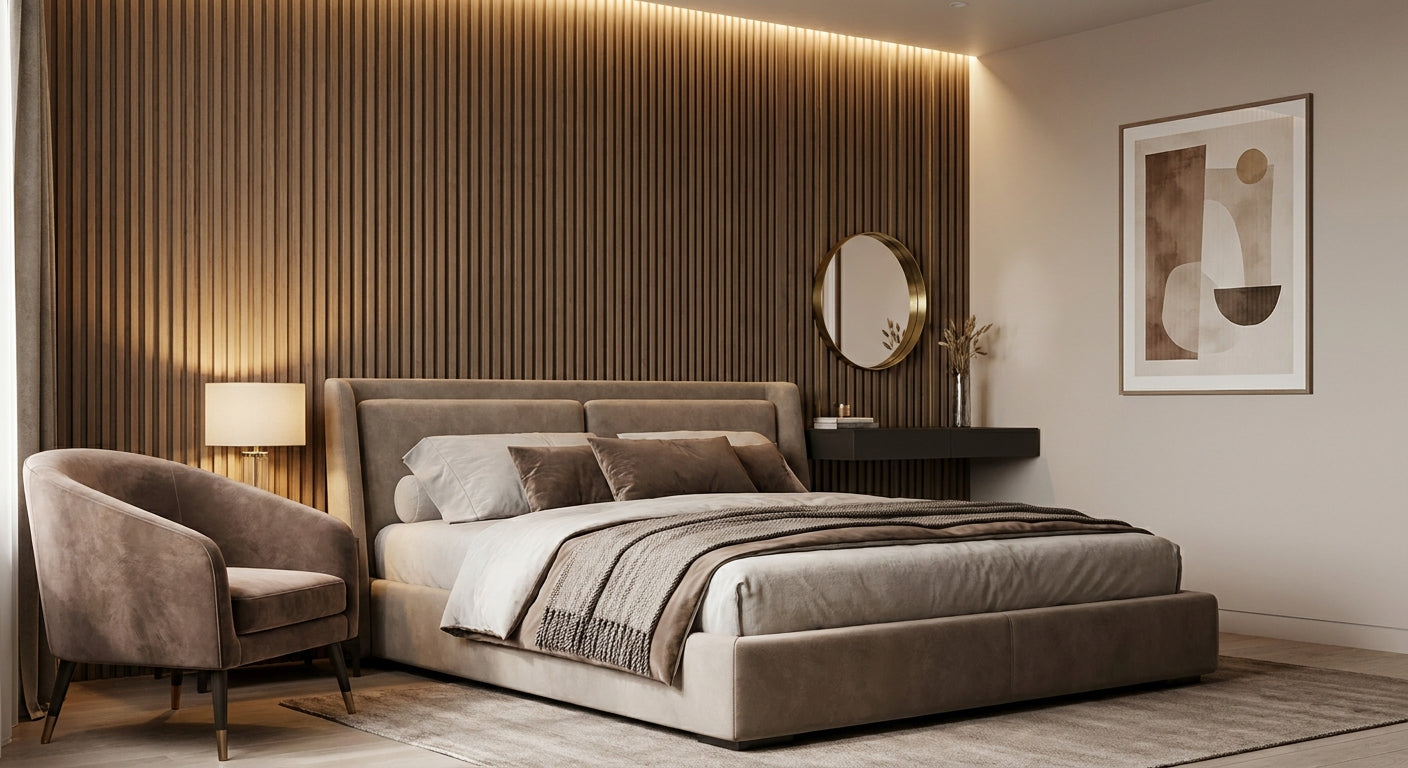
Mocca wall panels for bedroom accent walls deliver a warm, dark-toned finish that works harder than paint — adding depth, acoustic absorption, and a tactile quality that transforms a plain wall into a genuine focal point in 2026.
TL;DR: The Aku Wood Panel mocca wooden wall panel is the clearest choice for a bedroom accent wall in 2026. Its deep espresso-brown slat finish reads as both contemporary and earthy, it absorbs sound to reduce echo at the headboard wall, and it installs directly onto plasterboard without specialist trades. If you want a warmer bedroom without replastering, repainting, or a major renovation, mocca acoustic wood panels are the most direct route.
Why this matters
Bedroom acoustics are an afterthought in most UK homes. Hard plasterboard walls bounce early-morning sound around the room, and a standard feature wall refresh — wallpaper, limewash paint, a gallery — does nothing about that. A mocca acoustic wood panel solves the visual and acoustic problem at the same time. The slat-and-felt construction absorbs mid-frequency sound, which is exactly the frequency range that makes voices and alarms sound sharp and intrusive. For a bedroom behind a party wall or above a busy ground floor, that dual function matters.
Who this is for
This guide is for homeowners and renters in the UK who want a bedroom accent wall that does more than look good. You are probably replacing a plain painted wall or tired wallpaper behind your bed, and you want a finish that photographs well, holds up to daily wear, and does not require a decorator. You may also share the room with a partner on different sleep schedules, which makes sound management a practical priority, not just an aesthetic one. Mocca suits bedrooms with existing neutral, white, or grey palettes — it anchors the room without competing with soft furnishings.
What to look for in mocca wall panels for a bedroom
Tone consistency across the full panel run
Mocca is a specific shade — deep espresso-brown with warm undertones, not charcoal and not walnut. Buy all your panels from a single production batch if possible. Colour variation between batches is subtle but visible under bedroom lighting, especially with directional bedside lamps casting raking light across the slats. Check that the supplier manufactures to a consistent veneer specification rather than mixing wood sources.
Acoustic felt backing
A bedroom accent wall benefits most from panels that include a felt or fabric backing layer behind the slats. The felt is what does the acoustic work — it traps sound energy rather than reflecting it back into the room. Without felt, a slatted panel is a decorative product only. For a wall directly behind a bed, acoustic performance is the difference between waking up to reflected noise and sleeping through it.
Panel dimensions relative to wall size
Standard acoustic slat panels typically run 240 cm or 260 cm in height, which suits most UK bedroom ceiling heights of 240–270 cm. Check the width carefully — narrower panels (around 60 cm) give you more flexibility around chimney breasts, alcoves, and fitted wardrobes. Wider panels cover ground faster on a clear run of wall. Measure your wall in 2026 before ordering, accounting for sockets, switches, and skirting depth.
Slat spacing and light-play
Slat spacing determines how the panel reads in different light conditions. Tighter spacing (under 5 mm gaps) creates a near-solid surface that reads dark and dramatic — good for moody, hotel-style bedrooms. Wider spacing (8–12 mm) lets the felt backing show as a contrasting line, adding rhythm and depth. In a bedroom with low-wattage warm bulbs, wider spacing creates better visual texture. Examine product imagery under multiple lighting conditions before committing.
Ease of installation on plasterboard
Most UK bedroom walls are plasterboard on a timber stud or dot-and-dab on block. Acoustic wood panels that install with a combination of adhesive panel glue and face-fix pins are the most forgiving on these substrates. Systems that rely on mechanical clip rails need precise battening — manageable for a confident DIYer but slower. For a single accent wall behind a bed, adhesive-plus-pin installation completes in a weekend with basic tools.
Finish durability at the headboard zone
The wall behind your bed takes more contact than any other surface in the room — shoulders, hair, the occasional thrown pillow. A veneer-finished panel holds up better than a painted MDF slat because the veneer sits proud of the slat edge and resists scuffing. In 2026, three-sided veneer construction — where the veneer wraps the top and both sides of each slat, not just the face — is the specification worth paying for in a high-contact zone.
Top picks
The safe pick — Aku Wood Panel Wooden Wall Panel Mocca
Hook: The direct match for this application.
This is the panel this guide is built around. The wooden wall panel mocca delivers the espresso-brown slat finish with acoustic felt backing, sized for standard UK bedroom walls. The slat construction absorbs mid-frequency sound at the headboard wall — the most effective single placement in a bedroom. Verdict: Buy. If you are shopping specifically for a mocca bedroom accent wall in 2026, this is the product.
The contrast move — Wooden Wall Panel Black Oak
Hook: For bedrooms that can take a darker hand.
The wooden wall panel black oak steps further into dark-interior territory than mocca. Where mocca reads warm and earthy, black oak reads cooler and more architectural. It suits bedrooms with white or light-grey soft furnishings where you want the wall to recede dramatically rather than warm. The same acoustic felt construction applies. Verdict: Consider — if your brief is "dramatic" rather than "warm", black oak edges ahead of mocca on contrast.
The premium choice — Rustic Oak Premium 3-Sided Wood Veneer
Hook: When the headboard wall needs to hold up to daily contact.
The wooden wall panel rustic oak premium 3-sided wood veneer uses three-sided veneer wrapping on each slat, which means the finish survives contact at the edges — critical behind a bed. The rustic oak tone is warmer and lighter than mocca, so it suits rooms where you want texture without going dark. Verdict: Consider — the best durability specification for a bedroom wall in 2026, but the tone is a different proposition from mocca.
What to avoid
- Painted MDF slat panels sold as "acoustic": Many products use MDF slats with no felt or fabric backing and market themselves on appearance alone. In a bedroom, these provide no measurable sound absorption. Check for a documented felt or fabric layer before buying.
- Single-face veneer in a contact zone: Panels where the veneer covers only the front face of the slat will chip at the top edge and side edges where contact occurs. Behind a bed, this shows within months. Three-sided veneer or a genuine hardwood slat avoids this.
- Wide-format panels on a broken wall: If your bedroom wall has alcoves, a chimney breast, a door return, or fitted wardrobes that interrupt the run, wide panels (over 90 cm) become difficult to cut without visible end-grain exposure. Use narrower panel formats on complex walls and finish exposed edges with a matching trim profile.
Comparison table
| Panel | Tone | Acoustic felt | Veneer spec | Best for |
|---|---|---|---|---|
| Wooden Wall Panel Mocca | Espresso-brown, warm | Yes | Standard | Classic mocca bedroom accent wall |
| Wooden Wall Panel Black Oak | Deep black-oak, cool | Yes | Standard | High-contrast, moody bedroom |
| Rustic Oak Premium 3-Sided Veneer | Warm rustic oak | Yes | 3-sided wrap | High-contact headboard zone, durability priority |
FAQ
What are mocca wall panels for a bedroom? Mocca wall panels are acoustic wood slat panels finished in a deep espresso-brown tone. They are typically applied to a single accent wall — most often the wall behind the bed — to add visual depth and reduce sound reflection in the room.
Are mocca acoustic panels easy to install in a bedroom? Yes. Most acoustic slat panels install using panel adhesive and face-fix pins onto plasterboard, which is the standard UK bedroom wall substrate. A single accent wall of approximately 3.6 m wide by 2.4 m high is achievable in a day for a confident DIYer.
How many wall panels do I need for a bedroom accent wall? Measure the wall width and height, subtract any sockets or interruptions, and divide by the panel width. Allow 5–10% wastage for cuts. Most standard double-bed headboard walls in UK homes require between 4 and 7 panels depending on panel width.
Do mocca wall panels actually reduce noise in a bedroom? Acoustic slat panels with felt backing absorb mid-frequency sound, reducing echo and reverberation in the room. They are not a soundproofing solution — they will not block sound transmission through the wall — but they noticeably reduce the liveliness of a hard-walled bedroom, which improves sleep quality.
Is mocca or black oak better for a bedroom feature wall? Mocca suits warm or neutral bedroom palettes and creates an earthy, grounded feel. Black oak suits cooler palettes and delivers a stronger contrast effect. If your bedding and furniture are predominantly white or light grey, either works. If your room already has warm wood tones in furniture, mocca integrates more naturally.
Can mocca wall panels go on a wall with a radiator or socket? Yes. Panels can be cut around sockets and radiator brackets using a jigsaw or circular saw. Mark the cutout position carefully before cutting. Socket face plates may need a short extension box to sit flush with the panel surface — a standard electrical fitting available from any UK builders' merchant.
What colours go with mocca wall panels in a bedroom? Mocca pairs well with off-white, warm stone, terracotta, forest green, and aged brass. It contrasts cleanly against crisp white bedding. Deep jewel tones — midnight blue, burgundy — also sit well against mocca without competing. Avoid cool grey palettes, which can make mocca look muddy.
How do I clean mocca acoustic wall panels? Wipe down with a dry or very slightly damp microfibre cloth. Avoid saturating the slats or allowing water to sit in the gaps, which can swell the felt backing over time. For marks on the veneer surface, a small amount of wood furniture cleaner on a cloth works without damaging the finish.
One last thing
The wall behind your bed is the single most photographed surface in a bedroom — every flat-lay shot, every morning Instagram story, every estate agent photograph. Mocca acoustic wood panels ranked consistently among the top-performing dark-toned interior finishes for bedrooms in 2026 precisely because the slat shadow lines read strongly in both natural and artificial light. The acoustic benefit is real, but the visual return on a 4-panel installation is immediate from day one.
Share:
Wooden Wall Panels for Basement Conversions 2026
Mocca Wood Veneer Wall Panels for Living Rooms 2026