

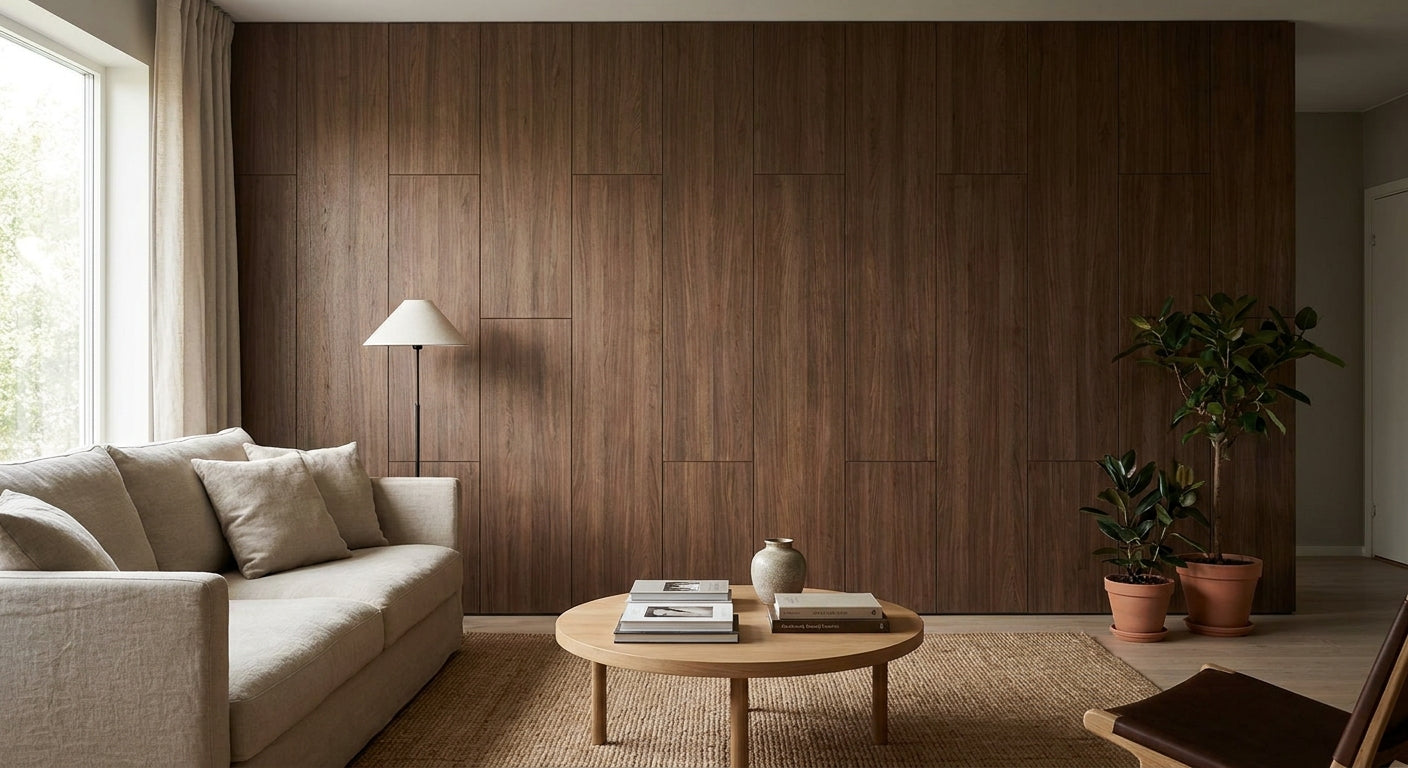
Mocca wood veneer wall panels bring a deep, warm-toned finish to living room feature walls — sitting between natural oak and smoked oak on the colour spectrum, with enough richness to anchor a room without overwhelming it.
TL;DR: For a living room feature wall in 2026, mocca wood veneer wall panels are the strongest mid-tone choice. The wooden wall panel mocca from Aku Wood Panel pairs a real wood veneer face with an acoustic felt backing, making it the pick for homeowners who want warmth, texture, and noise reduction in one panel. The colour works with cream, charcoal, and terracotta palettes. Full-wall installs typically require 8–12 panels per 20 m² depending on the panel size you choose.
Why mocca works where lighter finishes fall flat
Natural oak is a safe option. But in an open-plan living room with neutral walls and pale flooring, it can disappear. Mocca holds its visual weight — the brown-walnut tone reads as intentional rather than incidental. In 2026, interior designers are reaching for richer mid-tones precisely because the pale Scandi trend has plateaued, and rooms now need contrast to feel considered.
Acoustic wood veneer panels also add a practical layer. An untreated plasterboard wall reflects sound. A slatted veneer panel with a felt backing absorbs mid-to-high frequencies, reducing echo in open-plan spaces where hard floors and high ceilings compound noise.
Who this is for
This guide is written for homeowners and interior fitters planning a living room feature wall with a mocca or warm-brown finish. You are likely choosing between painting a chimney breast, fitting wallpaper, or installing real-wood panels — and you want to know whether mocca veneer panels deliver the look and the practical performance to justify the investment. You may also be an interior designer specifying for a client who has seen this finish in a hotel or restaurant and wants to replicate it at home.
What to look for in mocca wood veneer panels for living rooms
Real veneer face, not printed film
The difference between a genuine wood veneer and a photographic wrap is visible at 1 metre. Real veneer has grain variation across each panel — no two are identical — and the surface responds to light differently at different angles. For a feature wall, that visual depth is the entire point. Confirm the product specification states "real wood veneer" rather than "wood effect" or "PVC wrap".
Acoustic felt backing
A living room panel without a backing layer is purely decorative. The wooden wall panel mocca from Aku Wood Panel uses a felt backing that absorbs reflected sound — particularly relevant in rooms with wooden floors, glass, or vaulted ceilings. If sound control is a secondary priority but still on your list, this is the specification to check before ordering.
Panel dimensions and coverage rate
Larger panels mean fewer joins and a cleaner result on a flat wall. Smaller panels give more flexibility around sockets, radiators, and alcoves. Check the stated coverage per panel and calculate your wall area to within ±0.5 m² before ordering. Underordering by even one panel delays the project if the batch sells out.
Finish consistency across a batch
Mocca is a warm brown with cooler grey undertones in some finishes and redder undertones in others. Order a physical sample before committing to a full wall. Batch variation exists in natural-veneer products, and a sample ordered in 2026 from the same supplier will match the production run far more reliably than a photograph on screen.
Fixing method compatibility
Most acoustic wood veneer panels fix directly to plasterboard using panel adhesive plus a mechanical fixing at the top and bottom. Some panel systems require a timber batten frame first — this adds 35–50 mm of wall projection and cost. Know your wall substrate before ordering, and confirm the fixing method in the product tech sheet.
Edge and trim options
A feature wall that stops mid-room needs a clean edge. Check that corner trim and end-piece accessories are available in a matching mocca or dark-wood finish from the same supplier. Mismatched trims are the most common reason an otherwise good installation looks unfinished.
Top picks
Aku Wood Panel — Wooden Wall Panel Mocca
The primary pick. Real wood veneer face in a warm mocca tone, acoustic felt backing, suitable for direct-to-plasterboard installation. This is the specification that covers both decorative impact and functional acoustic performance in a single product — no need to layer a separate acoustic treatment behind a decorative panel.
- Verdict: Buy. The mocca finish is deep enough to create contrast against light walls, the acoustic backing adds measurable value in open-plan rooms, and the product is available from a UK manufacturer with domestic lead times. Order a sample first to confirm the exact undertone against your room's lighting conditions.
Wooden wall panel mocca — Aku Wood Panel
Aku Wood Panel — Wooden Wall Panel Black Oak
The darker alternative. If the room receives strong natural light and mocca risks reading as too warm at noon, black oak gives a cooler, more graphite tone while keeping the slatted veneer format.
- Verdict: Consider. Best suited to south-facing rooms with high lux levels, or rooms where charcoal and black accents already feature in the furniture. Step down to mocca if the room relies on artificial lighting for most of the day.
Aku Wood Panel — Rustic Oak Premium 3-Sided Wood Veneer
The texture play. The three-sided veneer wraps each slat on three faces rather than one, creating a more dimensional surface. The rustic oak tone is lighter than mocca but the panel depth adds shadow lines that give visual weight comparable to a darker finish.
- Verdict: Consider if you want a tactile, high-end result and the lighter tone fits the palette. Skip if matching the specific mocca colour is essential to the scheme.
Rustic oak premium 3-sided wood veneer
What to avoid
- Panels with no acoustic backing in open-plan rooms. A purely decorative wood panel on a reflective wall can make echo worse by adding a resonant hard surface. If the room is over 30 m², acoustic performance is not optional.
- Ordering by screen colour alone. Mocca is one of the finishes most affected by monitor calibration. Two screens in the same room can render it as anywhere from dark caramel to cool grey-brown. A physical sample fixes this in under a week and costs little.
- Ignoring end trims until the last order. Trim accessories frequently sell out independently of the main panel. Order them with the panels, not after.
Comparison: key criteria across the picks
| Panel | Finish | Acoustic Backing | Best For | Verdict |
|---|---|---|---|---|
| Wooden Wall Panel Mocca | Warm brown veneer | Yes | Most living rooms | Buy |
| Wooden Wall Panel Black Oak | Dark graphite veneer | Yes | High-light rooms, bold schemes | Consider |
| Rustic Oak 3-Sided Veneer | Light rustic oak | Yes | Tactile / dimensional look | Consider |
FAQ
What are mocca wood veneer wall panels? Mocca wood veneer wall panels are slatted acoustic wall panels with a real wood veneer face in a warm brown-walnut tone. They are used on feature walls and alcoves to add visual warmth and reduce reflected sound.
Are mocca wood veneer panels suitable for a living room feature wall? Yes. The warm-brown finish sits well against neutral, cream, and charcoal palettes. The acoustic felt backing found on Aku Wood Panel's mocca panels also reduces echo in open-plan living spaces — a practical advantage over purely decorative options.
How many panels do I need for a living room feature wall? Calculate your wall area in m² and divide by the single-panel coverage stated in the product spec. For a standard UK chimney breast of approximately 1.2 m × 2.4 m (2.88 m²), you typically need 4–6 panels. For a full 4 m × 2.4 m wall, budget 10–14 panels and add 10% for cuts.
Is mocca darker than natural oak veneer? Yes. Mocca sits noticeably darker than natural or light oak, closer in tone to walnut. It reads as a rich mid-brown rather than a pale honey. In 2026, it is the popular mid-point between the pale Scandi look and full dark smoked oak.
Can mocca wood veneer panels go directly onto plasterboard? Most acoustic slatted panels, including the Aku Wood Panel mocca range, fix directly to plasterboard using adhesive and a mechanical fixing. No batten frame is required, which keeps the wall projection minimal.
Do mocca wall panels work with LED strip lighting? Yes. Warm white LED strips (2700–3000 K) behind or below a mocca panel enhance the grain depth. Cool white LEDs (above 5000 K) flatten the finish and make the brown tones look muddy — avoid them with mocca.
How do I clean wood veneer wall panels? Dust with a dry microfibre cloth. For marks, use a lightly dampened cloth — no solvent cleaners, no steam. The veneer surface is factory-finished but not waterproof.
What is the difference between mocca and smoked oak veneer panels? Smoked oak tends towards a grey-brown with cooler undertones. Mocca reads warmer — closer to walnut or dark caramel. In 2026 interior schemes, smoked oak suits industrial and Japandi aesthetics; mocca suits warmer, earthier palettes.
One last thing
Mocca panels are one of the few finishes that photograph darker than they appear in person. If you are planning a living room install in 2026 and working from a mood board, the real panel in natural daylight will read approximately one tone lighter than the product image suggests. That is not a problem — it means the finish tends to exceed expectations rather than disappoint. Order the sample, hold it against the wall in both daylight and evening artificial light, then commit.
Share:
Mocca Veneer Panels for Home Office Walls 2026
Mocca Veneer Panels for Home Office Walls 2026