

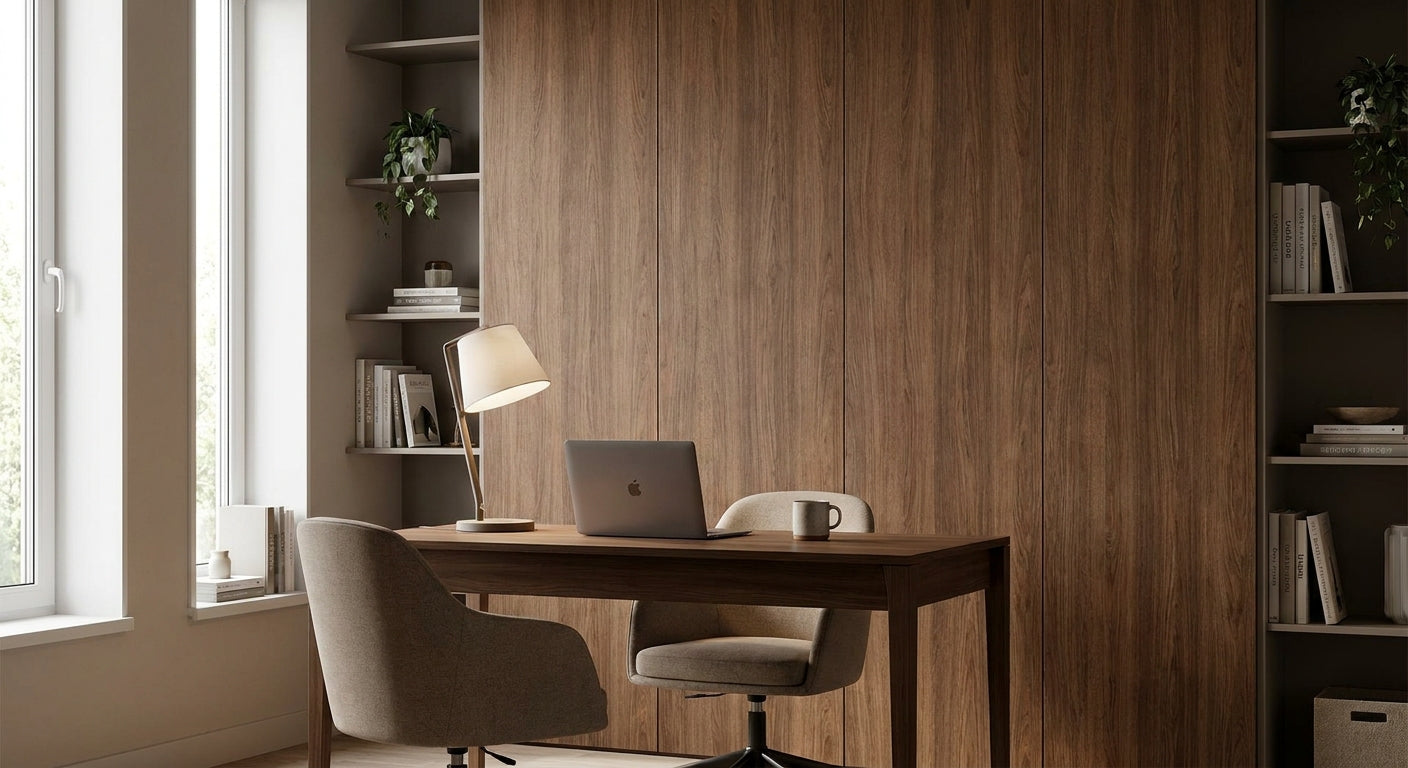
Mocca veneer panels bring a warm, dark-toned finish to home office feature walls — and they do it while cutting the echo that makes video calls exhausting. This guide covers who mocca veneer suits, what to look for before buying, and which Aku Wood Panel products to consider for a 2026 home office fit-out.
TL;DR: Mocca veneer wall panels are the right call for home office feature walls where you need acoustic control without sacrificing visual depth. The wooden wall panel in mocca from Aku Wood Panel is the standout pick for 2026 — warm chocolate tones, real wood veneer finish, and a felt backing that reduces mid-frequency echo. Best for dedicated home offices with a single accent wall behind a desk or camera line.
Why This Matters in 2026
Hybrid work is no longer a transitional phase — it is the permanent baseline for most UK knowledge workers. A home office feature wall now serves three functions simultaneously: acoustic treatment, visual backdrop for video calls, and interior design. Flat-painted plasterboard fails all three. Mocca veneer panels address each one in a single installation, which is why demand for dark-toned acoustic wood panels has climbed sharply through late 2025 and into 2026.
Who This Guide Is For
You are fitting out a dedicated home office — a spare bedroom, garden room, or loft conversion — and you want the main wall behind your desk to do real work. You care about how the room sounds on a call, how it looks on camera, and whether the finish will still feel considered in five years. You are not looking for foam acoustic tiles or peel-and-stick panels. You want a permanent wood veneer feature wall that performs acoustically and holds up visually.
What to Look for in Mocca Veneer Panels for a Home Office
Real Wood Veneer vs Printed Film
Mocca as a finish describes a warm, dark-brown tone with visible grain movement. Genuine wood veneer achieves this with a thin natural-wood surface bonded to an engineered substrate — grain depth, micro-texture, and colour variation are real. Printed film mimics the look under artificial light but reads as flat on camera and shows wear at edges within 12–18 months. Always confirm the product specifies real veneer, not a laminate or foil wrap.
Acoustic Backing Material
The visual panel is only half the product. The acoustic performance comes from the felt or foam backing behind the slats. For a home office, you want a panel that reduces mid-frequency reverberation (the frequency range of speech: roughly 500 Hz–2 kHz). Panels with a dense felt backing absorb this range far more effectively than bare MDF-backed alternatives. Check that the manufacturer publishes an NRC (Noise Reduction Coefficient) or equivalent absorption data.
Panel Dimensions and Coverage
A standard UK home office feature wall runs 2.4 m high by 2.4–3.6 m wide. You need panels that tile without visible joins at eye level. Confirm the panel length relative to ceiling height — panels that require a horizontal join mid-wall create a seam that draws the eye exactly where you do not want it. Aku Wood Panel's slat panels are designed for full-height runs, which matters here.
Colour Consistency Across Batches
Mocca veneer panels ordered in a single batch will be consistent. A second order six months later may not match — natural veneer colour varies between cuts. If your wall requires more than one order, buy all panels at once. This is not a brand-specific issue; it applies to every real-veneer product on the market.
Installation Method
For a plasterboard home office wall, direct adhesive fixing with a grab adhesive is the fastest approach and leaves the wall finish intact if panels are ever removed. Clip or rail systems add cost and depth (typically 20–35 mm). Confirm the panel weight per square metre before committing — heavier panels may require batten fixing regardless of wall type.
Fire and Safety Rating
Building regulations in England and Wales require interior wall finishes in habitable rooms to meet at minimum Class 1 surface spread of flame (BS 476 Part 7) or Euroclass C. Most acoustic wood panels from reputable UK manufacturers meet this. Verify the specification sheet before ordering, particularly if the home office is in a converted outbuilding subject to building control sign-off.
Top Picks for Mocca Veneer Home Office Feature Walls
The Anchor Pick — Wooden Wall Panel Mocca
Hook: The direct choice. Warm chocolate veneer finish, slat construction, acoustic felt backing.
The wooden wall panel mocca from Aku Wood Panel is the product this guide is built around. It combines a genuine mocca-toned wood veneer face with the acoustic felt backing that makes it functional for a home office, not purely decorative. The slat profile creates shadow lines that add visual depth on camera without competing with anything else in the room. For a single feature wall behind a desk in 2026, this is the default recommendation.
Verdict: Buy.
The Dark-Contrast Alternative — Wooden Wall Panel Black Oak
Hook: For offices where mocca reads too warm against cool grey walls or white joinery.
The wooden wall panel in black oak sits a tone darker than mocca. Where mocca pulls towards brown-amber, black oak moves into charcoal-brown. If your office has cooler paint tones (Farrow & Ball Purbeck Stone, Dulux Polished Pebble, or similar), black oak keeps the contrast intentional rather than accidental. Acoustic construction is comparable — felt backing, slat profile, engineered substrate.
Verdict: Consider if your wall palette skews cool.
The Texture Upgrade — Rustic Oak Premium 3-Sided Wood Veneer
Hook: More surface detail, three veneered faces per slat, for offices where close-up texture matters.
The rustic oak premium 3-sided wood veneer wraps veneer around three faces of each slat rather than just the front. The result is a panel where the shadow gaps between slats show genuine wood grain rather than a dark substrate edge. In a home office photographed or filmed regularly, this detail reads clearly and elevates the overall finish. The rustic oak tone is warmer than mocca, so factor that into your colour decision.
Verdict: Consider for high-visibility offices or content-creator setups where texture depth justifies the premium.
Comparison Table
| Panel | Tone | Veneer Type | Acoustic Backing | Best For |
|---|---|---|---|---|
| Wooden Wall Panel Mocca | Warm dark brown | Real wood veneer | Felt | Standard home office feature wall |
| Wooden Wall Panel Black Oak | Charcoal-brown | Real wood veneer | Felt | Cool-palette interiors |
| Rustic Oak Premium 3-Sided | Warm rustic oak | 3-sided real veneer | Felt | High-visibility / filming setups |
What to Avoid
- Foil-wrapped or printed-film panels sold as "wood effect." They look passable in showroom lighting and flat on camera. The grain has no depth and the edges chip at fixings. In a 2026 home office used daily, the finish degrades within 18 months.
- Panels without acoustic backing. A decorative slat panel with no felt or foam layer is wall art, not acoustic treatment. It will not reduce speech reverberation. If the product listing does not mention NRC, felt backing, or acoustic absorption, assume it has none.
- Mixing mocca and lighter oak tones on the same feature wall. The tonal gap between mocca and natural or light oak is wide enough that the join looks unplanned rather than deliberate. If you want contrast, commit to a clear two-wall split — not a single wall with mixed panels.
FAQ
What are mocca veneer wall panels? Mocca veneer panels are acoustic wood slat panels with a warm dark-brown wood veneer surface finish. The veneer sits over an engineered substrate, and a felt backing provides mid-frequency sound absorption — making them suitable for both feature wall decoration and acoustic treatment in home offices in 2026.
Are mocca veneer panels good for a home office feature wall? Yes. The dark tone reduces visual distraction on video calls, the slat profile adds depth without clutter, and the acoustic felt backing cuts speech-range reverberation. A single feature wall behind the desk is enough to make a measurable acoustic difference in a standard UK home office room.
How do you fix acoustic wood veneer panels to a plasterboard wall? Direct adhesive fixing with a construction grab adhesive is the standard method for plasterboard. Apply adhesive to the panel back in vertical beads, press firmly, and use temporary support pins or tape while the adhesive cures — typically 24 hours. No batten frame is required for most acoustic slat panels under 6 kg/m².
Is mocca darker than smoked oak? Mocca sits in the warm dark-brown range — think dark coffee or dark walnut. Smoked oak leans towards grey-brown. Mocca is warmer and works better with brass, copper, or warm-white light. Smoked oak is cooler and suits grey or stone-toned palettes.
How many panels do I need for a feature wall? Measure the wall area in square metres, then divide by the coverage per panel listed in the product specification. Add 10% for cuts and waste. For a standard 2.4 m × 3.0 m home office feature wall (7.2 m²), the number of panels required will be stated clearly in the product listing — do not estimate without checking the exact panel size.
Can mocca veneer panels be used in a garden room home office? Yes, for interior walls. Acoustic wood veneer panels are designed for interior use. If the garden room has an exterior-facing wall with moisture exposure, that wall requires an exterior-rated product — veneer panels are not weatherproof. Internal walls in a thermally insulated garden room are suitable for standard acoustic veneer panels.
Do acoustic wood panels actually reduce noise in a home office? Acoustic wood slat panels with felt backing reduce reverberation (echo within the room), not sound transmission through the wall. They will noticeably improve call clarity and reduce the "live" sound of a hard-surfaced room. They will not stop external noise from entering — that requires wall insulation and glazing upgrades.
How long does it take to install a mocca veneer feature wall? A single feature wall of 7–10 m² typically takes 3–5 hours for a competent DIYer using adhesive fixing on a flat plasterboard surface. Allow an additional day for adhesive cure before applying any trim or edge finishing.
One Last Thing
Mocca veneer performs differently under warm versus cool artificial light. Under 2700K–3000K warm white LED (the most common home office ceiling fitting), the dark-brown tones deepen and the grain contrast increases — the wall looks richer at night than in daylight photographs. Under 4000K cool white or daylight-balanced lighting, the same panel reads flatter. If your home office relies on artificial light for most working hours, the warm-white bias works in mocca's favour. Cool-white setups make black oak a stronger visual choice.
Share:
Mocca Wood Veneer Wall Panels for Living Rooms 2026
Mocca Wood Veneer Wall Panels for Living Rooms 2026