

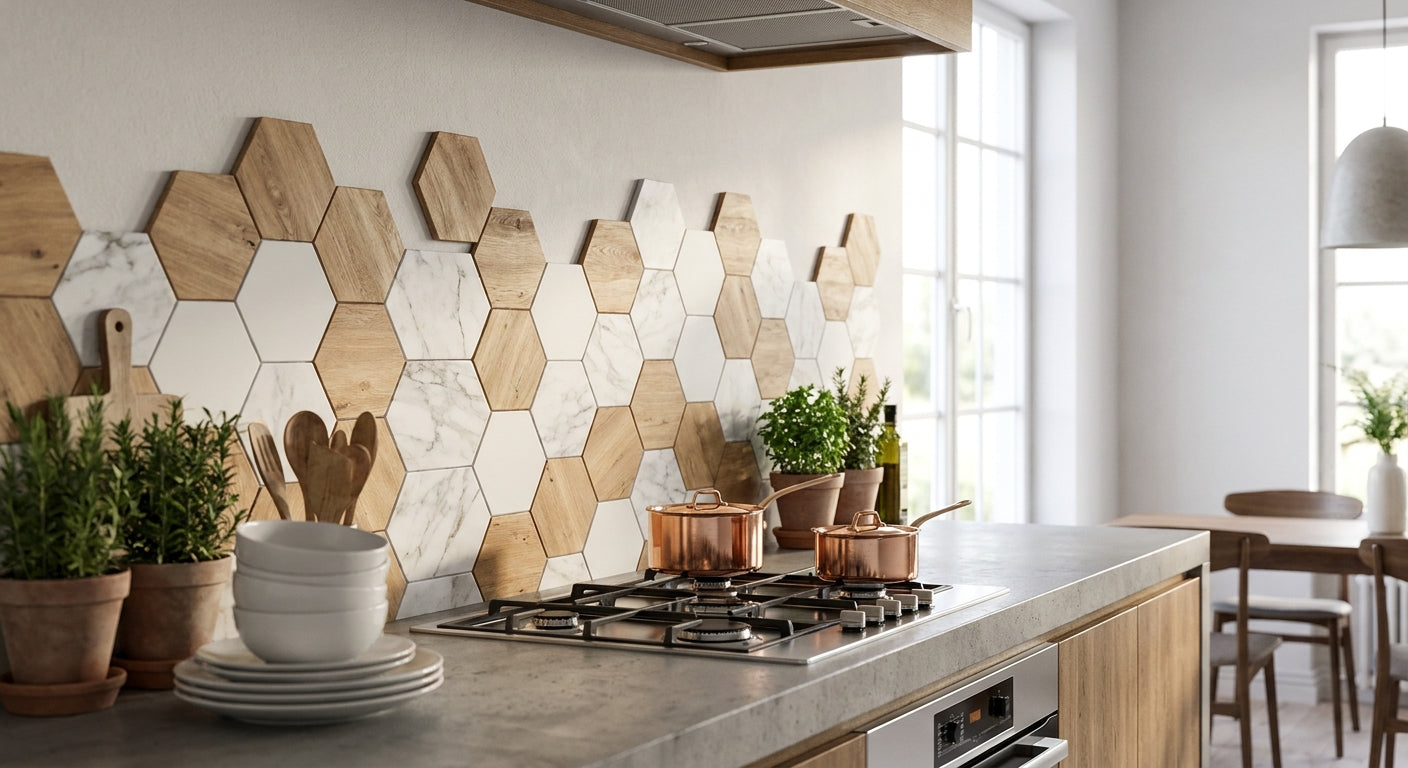
Hexagon wall panels turn a flat kitchen wall into a textured, real-wood feature that also cuts echo in open-plan kitchen-diners — but not every hexagon panel belongs on every wall, and the splashback zone has its own rules.
- Hexagon Acoustic Panel Natural Oak is the safe buy for hexagon wall panels kitchen projects in bright rooms.
- Natural Oak with Grey Felt adds sound absorption for open-plan kitchen-diners with hard floors — buy.
- Grey Walnut with Grey Felt suits dark cabinetry contrast — consider, not the first pick.
- Keep real wood veneer off the direct hob splash zone; reserve it for dry kitchen walls instead.
Why this matters
Most kitchen echo complaints in 2026 trace back to the same combination: tile floors, glass splashbacks, and bare plaster. None of those surfaces absorb sound, so every clatter of a pan bounces around the room. Hexagon wall panels with an acoustic felt backing solve the problem visually and acoustically at once, which is why wooden wall panels for kitchen splashbacks has become one of the most-read guides on the topic this year.
The catch: "splashback" is doing a lot of work in that search term. A real wood veneer panel is not a literal replacement for tile or glass directly behind a hob or sink. It's a feature treatment for the dry walls around a kitchen — breakfast bar ends, dining-side walls, the run behind an island that never sees a splash of oil.
Who this is for
This guide is for homeowners renovating an open-plan kitchen-diner who want texture and warmth on the walls without tiling the whole room, and who are dealing with noise bouncing off hard floors and glass. If your kitchen has a single small splashback strip behind a sink and nothing else, a hexagon panel probably isn't the fix you need — plain tile still wins there.
What to look for in hexagon wall panels for kitchen
Felt backing colour and coverage
The felt layer behind the veneer is what actually absorbs sound, not the wood face. In a kitchen-diner with hard flooring, a panel with grey felt backing does real acoustic work; a panel without a stated felt backing is decorative only. Check which finish you're buying before assuming it dampens noise.
Wood veneer tone against your cabinetry
Dark cabinets read heavier next to a light oak hexagon wall; pale cabinets can look flat next to another light finish. Match contrast, not similarity — a grey walnut or walnut veneer against white or cream cabinetry does more visual work than a matching tone.
Placement zone, not just wall size
Decide where the panel actually sits before you order. A dry feature wall behind a dining table takes real wood veneer fine; a strip directly behind a hob or sink does not, because sustained heat and moisture aren't what a veneer-and-felt panel is built for. Plan the hexagon run for the dry side of the kitchen.
Layout and cutting around fixtures
Hexagon panels have to be arranged in a pattern, and kitchen walls are full of sockets, extractor ducting and cabinet edges that break that pattern. Map the wall and mark every interruption before you buy panel count, not after.
Fixing method
Most installers set hexagon acoustic panels with a high-tack adhesive rather than screws, since the felt backing sits flush and doesn't want visible fixings punched through the veneer. High Tack Panel Glue 290ml is built for exactly this kind of flush wood-panel install.
Maintenance versus tile or paint
A veneer panel wipes down but doesn't take scrubbing the way glazed tile does. If the wall is going to see grease splatter daily, that's your signal it belongs in the tile zone, not the panel zone.
Top picks for hexagon wall panels kitchen
Hexagon Acoustic Panel – Natural Oak — the safe pick. Light natural oak veneer brightens a kitchen wall without adding visual weight, and it's the entry point into the hexagon acoustic panel natural oak range for anyone unsure about committing to a darker tone. Works especially well in smaller kitchens where a heavy finish would close the room in. Buy.
Hexagon Acoustic Panel – Natural Oak with Grey Felt — the acoustic upgrade. Same natural oak face, but the grey felt backing is stated explicitly, meaning this is the version built to actually cut noise, not just look good. For an open-plan hexagon acoustic panel natural oak with grey felt kitchen-diner running on tile floors, this is the pick that does double duty. Buy.
Hexagon Acoustic Panel – Grey Walnut with Grey Felt — the moody contrast pick. Dark grey walnut veneer against white or pale cabinetry creates the kind of contrast that photographs well and reads as intentional rather than incidental. Suits a hexagon acoustic panel grey walnut with grey felt dining wall better than a full-kitchen treatment, since too much dark tone in a working kitchen can feel heavy. Consider.
Hexagon Acoustic Panel – Walnut with Grey Felt — the warm mid-tone. Sits between the pale natural oak and the near-black grey walnut, and pairs with the wide middle band of cabinet colours — sage, terracotta, warm grey — that don't suit either extreme. Named as a felt-backed option, so it carries the same acoustic case as the other grey-felt panels. Consider.
Hexagon Acoustic Panel – Grey Walnut (no stated felt backing) — the one to flag. It shares the grey walnut face of the felt-backed version above, but without a stated felt layer its acoustic performance in a noisy kitchen-diner is unclear. If sound absorption is the reason you're panelling the wall in the first place, this isn't the version to reach for. Skip for splashback-adjacent use.
“If the hexagon panel sits where oil splatters land, tile wins every time.”
What to avoid
- Panelling directly behind the hob. Real wood veneer and felt backing aren't rated for sustained heat and grease exposure — reserve the panel run for dry walls and let tile or glass handle the true splash zone.
- Ordering the plain grey walnut finish for acoustic reasons. Without a stated felt backing, treat it as decorative, not as noise control, and pick a grey-felt version instead if echo is the actual problem.
- Skipping the socket-and-extractor map. Hexagon layouts break visually at every interruption; cutting panels on the fly around a socket almost always leaves an obvious seam.
Verdict comparison
| Pick | Veneer | Felt backing | Best for | Verdict |
|---|---|---|---|---|
| Natural Oak | Natural oak | Not stated | Small, bright kitchens | Buy |
| Natural Oak with Grey Felt | Natural oak | Grey felt | Open-plan kitchen-diners | Buy |
| Grey Walnut with Grey Felt | Grey walnut | Grey felt | Dark-on-light contrast walls | Consider |
| Walnut with Grey Felt | Walnut | Grey felt | Warm mid-tone cabinetry | Consider |
| Grey Walnut | Grey walnut | Not stated | Decorative accent, away from noise zones | Skip for acoustic use |
FAQ
What's the best hexagon wall panel for a kitchen splashback in 2026?
Hexagon Acoustic Panel Natural Oak with Grey Felt is the strongest 2026 pick for a kitchen splashback wall because it pairs real oak veneer with a stated felt backing for noise absorption. Use it on the dry walls around a kitchen-diner rather than directly behind a hob.
Are hexagon wood panels safe near a kitchen hob?
No — real wood veneer and felt backing aren't built for direct heat and grease exposure, so keep hexagon panels on the dry walls of a kitchen and let tile or glass cover the true splash zone. This is a placement issue, not a quality issue with the panel itself.
Is hexagon better than slat panels for a kitchen?
Hexagon panels suit a feature wall or breakfast-bar end where a distinct pattern reads well, while slat panels suit longer, uninterrupted runs. Choose based on the wall shape and how much of it is broken up by sockets, cabinets or extractor ducting.
Do hexagon panels need felt backing in a kitchen?
Felt backing is what actually absorbs sound, so if noise reduction is the goal, pick a version that states a grey felt backing rather than a plain veneer finish. Decorative-only hexagon panels still look good but won't cut echo the same way.
How do you cut hexagon panels around sockets and extractor ducting?
Map every socket, switch and duct on the wall before ordering panel count, then cut individual hexagons to fit rather than trimming after installation. Cutting on the wall after fixing almost always leaves a visible seam at the interruption.
Can you fit hexagon wall panels over existing tile or paint?
A flat, sound painted wall takes a hexagon panel fine with the right adhesive; existing tile needs checking for a flush, stable surface first since grout lines can create an uneven base. A high-tack panel adhesive is built for this kind of flush wood-panel fixing.
How many hexagon panels do you need to cover a kitchen wall?
Panel count depends on wall dimensions and how many hexagons get cut around fixtures, so measure the wall and mark every interruption before ordering. Add extra for cutting waste around sockets and extractor ducting rather than ordering the exact tiled count.
How much do hexagon acoustic panels cost?
Pricing varies by finish and felt backing, so check current pricing on the product page before budgeting a full wall. Compare the felt-backed and non-felt versions side by side since the acoustic value differs even when the face veneer looks the same.
One last thing
The detail most homeowners miss in 2026: the plain Grey Walnut hexagon panel and its grey-felt sibling look almost identical from three feet away, but only one of them is named as carrying the felt layer that actually does the acoustic work — read the product name, not just the photo, before you order for a noisy kitchen-diner.
Share:
Grey Oak Wall Panels for Boardrooms: 2026 Buying Guide
Acoustic Panels for Data Centres 2026: Buy vs Skip