

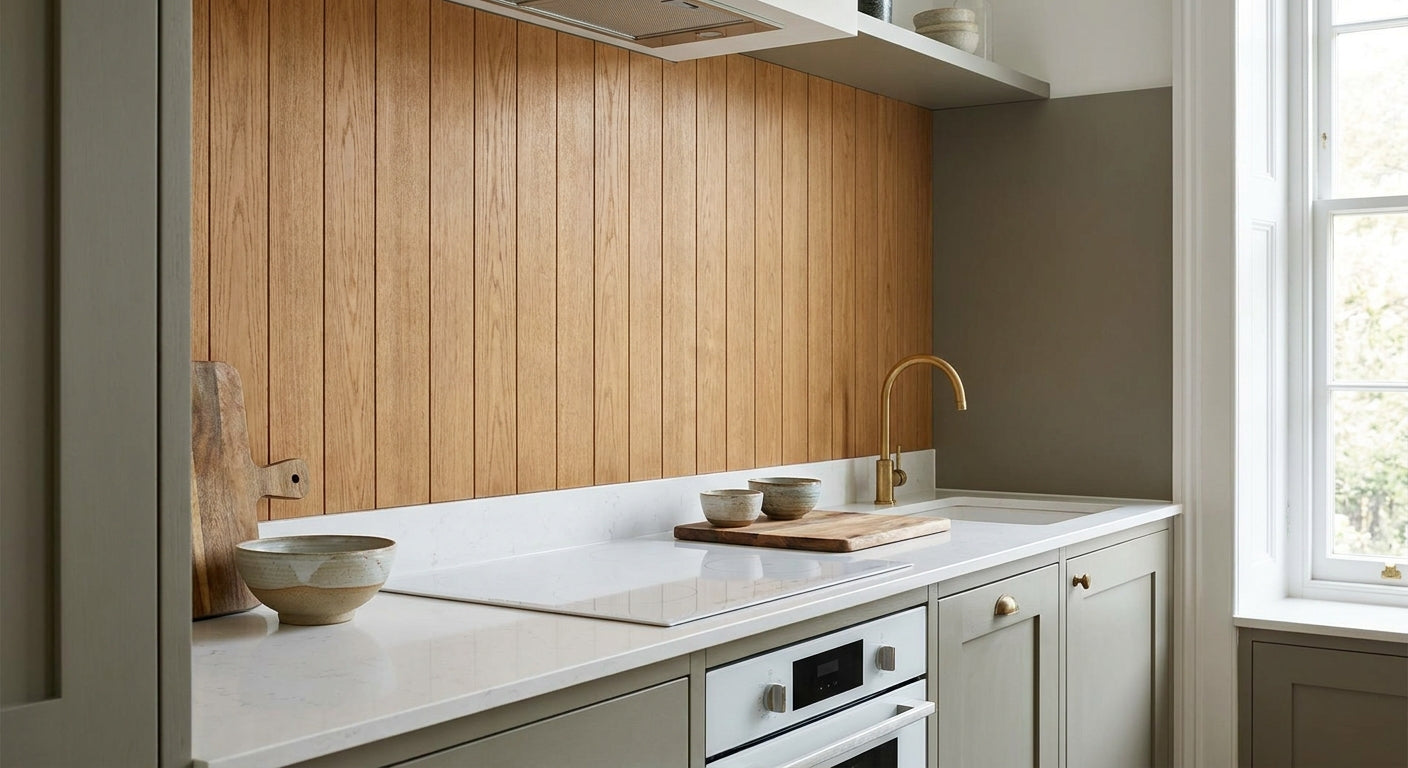
Wooden wall panels for kitchen splashbacks are one of the most searched interior upgrades in 2026 — and one of the most misunderstood, because most panels sold for this application were never designed with kitchens in mind.
TL;DR: Wooden wall panels for kitchen splashbacks work best when they combine a sealed or treated wood surface, a secure adhesive-fixed installation, and a finish that can be wiped clean without warping. In 2026, the strongest options are slat-style panels in natural oak, smoked oak, or walnut — applied to the wall behind a hob or sink as a feature rather than a raw timber surface. Aku Wood Panel manufactures acoustic wood panels that double as striking kitchen splashbacks when correctly sealed and installed. Order a sample before committing to a full run.
Why this matters
A standard kitchen splashback takes grease, steam, and occasional water splash every single day. Most decorative wood panels are designed for living rooms and offices — low-moisture, low-heat environments. Put the wrong panel behind a gas hob and you get warped slats and stained grooves within six months. The panels that hold up are ones built around an MDF or HDF core with a real-wood veneer or solid slat, properly sealed by the installer before and after fitting. Get that right and a wooden splashback outlasts most tiles.
Who this is for
This guide is for homeowners, self-builders, and kitchen designers who want a warm, textured alternative to glass or metro tile — specifically on the wall between worktop and upper cabinets, or behind a freestanding range cooker. You already know you want wood. What you need is clarity on which species, which finish, and which installation method survives a kitchen environment without constant maintenance.
What to look for in wooden wall panels for kitchen use
Core material density
Slat panels bonded onto a high-density fibreboard (HDF) backing hold their shape better than panels on a soft MDF or foam substrate when humidity rises. In a kitchen, ambient moisture regularly exceeds 60% RH during cooking. A denser core — typically 800–1,000 kg/m³ — resists the micro-expansion cycles that split grooves apart over time. Always check the backing material, not just the face veneer.
Surface sealability
Raw wood absorbs grease on contact. The panels you choose need either a factory-applied lacquer or a surface that takes a clear penetrating oil or hard-wax finish without blotching. Smooth-sawn veneers seal more evenly than heavily textured or wire-brushed surfaces. If the product spec does not mention a sealable surface, ask before ordering — or request a sample and test it yourself with a drop of cooking oil.
Colour and grain stability
Dark species — smoked oak, walnut, black oak — hide minor grease marks between cleans better than pale finishes. Natural oak and grey oak show fingerprints and light grease more quickly but are easier to assess when they need a re-seal. In 2026, smoked and charcoal-tone wood panels are the dominant choice for kitchen feature walls precisely because they tolerate a working kitchen's daily abuse without looking tired.
Panel depth and projection
Typical acoustic slat panels project 16–22mm from the wall face. Behind a hob, check that the combined depth of panel plus adhesive does not bring the surface closer than the manufacturer's minimum clearance distance from the burner — usually 400mm horizontal clearance is the absolute minimum for gas. Slim-profile panels reduce that risk and simplify socket and switch boxing.
Adhesive compatibility
Wood panels on a kitchen wall should be fixed with a high-tack construction adhesive, not standard PVA or panel pins alone. Pins through the slat face create entry points for grease. A panel adhesive rated for 290ml cartridges, applied in dots or a bead pattern, gives a permanent mechanical bond without penetrating the face. The high-tack panel glue 290ml from Aku Wood Panel is designed specifically for this panel system.
Species and finish options
Four species cover the vast majority of kitchen splashback applications in 2026:
- Natural oak — warm amber-brown, suits Shaker and country kitchen styles
- Smoked oak — deep tobacco tone, suits modern and industrial kitchens
- Walnut — rich mid-brown with prominent grain, suits contemporary and Scandi kitchens
- Black oak — near-matte charcoal, suits handleless and minimalist kitchens
All four are available from Aku Wood Panel as full panels and as samples — order the sample before buying full panels.
Top picks
Natural oak — the safe pick
Hook: Universally compatible with white, cream, and wood-tone kitchens.
Spec that matters: The natural oak veneer sits on a rigid HDF backing that holds flat under normal cooking humidity.
Verdict: Buy — if your kitchen is traditional, transitional, or Scandi. The wooden wall panel natural oak is the highest-volume seller in this range for a reason. Order the sample wooden wall panel natural oak first to check how the grain reads against your worktop.
Smoked oak — the design-forward pick
Hook: Adds depth without going full black, sits behind stainless steel or brass hardware better than any pale wood.
Spec that matters: The smoke-treatment process penetrates the veneer, so minor surface scratches do not expose a contrasting pale layer underneath.
Verdict: Buy — if your kitchen has dark cabinetry, brass fittings, or a modern-industrial finish. The wooden wall panel smoked oak is the standout pick for 2026 kitchen renovations.
Walnut — the premium pick
Hook: The richest grain in this range; makes a splashback look like a piece of furniture.
Spec that matters: Walnut grain is naturally oily, which gives the veneer better initial grease resistance than oak before any additional sealing.
Verdict: Buy — if budget is not the primary constraint and you want a kitchen that photographs well and holds its value. See the wooden wall panel walnut.
Black oak — the wildcard
Hook: Near-matte finish that reads as architectural rather than decorative.
Spec that matters: The darkest option in the range; maintenance marks are practically invisible in daily use.
Verdict: Consider — works brilliantly in all-dark or monochrome kitchens but can feel heavy in smaller or north-facing rooms. Worth ordering a sample before committing to a full splashback run.
What to avoid
Foam-backed panels — marketed as lightweight and easy to cut, foam substrates compress unevenly under adhesive and can bow away from the wall within 12–18 months in a steam-heavy kitchen environment.
Heavily textured surfaces behind a hob — deep grooves and wire-brushed finishes trap grease and are near-impossible to clean without soaking the wood. Behind a sink this is manageable; directly behind burners it is a hygiene problem.
Unfaced or untreated raw timber boards — they look beautiful on the day. By month three in a working kitchen, they have absorbed grease into the open grain and no amount of re-oiling will restore them cleanly. Always use a panelled product with a controlled veneer surface that can be properly sealed.
Comparison: 2026 kitchen splashback picks
| Panel | Tone | Grease visibility | Sealability | Best kitchen style |
|---|---|---|---|---|
| Natural oak | Warm amber | Medium | High | Shaker, Scandi, transitional |
| Smoked oak | Deep tobacco | Low | High | Industrial, modern, dark kitchens |
| Walnut | Rich mid-brown | Low–medium | High (naturally oily grain) | Contemporary, high-end |
| Black oak | Near-matte charcoal | Very low | High | Minimalist, handleless |
FAQ
Are wooden wall panels suitable for kitchen splashbacks? Yes — when they use a sealed veneer on a dense HDF backing and are installed with a construction-grade adhesive. The key is sealing the face and all cut edges before and after installation.
What is the best wood for a kitchen splashback in 2026? Smoked oak and walnut are the top choices this year because both species hide minor grease marks and take a clear sealant evenly. Natural oak works equally well if you prefer a lighter finish.
Can wooden panels go directly behind a hob? Yes, provided you maintain the hob manufacturer's minimum clearance — typically at least 400mm horizontal distance from the nearest burner — and seal all exposed surfaces before installation. Do not use foam-backed panels in this position.
How do you clean wooden wall panels in a kitchen? A damp microfibre cloth with a small amount of washing-up liquid removes daily grease. Avoid abrasive scourers. Re-apply a hard-wax oil or clear lacquer every 12–24 months depending on cooking frequency.
Do kitchen wood panels warp? Panels with a high-density fibreboard core resist warping under normal kitchen humidity. The risk increases with steam-only installation (no adhesive), poor wall prep, or panels left untreated on the cut edges.
How do you fix wooden panels to a kitchen wall? A panel adhesive applied in a dot or bead pattern — such as the high-tack 290ml adhesive — gives the most durable bond. Some installers add a small number of discreet fixings at the top and bottom edges, but face-pinning through the slats is not recommended.
Are slat wall panels hard to cut around sockets? No. Standard slat panels cut cleanly with a fine-tooth hand saw or circular saw with a wood blade. Mark socket positions on the backing board first and cut the slats individually where needed.
How much do wooden kitchen splashback panels cost in 2026? Quality slat panels from UK manufacturers start at approximately £40–£70 per panel for interior-grade veneer products. A typical splashback area of 0.6m x 1.5m requires 2–3 panels depending on panel width.
One last thing
The detail most people miss: seal the back face of each panel as well as the front before installation. Moisture migrating through a kitchen wall (condensation, minor leaks behind worktops) enters panels from the reverse side, not the face. One coat of hard-wax oil on the back surface before fitting adds no more than 20 minutes per panel and can double the lifespan of a wooden splashback in a busy kitchen.
Share:
How to Maintain Exterior Wall Cladding Panels (2026)
Wooden Wall Panels for Bathrooms: Best Picks 2026