

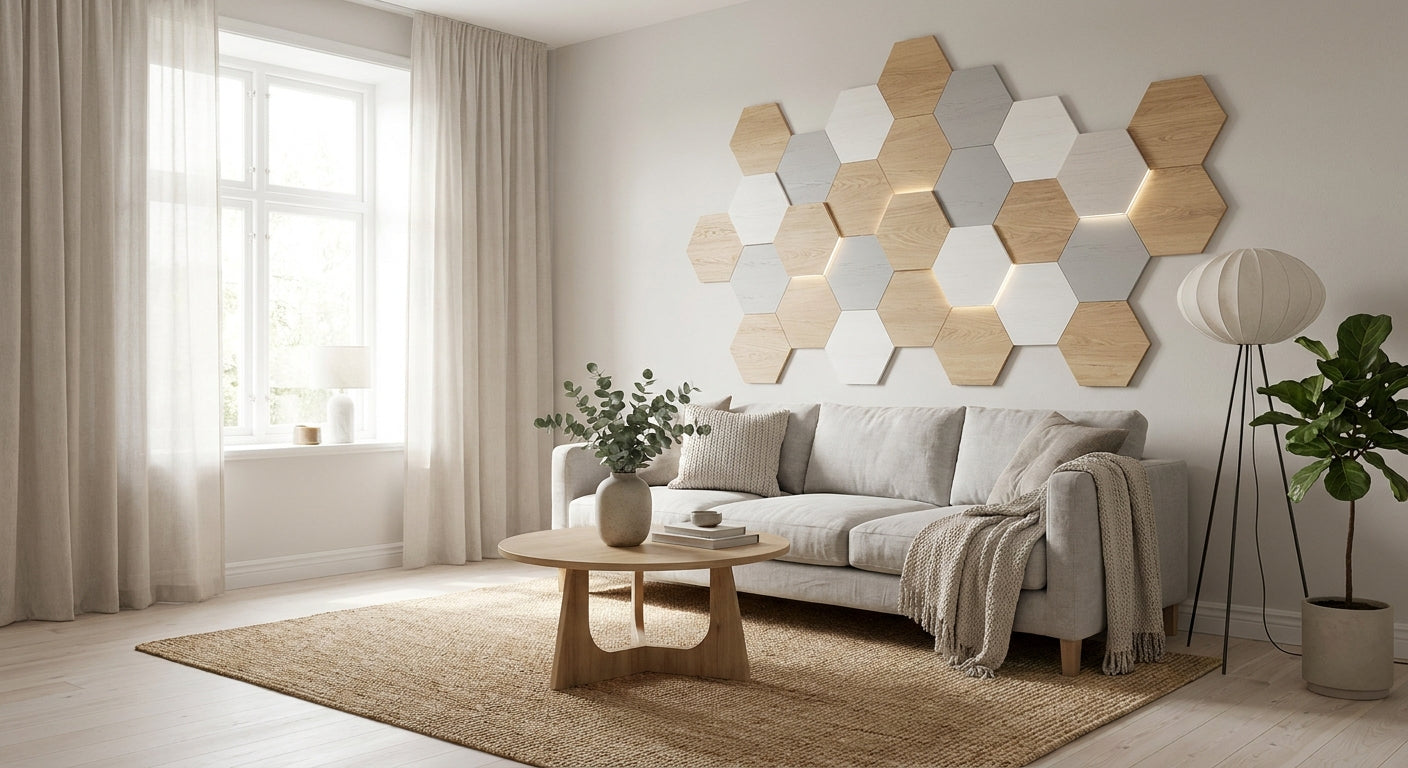
Scandinavian interiors run on light wood, muted grey, and almost nothing extra on the walls — which is exactly why hexagon acoustic panels have become the go-to feature-wall solution for the style in 2026. This guide ranks the hexagon panel options that actually fit the Nordic palette, and tells you which ones to skip.
TL;DR
For a genuine Scandinavian look, the Hexagon Acoustic Panel Natural Oak is the safest buy — light veneer, neutral grain, works in almost any Nordic-toned room. If you want the grey-and-wood combination that defines the style, the Hexagon Acoustic Panel Natural Oak with Grey Felt is the strongest pick for 2026, pairing pale oak with a felt backing that reads as intentional rather than industrial. Walnut hexagons work as an accent only — don't panel a whole wall in them if the brief is Scandinavian. Full comparison and verdicts below.
Why this matters
Scandinavian design is built on restraint: light timber, soft grey, and flat matte finishes with no clutter. A hexagon panel wall does two jobs at once in this style — it adds the geometric texture that keeps a minimalist room from looking sterile, and the felt backing behind the slats absorbs sound in rooms that otherwise have almost nothing soft in them (bare floors, few curtains, minimal furniture). Get the wall panels for a Scandinavian interior style wrong and you end up with a feature wall that fights the rest of the room instead of finishing it.
Hexagon shapes also solve a specific problem straight-slat panels don't: pattern flexibility. You can run them full-height on a chimney breast, cluster them as an asymmetric cloud above a sofa, or frame a doorway — all common moves in Nordic interior photography from 2025 and 2026.
How we ranked
Each panel here is judged on four things that matter specifically for Scandinavian rooms: veneer tone (does it read as light Nordic oak or does it skew warm and traditional), felt backing colour (grey felt versus a warmer natural tone), how easily it mixes with the rest of a wood-panel catalogue for a coordinated room, and how forgiving the finish is in a small or narrow space, since many UK terraced and flat living rooms are working with limited wall width. Panels that lean dark, high-contrast, or heavily grained are marked down — those suit farmhouse or industrial interiors better than Scandinavian ones.
The ranked list
1. Hexagon Acoustic Panel Natural Oak — the safe pick
This is the closest thing to a default Scandinavian hexagon panel: pale, low-contrast oak veneer with visible but quiet grain. It sits comfortably next to white walls, light oak flooring, and the pared-back furniture Nordic rooms are built around. One tile covers a manageable footprint, so a typical living-room feature wall of around 4 to 6 square metres needs roughly 15 to 20 hexagons depending on layout and gaps.
This is the panel to reach for if you're panelling an entire wall and want it to disappear into a light-toned room rather than dominate it. Verdict: Buy.
2. Hexagon Acoustic Panel Natural Oak with Grey Felt — the wildcard that actually wins
Swap the standard backing for grey felt and you get the pairing Scandinavian interiors are named for: pale wood against soft grey. It's a small change on paper but it shifts the whole panel from a plain wood feature to a considered Nordic design element, especially where the felt edges are visible between slats.
For 2026 builds where the brief is explicitly Scandi-Nordic rather than generic Scandi-adjacent, this is the stronger choice over the plain natural oak version. Verdict: Buy.
3. Hexagon Acoustic Panel Walnut with Grey Felt — consider, don't commit a whole wall
Walnut brings warmth and a deeper grain that photographs well but drifts away from the light, airy read Scandinavian rooms rely on. Paired with grey felt it's still workable — as a single accent cluster of 4 to 6 hexagons rather than a full wall.
Use it where the rest of the room is already light and you want one warm anchor point, not as the dominant material. Verdict: Consider.
4. Hexagon Acoustic Panel Grey Walnut — skip for true Scandinavian, fine for Nordic-industrial crossover
The grey-toned walnut finish is closer to a Scandi-industrial hybrid than pure Nordic minimalism — more tonal weight, more visible grain contrast. It works in open-plan spaces that mix concrete, black metal, and wood, but it competes with the light-and-airy brief rather than supporting it.
Good for a specific crossover look, not the default choice for a straightforward Scandinavian scheme. Verdict: Hold unless the rest of your palette is already grey-industrial.
5. Standard flat wood panels dressed as hexagon-style — skip
A handful of sellers market straight-slat panels as hexagon-adjacent by cutting angled end pieces. It's not the same acoustic or visual effect, and the geometry doesn't hold up once installed. If the product listing shows straight slats with cut corners rather than a true hexagon tile, treat it as a different product category entirely. Verdict: Skip.
Comparison table
| Panel | Veneer tone | Felt backing | Best use | Verdict |
|---|---|---|---|---|
| Hexagon Acoustic Panel Natural Oak | Light, low-contrast | Standard | Full feature wall, small rooms | Buy |
| Hexagon Acoustic Panel Natural Oak with Grey Felt | Light | Grey | Full Nordic-style wall | Buy |
| Hexagon Acoustic Panel Walnut with Grey Felt | Warm, medium | Grey | Accent cluster only | Consider |
| Hexagon Acoustic Panel Grey Walnut | Grey-toned, high grain | Grey | Nordic-industrial crossover | Hold |
Where to buy
- Order a physical sample of the exact finish before committing to a full wall — screen colour and felt tone rarely match perfectly, and Scandinavian schemes are unforgiving of a mismatch.
- Buy hexagon panels for one wall from a single batch or order date rather than topping up later; veneer runs vary slightly and 2026 batches won't always match a 2025 leftover order.
- Check panel coverage math before ordering: measure the wall in square metres, then add 10% extra for cutting waste around sockets, corners, or door frames.
FAQ
What is the best hexagon wall panel for a Scandinavian interior in 2026? The Hexagon Acoustic Panel Natural Oak with Grey Felt is the strongest match for 2026 — pale oak veneer against grey felt backing is the defining colour pairing of the style.
Are hexagon acoustic panels good for soundproofing? They reduce echo and reverberation thanks to the felt backing behind the wood slats, but they're an acoustic-absorption product, not a full soundproofing solution for blocking noise between rooms.
Is natural oak or grey walnut better for Scandinavian style? Natural oak reads as authentically Scandinavian; grey walnut leans toward a Nordic-industrial hybrid look. Choose oak if the room is otherwise light and minimal.
How many hexagon panels do I need for a feature wall? For a 4 to 6 square metre wall, expect roughly 15 to 20 hexagon tiles depending on the panel size and how tight the layout gaps are.
Can hexagon panels be mixed with straight-line wood panels? Yes — a common 2026 layout pairs a hexagon cluster above a sofa or bed with straight slat panelling running along the rest of the wall, using the same wood tone across both for consistency.
Do hexagon acoustic panels reduce echo? Yes, the felt layer behind the veneer absorbs sound reflections, which is particularly useful in Scandinavian rooms that skip curtains, rugs, and soft furnishings.
How much do hexagon wall panels cost? Pricing varies by finish and order quantity — check current listings directly rather than relying on older 2025 figures, since felt-backed and standard versions are priced separately.
What wall panel finish suits small Scandinavian rooms? Light, low-contrast finishes like natural oak keep a small room feeling open; darker or high-grain finishes visually shrink the space.
One last thing
The detail most people miss when planning a hexagon wall in 2026: lay the tiles out on the floor first, not on the wall. Scandinavian rooms are judged on spacing and symmetry more than most styles, and a floor mock-up catches uneven gaps before adhesive is involved — cheaper to fix a floor layout than a wall covered in panel glue.
Share:
Hexagon Wall Panels for Bathroom: Best Picks 2026
240x60 Wall Panels for Standard Ceilings: 2026 Verdict