

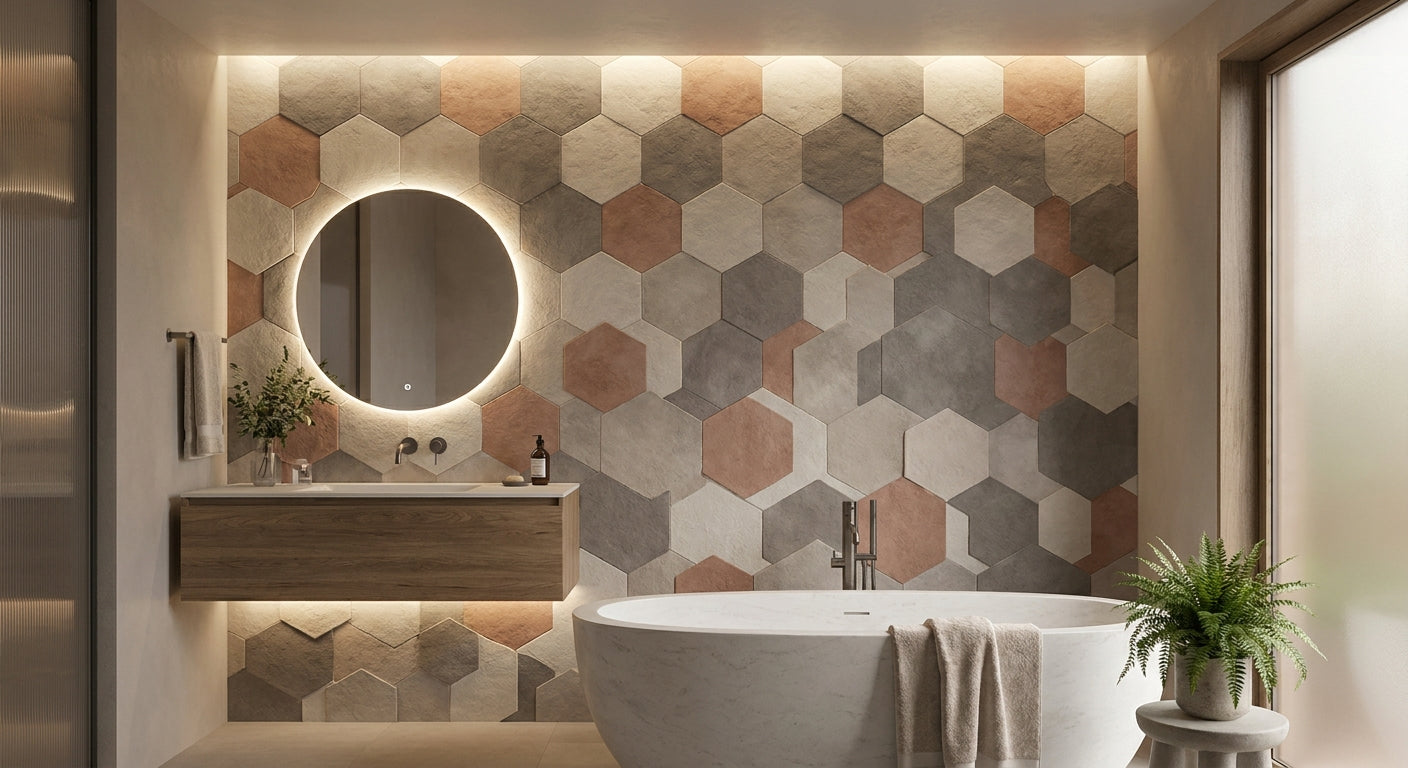
Hexagon wall panels turn a flat, tiled bathroom into a feature wall with real wood grain and a felt backing that quietens the echo tiles create. This guide covers what to check before buying hexagon panels for a bathroom, which finishes hold up best, and which picks are worth the money in 2026.
TL;DR
Hexagon wall panels for bathroom feature walls work best on a dry accent wall, not inside the shower enclosure, because the panels use a real wood veneer with an acoustic felt back rather than a wet-room laminate. The Hexagon Acoustic Panel Natural Oak is the safe pick for small or windowless bathrooms, and the Hexagon Acoustic Panel Walnut with Grey Felt is the upgrade if echo off tile and glass is your main complaint. Skip hexagon panels on any wall that gets direct shower spray. Install with a proper wall panel glue, not filler adhesive, and check your extractor fan is working before fitting.
Why this matters
A bathroom with tile, glass, and a mirror reflects far more sound than a room with plaster and soft furnishings, which is why even a small ensuite can sound loud and harsh. A hexagon feature wall breaks up that hard surface with real wood veneer and adds an acoustic felt layer behind it, which softens the slap-back you get between tile and glass. It also solves the aesthetic problem: white tile bathrooms in 2026 are still the most common finish in UK new-builds, and a single textured wall is the fastest way to make one feel less clinical. The catch is that bathrooms are wet rooms, and not every wood panel finish is built for that environment, so wooden wall panels for bathroom feature walls is worth reading alongside this guide before you commit to a hexagon layout specifically.
Who this is for
This guide is for homeowners and renovators fitting a bathroom or ensuite in 2026 who want a textured, geometric feature wall rather than a flat plank layout, and who are choosing between hexagon panel finishes, felt colours, and placement rather than deciding whether panels are the right idea at all.
What to look for in hexagon panels for a bathroom
Placement away from direct water
Hexagon panels use a real wood veneer and felt backing, not a sealed wet-room laminate, so they belong on a dry feature wall — behind a vanity, along the bath's non-splash side, or on the wall facing the shower rather than inside it. Direct spray shortens the life of any wood veneer panel regardless of finish. Treat the panel wall the way you'd treat a wallpaper feature wall: dry, ventilated, and out of the direct splash zone.
Ventilation before installation
Bathrooms trap moisture in the air even when the panel wall itself stays dry, so a working extractor fan matters more here than in any other room. Check your extraction rate is adequate and run the fan during and after showers, especially in the first few weeks after fitting while the panels settle into ambient humidity. Skipping this step is the single most common reason a bathroom feature wall underperforms.
Wood tone against your tile and fittings
Hexagon geometry repeats across the wall, so the wood tone reads stronger than it would on a flat panel layout — a dark finish against white tile reads as a bold contrast, while a lighter oak blends in. Natural Oak and lighter grey-walnut tones tend to suit smaller bathrooms because they don't visually shrink the room. Darker walnut or smoked tones work better in larger bathrooms or ensuites with good natural light.
Felt backing colour and acoustic benefit
The felt layer behind the veneer isn't just structural — it's what reduces the slap-back echo that tile and glass create, and the felt colour shows slightly at the panel edges and joins. Grey felt reads neutral against most tile colours, which is why it's the most common pairing for bathroom installs. If your bathroom already sounds harsh with the door shut, prioritise the felt-backed hexagon options over a plain veneer panel.
Panel format and hexagon layout
Hexagon panels are supplied as individual tiles you arrange into a pattern, so plan your layout against the wall's actual dimensions before ordering — a botched cut line at a window reveal or extractor duct is far more visible in a hexagon grid than in a straight plank layout. Measure the wall in both directions and sketch the hexagon rows before you order, not after.
Adhesive suited to a humid room
A bathroom wall needs a panel glue rated for the surface and the room, applied to a clean, dry, dust-free wall — not a generic filler adhesive that skims over uneven plasterboard. The High Tack Panel Glue 290ml is built for exactly this kind of wood panel fixing and holds better long-term than a general-purpose grab adhesive on a wall that sees humidity swings.
Top picks for a bathroom feature wall
Hexagon Acoustic Panel Natural Oak — the safe pick. Light oak veneer with a standard felt back, and the tone that blends with white or cream tile without shrinking a small bathroom visually. It's the finish most homeowners default to for a first hexagon feature wall in 2026 because it pairs with almost any existing tile colour. Verdict: Buy.
Hexagon Acoustic Panel Grey Walnut — the moody pick. Cooler, greyer grain than standard walnut, and it reads best in a larger bathroom or ensuite with strong natural light rather than a small windowless one. In a compact room with only spotlights, this tone can flatten and look dark rather than rich. Verdict: Consider — check your light levels first.
Hexagon Acoustic Panel Walnut with Grey Felt — the acoustic upgrade. This finish pairs a deeper walnut grain with the grey felt backing, and it's the strongest option if the main complaint is echo bouncing off tile and glass rather than aesthetics alone. The darker tone also hides day-to-day marks better than a light oak on a wall near a sink. Verdict: Buy — best pick if noise is the real problem.
Hexagon Acoustic Panel Natural Oak with Grey Felt — the quiet bathroom pick. Combines the lighter oak tone with the same felt backing as the walnut version, which suits anyone who wants the acoustic benefit without darkening the room. It's a reasonable middle ground between the two other felt-backed options above. Verdict: Consider — good compromise if you're torn between light and dark.
What to avoid
- Panelling the entire shower enclosure. Hexagon panels are a feature wall product, not a wet-room lining — reserve them for the dry side of the room.
- Floor-to-ceiling coverage in a tiny bathroom. A full hexagon wall in a small windowless ensuite can make the room feel smaller rather than larger, especially in darker finishes; a half-wall or single accent wall usually reads better.
- Generic adhesive on plasterboard that's still damp from a recent skim. Let a newly plastered wall cure fully before fixing panels, or the veneer can lift at the joints within months.
Verdict comparison
| Finish | Best for | Felt colour | Verdict |
|---|---|---|---|
| Natural Oak | Small or windowless bathrooms | Standard | Buy |
| Grey Walnut | Larger, well-lit bathrooms | Standard | Consider |
| Walnut with Grey Felt | Echo-heavy tiled ensuites | Grey | Buy |
| Natural Oak with Grey Felt | Balanced light + acoustic need | Grey | Consider |
FAQ
Are hexagon wall panels waterproof for bathrooms? No — hexagon acoustic panels use a real wood veneer and felt backing, so they're built for a dry feature wall rather than direct water contact. Fit them away from shower spray and rely on ventilation to manage ambient humidity.
Can you install hexagon acoustic panels near a shower? Yes, on the wall facing the shower or on an adjacent dry wall, but not inside the enclosure or splash zone itself. Keep a reasonable distance from any point where water hits the wall directly.
What size are hexagon wall panels? Hexagon panels are supplied as individual tiles you arrange into a repeating pattern, and the wider Akuwood Panel range spans 240cm and 300cm board formats for the standard plank panels the hexagon tiles are cut from. Measure your wall in both directions before ordering to plan the grid.
Do hexagon panels need ventilation in a bathroom? Yes — a working extractor fan matters more with wood veneer panels than with tile or laminate, since the panels sit in a room with regular humidity spikes. Run the fan during and after every shower, especially in the first few weeks after installation.
What's the best wood finish for a small bathroom? Natural Oak is the strongest default for small or windowless bathrooms because the lighter tone doesn't visually shrink the room the way a dark walnut or smoked finish can. If echo is the bigger issue, Natural Oak with Grey Felt keeps the light tone and adds the acoustic benefit.
How do you fix hexagon panels to a bathroom wall? Clean, dry, dust-free plasterboard or tile backer is the starting surface, followed by a wall panel glue rated for wood veneer rather than a generic grab adhesive. Let any newly plastered wall cure fully before fitting.
Can hexagon panels reduce noise in a tiled bathroom? Yes, to a degree — the felt backing behind the veneer softens the slap-back echo that tile and glass create, more noticeably than a plain veneer panel without felt. It won't soundproof the room, but it takes the harsh edge off voices and running water.
How many hexagon panels do I need for a feature wall? It depends on the wall's dimensions and how much of it you're covering — a half-wall accent uses roughly half the tiles a full floor-to-ceiling wall would. Sketch the hexagon rows against your actual measurements before ordering rather than estimating by eye.
One last thing
The detail most people miss on a bathroom hexagon wall isn't the finish — it's the grid alignment at the ceiling line and around any extractor duct or mirror edge, because a hexagon pattern shows a bad cut far more obviously than a straight plank ever would. Plan the layout on paper first, cut the edge row last, and the wall reads intentional rather than improvised.
Share:
Hexagon Acoustic Panels for Office: 2026 Buy Guide
Best Hexagon Wall Panels for Scandinavian Interiors 2026