


No—acoustic panels do not guarantee that echo will disappear completely, but suitable panels, coverage and placement reduce reflected sound and make a room less reverberant. They do not stop the original sound or replace soundproofing, so your target should be clearer conversation and a shorter sound decay—not silence.
- Can acoustic panels completely stop echo? No guaranteed result: room size, treatment coverage and placement determine the outcome.
- Akustiq UK acoustic wood panels combine a wood finish with acoustic backing; they are not a substitute for soundproofing.
- Treat reflected sound inside your room separately from noise entering through walls, windows and doors.
- Check absorption test data and mounting details before choosing panels for echo reduction.
Can acoustic panels completely stop echo?
Acoustic panels absorb some of the sound that would otherwise bounce back from a surface. A suitable treatment can make a distinct echo inaudible at your listening position, but that does not mean every reflection has disappeared throughout the room.
The distinction matters when you compare treatments for a 2026 room refurbishment. Choose according to the problem you hear, rather than treating every unwanted sound as echo. For a wall-focused approach, see the guide to reducing echo with grey acoustic wall panels.
| Approach | Best for | Main benefit | Main limitation |
|---|---|---|---|
| Acoustic wall panels | Reflections from wall surfaces | Add sound absorption to selected areas | Leave other reflective surfaces untreated |
| Acoustic ceiling treatment | Rooms with limited usable wall space | Adds absorption overhead | Requires a suitable ceiling and fixing design |
| Rugs, curtains and upholstered furniture | Adding absorption through furnishings | Treat surfaces as part of normal room use | Performance depends on material, thickness and arrangement |
| Sound-insulating construction | Noise passing between spaces | Addresses sound transmission through the building | Does not automatically control reflections inside the room |
Use absorption for echo and sound insulation for noise transfer. Some rooms need both, but they are different jobs.
Why this matters
A room can look finished and still sound uncomfortable. Glass, plaster, hard flooring and other reflective surfaces return sound into the space, allowing speech and television audio to overlap with their own reflections.
Adding absorption changes that reflected sound. It does not turn down the person speaking or remove noise at its source, which explains why a treated room can sound clearer without becoming silent.
Before buying acoustic treatment in 2026, describe the result you want in practical terms: follow television dialogue, hold a conversation across the dining table, or reduce the ringing sound in a home office. That gives you a useful test after installation.
Echo and reverberation are not quite the same
A distinct echo is a reflection you hear separately from the original sound. Reverberation is the overlapping decay of many reflections after the source stops.
In everyday conversation, people call both effects echo. Panels can help with both when they absorb sound along the relevant reflection paths, but a short ringing sound between parallel walls needs a different layout from widespread reverberation in a large room.
Why echo reduction varies between rooms
No panel count or coverage percentage guarantees the same outcome everywhere. These factors explain why the same treatment produces different results:
- Room volume and shape: The space available for sound to travel affects its decay and reflection paths. Tall ceilings and connected spaces belong in the assessment.
- Existing surfaces: Bare glazing, hard floors and plastered walls reflect sound differently from thick curtains and upholstered seating. Judge the finished room, including its furniture.
- Treatment area: Absorption depends on how much effective treatment you introduce. A small decorative patch is not equivalent to treating a substantial reflective area.
- Panel construction: Thickness, porosity and the complete panel assembly affect which frequencies the treatment absorbs. Appearance alone does not establish acoustic performance.
- Installation method: A tested panel mounted with a cavity is not automatically equivalent to the same panel fixed directly to a wall. Follow the mounting arrangement behind the stated result.
- Sound and listening positions: Speech, loudspeakers and listeners occupy different positions. Treatment needs to address the paths that matter where you actually sit or work.
Match the treatment to the room, not just the wall colour. A visually balanced layout is useful, but it is not evidence that the acoustic layout is effective.
How do you work out what your room needs?
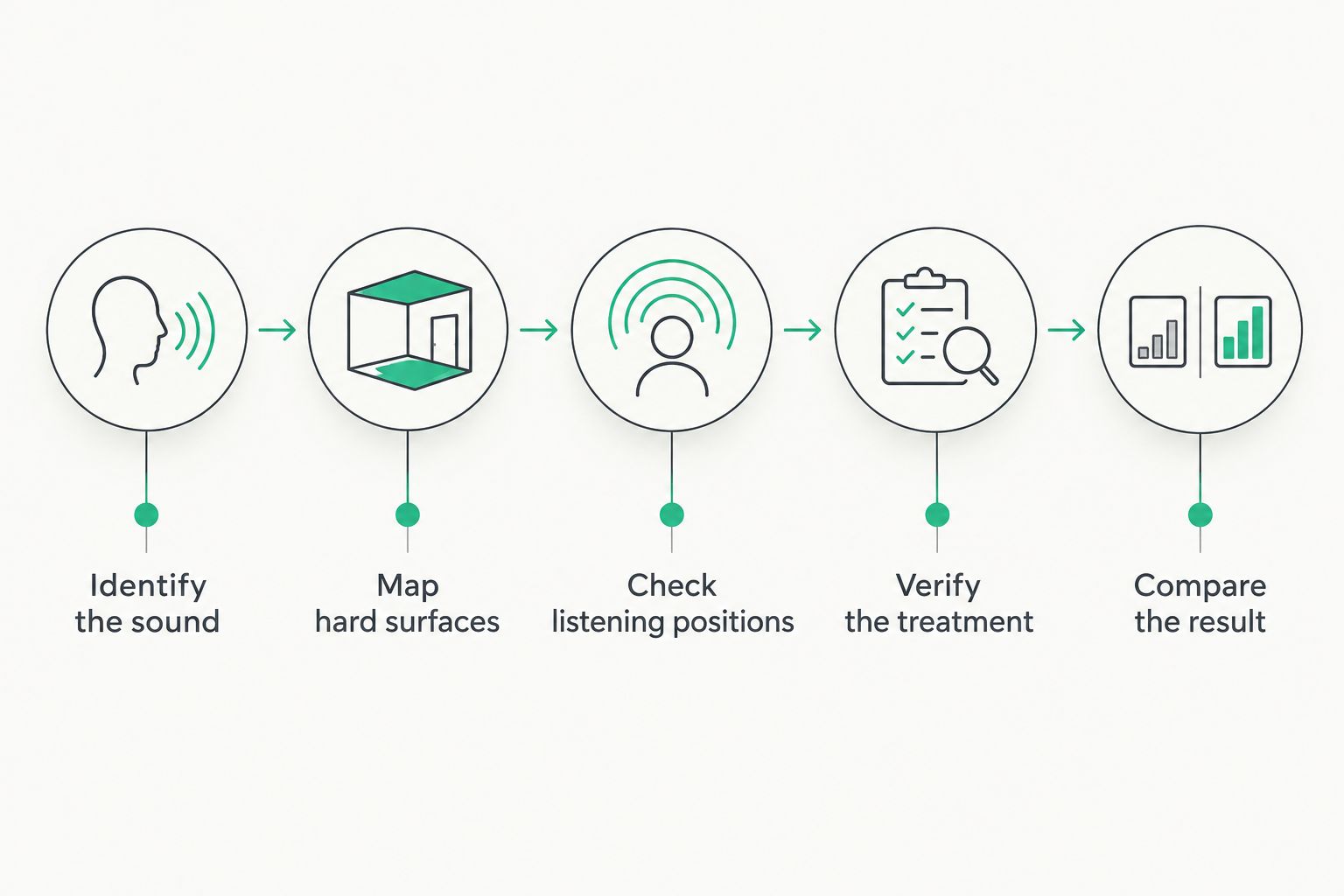
Use this sequence to turn a general complaint about echo into a treatment plan. For your 2026 project, record the starting conditions before changing furniture, curtains or panel coverage.
- Identify the sound. Speak normally, play familiar dialogue and listen after a hand clap. Separate a repeated reflection, a diffuse sound tail and a low-frequency boom.
- Map hard surfaces. Note bare walls, windows, flooring and the ceiling. Include openings into adjoining rooms because sound does not stop at an imaginary room boundary.
- Check listening positions. Listen from the sofa, desk or dining chair you use. A result heard beside the treated wall does not prove that the whole room has improved.
- Verify the treatment. Request absorption data for the actual panel assembly and mounting method. Confirm suitable fixings and any requirements relevant to your installation.
- Compare the result. Repeat the same listening checks after installation with the room arranged as before. If a problem remains, identify the untreated reflection path before adding more panels.
A hand clap is a useful screening check, not a complete acoustic test. It can reveal an obvious ringing reflection, but it does not describe every frequency or predict how a room will sound during normal conversation.
For a commercial meeting room, recording space or project with a specified acoustic target, use a qualified acoustician rather than relying on a clap test alone. The assessment should cover the intended room use and the finished installation.
Where should you put acoustic panels to reduce echo?
Start with the reflective surfaces involved in the problem. Do not assume the wall behind the television, bed or desk is automatically the best acoustic location simply because it suits the design.
In a living room, assess the walls around your seating and loudspeakers. In a home office, listen from your working position and consider the nearby bare walls that return speech towards you or your microphone.
Treat the relevant reflection paths
A rapid ringing sound between parallel hard walls is often called flutter echo. Adding suitable absorption to the surfaces involved interrupts those repeated reflections.
For more general reverberation, consider how absorption is distributed across the room. Concentrating everything in one small area leaves other sound paths untreated, particularly in a room with extensive glazing or a hard ceiling.
Keep acoustic surfaces exposed
Do not plan an acoustic feature wall and then conceal its absorbing surface behind a large cabinet. Sound needs access to the treatment for it to perform its intended role.
Check the proposed arrangement with the furniture in place. A panel location that works on an empty floor plan can be obstructed once shelving, storage and seating arrive.
Include the ceiling in the assessment
Wall panels are not the only route to reducing reverberation. A suitable ceiling treatment provides another absorbing surface when windows, doors or storage restrict wall coverage.
Ceiling installations need their own fixing and safety assessment. Do not transfer a wall-mounting method overhead without confirmation that the product and fixing system suit that use.
What acoustic evidence should you check in 2026?
Ask for a test report that identifies the panel assembly, the mounting method and absorption across frequency bands. A single headline rating does not explain every aspect of a room's likely response.
The Noise Reduction Coefficient, or NRC, averages sound absorption coefficients at 250 Hz, 500 Hz, 1,000 Hz and 2,000 Hz, rounded to the nearest 0.05. It summarises absorption; it is not a rating for how much sound a wall blocks between rooms.
Reverberation time describes sound decay in a room. RT60 refers to a decay of 60 dB, although acoustic measurements commonly estimate that decay from a shorter measured interval.
These figures answer different questions. NRC describes an absorber under test conditions; reverberation time describes the room's sound decay. Neither number alone promises that every audible echo will disappear.
For a 2026 specification, ask these questions before comparing ratings:
- Does the report identify the exact panel construction?
- Does the tested mounting match the planned installation?
- Are frequency-band results included, rather than only an average?
- Does the proposed treatment area relate to the room being treated?
Are wooden acoustic panels suitable for reducing echo?
Wooden acoustic panels combine an interior finish with an absorbing component, but the complete construction matters. A decorative wooden surface alone does not establish how much sound the assembly absorbs.
Akustiq UK acoustic wood panels are best suited to buyers who want a wood-veneer finish with acoustic backing, rather than a soundproofing system. The brand's indoor slat panels feature a 3-sided real wood veneer finish and acoustic felt backing, with 240 cm and 300 cm size formats.
Those dimensions help you plan the wall layout; they do not establish an echo-reduction result. Choose a format for the space, then assess treatment area and installation separately.
The practical benefit of Akustiq UK's acoustic panels is the combination of a wooden wall finish and acoustic backing. The limitation is equally important: neither the veneer finish nor panel height proves a particular absorption rating, and the panels should not be specified as a replacement for sound-insulating construction.
Will covering one wall be enough to stop echo?
One treated wall is not a universal solution. It can address a strong reflection path, but the result depends on the room and the remaining reflective surfaces.
Listen from your normal positions after treatment. If the sound tail remains obvious, assess the ceiling, glazing and other bare walls before assuming the existing panels have failed.
Will acoustic panels stop bass booming in a room?
Acoustic panels do not automatically solve low-frequency booming. Bass problems depend on room resonances, source and listener positions, and the absorber's low-frequency performance.
Check frequency-specific absorption evidence rather than judging by panel appearance or a broad acoustic label. Persistent bass problems need an assessment that includes speaker placement and suitable low-frequency treatment.
Will acoustic panels stop neighbours hearing your television?
Acoustic panels are not a substitute for sound insulation between homes. They address reflected sound inside your room, while transmission can occur through walls, floors, doors and other building paths.
If privacy or neighbour disturbance is the main concern, assess those transmission paths first. Reducing reverberation and improving sound insulation can be parts of the same project, but one does not prove the other.
FAQ
Can acoustic panels completely stop echo in my living room?
Acoustic panels do not guarantee complete echo removal in a living room. Suitable absorption and placement can make a distinct echo inaudible at a listening position, while other reflections remain.
How many acoustic panels do I need for my room?
The required number depends on room volume, existing surfaces, panel absorption and mounting method. Start with the room and the acoustic target rather than a universal panel count.
Do acoustic panels make a room soundproof?
Acoustic panels do not make a room soundproof. They absorb reflected sound inside the space rather than replacing the construction needed to control sound transmission.
Are wooden slat panels enough without rugs or curtains?
Wooden slat panels do not automatically remove the need for other absorption. Assess the complete room, including bare glazing, flooring and ceiling surfaces, before deciding whether wall treatment is enough.
Does a higher NRC mean a panel blocks more neighbour noise?
A higher NRC does not establish better sound insulation between homes. NRC summarises sound absorption under test conditions, not sound transmission through a separating wall.
Can I test room echo with my phone?
A phone recording can help you compare an obvious sound tail before and after treatment. It does not replace controlled acoustic measurements or prove a specified reverberation time.
Should I choose Akustiq UK panels by finish or acoustic performance?
Choose Akustiq UK panels by checking their suitability for the acoustic task first, then selecting the finish and format. Request evidence for the planned panel assembly and mounting method rather than treating appearance as a performance rating.
One last thing
A room can stop sounding echoey without becoming silent. That is the useful distinction: your aim is to control distracting reflections while preserving normal conversation, music and everyday room use.
Before signing off your 2026 installation, sit where you normally watch television or take calls and repeat a familiar listening check. Judge the finished room from the position that matters—not from directly beside the new feature wall.
Share:
How long does exterior wood cladding take to install?
How much do acoustic wall panel samples cost?