

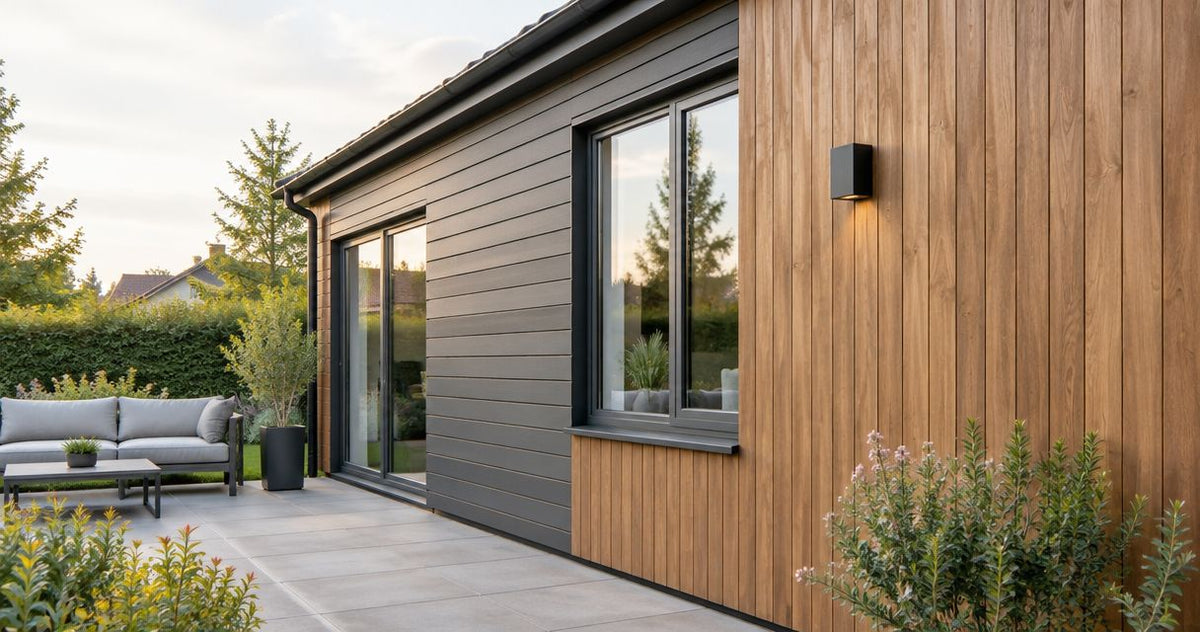
Best overall shortlist for a low-upkeep house façade in 2026: fibre cement. Best for natural character: timber. Best for a wood-effect finish: composite. If you're asking what is the best exterior wall cladding, this guide compares those options with PVCu and metal, then explains what to check before ordering from suppliers such as Akustiq UK.
- What is the best exterior wall cladding? Shortlist fibre cement for low upkeep, then check the complete façade specification.
- Timber wins for natural grain; composite suits homeowners who want a manufactured wood-effect finish.
- Akustiq UK exterior wall cladding suits buyers comparing dedicated outdoor panels rather than indoor acoustic panels.
- Choose exterior cladding by fire evidence, drainage details, exposure and maintenance—not colour alone.
Why this matters
Exterior cladding forms part of your building's weather protection. An attractive board cannot compensate for poor window flashings, unsuitable fixings or water trapped behind the façade.
Your best choice also changes with the building. A garden office, a detached house and a block of flats need different assessments, even when you want the same appearance. For a 2026 project, confirm the applicable requirements in England, Scotland, Wales or Northern Ireland before choosing a material.
Choose the wall system first and the finish second. That keeps appearance from driving decisions about fire safety, moisture and structural support.
What makes the best exterior wall cladding?
Use these criteria before comparing finishes. Ask your installer to explain how each shortlisted system meets them on your actual wall.
- Weather detailing: Check drainage, ventilation where required, flashings and junctions around openings.
- Fire evidence: Request the exact product classification and confirm its relevance to the proposed wall construction.
- Maintenance: Establish what cleaning, coating, inspection and repairs involve—not just whether repainting is needed.
- Exposure suitability: Assess wind-driven rain, coastal conditions, sunlight and sheltered areas that dry slowly.
- Installation requirements: Confirm the substrate, support arrangement, fixings, movement allowances and approved board orientation.
- Appearance over time: Decide whether you want natural weathering, a retained colour or a finish you can renew.
Exterior wall cladding at a glance
The order below follows the ranked sections. These are material-level choices, not claims that every product in a category performs identically.
| Material | Best for | Standout feature | Key limitation |
|---|---|---|---|
| Fibre cement | Low-upkeep house façades | Manufactured boards without natural timber grain | Cutting and edge treatment need product-specific care |
| Timber | Natural character | Real grain and individual boards | Appearance changes outdoors; retaining colour needs maintenance |
| Composite | Manufactured wood-effect finishes | Repeated profiles and wood-effect surfaces | Composition, movement and fire performance vary |
| PVCu | Straightforward utility elevations | Wipe-clean surface and interlocking profiles | Expansion and impact resistance need attention |
| Metal | Crisp contemporary façades | Folded edges and precise junctions | Poor detailing exposes dents, distortion and corrosion risks |
1. Fibre cement: best exterior cladding for low-upkeep façades
Fibre cement is the starting shortlist for homeowners who want a board-clad house without maintaining a natural timber finish. It combines cement-based material with reinforcing fibres, with finishes that vary by manufacturer.
For your 2026 shortlist, compare the actual coating, fixing method and installation instructions. A factory-finished board is not permission to ignore cut edges or maintenance guidance.
Fibre cement pros:
- Avoids the natural grain variation of timber when you want consistency.
- Offers a board format for repeated lines across an elevation.
- Does not require you to preserve a natural wood colour.
Fibre cement cons:
- Cutting requires suitable tools and control of potentially harmful dust.
- Cut edges and damaged coatings need the specified treatment.
- Board edges need careful handling during installation.
Best for: House façades where a consistent finish and limited coating work matter more than real timber grain.
Verdict: Buy when the documented system suits your building and your installer understands its cutting, fixing and finishing requirements.
2. Timber: best exterior cladding for natural character
Timber is the strongest choice when you want real wood rather than a printed or moulded interpretation. Species, treatment, profile and exposure all affect how the façade behaves and changes.
Choose timber with an explicit appearance plan. You either accept weathering or maintain a finish intended to retain the colour you prefer; those are different commitments.
Timber pros:
- Provides genuine grain and variation between boards.
- Suits projects where natural ageing is part of the design.
- Allows individual board replacement where the fixing arrangement permits it.
Timber cons:
- Weathering is not necessarily even across sheltered and exposed areas.
- Moisture movement needs appropriate detailing and fixings.
- Retaining a chosen colour requires ongoing surface maintenance.
Best for: Garden rooms, extensions and homes where authentic wood character is the main design requirement.
Verdict: Buy if you accept natural change or commit to the chosen coating's maintenance instructions. Skip if an unchanged appearance is essential but surface maintenance is not acceptable.
3. Composite: best exterior cladding for a wood-effect finish
Composite cladding combines materials into a manufactured board. Wood-plastic composite is one type, but the word composite alone does not identify a product's ingredients or performance.
Shortlist composite when you want a wood-effect surface with a repeatable profile. Then check the technical information rather than assuming that all composite boards have the same movement, fire or weathering characteristics.
Composite pros:
- Offers a wood-effect appearance without using natural timber boards.
- Provides repeated profiles for a consistent layout.
- Gives you an alternative when natural timber weathering is not the design goal.
Composite cons:
- Thermal movement requires the manufacturer's specified allowances.
- Surface damage and colour changes need product-specific assessment.
- Fire performance cannot be inferred from the category name.
Best for: Homeowners who prioritise a manufactured wood-effect finish over the variation of real timber.
Verdict: Hold until you have the exact composition, installation instructions and relevant performance evidence. Buy the specified product, not the promise attached to the category.
4. PVCu: best exterior cladding for utility elevations
PVCu cladding suits projects where a straightforward manufactured finish matters more than natural texture. Profiles and accessories typically work together, so assess the corners, joints and terminations alongside the boards.
Choose exterior-grade products explicitly intended for the application. Interior wall panels and exterior PVCu cladding are not interchangeable simply because both have wipe-clean surfaces.
PVCu pros:
- Provides a surface that does not need a natural timber coating.
- Offers interlocking profiles for repeated board layouts.
- Suits simple designs where a manufactured appearance is acceptable.
PVCu cons:
- Thermal expansion must be accommodated during fixing.
- Impact resistance varies between products and conditions.
- The appearance does not reproduce the individual grain of real wood.
Best for: Utility buildings and secondary elevations where an uncomplicated finish is the priority.
Verdict: Buy for a suitable application with documented exterior performance. Skip when natural material character is central to the design.
5. Metal: best exterior cladding for precise modern detailing
Metal cladding suits façades designed around clean planes, folded corners and deliberate joints. Aluminium, steel and zinc are distinct choices; the metal and surface treatment need assessment together.
Pay particular attention to compatibility between metals, fixings and adjacent materials. A visually simple elevation still needs careful technical design.
Metal pros:
- Supports crisp edges and purpose-made folded details.
- Offers an alternative to timber-style board textures.
- Suits contemporary designs with clearly planned joint lines.
Metal cons:
- Dents and surface distortion are visible on exposed flat areas.
- Incompatible materials and damaged protection create corrosion risks.
- Fabrication and installation require suitable skills.
Best for: Architect-led extensions and modern façades where precise junctions define the design.
Verdict: Buy with a coordinated fabrication and installation plan. Hold if the proposal specifies only the sheet material and leaves junctions unresolved.
Match the cladding to the wall behind it
The material ranking is only the start. In a 2026 refurbishment, inspect the existing wall before covering it: identify damp, loose finishes, defective masonry and the structure that will carry the new system.
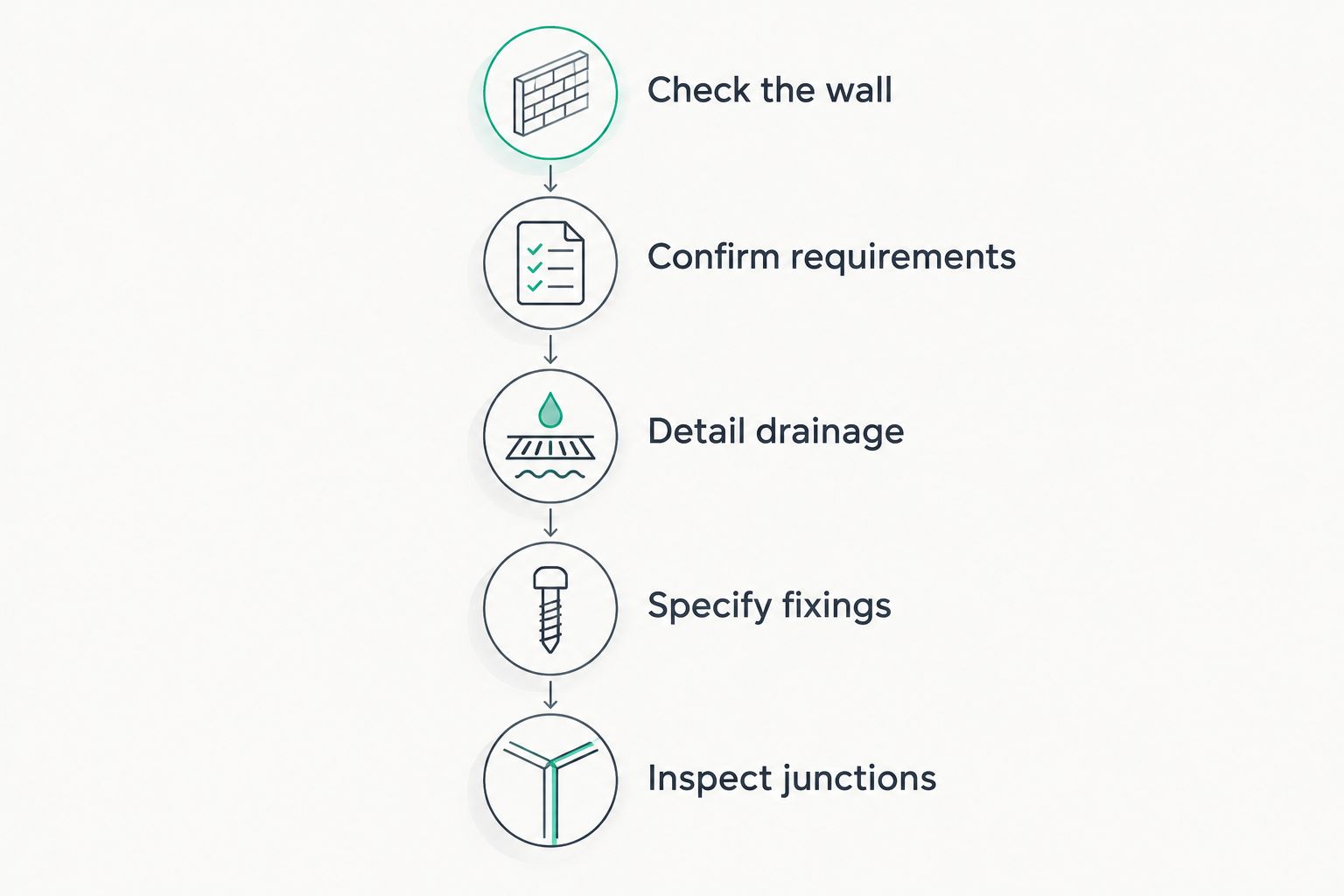
Use this sequence to turn a preferred finish into a specification your installer can follow:
- Check the wall: Establish its condition, construction and load-bearing fixing locations.
- Confirm requirements: Resolve planning, building regulations and fire-design questions for the project.
- Detail drainage: Show how water leaves the assembly and how openings are protected.
- Specify fixings: Match the supports, fasteners and movement allowances to the system.
- Inspect junctions: Review the base, corners, roof edge, windows and doors before work starts.
A cladding board is only the visible layer of that decision. The same distinction applies to porcelain slab thickness: the facing material must suit its application and support arrangement, not just the appearance you want.
Do not specify a universal cavity depth, fixing distance or expansion gap from a general buying guide. Those dimensions belong in the selected system's instructions and the project design.
Where Akustiq UK fits into your shortlist
Akustiq UK exterior wall cladding is best for buyers comparing dedicated outdoor panels rather than indoor acoustic panels. Start with the intended application, then assess the finish; the Oak exterior wall cladding panel belongs in that outdoor comparison.
The exterior range includes Oak, Birch, Stone Grey and Black options. Those names identify choices to investigate, not proof of composition, fire classification or a particular maintenance requirement.
Akustiq UK pros: A dedicated exterior range gives you outdoor options to compare separately from indoor acoustic products. Multiple named finishes let you coordinate the façade with existing materials.
Akustiq UK cons: A finish name does not establish technical suitability. You still need to confirm the exact product's installation requirements and performance against your building specification.
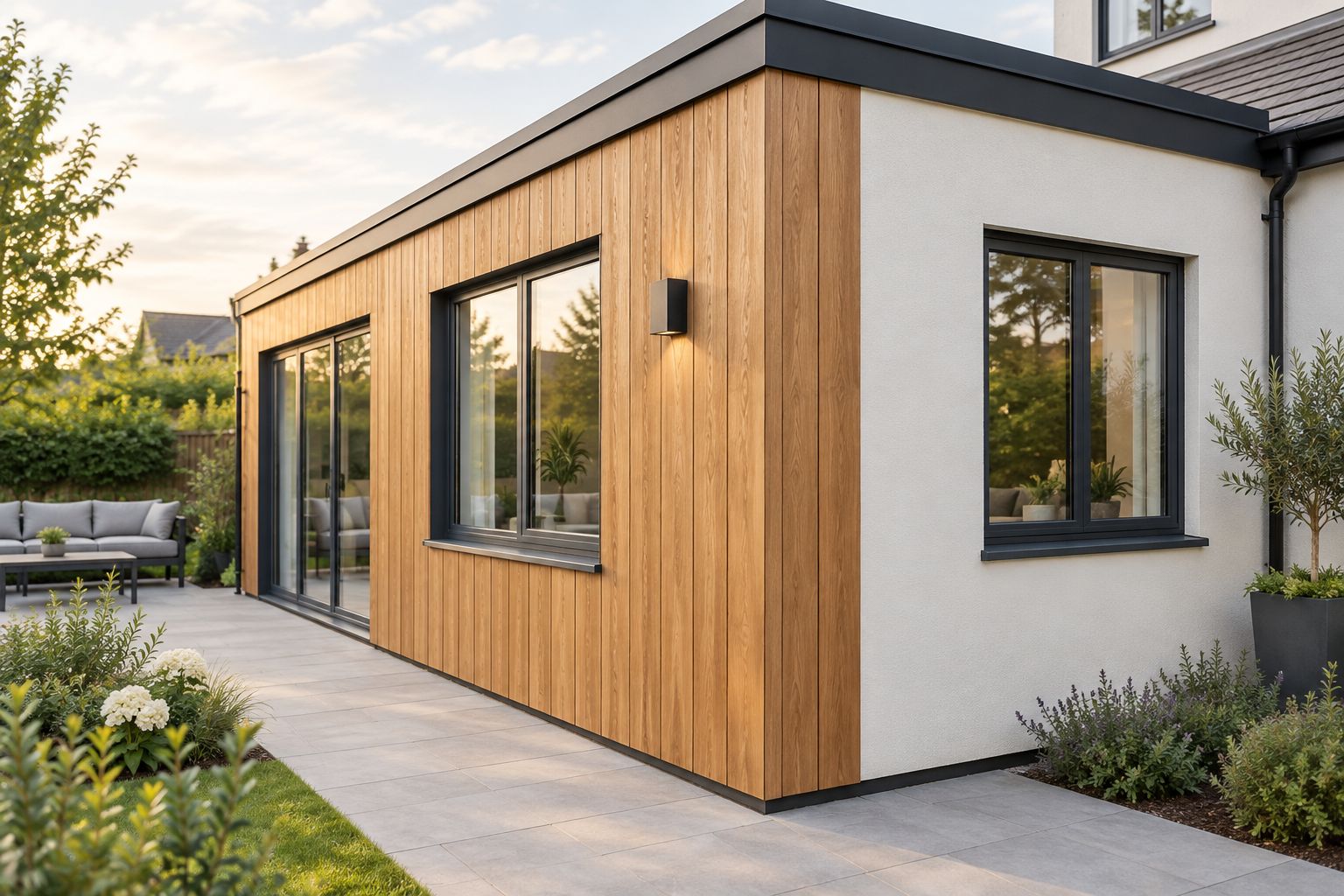
For an oak-toned façade, assess the finish beside the actual render, brick and window frames. Look at a broad section of wall rather than treating the colour as an isolated swatch.
Keep the indoor and outdoor specifications separate. The indoor acoustic range includes 240 cm and 300 cm panel heights with 60 cm widths; those dimensions do not establish exterior suitability, and neither does a real wood veneer finish.
How the ranking works
This 2026 ranking follows the criteria above: maintenance expectations, exposure, installation, appearance and the need for verifiable performance evidence. It is a material-selection guide, not a laboratory test or a scored comparison of named manufacturers.
Fibre cement leads the general house-façade shortlist because it avoids maintaining natural timber colour. Timber leads when real grain matters; composite, PVCu and metal each serve a different appearance or application. No category wins automatically on fire safety or weather protection: assess the exact system.
Which exterior wall cladding should you choose?
Start with fibre cement for a low-upkeep house façade, and timber for authentic natural character. Compare composite when you want a manufactured wood-effect finish; choose PVCu for a suitable utility application or metal for a deliberately detailed contemporary design.
Before committing to a 2026 installation, ask your designer or installer for a written specification covering the wall, supports, drainage, fixings and junctions. If those details are unresolved, hold the order—even if the finish is exactly right.
FAQ
What is the best exterior wall cladding for a UK house?
Fibre cement is a practical starting shortlist for a low-upkeep house façade, while timber is the better choice for genuine wood character. The final choice must meet the building's exposure, fire and installation requirements.
Is composite cladding better than timber cladding?
Composite is better suited to buyers who want a manufactured wood-effect finish; timber suits buyers who want real grain and natural variation. Compare the exact composite specification with the timber species, finish and maintenance plan.
What exterior cladding needs the least maintenance?
Shortlist factory-finished fibre cement, suitable composite or PVCu when avoiding regular timber coating work is a priority. None removes the need for cleaning, inspection and maintenance of joints and fixings.
Can I put exterior cladding over existing render?
Only use a design that accounts for the render's condition and provides suitable structural fixing. Covering loose render or unresolved damp does not repair the underlying wall.
Does exterior cladding make a wall waterproof?
Cladding alone does not make the complete wall waterproof. Weather protection depends on the coordinated design of boards, joints, flashings, openings and water-management layers.
Can indoor acoustic wood panels be used outside?
Do not use indoor acoustic panels outside unless the manufacturer explicitly approves that application. An indoor veneer finish and acoustic backing are not evidence of outdoor suitability.
Is all fibre cement cladding suitable for every building?
No, fibre cement is not automatically suitable for every building. Confirm the exact product, wall construction, fixing design and relevant fire requirements before specifying it.
Do I need planning permission to clad my house?
Whether you need planning permission depends on the property, location and proposed work. Check with the local planning authority, particularly for listed buildings and properties in designated areas; building regulations are a separate consideration.
One last thing
Ask for the window-head and base details before choosing the final colour. Those drawings show how the proposed façade handles water and finishes at its most important junctions. A supplier can show you an attractive board; your project still needs a workable wall.
Share:
Best waterproof exterior wall cladding panels in the UK 2026
Best adhesives for acoustic wall panels in 2026